

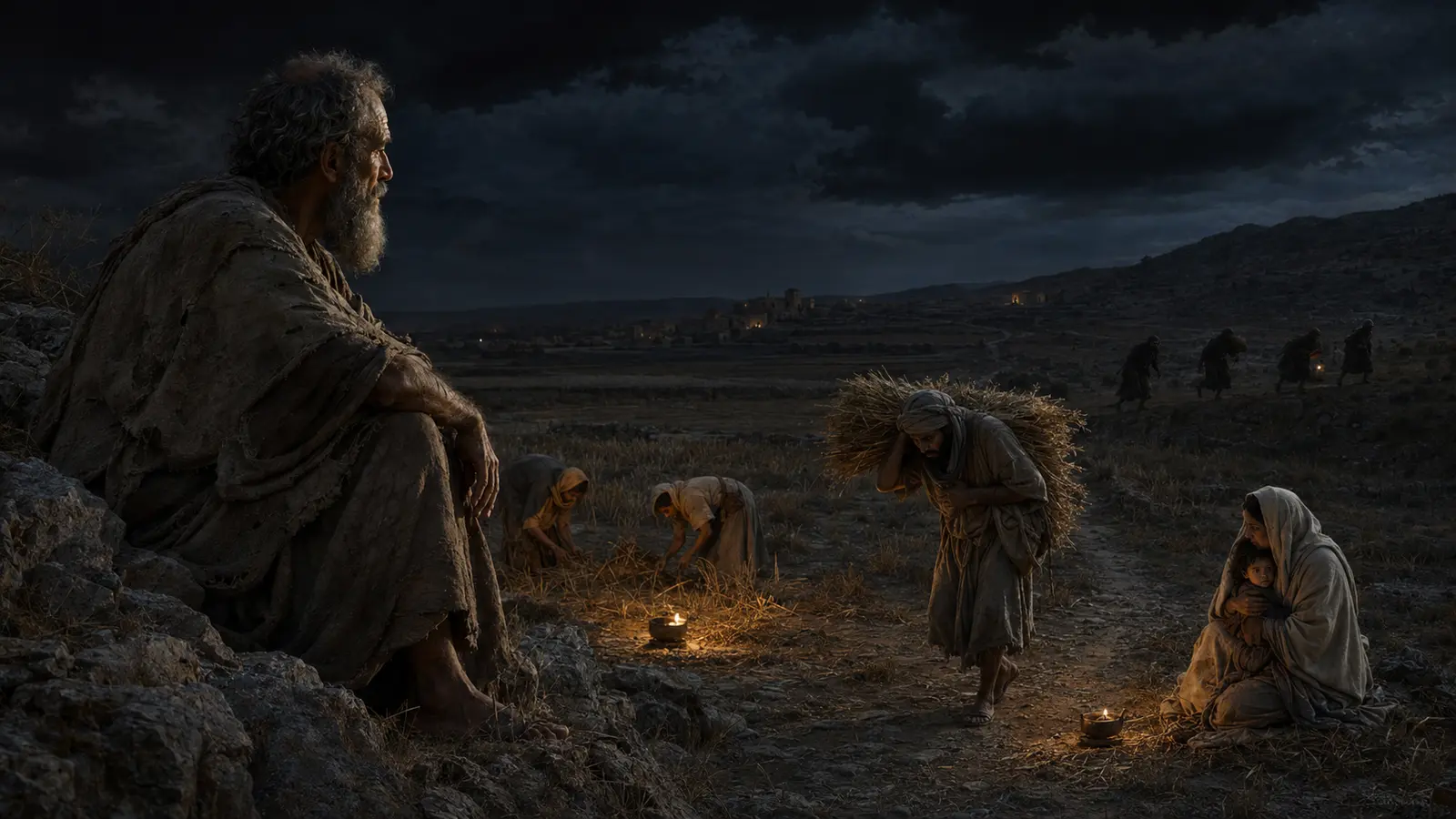
There are scenes in which a pile of ashes turns into a window. Job 24 begins with one burning question: why does the Almighty not set the times of judgment? Then Job turns his eyes away from his own suffering and looks at a world wounded by injustice—borders are moved, livestock is plundered, widows are exploited, children are taken, workers are starving beside the harvest they are not allowed to eat, the poor are rained on while hiding in the rocks, the dying are sick in the city, and criminals use darkness as their veil. Job's pain turns into a prophetic vision. You don't just ask, "Why am I suffering?" He also asks, "Why does God let the oppressed continue to wait?"
01
Introduction
There are scenes in which a pile of ashes turns into a window. Job 24 begins with one burning question: why does the Almighty not set the times of judgment? Then Job turns his eyes away from his own suffering and looks at a world wounded by injustice—borders are moved, livestock is plundered, widows are exploited, children are taken, workers are starving beside the harvest they are not allowed to eat, the poor are rained on while hiding in the rocks, the dying are sick in the city, and criminals use darkness as their veil. Job's pain turns into a prophetic vision. You don't just ask, "Why am I suffering?" He also asks, "Why does God let the oppressed continue to wait?"
02
1.0 Introduction: When Personal Pain Turns into a Cry for Social Justice
There is suffering that turns our eyes inward, locking us in the darkness of our souls. Pain can turn the world upside down, until we see nothing but the scar we carry. But, there is another pain—more maternal, which vibrates with metaphors and a prophetic voice—which instead of blinding us, opens our eyes to look at the wounds of the world.
Job 24 is of the second type.
In Job 23, Job sought God in every direction. He wanted to reach the throne of God, present his case, and be declared innocent. But God seemed to hide himself—in front, behind, left and right. However, Job admitted that God knew his way, and that after being tested he would be revealed either pure gold without the mud of accusations thrown at him.
Now in Job 24, Job expands on the question.
You don't just ask, "Why can't I find God?" He asks, "Why don't the oppressed see God's times to do justice?" He does not only struggle with the silence of God in his personal life; he struggles with that silence in the broader social experience. The poor are exploited. The weak are preyed upon. The hungry are working in the fields with their hunger. Those who are naked sleep cold without covering themselves. The city is sick. Murderers, adulterers and thieves do their work under the cover of darkness.
And God seems not to intervene.
That question is the one that shines as it pierces the heart in this chapter.
Job 24 is one of the strongest poems in the Bible about social injustice. The author does not hide behind light emotions or language to embellish the truth, but distinguishes himself by openly revealing the daily evil that oppresses the poor: land grabbing, injustice in livestock and debts, exploitation of orphans and widows, wages that do not meet needs, urban violence, and evil that is done in secret.
This chapter dismantles Eliphaz's false accusation from Job 22. Eliphaz falsely claimed that Job denied bread to the hungry, water to the thirsty, and oppressed widows and orphans. Now Job proves that he knows injustice in more detail. He does not speak as an exploiter who hides behind religion, but as a righteous victim - with an eye that sees the poor and a heart that mourns with them.
The central question of Job 24 is this:
Why does God allow injustice to reign—and what kind of faith dares to break the silence and rebuke evil?
This chapter talks about delayed justice, the suffering of the poor, the darkness that harbors evil, and the cry that asks God to set a day when wrong things will finally be straightened out.
03
2.0 Historical and Literary Context: The Second Half of Job's Eighth Discourse
Job 24 is Job's continuing response to Eliphaz's third speech. In Job 22, Eliphaz accused Job of social sins: unjustly taking mortgages, denying water to the weary, withholding bread from the hungry, driving away widows empty-handed, and destroying orphans. Job 23 responded by wanting to reach God directly. Job 24 responds by turning to the world of the oppressed.
The movement from chapter 23 to chapter 24 is important to note:
Job 23: Job wishes to appear in God's court because he needs to be personally proven innocent.
Job 24: Job longs for God's judgment because the world needs clear justice for all.
In that sense, Job's complaint is not based on selfishness. His personal suffering has become part of deeper questions about justice and morality. If the theology of his friends were correct, evil would be clearly punished and the weak would be protected. Instead, Job sees the opposite reality: the powerful oppress the weak, without God immediately intervening to hold them accountable.
The structure of Job 24 can be understood by dividing it into four main sections:
1. The opening question about delayed judgment (24:1).
2. Social and economic injustice against the weak (24:2-11).
3. Urban violence and underground crime (24:12-17).
4. The last difficult part about the fate of the wicked (24:18–25).
The last section, verses 18–24, is one of the most discussed sections in the book of Job. In the Hebrew Masoretic Scriptures, these verses are contained within Job's speech and seem to describe the fall of the wicked in language more akin to the theology of his friends. Some interpreters see them as words of friends that Job recites sarcastically, or as an acknowledgment that judgment sometimes comes. Some see the verses as having been moved and that they would be more appropriate in the third speech of Sofari which does not exist.
In the analysis of this chapter, we should respect their place in the final structure of the Bible while recognizing the tension that exists. The chapter itself forces us to grapple with the same difficulty that Job continues to reveal: sometimes the wicked prosper; sometimes it falls; but the timing of God's intervention remains hidden.
In that sense, Job 24 is not a quiet classroom discussion. Except, this chapter stands
as an official document of legal charges, mourning with prophetic weight, and a cry of strength rising from the lower side of the disenfranchised in history.
04
3.1 "Why does the Almighty not set times?": The Question of Delayed Justice (24:1)
Job begins with a question:
"Why does the Almighty not set the times of judgment, and why do those who know him not see his days?" (Job 24:1)
The "times" and "days" here are not ordinary calendar dates. Job asks about the appointed times for judgment—the days when God makes clear and straightens out the crooked. Those who know God long for those days like watchmen wait for the morning.
But the morning does not come.
This question is at the center of the biblical lament. The prophets also cry, "How long?" (Habakkuk 1:2; Zechariah 1:12). The psalmists ask why the wicked prosper while the poor are oppressed (Psalm 10:1-11; 73:3-12; 94:3-7). Habakkuk asks why God sees injustice but seems silent (Habakkuk 1:2-4, 13). Job joins the chorus of wounded faith, asking why the wicked continue to live, prosper, and rule while the afflicted cry without help (Job 21:7–15; 24:1–12).
It is important to note that Job does not oppose the existence of God's days of justice, but questions the reasons for its concealment. He does not deny the role of God as the Supreme Judge, but he questions the delay in his decisions. The issue here is not a lack of faith—it is the suffering of waiting for justice deferred.
The issue still haunts us today. Why should corrupt leaders end their days with comfort and luxury? Why should the violent flee from the judgment of their wickedness? Why do the poor continue to wait for justice years after years? Why are the legal institutions slow to provide justice and betray hope? Why does the cry of widows end in the air without answers? And why should children become victims of systems corrupted by adults?
Job teaches us that such questions have a place within the language of faith. It is not a sign that faith is dead. It may be a sign that the conscience is still alive.
Faith that never asks why justice is delayed may have stopped listening to the cries of the oppressed.
05
3.2 Boundary Stones and Stolen Livestock: When Power Steals Land and Sustenance (24:2–3)
Job begins his testimony with land theft:
"People move the boundary markers; they take herds and tend them. They drive away the orphan's donkey; they take the widow's cow as a mortgage." (24:2–3)
This crime is obvious. Moving the boundary stones was no small act of individual deception. It was an attack on inheritance, family life, and the covenant order. Land was not just property; it was sustenance, memory, and a place to live. Moving the border marker was erasing the family's future step by step.
Then the wicked grab the livestock. In the ancient world, livestock was wealth, food, work and life. Stealing a herd of livestock was like uprooting the economic lungs of a house.
The following images focus on the most vulnerable: the orphan and the widow. An orphan donkey is taken. A widow's cow is seized as a mortgage. These animals are not luxury items. They are survival tools. Without them, the weak cannot work, travel, farm, carry loads, or sustain their vulnerable lives.
This is why the Torah and the Prophets emphasize the protection of widows, orphans, and the poor (Exodus 22:21-24; Deuteronomy 10:17-18; 24:17-22; Isaiah 1:16-17; Zechariah 7:9-10). The heart of any society is not measured by how it nurtures the strong, but by how it protects the defenseless.
Moreover, the list that Job gives answers Eliphaz's suspicions with great calmness and focus. The same crime he was accused of by Eliphaz, now Job condemns it with an unwavering moral stance (Job 22:7-9; 24:3-12). Job witnesses the victims and knows well the law of mercy - he is not the exploiter imagined in Eliphaz's mind, but a man who later proves that he never denied the poor, widows, or orphans their help (Job 29:12-17; 31:16-23).
The righteous who suffers does not remain in his pain; he becomes the eye and the voice of the suffering of his colleagues.
06
3.3 The Poor Are Pushed to the Side of the Road: When the Weak Are Forced to Hide (24:4–8)
Job continues:
"He drives the poor out of the way; all the poor of the land are forced to hide." (24:4)
This is not the only place removed. It is dissolved in the life of society. The poor are pushed out of public spaces. They are forced to hide. The road is owned by the powerful. The weak have to pass cautiously, silently, as if they were invisible.
Job then compares them to wild donkeys in the desert:
"Like a wild donkey in the desert, the poor go out to do their work, looking for food; the wilderness provides food for their children." (24:5)
The picture being painted here is very sad. Humans created in the image of God live like animals that are hunted, looking for scraps to run their lives in dry places. Their sweat brings neither peace nor joy, but a desperate struggle; they do not sweat to develop life, but they fight day and night so that their children do not die of hunger.
The poor gather in the fields and in the vineyards (Job 24:6). But here is a great pain: the act that the Torah placed as a shield of mercy for the poor, strangers, orphans, and widows, has been turned into a field of exploitation (Leviticus 19:9-10; 23:22; Deuteronomy 24:19-21). These weaklings pick up scraps from the edges of others' wealth, fighting to survive in the midst of a world that has forgotten their humanity (Job 24:10-12; Amos 8:4-6).
Then the cold of night sets in:
"They sleep all night naked, without clothes, and they have no covering in the winter. They are rained on by the rains of the mountains, and for lack of shelter they cling to the rock." (24:7–8)
This image cuts to the bone. The poor are not statistics. It's frozen skin, wet clothes, shivering children, empty bellies, and backs cast to stone. Job makes us feel the rain itself falling on us.
This is the voice of prophetic and biblical justice: it refuses to let suffering become a faceless thought. The scriptures draw us close enough to make us hear the cry and witness the body trembling with cold and distress.
Abuse is not just an error in the system; it is the bitter cold of the night that penetrates and bites into the human skin.
07
3.4 Children Are Taken and Workers Left to Starve: The Economy Eats the Weak (24:9–11)
Job adds to the starkness of the image:
"There are those who snatch an orphan from the chest, and take a mortgage from the poor." (24:9)
The image of a child being snatched from its mother's breast is heartbreaking and unbearable. It exposes debt slavery, child extortion, and brutal exploitation of the poor. The main point here is unambiguous: those in power are turning the blood and flesh of the poor into debt securities. The deepest bond of love—between a child and its mother—is torn apart by impersonal materialism.
Job then describes the workers who work while hungry:
"They walk naked, without clothes; when they are hungry they carry sheaves of grain; in the olive groves of the wicked they press oil; they tread the winepress, but they themselves are thirsty." (24:10–11)
This is one of the strongest images of exploitation in Scripture. The poor carry grain but remain hungry. They squeeze fat but they don't get comfort. They do not tread on grapes but they are thirsty. They are surrounded by food and drink, but they are denied the fruits of the work of their hands.
This is not just looting—it is legalized and systematic exploitation. It is a system that milks the worker to produce grace, while leaving the subject to starve to death. In this environment, the harvest becomes evidence of injustice, the means of production turn into judgment courts, and the sheaves carried by the economic builders who lacked food strike and sue the entire system.
Later James will say in a similar voice: the withheld wages of the workers shout, and the cries of the reapers reach the ears of the Lord of hosts (Jas. 5:4). Job 24 is within that prophetic voice.
Here the theology of Job breaks into pieces the piety of words that lacked the personality of actions. You can't pretend you worship God while getting fat through systems that make the hungry carry food that can't fit in their mouths! Even when
when the thirsty press the grapes in the press, the very abundance of wine turns into a screaming testimony against their injustice.
08
3.5 Mourning from the City: When God Appears Not to Prosecute Evildoers (24:12)
Now Job moves from the countryside to the city:
"From the city the dying are sick, and the souls of the wounded cry for help; but God does not seem to impute fault to anyone." (24:12)
This verse is the one that carries the pain of the whole chapter. The city is sick. The injured are crying. The dying are not silent. Their voices are rising from the streets, alleys, houses and gates.
But God does not seem to hold the evildoers accountable.
This is not a complete theological definition with clean boundaries. It is mourning. Job describes how the real situation feels when injustice continues unabated. Cries are heard on earth, but heaven seems not to issue an indictment.
Here Job is about to accuse God—not that God does evil directly, but that He does not act against evil as quickly as expected. That is a dangerous request, but the Scriptures preserve it because the wounds of the world need true language.
The Bible does not teach us to call evil good. It does not ask the injured to praise the silence of the court. It allows this cry: "The wounded call for help, but God seems not to prosecute the wicked."
For Christian readers, this verse should be placed next to the cross. There, too, the Innocent One was killed outside the city, wounded and exposed, while the people in authority appeared to be unindicted and victorious. But the resurrection reveals that God's delay was not God's failure. However, Good Friday teaches us not to speak lightly of the silence that exists between the cry and the answer.
The cry of the wounded never goes away, even when judgment seems delayed.
09
3.6 Rebels Against the Light: Murder, Adultery and Stealing in the Night (24:13–17)
Now Job describes another group of evildoers:
"There are those who rebel against the light, who do not know its ways or stay in its paths." (24:13)
In Scripture, light often means truth, order, wisdom, and God's revelation that makes things clear. These people rebel against the light. They choose darkness not because they cannot see, but because they do not want to be seen.
Job mentions three types of crimes committed at night:
The murderer rises before dawn to kill the poor and the needy (24:14).
The adulterer waits for the evening, saying, "No eye will see" (24:15).
Thieves break into houses in the dark, and during the day they lock themselves in (24:16).
For them, darkness is the morning (24:17).
This image shows evil as rebellion against creation. In Genesis, God calls light to be good. Here sinners make darkness their home. They disrupt the order of creation. Morning scares them because it reveals them. Darkness comforts them because it hides them.
The adulterer's statement reveals a lot: "No eye will see you." This is the practical theology of secret sin. It is not necessary to make God with words. It lives as if hiding is survival. But the Scriptures warn again and again that what is hidden from the eyes of men continues to be seen before God.
However, Job's complaint remains in the air: if God sees, why does he not act now?
This question continues to remain without easy answers. However, by making clear the presence of this darkness, Job performs a strategic act of moral resistance. Evil depends on concealment and secrecy to continue; Job reveals it by giving it verbal form. Darkness holds its power when no one questions it; Job rebelled against the situation by declaring it openly.
Facing evil and calling it by its true name is already the victory of light over darkness.
10
3.7 “Swim on the Water”: A Hard Turn About the Fate of the Wicked (24:18–24)
The last part of the chapter changes the tone. Suddenly the poem speaks of the wicked being light on the water, their part being cursed, drought and heat swallowing the snow water, Hell swallowing the sinners, the womb forgetting them, worms eating them, and their memory broken like a tree.
These verses sound closer to the theology of friends: the wicked are judged, wiped out and cast down.
That creates tension. Does Job now agree with his friends? Does he quote their words? Is he being sarcastic? Does he admit that judgment sometimes comes? Or are these verses transferred from another speech, perhaps the third speech of Sofari which does not exist?
A wise reading should not make this difficulty any easier than it is. Job 24 itself has been revealing a world where justice does not come overnight. Verses 18-24, read as Job's words, may show him holding a two-fold reality: the wicked often oppress with impunity, but their end is still subject to God's judgment. Whether these paragraphs are the voice of friends or a displaced section, their place still serves the book by reminding us of the competing claims within the debate.
In any case, this tension has theological fruits. The scriptures teach that the wicked will not prevail forever. They also teach that, for now, the wicked often win. Faith must learn to speak both truths without using one to silence the other.
The wicked can be forgotten by the womb, eaten by worms, and broken like a tree. However, the poor may still be hungry today. The fall of wickedness at the last day does not erase the present cry of righteousness.
Future judgment is not a license to be careless today.
11
3.8 "Who will prove that I have lied?": Job's challenge to the Comforters (24:25)
Job closes with a challenge:
"If things are not like that, who will prove that I am a liar and show that my words have no weight?" (24:25)
This is not boasting. It is to give evidence. Job says: Look at the world. Ask the poor. Walk in the countryside. Listen in town. Watch the night. If you think I'm wrong, tell me.
Friends have built their theology starting from principles and going down to life. Job builds his complaint starting from the reality and rising to the theology. He does not deny that God is just. What he rejects is a theology that pretends to be blind to the fact that sometimes justice is delayed.
This final challenge also shows Job's courage. Despite being faced with false accusations, he does not stop at defending himself, but takes the opportunity to be a witness to all who face injustice. The pain he experienced did not make him forget his moral responsibility—it made his mind more alert to see oppression and oppose it.
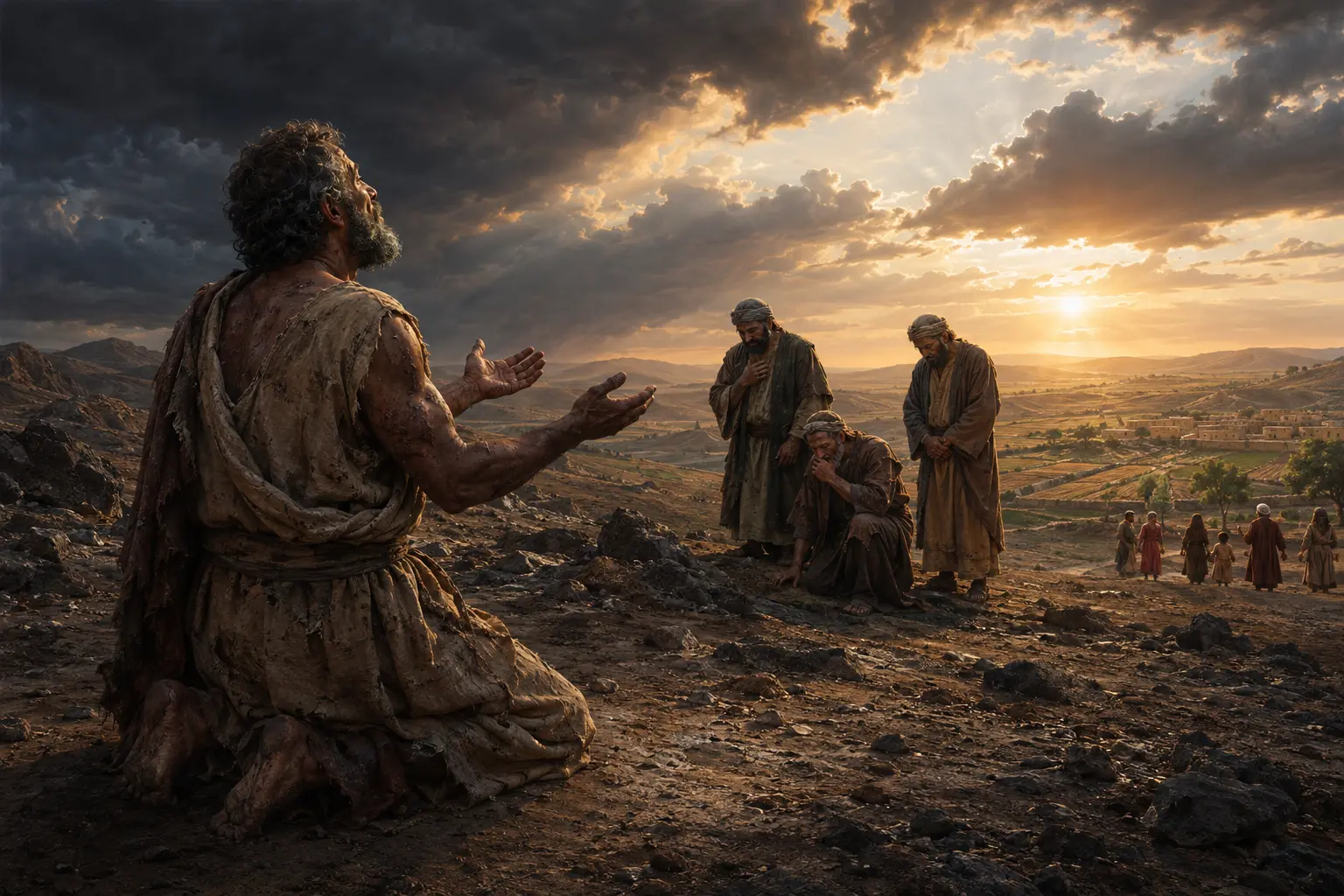
Job's pile of ashes has turned into a martyr's cage.
12
4.0 Theological Reflection: God Whose Righteousness Is Real, Although It Doesn't Always Come Immediately
Job 24 teaches us to reject two mistakes.
The first mistake is the mistake of friends: believing that justice always comes immediately, is obvious, and is easy to interpret. This attitude breeds cruelty. It makes us blame those who suffer, defend oppressive systems, and interpret life's situations as if they were God's judgments.
The second mistake is despair: believing that because justice is delayed, then justice is not real. Job doesn't get there either. He asks God harshly, but continues to speak like a person who believes that God's judgment makes sense. His question—"Why doesn't the Almighty set the times?"—is only meaningful if the Almighty is the one who should set the times.
This tension is found throughout the Bible. Abraham asks, "Will not the Judge of all the earth do justice?" (Genesis 18:25). Moses builds the law of Israel around the protection of the poor, the widow, the orphan and the stranger (Exodus 22:21-24; Deuteronomy 10:17-19; 24:17-22). The prophets roar against those who sell the righteous for money and the needy for a pair of shoes (Amos 2:6–7; 8:4–6). The psalmists weep over the prosperity of the wicked (Psalm 73:2-12; 94:3-7). Jesus announces good news to the poor and pronounces woe on those who devour widows' houses (Luke 4:18-19; 6:20-24; Mark 12:38-40).
Job 24 is in that river.
But this chapter adds something unique: the sufferer becomes a theologian of social justice. Job is not a sick person who only cries for himself; is a moral witness. In the ashes, he sees what the comfortable ignore—the hungry laborers at the harvest, the poor wet under the rocks, the wounded sick in the city, and the wicked who use darkness as a cover for their crimes (Job 24:5–12, 14–17).
This is theologically important because God's justice is not limited to the fate of individuals. It is about the order of the world. Friends reduce justice to an individual calculation: Job suffers, therefore Job has sinned. Job expands justice to include land, work, bodies, children, courts, streets and night crimes.
This broad vision has deep roots in the Bible. Sin is not only a stain on the heart; it can also create systems of violence and exploitation. Justice is not just personal innocence; it is the loyalty seen in the way we treat others and create a shared life.
For Christian readers, Job 24 points us to Jesus in at least three ways.
First, Jesus stands on the side of the poor, the marginalized, and those left without a defender. He announces the good news to the poor, touches the marginalized, feeds the hungry, welcomes the children, and rebukes the religious systems that burden the weak (Luke 4:18; Mark 1:40-42; 6:34-44; 10:13-16; Matthew 23:4).
Second, Jesus himself enters into the injustice that Job describes. He is falsely accused, stripped, mocked, wounded, and killed outside the city. The night of betrayal, the violence of authority, and the silence of justice gathers upon him (Mark 14:55–65; 15:15–20; John 19:23–24; Hebrews 13:12).
Third, the resurrection of Jesus is the dawn of the day of God's justice. You have not yet put an end to all injustice, but you confirm that God has appointed a day to judge the world with justice. The Resurrection says that the cry of the afflicted has been heard, darkness has been invaded, and the final Judge has already been announced (Acts 17:31; Romans 8:22-23; Revelation 21:4).
Therefore, Job 24 teaches us hope that does not close our eyes in the face of the truth. We do not hide the delay of justice, nor pretend that the poor are safe while they are crushed. We do not bless systems that exploit workers and call it fair. But neither do we consign the world to darkness.
God's justice may seem late, but it is not dead; his day is coming.
13
5.1 Ask Better Questions About Rights
Job doesn't just ask, "Why am I hurting?" He asks, "Why do the oppressed wait?" A mature faith learns to ask for both. Our personal suffering should not make us indifferent to the suffering of society. Sometimes our own wounds can teach us to see the wounds we used to ignore.
14
5.2 Don't Turn Poverty Into Just a Spiritual Thing
Job talks about hunger, clothing, shelter, work, land, debt and theft. These are things that touch the body and everyday life. Biblical faith is not put aside. A hungry person needs prayer, but he also needs bread. The victim needs compassion, but he also needs to be covered. A worker needs to be prayed for, but he also needs a fair wage.
15
5.3 Protect the Weak Against Systems That Deprive Them of Tools for Living
The orphan's donkey and the widow's cow represent the basic means of livelihood. In today's world, we can think of wages, tools for work, access to land, housing, documentation, education, health care, and protection of rights before the law. Justice protects what the poor need to survive.
16
5.4 Bring Darkness to Light
Job mentions a crime that likes to hide. Churches and communities should not protect darkness for fame, friendship, money or power. Abuse, exploitation, theft and betrayal must be put before the truth. Silence can be the abode of evil.
17
5.5 Hold Mourning and Hope Together
Job 24 teaches us the art of mourning delayed justice without losing faith in the final judgment. It gives us permission to cry, 'How long, Lord?' as we hold on to the promise of his intervention. It gives us the courage to call today's injustice by its name, with our eyes fixed on the coming Day of the Lord.
Christian hope is not running away from the truth; it is a firm position of faith that the dawn of God will overcome the thick darkness of any night.
18
6.0 Reflection Questions
1. What does Job 24 teach us about the relationship between the suffering of one person and the systems of injustice that hurt the whole society?
2. Why is Job's question about God's "times" and "days" important in understanding the delay of justice?
3. Which image in Job 24 reveals to you more strongly the pain and cruelty of injustice? Why?
4. How does Job's concern for the poor, widows, and orphans respond to Eliphaz's accusations in Job 22:6–9?
5. Where in today's society do we see people carrying "bundles" of other people's wealth while they themselves remain hungry?
6. What kinds of darkness—silence, fear, secrecy, power or corruption—allow evil to hide in families, churches, communities and nations?
7. How does the death and resurrection of Jesus strengthen our hope that God has set a day when he will judge the world with justice?
19
7.0 Response Prayer
Lord God,
You hear wails coming from the city.
You see the poor being pushed out of the way.
You know the child who is snatched from the bosom, the widow who is robbed of her cow, the hungry worker who carries the grain, and the thirsty who treads on the grapes in the winepress.
Teach us to see what Job saw.
Forgive us for the times we defended easy answers while the weak suffered. Forgive us for spiritual words that did not turn into bread, compassion that did not turn into shelter, and prayers that did not turn into righteous deeds.
Bring hidden things into your light. Uncover your favorite crime of the night. Strengthen the weary, clothe the naked, feed the hungry, protect the widows and orphans, and make your people a home in a stormy world.
And when justice is delayed, protect our hope from being extinguished. Give us the courage to mourn without despair, to wait without deceiving ourselves, and to work without our hearts growing cold.
In the name of Jesus Christ, wounded outside the city and resurrected as the dawn of your coming righteousness,
Amen.
20
8.0 Next Chapter Window: Bildad Humbles Man Before God
Job 24 ends with Job's challenge: who can prove him wrong? He has described a world where the poor are crushed, the wicked hide in darkness, and justice seems delayed.
In Job 25, Bildad gives his last speech. It's short—surprisingly short. The words of friends begin to fade. Bildad does not respond to Job's testimony. He returns to a familiar theme: God is sovereign, man is impure, and no one born of woman can be righteous before him.
The next chapter will bring us to a small but important moment in the discussion: when the friends again fail to explain Job's suffering, they promote human filth and leave the sufferer without an answer.
Job 25 will ask what happens when respect for God turns into contempt for man.
21
9.0 Bibliography
Alter, Robert. The Wisdom Books: Job, Proverbs, and Ecclesiastes: A Translation with Commentary. New York: W. W. Norton, 2010.
BibleProject. The Book of Job: Guide with Key Information and Resources. Portland: BibleProject, 2026.
Clines, David J. A. Job 21–37. Word Biblical Commentary 18A. Nashville: Thomas Nelson, 2006.
Hartley, John E. The Book of Job. New International Commentary on the Old Testament. Grand Rapids: Eerdmans, 1988.
Newsom, Carol A. The Book of Job: A Contest of Moral Imaginations. Oxford: Oxford University Press, 2003.
Walton, John H., and Tremper Longman III. How to Read Job. Downers Grove: IVP Academic, 2015.

Be the first to leave a comment.