

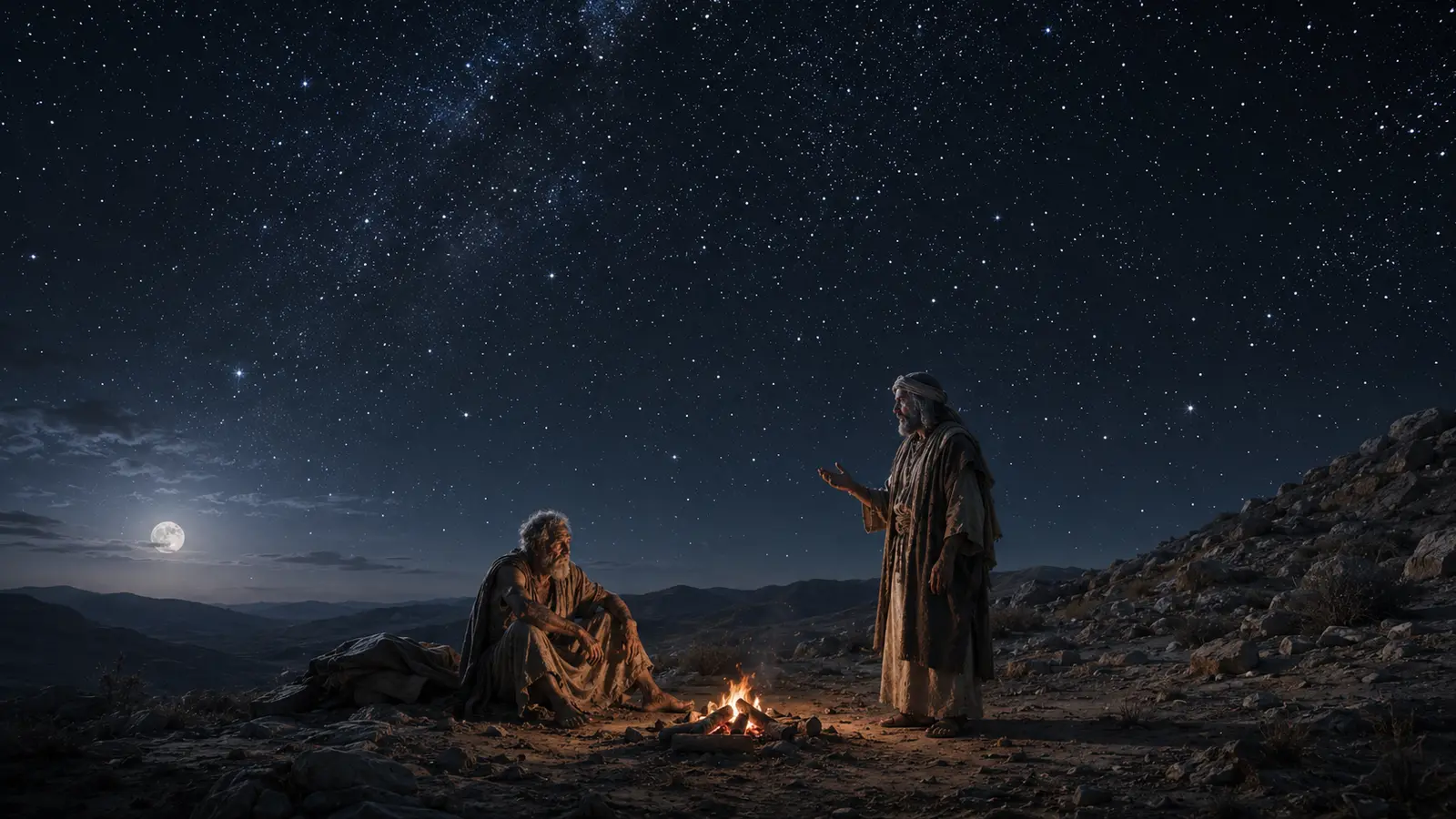
There are times when theology reaches the end of the road. In Job 25, Bildad speaks for the third and final time, but his speech is surprisingly short. Friends who used to come with long explanations now give only a short song about the greatness of God and the filth of man. God has authority. His armies are innumerable. Even the moon has no light before it. So how can man be righteous? Those words are not completely false, but they leave the sufferer helpless. They glorify God by bringing man down, but they do not answer Job's cry for justice.
01
Introduction
There are times when theology reaches the end of the road. In Job 25, Bildad speaks for the third and final time, but his speech is surprisingly short. Friends who used to come with long explanations now give only a short song about the greatness of God and the filth of man. God has authority. His armies are innumerable. Even the moon has no light before it. So how can man be righteous? Those words are not completely false, but they leave the sufferer helpless. They glorify God by bringing man down, but they do not answer Job's cry for justice.
02
1.0 Intro: When Friends Are Almost Out of Words
Sometimes silence is wisdom. Sometimes silence is tired.
Job 25 is one of the shortest speeches in this book. Bildad, who once spoke with the confidence of the ancient tradition, now gives only six lines. There is no long argument, no pastoral request, no careful dealing with Job's pain, no response to the poor who cry in Job 24, and no response to Job's desire to find God in Job 23.
Bildani has only a short piece of the song left.
God is above. God rules. He brings peace in the highest places. His armies are innumerable. His light reaches all. If even the moon and the stars are not pure before him, how can man—born of a woman, who is like a worm and a worm—be pure?
That was Bildad's last word.
On the one hand, his speech sounds reverent. It respects the majesty of God. It refuses to make God small. It reminds Job and the reader that the Creator is no ordinary defendant in a human court. The heavens are not governed by human complaints. The Almighty is above our measurements.
But this speech also shows the collapse of the advice of friends. Bildad does not really answer Job. Job has asked why the times of God's judgment are hidden (Job 24:1); Bildad answers that God reigns supreme (Job 25:2–3). Job has shown the cry of widows, orphans, hungry workers, and victims of crime (Job 24:2-17); Bildad reduces the whole argument by saying that man is like a worm and a worm (Job 25:6).
Job longs to be heard and declared innocent (Job 23:3–7); Bildad emphasizes that no one born of a woman can be righteous before God (Job 25:4). Instead of confronting the injustice in the world, he hides behind a general statement about human weakness.
The result is a theology that is big in heaven but small on earth.
The main question of Job 25 is this:
How can we respect God's majesty without using that majesty to destroy human dignity, to silence mourning, or to avoid the cry of justice?
This chapter deals with the last gasp of the theology of friends, the danger of ruthless piety, and the mystery of human weakness before a holy God.
03
2.0 Historical and Literary Context: Bildad's Final Fragment in the Broken Third Circle
Job 25 is in the third violent cycle of discussion. The first two rounds followed a relatively clear pattern: Job speaks, each friend responds, then Job responds to each. But the third cycle is starting to fall apart. Eliphaz gives the third full speech in Job 22. Job responds at length in Job 23–24. Then Bildad speaks very briefly in Job 25. Zophar does not have a third speech in the text we received.
This breakdown in literary order makes sense. Friends are at a loss for words.
Some scholars think that the text of the third cycle was destroyed during copying and transfer. Bildad's speech may have been longer, and some of the fragments now in Job 26 or 27 were originally part of it. Hartley, for example, considers Job 25:1–6 along with Job 27:13–23 to be the most complete reconstructed speech of Bildad. Clines, although suggesting a different order, also emphasizes the disruption of the third cycle and sees Bildad's speech as centered on the "fearful reign of God."
But as the text is in our Bibles, Job 25 is short—and that brevity has a theological meaning. Friends continue to have little to say because their system cannot bear the weight of Job's complaints. They cannot explain his innocence. They cannot respond to the welfare of the wicked. They cannot handle delayed justice for the poor. So Bildad returns to the basic claim: God is great, man is not clean.
This chapter moves through easy-to-understand steps:
1. God's rule and order of the world (25:1-3).
2. Man's failure to be righteous before God (25:4).
3. The imperfection of creatures and the weakness of man (25:5-6).
This speech repeats the previous words of Eliphaz, especially the claim that humans cannot be clean before God (Job 4:17-19; 15:14-16). Bildad does not add anything new of significance. That is part of the message itself. The theology of friends is now repeating itself. It has turned into an echo chamber.
However, let's not dismiss this chapter too quickly. Bildad says something important, even though he says it wrongly and misuses it. God is great. Humans are weak. No one can stand before God with the purity of self-purification. They really exist. But in Job 25, they are turned into weapons against the suffering person instead of being windows to lead us into humble worship.
This chapter teaches us that even true theology becomes dangerous when it refuses to answer the real question being asked.
04
3.1 "Dominion and Fear Belong to God": The Greatness That Bildad Can't Stop Seeing (25:1-2)
Bildad begins:
"Government and fear belong to God; he makes peace in his high heavens." (Job 25:2)
This is the best part of Bildad's speech. He sees that God is not one ruler among other rulers. The rule is his. An awe of honor surrounds him. Heaven is not a place of chaos, instability, or endless competition. God keeps peace in the highest places.
The statement "peace in the highest heaven" is good. It implies that even the heavenly world, with its hosts and mysteries, is placed under God's rule. The sky above the suffering earth is not left unattended. God reigns in the highest place.
But Bildad's use of this fact is problematic. He is talking about peace in heaven when Job has just talked about violence on earth. Job has set before us the frontiers that have been moved, the widows deprived of support, the children taken captive, the workers starving in the midst of the harvest, and the wounded who are sick in the cities (Job 24). Bildad does not answer that. He looks up and speaks as if the order of heaven is ending the problem of violence in the world.
It's not right.
It is true to say that God brings peace in the highest places. But the question that Job has asked is this:
Why hasn't that heavenly peace made justice appear on earth?
True worship must embrace both. It must raise its eyes to the throne and lower its hands to the wounds of the road. It must acknowledge God's rule in heaven while refusing to ignore the violence under the sun.
The presence of heavenly Peace does not give permission to be indifferent to earthly suffering.
05
3.2 "Can His Armies be Counted?": God of Countless Armies (25:3)
Bildad continues:
"Can his armies be numbered? On whom does his light not shine?" (Job 25:3)
Here Bildad sees God as the Commander of countless armies. The armies of heaven cannot be numbered. God's rule is vast beyond the limits of man. His light rises above all creatures.
Again, this theology is not false. The Scriptures often call the Lord the God of hosts, surrounded by heavenly hosts. The stars themselves can be seen as their organized forces. God is not alone in heaven. His creation is full of servants, messengers, witnesses, and powers under his command.
The second verse expands that claim: God's light reaches everyone. No creature can escape the scope of his rule.
But in this context, that thing aggravates Job's problem. If the armies of God cannot be numbered and his light stands above all, why do murderers, adulterers, and thieves thrive in darkness? If God has countless armies, why are the poor pushed out of the way? If the light of God reaches every creature, why do the wounded cry as if no charges are brought against their persecutors?
Bildad thinks that God's greatness should silence Job. But for Job, the greatness of God makes the question more serious. An impotent God could be forgiven for delaying justice. But God with innumerable armies cannot be explained in that way.
This is why Job's complaint has great theological force. He does not fight because God is very small. He fights because God is great, but justice seems to be delayed.
When we admit that God has all power, we must also take seriously the cry of the people when they ask for His justice to be seen. You cannot believe in the greatness of God while ignoring the cry of justice.
06
3.3 "Then How Can Man Be Righteous Before God?": The Question Bildad Uses Against Job (25:4)
Now Bildad comes to the middle of his speech:
"Then how can a man be righteous before God? How can one born of a woman be pure?" (Job 25:4)
This is the strongest line in this chapter. Bildad's argument is simple: if God is so great, pure, and exalted, no human can claim justice before him. Everyone born of a woman is impure when compared to the holiness of God.
There is a deep biblical truth here. Humans have limits; we are creatures of dust breathed into the breath of life (Genesis 2:7; Psalm 103:14). We are morally broken, and no one can stand before God on the basis of self-acquired purity.
The Psalms ask, "O Lord, if You had counted the iniquities, who would stand?" (Psalm 130:3). The prophets tremble before the Holy One and recognize their filthiness (Isaiah 6:1-5; Daniel 10:7-9). Later Paul concludes, "All have sinned and come short of the glory of God" (Romans 3:23; see also Romans 3:9-12).
But Bildad's use of this fact is unfair.
Job did not claim to be equal with God. He does not claim to be pure in the infinite sense. He has claimed his innocence of the charges brought against him and his integrity in the face of the torture that has befallen him. The author and God himself have already called Job a perfect and upright man. Job's point is not, "I am pure like God." His argument is, "I have not committed the secret evil that my friends devise, and my suffering is not the punishment I deserve."
Bildad blurs the distinction between creaturely humility and moral guilt.
That is a great danger in pastoral ministry. It is one thing to say, "We all need mercy before God." It is another thing to say to someone who has been falsely accused, "However, you are not justified, so stop seeking to be declared innocent." The general sinfulness of man should not be used to erase his innocence in a particular matter.
A person can be a sinner in need of grace, but still be innocent of a certain charge (Psalm 32:5; Job 27:5-6). Jesus taught us to ask for forgiveness of our sins, but he did not accept false accusations without contradicting them (Matthew 6:12; John 8:48-49; 18:23). Paul knew that he was saved by grace, but he still defended his conscience and conduct when he was unjustly accused (1 Corinthians 15:9-10; Acts 24:10-16; 2 Corinthians 1:12). Humility before God does not force us to deny the truth before men.
The fact that we all need mercy should not be distorted into a license to judge the innocent.
07
3.4 "Not Even the Moon Shines": Creation Fading Before the Holy One (25:5)
Bildad continues with the example of the sky:
"Look, even the moon does not shine, and the stars are not clean in his eyes." (Job 25:5)
This image is light and simple. The moon that shines at night is weak before God. The stars that seem pure and distant are not pure in his eyes. The beauty of creation is real, but not final. The brightest lights of creation are like shadows before the holiness of the Creator.
This is a poem about God's majesty above creation. It teaches us that God is not the greatest thing in the universe. He is a holy Creator before whom even the heavens are mere creatures. The stars do not compete with him. The moon does not shine on the sun. God is the source above all light.
But once again, Bildad uses God's majesty to tear down instead of comfort. Job has just described people who rebel against the light (Job 24:13). Now Bildad is talking about the lights of the sky which are not clean before God. But he does not bring the light of God down to expose the criminals. You do not ask how God's light should save the poor. He turns light into distance.
This is the spiritual danger of talking about God's greatness as a distant thought. We can express his holiness in a way that remains above the clouds without touching the ground of suffering. But in the Bible, God's holiness is not the only distance. You burn against oppression, you cleanse the unclean, you call sinners back, and you make a covenant with the creatures of dust (Isaiah 1:16-17; 6:5-7; Hosea 14:1-4; Genesis 2:7; 17:7).
Isaiah saw the Lord on high and lifted up; but the vision did not end in fear. His lips were cleansed, then he was sent to the lost people (Isaiah 6:1-8). Ezekiel saw the glory of God not only in the temple, but also by the river in the land of exile, showing that the presence of God follows his people even in places of pain and loss of hope (Ezekiel 1:1-3, 26-28; 11:16).
Mary sang that the mighty one lowers the rulers and lifts up the weak, fills the hungry and leaves the rich empty-handed (Luke 1:51-53). God's holiness does not make man only small; it also sends mercy, justice, and redemption into history.
God's light does not conquer the stars with just brightness; it also reveals darkness and heals the broken.
08
3.5 "Man Who Is a Worm": A Very Low View of Humanity (25:6)
Bildad closes with one of the strongest images in this discussion:
"Then man is not much more—he is a worm; and the son of Adam is a worm!" (Job 25:6)
This is the last word of the friends' speeches in the text we received. Not comfort. Not a prayer. Not repentance for their false accusations. Not solidarity with Job. It is not an answer to injustice.
Learn. A bug.
Bildad's argument is a "not much more" argument: if the moon and the stars are not clean before God, what will man be like? The logic is understandable, but the effect is devastating. A person who lost children, property, health, respect, and friendship is now told that humanity itself is like a worm before God.
There is a way of talking about the smallness of man that leads us to worship. Psalm 8 asks, "What is man that you should remember him?"—and his answer is not contempt, but surprise: God has crowned man with a crown of glory and honor. There is a way of talking about dust that leads us to humility and hope: God remembers that we are dust, and like a father he has mercy on his children (Ps. 103). There is a way to confess sin that opens the door to mercy.
Bildad's words do not.
His narrow view of man is out of proportion to God's mercy. He does not say, "You are dust, but God remembers you." He does not say, "You are weak, but God lifts up the weak." He does not say, "You are poor, but God hears the cry of the poor." In a real sense he says, "You are so low that you have no right to question."
That is not all the Bible tells about humanity.
Genesis says that man is created in the image of God (Genesis 1:26-27), and Psalms that he is clothed with glory and honor (Psalm 8:4-6). The prophets declare that God knows and creates man from the womb (Jeremiah 1:5; Isaiah 44:24).
In the incarnation, the Son of God accepted to be a man, was born of a woman, and entered the same state that Bildad considers inferior (John 1:14; Galatians 4:4; Philippians 2:6-8). Resurrection declares that the dust of man is not commanded to be despised, but to be clothed with incorruption and glory in Christ (1 Corinthians 15:42-49; Philippians 3:20-21).
Therefore Christian readers should reject Bildad's last word as the last word about man. It is true that humans are weak. We are sinners. We depend on God. We are not God. But we are not just worms. In Christ, the Word became flesh—not because the flesh is worthless, but because God intends to redeem it.
The Gospel responds to Bildad's "worm" with the wonder of the Word made flesh.
09
4.0 Theological Reflection: Merciless Supremacy Is Not Enough
Job 25 is theologically important because it says things that are partially true.
God is great. God rules heaven. His armies cannot be numbered. His holiness surpasses the light of the moon and the stars. Humans are weak. No one can claim purity before God without mercy. That's not wrong.
But Bildad's speech is still not enough.
Its shortcomings are seen in the things it does not say.
It leaves Job's innocence in this matter. It leaves the poor of Job 24. It leaves the wounded crying from the city. It leaves open the possibility that God's holiness can demand justice for the oppressed rather than demand silence from the sufferer. It leaves God's mercy. It leaves the image of God in man. It leaves a mystery that the Saint can approach the dust.
So Job 25 warns us against one-sided theology. One truth about God can be distorted when separated from the fullness of his character. God's majesty without mercy can be intimidating. Man's sin that is not accompanied by his honor can be contempt. Merciless piety can be cruel. Unjustified humility can be a license to accept abuse.
Bildad thinks he is defending God. But he advocates a form of God's majesty that has no room for his mercy.
The complete testimony of the Bible unites the things that Bildad has separated. God is high and holy, but he is also close to the broken hearted. God dwells in unapproachable light, but he hears the cries of slaves in Egypt. God rules the stars, but feeds the ravens. God humbles the proud, but lifts up the lowly. God exposes sin, but covers the naked. God judges the world, but he also becomes flesh and dwells among us.
Job 25 also prepares us for Job 26. Bildad has spoken in a few verses about God's rule. Job will respond with a greater song about God's power. In other words, Job does not have a narrow view of God. A sufferer can speak more deeply about God's greatness than a comforter who uses that greatness to silence him.
That is one of the wonders of this book.
The accused person often sees God more deeply than the accusers.
For Christian theology, the deepest answer to Bildad is found in Jesus. Bildad asks, "How can one born of a woman be pure?" The New Testament answers: there is one born of a woman who is pure—Jesus the Messiah, born of Mary, a perfect man, without sin, faithful unto death. Bildad says man is a bug. The Gospel says that the Son took on a human body, bore human sorrow, entered into human death, and rose again as the first born of a new creation.
That fact does not negate human sin. It reveals the depth of God's grace. We are not saved by pretending to be clean. We are saved because the Pure One entered into our filth and carried us to purification.
Job 25 leaves us with a necessary but incomplete message: God is great, and man is weak.
Other scriptures complete the word: the greatness of God is not only seen in making man small, but also in lifting up the weak, declaring the righteous innocent, judging the wicked, and redeeming the flesh through the Son born of a woman.
10
5.1 Talk About God's Greatness Compassionately
We should never make God small. But we should also not talk about his greatness in a way that makes those who suffer feel invisible. God's majesty should lead us to worship, humility, and courage—not to keep us away from those in pain.
When someone is grieving, the statement "God is in control" may be true, but it needs to be said with tears, at the right time, and gently.
11
5.2 Do not use the General Guilt of Man to Erase Innocence in a Specific Matter
It is true that all people need grace. But that doesn't mean every accusation is true. A person can be a sinner before God and still be innocent of a crime, rumor, or accusation placed upon him. Justice requires a careful examination of the facts, not a blanket judgment without evidence.
12
5.3 Let Human Weakness Give Birth to Mercy, Not Contempt
Bildad calls man a worm. Scripture also calls man dust. But biblical dust is not despised by God. God molds the dust, breathes into it, remembers it, and revives it. Our weakness should make us gentle to others.
13
5.4 Respond to Abuse, Not Just Theological Arguments
Job 24 asked urgent questions about the poor and oppressed. Bildad's speech does not address them. Our churches should not do that. Correct teaching must turn into social justice, compassion, advocacy, and practical support.
14
5.5 Find the Most Complete Answer in Christ
Bildad asks how a man born of a woman can be pure. Jesus answers by being a faithful Man, born of a woman, full of grace and truth. In it, God's majesty and mercy meet. In it, human dignity is restored. In it, the word "bug" is not the last word about humanity.
15
6.0 Reflection Questions
1. Why does Bildad's speech have some truth, but still fails to touch the heart of Job's suffering?
2. How can the statement "God rules" comfort the one who is suffering, and how can it also be used to silence him?
3. What is the difference between admitting human guilt and accusing someone without evidence?
4. How does Psalm 8 balance the smallness of man with the honor given to him by God?
5. What questions of Job 24 about the poor and oppressed does Bildad leave unanswered?
6. How does Jesus, born of a woman but without sin, answer Bildad's question in Job 25:4?
7. What would it be like to live a worship that kneels before God and also stands beside the wounded?
16
7.0 Response Prayer
O Lord God,
You are high and holy.
The rule is yours.
Your light surpasses the moon and the stars.
Your wisdom is deeper than our arguments,
and your throne is not shaken by our questions.
Teach us to respect you correctly.
Save us from using your majesty to silence the wounded. Save us from speaking scornfully of human weakness. Save us from the theology that looks to heaven but refuses to hear the cry from the city.
We confess that we are dust, but we are dust held in your hands. We confess that we are sinners, but we are sinners who are followed by mercy. We admit that we are weak, but our weakness has been visited by the Word made flesh.
Through Jesus Christ, born of a woman, pure in heart, crucified under false accusations, and resurrected in glory, teach us to unite humility and hope, piety and compassion, truth and gentleness.
Amen.
17
8.0 Window to the Next Chapter: When Job Sings to God Above His Comforter
Bildad has spoken briefly about the rule of God and the filth of man. He has tried to answer Job by lowering man before the majesty of God. But Job will not accept that as wisdom.
In Job 26, Job responds with strong irony: "What a help you have been to the weak!" Then he does something unexpected. He gives a greater vision of God's power than that of Bildad. Hell is open before God. The world is hung with nothing. Clouds carry water. The horizon is drawn on the surface of the abyss. God calms the sea, crushes Rahab, and stabs the running snake.
The next chapter will show that Job's complaints are not based on a narrow view of God. They come from a wounded man who sees God's majesty clearly—and yet asks why that majesty has not brought justice to his pain.
Job 26 will ask what happens when the sufferer can speak more accurately about the greatness of God than his comforter.
18
9.0 Bibliography
Alter, Robert. The Wisdom Books: Job, Proverbs, and Ecclesiastes: A Translation with Commentary. New York: W. W. Norton, 2010.
BibleProject. The Book of Job: Guide with Key Information and Resources. Portland: BibleProject, 2026.
Clines, David J. A. Job 21–37. Word Biblical Commentary 18A. Nashville: Thomas Nelson, 2006.
Hartley, John E. The Book of Job. New International Commentary on the Old Testament. Grand Rapids: Eerdmans, 1988.
Newsom, Carol A. The Book of Job: A Contest of Moral Imaginations. Oxford: Oxford University Press, 2003.
Walton, John H., and Tremper Longman III. How to Read Job. Downers Grove: IVP Academic, 2015

Be the first to leave a comment.