

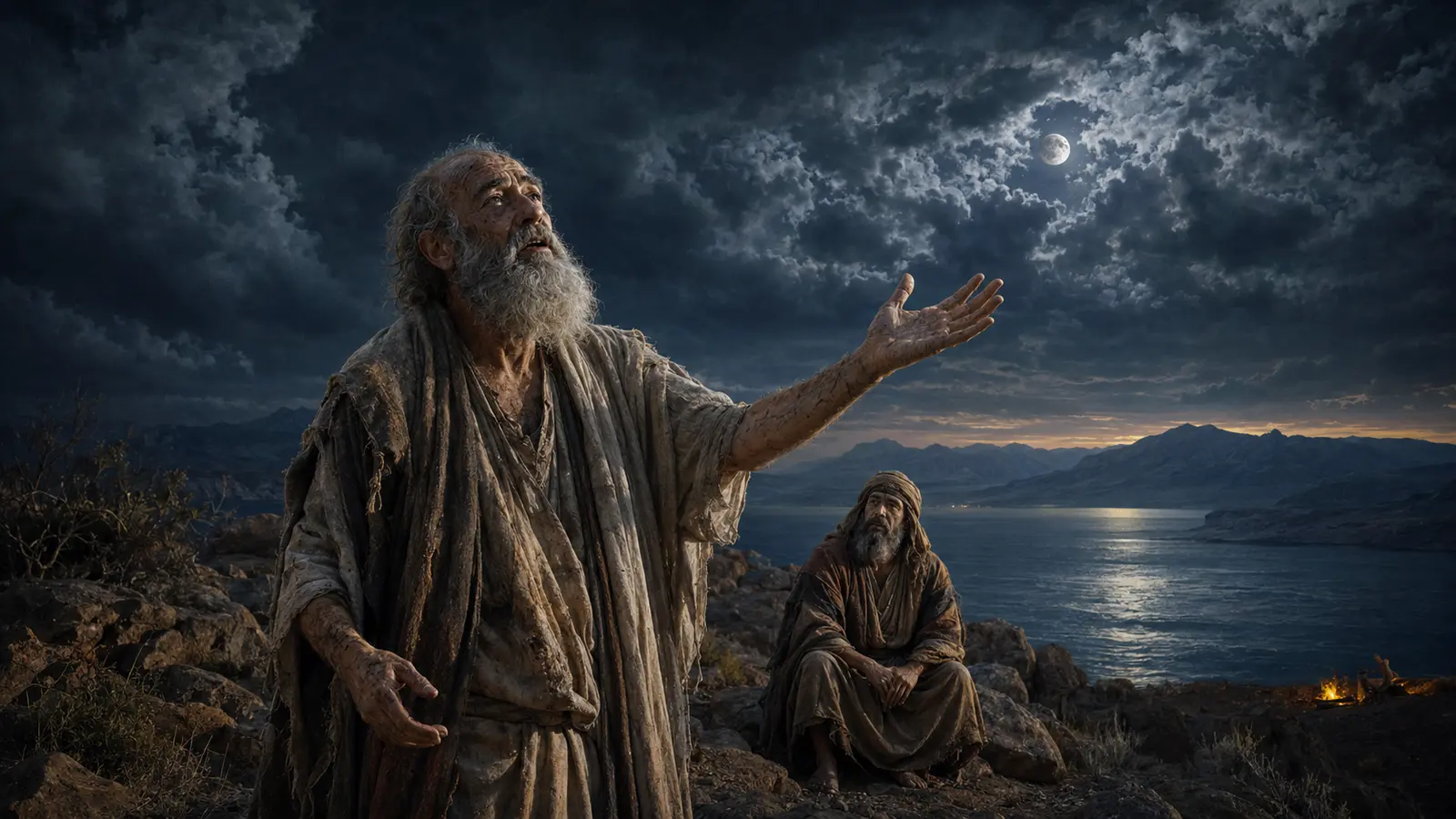
There are times when the injured see farther than those who are protected by their responses. In Job 26, Job responds to Bildad's short speech with sharp sarcasm, then rises and sings one of the most glorious songs about God's power in the book. The dead tremble under the water. Sheol is open before God. The earth is suspended above the void. Clouds block the water. The horizon sets the boundary between light and dark. God calms the sea, breaks Rahab, and stings the running serpent. But after saying all that, Job admits that those are just the ends of God's ways. The sufferer accused of being dishonorable now speaks more deeply of God's majesty than his comforters ever did.
01
Introduction
There are times when the injured see farther than those who are protected by their responses. In Job 26, Job responds to Bildad's short speech with sharp sarcasm, then rises and sings one of the most glorious songs about God's power in the book. The dead tremble under the water. Sheol is open before God. The earth is suspended above the void. Clouds block the water. The horizon sets the boundary between light and dark. God calms the sea, breaks Rahab, and stings the running serpent. But after saying all that, Job admits that those are just the ends of God's ways. The sufferer accused of being dishonorable now speaks more deeply of God's majesty than his comforters ever did.
Some people think that mourning comes from weak faith.
They think that if a person questions, suffers in the heart, or complains, then he has forgotten the greatness of God. He thinks that those who are suffering need only be reminded that God is high, holy, sovereign, and far beyond human understanding.
Job 26 says otherwise.
Job has not forgotten the greatness of God. He sees it. He sings it. He describes it with poems that embrace the whole sky. He knows that God's rule reaches under the water, beyond the clouds, into Sheol, to the horizon, over the sea, and in the sky. Job's complaints do not come from seeing God in a small way. They stem from the unbearable tension of believing in a great God while living in indescribable pain.
Bildad had just spoken briefly about the kingdom of God and the filth of man. There was some truth in his words, but not enough compassion. He used God's greatness to make man look as small as an insect. He did not answer Job's thirst to see justice done. He did not answer the cry of the poor in Job 24. Nor did he answer Job's desire to meet God in Job 23.
Now Job responds first with sarcasm, then with praise.
He begins with the words: You helped the weak one very well! You counseled the unwise with great skill! Those words sting because Bildad has described unhelpful grandeur, merciless majesty, and unhealing theology.
Then Job does something amazing. He speaks about God's power with greater beauty and breadth than Bildad. He goes from a humiliating joke into a glorifying ritual; he comes out of the words of the wound and into the vision of the whole world. He shows that a sufferer can reject bad theology without rejecting the glory of God.
The central question of Job 26 is this: Can we combine genuine complaint with deep respect, mentioning our pain and at the same time acknowledging God's immeasurable majesty?
This chapter teaches us the difference between superficial respect and wonder born in suffering; it reveals to us the God who rules the visible and invisible world; and it calls us to a humility that acknowledges that even our best theology is only a whisper of His power.
Job 26 follows Bildad's third and final speech. In the order of the text we have, Bildad's words in Job 25 are very brief. He declares that dominion and fear belong to God, that God brings peace in the highest, that his armies are innumerable, and that no man born of woman can be clean before him.
Now Job answers.
This chapter has two main parts:
1. Job sarcastically rejects Bildad's advice (26:1-4).
2. The song of God's power in the whole world (26:5-14).
The wider context of this text is controversial. The third round of speeches has begun to be disrupted. Bildad's speech is very short, Zophar does not have a third speech in the text we have received, and Job's subsequent speeches are unusually long. Some translators think that parts of Job 26 may have originally belonged to Bildad, because the song of verses 5-14 is close in content to his words about the greatness of God. Others, especially those who read the last order of the book, hear this song as Job's own answer: Bildad has given a small vision of God; Job offers a broader vision.
In this lesson we follow the order of the text we received: Job is the speaker in Job 26. The order is very powerful. You mean that the one accused of being irreverent becomes a true poet of God's majesty. The sufferer who rejects false comfort is not a godless rebel; is a wounded worshipper.
Song of Job 26 also predates by far God's speeches that will come later in the book. You touch on themes that Yahweh will expand on: the sea, darkness, borders, the order of the world, the pillars of the heavens, and strange creatures. Job already knows that the world is wide and wild under God's hand. What he doesn't know yet is how that universal wisdom relates to his own suffering.
That tension is what gives this look its depth. Job may sing to the world, but he still suffers for justice. He can see the ends of God's ways, but he cannot understand the thunder of his power. He can acknowledge the greatness of God, but that greatness alone has not yet healed him.
02
3.1 "Truly You Helped Him!": Sarcasm Versus Empty Advice (26:1–2)
Job begins:
"How you helped the weak! How you saved the helpless hand!" (Job 26:2)
Those words sound like praise, but they sting like a hurtful joke. Job means the opposite of what it sounds like on the surface. Bildad did not help. He did not save. He did not strengthen the weak hand. He did not lift up the helpless.
Here is an important pastoral teaching. Advice can be dressed up in beautiful theological language and still not help anyone. A speech can mention God's name many times and still leave the sufferer all the more lonely. Bildad spoke of God's sovereignty, but Job needed more than a reminder that God is above. He needed real presence, wise discernment, and compassion that could carry the weight of unanswered pain.
"The weak hand" is a powerful image. In the ancient world, the hand often represented power, performance, and liberation. Job's arm is weak. He is tired, stripped of everything, sick, accused, and socially broken. Bildad's words have not strengthened him.
They have not been a hand to hold his hand.
The irony reveals the failure of the work of friends. They came to comfort Job. Instead, they became another burden on him.
Words about God must be oil to heal the wounded; otherwise, they remain a wind that blows over the wounds without bringing relief.
03
3.2 "You Have Gave Wonderful Counsel!": Unfathomable Wisdom (26:3–4)
Job continues:
"How you counseled the unwise, and revealed to him full knowledge in abundance!" (Job 26:3)
This verse also reveals irony. Instead of providing solid wisdom, Bildad merely reflects ancient traditions without considering the reality of things. His teachings have remained theories that do not touch Job's life; he talks about humanity in general but fails to do justice to Job in the context of his specific suffering.
Then Job asks:
"You uttered those words with whose help, and whose breath came from you?" (Job 26:4)
This is a tough question. Bildad spoke as if he were a representative of God's wisdom. Job asks, in another sense: Who inspired you? Whose spirit is behind this speech? If Bildad's words did not help, did not save, did not advise with wisdom, and did not give strength, then what kind of breath gave them?
That question is important because in the Scriptures, the words of wisdom are not the only correct information.
You must carry the breath of life. God's Spirit brings order, understanding, conviction, and renewal. Words that crush the innocent and ignore the suffering of the poor may sound spiritual on the outside, but they don't necessarily carry a holy breath.
Here is a serious warning for teachers and preachers. Before we ask if our words are interesting, we should ask if they are true, timely, compassionate, and life-giving. The question is not only, Did we teach the right doctrine? The question is also, whose breath was in our words?
Wisdom without discernment may sound authoritative and respectable, but it has no life in it.
04
3.3 The Dead Tremble Under the Water: God's Rule Over the Hidden Depths (26:5–6)
Now Job moves from irony to praise:
"The dead tremble under the water, with them that dwell therein. Sheol is open before God, and
Abaddon has no cover.” (Job 26:5–6)
This turnaround is amazing. Job walks out of Bildad's failed speech and into the hidden map of creation. It does not begin with the heavens above, but with the depths below.
"The dead," that is, the shadows of the dead, tremble under the water. Sheol—the world of the dead—is open before God. Abaddon, the place of destruction, has no cover.
What this means is that God's kingdom is reaching a place that human eyes cannot see. Death is not a closed room before him. The world of the dead is not a hidden land outside of his gaze. Even the area farthest from the reach of man is open to the Creator.
This is surprising because Job has often wished for Sheol to be a place of hiding—darkness to protect him from the pain and scrutiny of God (Job 3; 14). But here he admits that even Sheol appears before God. There is no final place to hide from the Almighty.
Theologically, this truth is frightening and at the same time hopeful. You are scary because there is no darkness that can hide us before God. You give hope because even death is not beyond his knowledge. The faith of the Bible will take this truth forward to the hope of resurrection: if Sheol is open before God, then the grave is not beyond his power.
The God that Job cannot find is the God from whom even death cannot hide.
05
3.4 The Earth Hanging on the Void: God's Rule over Space, Void, and Solidity (26:7)
Job continues:
"He spreads the northern heavens over the void, and hangs the earth on nothing." (Job 26:7)
This is one of the most memorable lines in this book. This picture is not modern science in technical language, but a profound poetry. Job sees the earth held up by the power of God, firm without a pillar to be seen, held above the void by the command of the Creator.
"North" probably refers to the northern sky—the secret region, the top, or horizon of the sky. God spreads over the void. He hangs the world on nothing. Creation does not depend on opposing forces. You do not rely on independent foundations outside of God. You are standing because God is holding you.
This picture directly touches the fear of man about the basics of life. Job's own life seems unfounded. His children are gone. His property is lost. His health has collapsed. His honor has faded. His friends have become accusers. However, he still sees the whole world as suspended over the void and continues to be held.
That doesn't solve his suffering, but it gives him the language of faith. Sometimes the believer feels suspended in the void. There is nothing visible that holds the heart. But the song of Job says that God who hangs the world on nothing can hold on to life when every earthly support is gone.
When all visible foundations are gone, creation itself whispers that God can hold what is hung above the void.
06
3.5 Water Enclosed in Clouds: God's Rule over What Can Be Broken (26:8–9)
Job turns his eyes to the clouds:
"He binds the water in his heavy clouds, and the cloud does not break under his weight. He covers the face of the crescent moon, and spreads his cloud over it." (Job 26:8–9)
Clouds carry water. This ordinary thing becomes a miracle of prevention. Clouds carry a weight that they don't release all at once. The waters that could flood the earth are contained, collected, stopped, and controlled.
In the minds of the ancients, water often represented danger and violence, but also a life-giving blessing. Too little water leads to drought. Too much water brings destruction. God's wisdom holds the balance.
The cloud also covers the face of the crescent moon—or the face of the throne, depending on how this difficult verse is read. Either way, the image points to a cover-up. God rules what is hidden behind the cloud. The sky itself becomes an example: a luminous object can be covered without disappearing.
Job knows the meaning of the light being covered. In chapter 23 he looked for God but could not see him. Here he sings about God spreading a cloud over the light. The image does not remove the pain of God's invisibility, but it puts it in the context of creation. Stealth is woven into the universe. Not every cover is non-existent. Not every cloud is abandoned.
The cloud that hides the light may also be held in God's hand.
07
3.6 Horizon Over Water: God's Boundary Between Light and Darkness (26:10)
Job says:
"He has drawn a circle on the surface of the water, on the boundary between light and darkness." (Job 26:10)
This is a picture of the horizon and the border. God paints the border where light meets darkness, where the visible and the hidden, day and night, order and mystery meet.
The words "he drew a circle" show the skill of the artist and the authority of the ruler. The world is not a formless thing. God draws the lines. It sets boundaries. It shows where seemingly opposite things meet.
That fact is important in Job because his own life seems to be standing on the border between light and darkness. He has known blessing, now he knows loss. He has known honor, now he knows shame. He has known close friendship with God, now he feels God has hidden himself. His life has been like a horizon—light behind him, darkness before him, and God somewhere beyond the reach of the eye.
But the song of Job says that God is the Lord of that border. Darkness has a limit. Light has a limit. The place where they meet is not outside of God's rule.
The Bible narrative begins with God separating light from darkness. It ends in a new creation where night will be no more. Job stands in the middle, before the final dawn, acknowledging that even now God has drawn the line.
Where light and darkness meet, God has already set a boundary.
08
3.7 Pillars Trembling, Seas Calming, Rahab Broken: God's Reign Over World Violence (26:11–12)
Job's song grows stronger:
"The pillars of heaven tremble and are astonished at his rebuke. By his power he calms the sea; by his understanding he breaks Rahab." (Job 26:11–12)
The pillars of heaven tremble. The very structures of the world shake when God rebukes. That which seems most solid still responds to his voice.
Then comes the sea. In the ancient world, the sea was often a symbol of violence, danger, and untamed power. God calms it down. He doesn't just look at chaos; he subdues.
Rahab—an ancient mythological sea creature who represented chaos and rebellion—is defeated by God's understanding. This is a serious truth: God's victory does not depend on strength alone, but is built on wisdom. His authority and recognition work together. The Creator does not overcome violence by using force alone; rather he brings peace to the world through an age of reason and purpose.
Job has used similar images before. He knows that God can defeat the enemies of the world. He knows that God can calm the sea. He knows that God controls what makes men afraid.
That knowledge makes his suffering harder to understand, not easier. If God can calm the sea, why hasn't he calmed Job's storm? If he can break Rahab, why has he not broken injustice? If God's wisdom overcomes chaos, why does Job's life seem to be dominated by chaos?
That is the wound hidden under this song. Job's theology is so high as to make his lamentations all the more intense. He does not suffer because he doubts God's power. He suffers because he knows the power, but he does not understand why you are slow to intervene.
Faith can know that God can calm the sea and still continue to ask why the waves keep crashing.
09
3.8 The Running Serpent Is Burnt: The Beauty and Victory of God in Heaven (26:13)
Job continues:
"By his breath the heavens are cleansed; his hand pierces the running serpent." (Job 26:13)
The wind or breath of God cleans the sky and makes it bright and beautiful. The same breath of God that hovered over the water in creation brings order and beauty to the sky.
Then the hand of God pierces the fleeing serpent—another image of the enemy of the world, a creature of violence, or a force of rebellion. The snake runs away, but cannot escape. God's victory comes even to that which tries to escape in the darkness.
This image echoes throughout Scripture. Dragons, serpents, seas, and violent forces appear in various forms, and the Bible declares again and again that God is sovereign over them. Later Christian readers will hear echoes leading to Christ's victory over the powers of evil. On the cross, what seemed like defeat became a blow against the serpent's head. In the resurrection, the fleeing forces of death were revealed as defeated enemies.
But Job has not yet stood up on Easter morning. He stands in the old night, singing that the hand of God is piercing the serpent even when his own wounds are still unhealed.
This is a ritual full of tension.
The God who makes the heavens beautiful is also the God whose hand will not allow violence to have the last word.
10
3.9 "The Ends of His Ways": Whispering and Thundering (26:14)
Job concludes with surprisingly humble words:
"Behold, these are but the ends of his ways; how small a whisper we hear of him! But who can understand the thunder of his power?" (Job 26:14)
After talking about Sheol, the void, the earth, the clouds, the water, the horizon, the pillars of the sky, the sea, Rahab, and the running serpent, Job says: This is just the edge.
The main theology that we can pronounce is still only the ends. Our deepest song is still a whisper. Thunder remains far beyond our understanding.
This line is central to the entire book. Job knows that God is beyond human understanding. He doesn't need Bildad to tell him that. But Job's humility before the mystery does not make him accept the false accusation. You don't make him stop seeking justice. And you don't make him call evil as good.
This is mature theological humility. You don't pretend to understand thunder. And you don't pretend that easy answers are the thunder.
The words "little whisper" are very beautiful. All human theology, even if true, is only part of the truth. We hear only the faint voice of the Infinite One. That should make us humble, patient, and careful. It should make us quicker to listen than to accuse, and gentler to those who suffer.
Friends act as if they heard all the thunder. Job knows that he has only heard a whisper.
True wisdom knows that even its highest praise stands only at the ends of God's ways.
11
4.0 Theological Reflection: Suffering's Advanced Theology About God
Job 26 breaks the common assumption: questioning God does not have to be the result of looking down on God.
Sometimes the most profound questions come from those who believe most strongly that God is great, just, wise, and sovereign. If God were weak, Job's pain would be a small mystery. If God did not know, Job could explain his delay. If God did not care about morality, Job would not expect justice. But Job believes that God has the power to rule Sheol, hang the earth, shut up the waters, calm the sea, break Rahab, and stab the running snake. That is why his suffering gives birth to a deep pain that even unbelief cannot bear.
Job's mourning is the product of faith choked and passed through the fire of intense pain.
This chapter also teaches us that true respect for God is wider than the respect given to him by Job's friends. Bildad's honor humbles man and silences questions. Job's honor trembles before God whose ways are only partially visible. Bildad uses greatness as a wall. Job tastes greatness as a mystery.
That distinction is important.
God's majesty should not make us cruel. You should make us humble. If we only hear whispers, we should be careful when we claim to interpret every tragedy. If we stand only at the ends of God's ways, we should not speak as if we had entered into the secret chamber of his purposes. If the thunder of his power is far from our understanding, then let us not reduce suffering to simple formulas.
Job 26 beyond discernment also broadens our view of creation. Creation is not a one-time event of establishing things, but God's ongoing rule over boundaries, depths, waters, clouds, death, chaos, and all hidden forces. The world is held, protected, organized, and maintained. The earth is hung on nothing because God supports it. Clouds hold water because God binds them. Darkness and light meet because God has set a boundary. The sea and the serpent cannot rule because God rebukes them.
That understanding prepares us for Yahweh's speeches. When God speaks out of the storm, He will not give Job an easy answer about suffering. He will invite him to look at a world that is wider than human ability to manage. Job 26 shows that Job already knows part of that truth. He can already sing about endings. But he has yet to meet face to face with the Hurricane Speaker.
For Christian readers, Job 26 finds its ultimate fulfillment in Christ. He through whom all things were made enters into the world which he sustains. The one who holds the earth above the void is held in the hands of Mary. The one who calms the sea stands in the boat and says, "Hush! Be still!" The one who bites the snake is himself burned on the cross. He whose thunder no one can understand speaks with a human voice: "Come to me, all you who are troubled and heavy laden."
In Jesus, an audible whisper becomes a tangible body.
However, even in Christ, we do not possess the secret of God. We receive him. We follow him. We trust him. We learn that the power of God is not only seen in the victory of the world, but also in love in the form of the cross. God's thunder is heard not only in the storm, but also in the silence of the Lamb being led to the slaughter and in the echo of the resurrection morning.
Job 26 leaves us standing in awe at the edge of a mystery: God is greater than our theology, nearer than our fear, stronger than violence, and wiser than our explanation.
12
5.1 Do not confuse Mourning with Disrespect
Job could complain and still worship. He can ask and still sing the greatness of God. When people in pain ask difficult questions, don't jump to the conclusion that they have dishonored God. Perhaps, their pain and questions come from realizing the weight of God's majesty in their state of weakness.
13
5.2 Let Your Theology Help the Weak
Job's irony asks if Bildad's words helped the weak. That question should examine every speech, lesson, advice, and conversation we have. Does our theology strengthen weak hands? Does it give life? Does it breathe mercy?
14
5.3 Practice Humility Because We Only Hear Whispers
The last verse of Job calls us to be careful. We cannot fully measure or understand the thunder of God's power. We do know it, but only in part. This situation should make us considerate—easy to listen, but too heavy-handed in judging or explaining the suffering of others.
15
5.4 Trust God When Life Is Hung On Emptiness
Many periods of life feel hopeless. Work is lost. Health falls. Friends don't understand. Plans fall apart. Visible foundations are disappearing. The Song of Job reminds us that the God who hangs the world on nothing can hold his people when there is nothing visible left.
16
5.5 Put Violence Under the Hope of God's Victory
The sea, Rahab, and the running serpent represent forces beyond human control. Our lives also encounter violence: sadness, injustice, fear, addiction, cruelty, shame, and death. Job 26 does not say that violence is just a thought. It says that violence is not the end. God's hand is stronger.
1. Why is Job's irony in verses 2–4 important in revealing the weakness of unhelpful comfort?
2. How does Job 26 show that Job's complaints are not based on a narrow view of God, but on a broader understanding of his greatness?
3. Which image in this song gives you the most strength: Sheol that is open before God, the earth hung on nothing, the clouds carrying water, the boundary between light and darkness, the calmed sea, or the burnt snake?
4. How can remembering that we only hear God's "small whisper" make us more humble and compassionate teachers, pastors, friends, and comforters?
5. In what area of your life do you feel like you are hanging "on nothing," needing God to hold you when every visible hope is gone?
6. How does Jesus complete and expand the meaning of God's rule over the sea, snakes, death, and violent forces?
7. What would it be like if our theology did not remain just the right words, but would be a hand that lifts weak hands in reality?
17
7.0 Response Request
Lord God,
You spread the heavens over the void.
You hang the world on nothing.
You bind the water in the clouds.
You draw the line between light and dark.
You see Sheol open.
You calm the sea.
You break Rahab.
You stab a running snake.
And all these are just the ends of your ways.
Teach us to tremble with humility.
Save us from speaking as if we understand the thunder when we have only heard a whisper.
Make our words gentle, true, and helpful to the weak.
Hold us when life seems to hang on the void.
Cover us when the clouds hide the light.
Give us strength when violence rises like the sea.
Give us the faith to believe that darkness has a limit and evil will not have the last word.
Through Jesus Christ,
The Word made flesh,
He who calmed the storm,
defeated the serpent,
he entered into death,
and rose in glory,
Amen.
18
8.0 A Window to the Next Chapter: When Job Refuses to Let Go of His Integrity
Job 26 concludes with a surprise: all man's knowledge of God is but a whisper of his ways. But that surprise does not make Job surrender his integrity. In Job 27, he will make a solemn oath. "As God lives," Job will say, he will not lie. Until he dies, he will not put away his righteousness. His heart will not condemn him all the days he lives.
The next chapter takes us to one of Job's most powerful proclamations about moral endurance. He is accused, misunderstood, and left in the dark, but he refuses to confess sins he did not commit. He will not buy peace by telling lies.
Job 27 will ask what it means to uphold righteousness before God when all friends and circumstances insist that you are guilty.
19
9.0 Bibliography
Alter, Robert. The Wisdom Books: Job, Proverbs, and Ecclesiastes: A Translation with Commentary. New York: W. W. Norton, 2010.
BibleProject. The Book of Job: Guide with Key Information and Resources. Portland: BibleProject, 2026.
Clines, David J. A. Job 21–37. Word Biblical Commentary 18A. Nashville: Thomas Nelson, 2006.
Hartley, John E. The Book of Job. New International Commentary on the Old Testament. Grand Rapids: Eerdmans, 1988.
Newsom, Carol A. The Book of Job: A Contest of Moral Imaginations. Oxford: Oxford University Press, 2003.
Walton, John H., and Tremper Longman III. How to Read Job. Downers Grove: IVP Academic, 2015.

Be the first to leave a comment.