

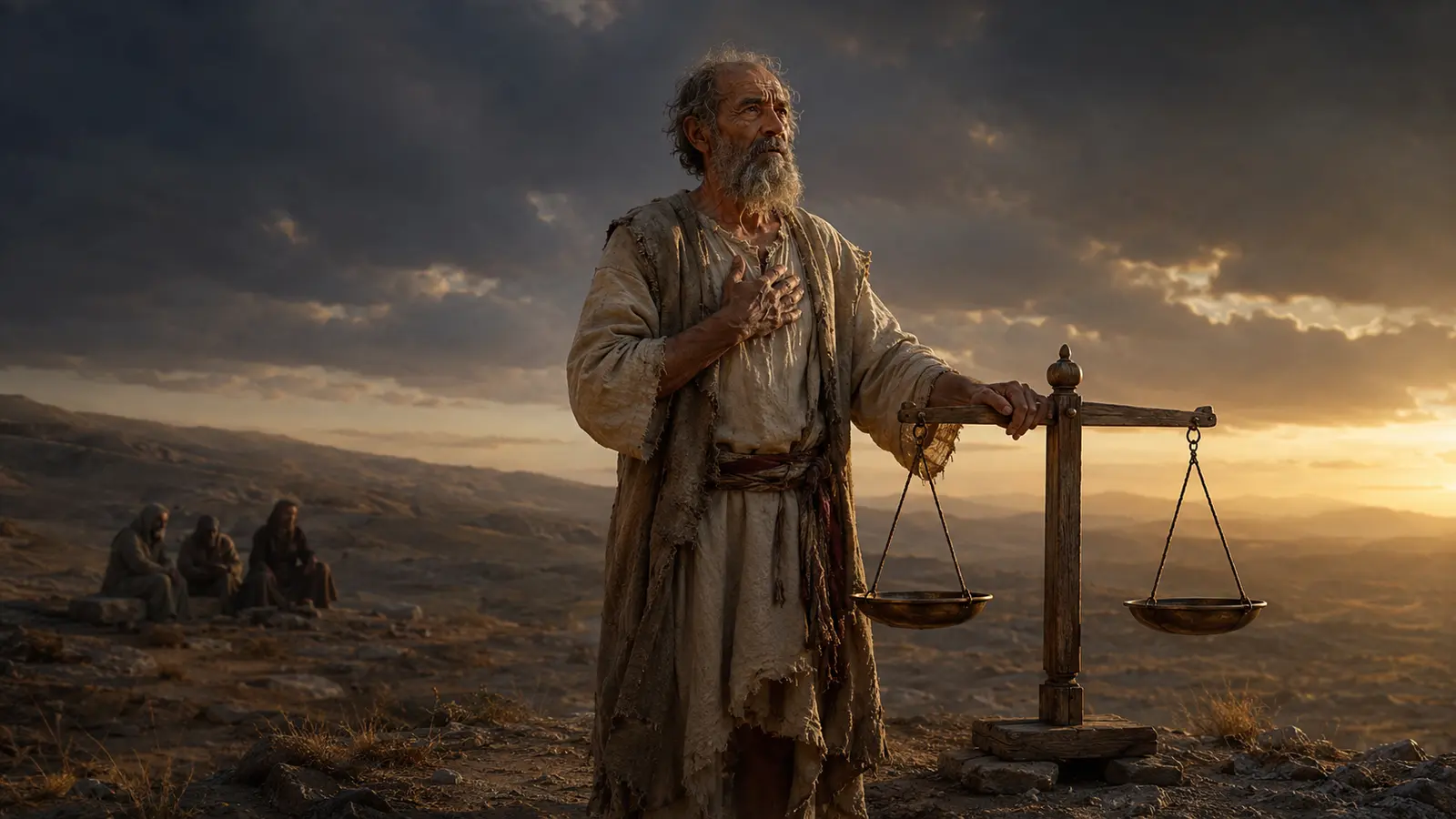
There are times when survival requires silence, and there are times when faith must utter an oath. In Job 27, Job raises his voice saying, "As God lives," and refuses to buy peace by confessing wrongs he did not commit. His friends want repentance consistent with their theology. Job will not agree. He will not allow his lips to speak lies, nor his tongue to utter deceit. However, this chapter also turns to the fate of the wicked—children facing the sword and famine, riches stored up for the righteous, houses as weak as a spider's web, and threats sweeping like a storm. Job stands between two truths: he will not surrender his righteousness, nor will he deny that evil has an end.
01
Introduction
There are times when survival requires silence, and there are times when faith must utter an oath. In Job 27, Job raises his voice saying, "As God lives," and refuses to buy peace by confessing wrongs he did not commit. His friends want repentance consistent with their theology. Job will not agree. He will not allow his lips to speak lies, nor his tongue to utter deceit. However, this chapter also turns to the fate of the wicked—children facing the sword and famine, riches stored up for the righteous, houses as weak as a spider's web, and threats sweeping like a storm. Job stands between two truths: he will not surrender his righteousness, nor will he deny that evil has an end.
02
1.0 Introduction: When Peace Could Cost the Truth
There are times when the easiest way to get away is to lie.
It's not a big lie you're shouting. It is not a public scandal. It is a small betrayal that takes place quietly in the soul. It is a confession that even the heart denies. It is asking for forgiveness for a mistake we did not commit. It is the silence that allows the lie to stand because we are too tired to challenge it. It is a religious drama that gives others the conclusion they want while slowly burying the truth that God knows.
Job 27 is about rejecting that kind of peace.
Job has listened to his friends in many ways. They have pleaded with him, warned him, accused him, and pressured him to repent. Eliphaz has created fabricated errors. Bildad has reduced man to the level of filth and worms. Sofari has painted the wicked as sweet poison awaiting judgment. Again and again their argument has been the same: Job is suffering; therefore he must be guilty.
Now Job swears.
He swears by the living God—the same God who he believes has denied him justice and made his soul painful—that he will not lie. He will not say his friends are right when he knows they are wrong. He will not give up his righteousness until he dies.
This is a sacred and dangerous time.
Job's oath is not pride. It is the conscience standing before God. He does not claim to be equal to God. Nor does he claim sinless perfection in the general sense. He says that the accusations of his friends are false, and he will not call them true to make his life easier.
However, Job 27 is also controversial. After Job's oath, this chapter speaks strongly about the fate of the wicked. Some parts sound like the theology of his friends. For this reason, many translators consider verses 7–23 to be part of a disrupted third cycle, perhaps preserving the lost third speech of Zophar; others read the whole chapter as Job's speech in the order of the text we received. However we deal with the textual tension, the chapter in its final setting forces us to hold two truths together: Job rejects false guilt, but he does not reject moral judgment.
The main question of Job 27 is this:
How can we uphold justice without self-righteousness, deny false accusation without denying sin, and believe in judgment without using it as a weapon against the innocent?
This chapter is about a true conscience, refusing to confess lies, the weak fate of ill-gotten wealth, and the difficult wisdom of standing before God with clean hands in a world full of accusations.
03
2.0 Historical and Literary Context: Job's Oath in the Disturbed Third Cycle
Job 27 is near the end of the discussion between Job and his three friends. The third round has already begun to break. Eliphaz gave a full speech in Job 22, accusing Job of oppressing the people in the community. Job responded in Job 23–24, desiring to appear before God's court and publicly mentioning injustice. Bildad gave a short final speech in Job 25, emphasizing the greatness of God and the depravity of man. Job responded with sarcasm and praise of God's greatness in the whole world in Job 26.
Now Job continues.
The chapter begins with an official statement: "Job continued his speech" (Job 27:1). This statement gives the speech a special weight and dignity. Job no longer answers one argument after another. Now he makes a statement.
The chapter can be divided into four parts:
1. Job's oath before the living God (27:1-6).
2. Job's desire that his enemy be counted with the wicked (27:7-10).
3. T he realization that his friends already know the power of God, so they should not speak empty words (27:11-12).
4. Description of the portion that awaits the wicked (27:13-23).
The main difficulty is in verses 7-23. In the Masoretic Text, these verses are attributed to the words of Job. But his harsh description of the fall of the wicked is very similar to the speeches of friends, especially Sofari. Clines observes that the ninth speech of Job consists mainly of 27:1–6 and 11–12, while most of 27:7–23 preserves words from the lost third speech of Zophar. Hartley connects Job's final response to his friends with Job 26:1–27:12, and then reads the next section about the fate of the wicked in the context of the disrupted third cycle.
In this lesson we will respect the final order of the text while acknowledging that translational tension. Theologically, the chapter we received shows a strong conflict: Job refuses to confess the guilt of lying, but the book does not leave the fact that evil has its place under God.
This is surprising because Job was never an advocate of evil. He has disputed the claim of friends that punishment comes immediately and is always obvious. He has shown that the wicked often succeed. He has complained that the poor suffer while the days that God has set remain hidden. But Job does not deny that evil is evil. You do not bless oppression. He does not join the counsel of the wicked.
Therefore, Job 27 sets an important boundary:
Mourning is not rebellion against the law, complaints are not the collapse of morals, and righteousness is not rebellion against God.
04
3.1 “As God Lives”: Swearing by God Who Appears as an Enemy (27:1–2)
Job begins with an oath:
"As God lives, who deprived me of my justice, and the Almighty, who brought pain to my soul..." (Job 27:2)
And this is surprising.
Job swears by the living God, but in the same breath he accuses that God of denying him justice and making his soul painful. He does not leave God, but he also does not recommend himself to Him. His faith is so real as to acknowledge the tension in prayer: God is alive; God is the Judge; God is the one before whom the oath has weight - and yet Job feels that God has denied him his right.
This is not disbelief that God exists. It is the pain of the covenant.
Job cannot leave God, because God is still the final court of truth. But he cannot speak as if the way God treated him is understandable. Therefore, he holds together God and complaints in one sentence. He swears by a God he cannot understand.
The words "as God lives" carry great weight. Job's oath depends on the reality of God. If Job is lying, the living God will know. If he utters a lie, God may judge him. Job does not use God's name without respect. He stands under the testimony of God.
This makes his charge against God unusually bold. Job does not speak out of fear of God. He speaks while in it. He believes that God is alive, and therefore truth has weight.
This is one of the great conflicts in the suffering heart: God, though thought to be the source of suffering, is the only one to whom the broken soul can fearlessly pour out His truth.
Job swears by the God who wounds him because even a wounded faith knows that the truth lives before God.
05
3.2 "As long as my breath is within me": Life Held by God Whom Job Questions (27:3)
Job continues:
"As long as my breath is within me, and the spirit of God is in my nostrils..." (Job 27:3)
Job admits that his life is sustained by God. The breath in his nostrils was not made by himself. The same God that Job accuses of making his soul painful is the God that keeps him alive.
This verse reflects the story of creation, where God breathed into man the breath of life. Job recognizes himself as dust animated by the breath of God. His complaint is not to declare himself free from God. It is the cry of a creature whose every breath is borrowed from God.
This makes Job's oath humble even as it is bold. He does not say, "I stand alone." He says, "As long as God's own breath sustains me, I will not use that breath to lie."
This is a strong moral position. Every word we say is a breath that can create truth or deception. If God gave us that breath, our mouths should not be used to serve lies.
Persecution has robbed Job of many things, but it has not robbed him of his honor to manage the truth. He may be angry. He can be confused. He may be in pain. But he will not allow pain to turn his mouth into a false witness.
The breath that God gives should not be used to confess what the conscience knows to be false.
06
3.3 "My lips shall not lie": The Oath of Truthfulness (27:4)
Now Job clearly states his vow:
"My lips shall not speak lies, nor shall my tongue utter deceit." (Job 27:4)
This verse is at the heart of the moral force of this chapter. Job refuses to lie.
The lie we are talking about here is not any untrue statement. It is a false confession that his friends want him to utter. They want him to say, "You are right. My suffering proves my guilt. I have been wicked in secret. I deserve this."
Job will not say that.
There are times when refusing to lie is the greatest spiritual bravery a person can display. Job does not protect himself with pride. He guards the truth with fear. Confession of falsehood would not be humility; it would be disrespecting God, because God is the true God.
This is happening. Sometimes religious communities pressure sufferers to accept false narratives just to protect their worldview. When a person is treated cruelly, society pushes him to say that he misunderstood what happened. When he is falsely accused, he is told to take the blame in order to 'keep the peace.' When a person is sick, when he mourns, or when he is poor, he is encouraged to find a secret sin and confess it—all this so that those around him can be comforted that the world still obeys their principles and theories.
Job says no.
He will not lie to comfort those who came to comfort him.
This does not mean that Job denies the existence of all sin. He rejects the sin of invention. The scriptures call us to confess, but the confession must be true. Repentance is holy; therefore it should not be acted upon.
False confession is not humility; it is a lie dressed in sackcloth.
07
3.4 “Until I Die”: Righteousness Upheld to the End (27:5–6)
Then Job says:
"Let me say that you are right; even when I die I will not remove my integrity. I will hold on to it
my right and I will not leave it; my heart does not blame me for any day of my life.” (Job 27:5–6)
The language of "hold" here takes us back to the introduction of the book. God said that Job still held his integrity even after a great loss (Job 2:3). Job's wife asked why he still held to his righteousness (Job 2:9). Now Job says he will continue to hold it.
The whole tension of the book gathers in those words.
The accuser claimed that Job would leave God when the blessings left. The friends demand that Job must give up his claim of innocence and accept the secret evil. Job rejects both. He does not curse God as the accuser predicted, nor will he be falsely accused as his friends want.
His righteousness is not stubborn pride. It is covenant faithfulness that endures in the midst of fire.
Job says his heart does not blame him. Again, this does not mean that he thinks he has never sinned. It means that his conscience does not accuse him of the kind of evil that would explain his suffering or justify the accusations of his friends. Regarding the case in question, he stands before God with a clear conscience.
Here is great courage. Sometimes integrity means standing alone when every visible sign seems to be against you. Circumstances say you are guilty. Friends say you are guilty. Theology says you are guilty. Your reputation says you are guilty. But the conscience before God says: I will not release.
Righteousness is the hand of the soul that refuses to let go of the truth that God knows.
08
3.5 "Let My Enemy Be as Wicked": Job's Prayer Against False Accusers (27:7–10)
Job continues:
"Let my enemy be like an evil one, and he who rises up against me like an unjust person." (Job 27:7)
This is no ordinary curse. It is the language of moral judgment. Job has been treated like a wicked man. Now he prays that the one who accuses him falsely should be placed in the group where the guilt should really exist.
The following verses describe the hopelessness of an ungodly person when God cuts him off:
What hope does an ungodly person have when God takes away his life? (27:8)
Will God hear his cry when trouble comes to him? (27:9)
Will he rejoice in the Almighty? Will he call on God all the time? (27:10)
These questions sting because they separate Job from a true godless man. Ungodly people do not delight in God. They don't always call God. They have no active relationship with the Almighty beyond their own interests.
But Job calls God. Job seeks God. Job longs to come to God's court. Job appreciates God's words. His mourning is full of God because his life is still directed to God.
This is one of the most powerful responses to friends. If Job really did not fear God, why does he continue to turn to God? Why does he keep looking for her face? Why does he swear by the life of God? Why does he reject deception before God?
An ungodly person may only weep when tragedy strikes, but Job weeps in the midst of all his suffering because his relationship with God—though full of pain—is still vibrant and alive.
A person who has been hurt but still calls God, is not an ungodly person as his accusers consider him.
09
3.6 "I will teach you about the hand of God": Job turns into a teacher (27:11-12)
Now Job says:
"I will teach you about the hand of God; I will not hide what is with the Almighty. Look, you have all seen it; why then have you been completely empty?" (Job 27:11–12)
This is a remarkable turn. The friends have spent the entire discussion trying to teach Job. Now Job says he will teach them.
He will talk about the hand of God. He will not hide what is from the Almighty. Friends have seen enough to know better, but their words have been empty.
The word "empty" has weight. Friends have made many speeches, but those speeches do not carry real weight. Their theology has become futile because it denies reality. They have seen the power of God, they have seen the pain of Job, they have seen the complexity of the world, but they still continue to explain it with lifeless formulas.
Job does not deny that God's hand is meaningful. What he rejects is the deception of his friends who claim to understand it fully. They speak as if God's intentions can be read at once in every event. Job knows God's hand is real—but it is also hidden, deep, and cannot be contained within their simple thought patterns.
In that sense, Job's teachings are not just information. It is a call to humility. If they really know anything about the Almighty, why do they speak empty words?
To talk about the hand of God without humility is to turn theology into vapor.
10
3.7 "This Is the Bread of the Wicked": The Terrible Harvest of Wickedness (27:13–15)
Now the chapter turns to the fate of the wicked:
"This is the share of the wicked man with God, and the inheritance that the oppressors receive from the Almighty." (Job 27:13)
Whether these words are read as Job's own teaching, as a tradition he quotes, or as a transferred part of Zophar's third speech, they express a biblical truth: evil has its share. Oppression has its legacy. Evil does not remain weightless forever.
The first results fall on children:
If the children of the wicked multiply, they will face the sword (27:14).
His descendants will not be satisfied with bread (27:14).
Those who remain will be buried in the plague, and their widows will not mourn (27:15).
This language is heavy. It reflects the way the ancient world understood the fate of the family together.
The wicked build a house, but that house is left open to violence, hunger, disease, and shame. The future he seeks to surrender becomes weak.
This type of text must be handled with care. It does not mean that every child who suffers is punished for the sin of the parent. Job himself has challenged such simple logic.
Rather, it shows that evil destroys, especially when it becomes a family custom, a social system, or an inherited way of life. Evil creates an environment in which future generations can suffer.
Today's readers know this fact. Corruption eats away at the future of children. Violence begets other violence. Greed destroys society. Injustice leaves those who come after us with debts, internal wounds, and broken trust.
Sin does not remain an individual matter; they build houses where the next generation may have to live amidst the ruins.
11
3.8 Money Like Dust, Clothes Like Clay: Wealth The Wicked One Cannot Maintain (27:16–17)
The wicked can gather money like dust and heap clothes like dust (27:16). This picture shows immeasurable abundance. Money becomes as common as dust. Clothes are piled up like dirt.
But the twist comes quickly:
"He may pile them up, but the righteous will wear them, and the innocent will divide the money." (Job 27:17)
This is the conversion of ill-gotten wealth. The wicked gather, but in the end they cannot possess. They stack, but they cannot store safely. Wealth obtained through oppression does not have a solid foundation because it is not compatible with God's justice.
This theme echoes throughout Scripture. Proverbs says that the wealth of the sinner is stored up for the righteous. Jesus warns against storing treasures where moth and rust destroy. James rebukes the rich whose rotten wealth testifies to them.
In the context of Job, this verse is ambiguous. Job himself lost wealth, while the wicked often keep it. He has already said so in Job 21. Therefore, if Job is the one who says these words, he does not deny the delay in judgment. He admits that the property of tyranny will not have the last word. It may last for a while, even a long time, but it is still morally groundless.
Theologically, it does not mean that every righteous person will immediately inherit the bank account of the wicked. The meaning is that wealth cannot protect evil before God. What is gathered unjustly cannot be held forever.
The hands that collect money unjustly cannot dictate the fate of what they hold.
12
3.9 A House Like a Spider's Web: The Weakness of the Security of the Wicked (27:18–19)
The wicked builds a house like a spider's web or like a hut made by a field guard (27:18). Both images show weakness and ephemerality.
Spider webs may look intricately woven, but they break easily. The keeper's hut can be used for one season in the field, but it is not a permanent dwelling. The wicked may build with confidence, but his security is thin.
Then comes the twist:
The wicked go to bed rich, but will never be so again.
He opens his eyes, and his property is gone (27:19).
This is the fear of sudden loss. What seemed solid at night disappears in the morning. A house of ill-gotten wealth cannot guarantee tomorrow.
This image speaks powerfully in every generation. Humans build safety nets: money, reputation, influence, secrets, social networks, positions, legal protection, and public image. But the web is not a fortress. The dawn can reveal what the night hid.
However, Job's own life makes this picture controversial. He was righteous, but his house fell in one day. That is why this chapter should not be used lightly. It does not say, "If you lose wealth, you were wicked." The entire narrative of Job rejects that conclusion.
It says, "If wealth is built on evil, then it is weak before God, no matter how safe it seems."
Not every fall proves evil, but evil always builds upon a fall waiting to happen.
13
3.10 Threats, Floods, and the East Wind: When the Wicked is Swept Away (27:20–23)
The chapter concludes with images of storms:
Threats reach the wicked like a flood (27:20).
A whirlwind steals him during the night (27:20).
The east wind lifts him up and takes him (27:21).
He throws him mercilessly (27:22).
People clap and shout at him until he leaves his place (27:23).
In Scripture, the east wind is often dry, strong, and destructive. They wither, scatter, and blow away. Here you become a picture of unstoppable judgment.
The wicked who was previously seen to be planted by force is uprooted. He who built a house is blown away from it. He who relied on hidden power is revealed. The powers of the world become instruments to remove him.
The final shot of clapping and booing shows the public embarrassment. The villain may have been feared, praised, or desired, but in the end society recognizes his downfall. The place that once carried him rejects him.
Again, reading in the light of the book as a whole, this is not a simple formula for friends. Job has taught us that judgment does not always come immediately. The wicked can prosper. The righteous may suffer. The poor can wait. But Job 27 emphasizes that delay is not immunity.
The moral world will not remain forever indifferent.
For Christian readers, this points to the final judgment, not to a simple description of each event. The New Testament warns that hidden things will be revealed, God will judge secrets, and evil will not inherit the kingdom. But it also places judgment in the hands of Jesus who was crucified and resurrected, who judges with truth and mercy.
The storm may linger, but evil cannot command the wind forever.
14
4.0 Theological Reflection: Justice, Judgment, and Rejection of Lies
Job 27 connects two themes that should never be separated: justice and judgment.
Justice without judgment can turn into self-preservation. An unjust verdict can turn into an indictment. Job shows another way. He stands before God with a clear conscience, rejects false guilt, and yet admits that evil is real and terrible.
This is important because Job's complaint can be misunderstood. He has opposed the theology of his friends so strongly that one might think he has given up belief in moral order altogether. But Job 27 does not accept that conclusion. Job does not deny the difference between the righteous and the wicked. He is not interested in godlessness. He is not saying that injustice is harmless. He says his friends have misused judgment against him and have not understood the timing of God's justice.
That distinction is fundamental to theology and ministry.
The question is not whether sin has meaning. Sin has a big meaning. The question is whether we are allowed to invent sin to explain suffering. The question is not whether the wicked will stand before God. They will stop. The question is whether we can identify the evil one by looking at someone's pain. Job says no.
Job's oath also teaches us that telling the truth is a form of worship. Job swears by the living God that his lips will not lie. This is not just a moral discipline; it is honor to God. The mouth belongs to God who gives breath. To use it for a false confession would be to betray the Creator.
From a Christian perspective, Job's righteousness points to Jesus, a perfectly righteous sufferer. Jesus was falsely accused, persecuted, mocked, and condemned. He did not defend himself by deception. He did not confess to a crime he did not have. He committed himself to the One who judges righteously. At the cross, evil seemed to win. In the resurrection, God vindicated the righteous sufferer and announced the coming judgment on the world.
Jesus also gives Job's oath more weight. Job says, "Even when I die I will not remove my righteousness." Jesus lives that sentence to the very end. He remains faithful until death, yes, death on a cross. His righteousness becomes our salvation.
But Job 27 also talks about ordinary daily discipleship. There are times when believers must say: I will not lie to protect peace. I will not confess what I did not me. I will not call trickery repentance. I will not let pressure rewrite my conscience. I will not deny the fact that
God knows it.
At the same time, Job's oath must be kept with humility. Integrity is not the same as perfection. A clear conscience is not a license not to be examined by God. The believer must remain open to conviction, repentance, and reformation. But conviction is not the same as accusation. The Spirit of God enters and identifies the truth; but accusers, by their nature, generalize things, distort the truth, and judge quickly.
Therefore, Job 27 gives us a mature moral position:
Be humble enough to repent of real sins.
Be brave enough to deny false guilt.
Be wise enough to know that evil has an end.
Be patient enough to admit that God's judgment may not come on our schedule.
Be honest enough to keep telling the truth as long as the breath is in your nostrils.
This is righteousness in the midst of the ashes.
15
5.1 Don't Confess False Guilt to End a Conflict
Peace built on lies is not biblical peace. There are times when pressure, fatigue, or spiritual delusions tempt a person to confess something that is not true. Job teaches us that conscience before God has meaning. Don't buy acceptance by lying against yourself.
16
5.2 Your speech should respect the breath that God gives
Job connects words with breath. God gives breath; therefore the tongue should not serve deception. This includes accusation, confession, preaching, counseling, testimony, and prayer. Words are sacred because breath is a gift.
17
5.3 Distinguish Conviction from Condemnation
The Holy Spirit brings true conviction that leads to repentance and life. A false accusation creates confusion, shame, and pressure to agree with the lie. Learn the difference. Persuasions are specific, tell the truth, and aim to restore. Condemned judgment is often general, subtle, and crushing.
18
5.4 Do Not Use Final Judgment as a Simple Explanation for Present Pain
Job 27 teaches that evil has an end, but the whole book teaches that not everyone who suffers is evil. We must trust the judgment without using it as a weapon against the injured.
19
5.5 Maintain Integrity with Humility
Job maintains his integrity, but he still stands before God. Integrity should not turn into pride. A clear conscience should remain praying: "O God, examine me." The goal is not to defend yourself for the sake of defending yourself, but to stand in truth before the living God.
20
6.0 Reflection Questions
1. Why does Job's oath in Job 27 have great courage and spiritual significance?
2. What is the difference between denying false guilt and refusing to repent?
3. How can religious communities pressure people to confess false things?
4. Why does Job swear by the same God who he believes has denied him justice?
5. How does Job 27 connect righteousness and faith in the final judgment of evil?
6. What area in your life do you need the courage to say, "My lips shall not lie"?
7. How does the faithful suffering of Jesus add depth to the way we understand Job's refusal to let go of his righteousness?
Lord God,
You are the living God.
Our breath is in your hand.
Your spirit brings life to our nostrils,
and our words go up before you.
Teach us to tell the truth.
Give us the courage not to confess lies for the sake of comfort. Give us the humility to repent when we are truly guilty. Give us the discernment to distinguish your convictions from the accusations of those who do not understand our pain.
Keep our lips from speaking lies and our tongues from uttering deceit. Our righteousness should not be pride, but honesty. Our conscience should not be hardness of heart, but the truth held before you.
And when evil seems to be strong, let us remind you that it has no eternal home. His money cannot protect it. His web cannot hide it. Its darkness cannot cover it. His wind will come.
Let us hold fast in Christ, the righteous sufferer, who spoke no deceit, endured false accusations, and was vindicated by the glory of the resurrection.
Amen.
21
8.0 A Window to the Next Chapter: When Wisdom Can't Be Mined
Job 27 concludes with justice and judgment. Job has sworn not to lie, and the chapter turns to the unstable fate of ill-gotten wealth. But the discussion has reached a deeper question: if the friends are wrong, and Job still cannot understand God's ways, where can wisdom be found?
Job 28 answers with one of the most beautiful poems in the book. Miners can drill deep into the earth and bring up silver, gold, iron, copper, sapphires, and hidden treasures. Human ingenuity can reveal what birds cannot see and animals cannot reach. But wisdom cannot be mined like ore. It is not found in the land of the living, in the deep, in the sea, nor in the market of precious stones.
Only God knows the way of wisdom.
And the last word of the poem is simple but it probes the heart: "To fear the Lord, that is wisdom; and to avoid evil is understanding."
Job 28 will ask what wisdom means when human investigation has reached its end and what remains is respectful obedience to God.
22
9.0 Bibliography
Alter, Robert. The Wisdom Books: Job, Proverbs, and Ecclesiastes: A Translation with Commentary. New York: W. W. Norton, 2010.
BibleProject. The Book of Job: Guide with Key Information and Resources. Portland: BibleProject, 2026.
Clines, David J. A. Job 21–37. Word Biblical Commentary 18A. Nashville: Thomas Nelson, 2006.
Hartley, John E. The Book of Job. New International Commentary on the Old Testament. Grand Rapids: Eerdmans, 1988.
Newsom, Carol A. The Book of Job: A Contest of Moral Imaginations. Oxford: Oxford University Press, 2003.
Walton, John H., and Tremper Longman III. How to Read Job. Downers Grove: IVP Academic, 2015.

Be the first to leave a comment.