

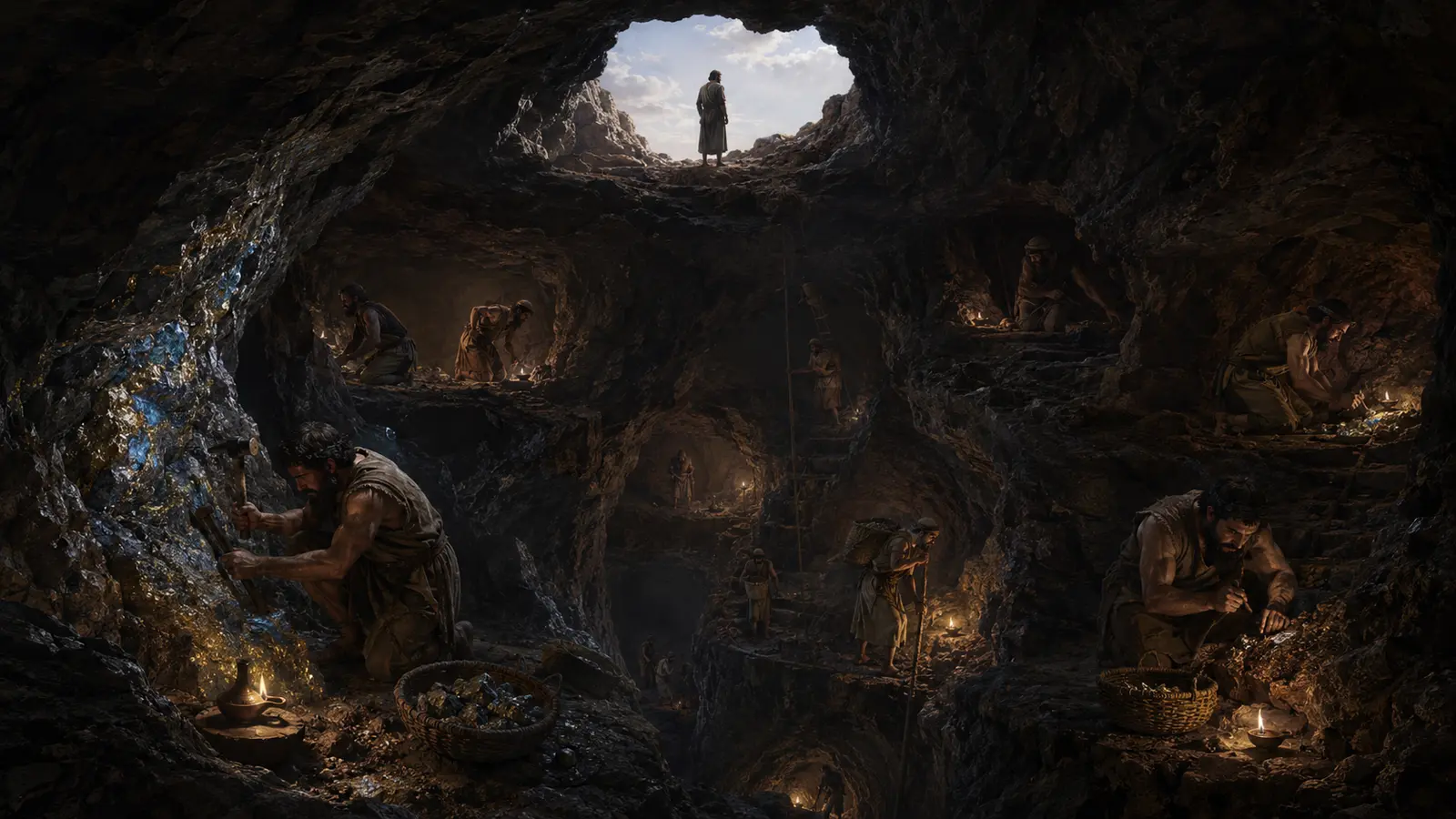
There are treasures that human hands can reach, and there are treasures that no soul can touch. In Job 28, the poem descends into the earth with the diggers who dig a way in the darkness, uproot the mountains and bring the hidden gems to the light. Silver, gold, iron, copper, sapphires and precious stones can be obtained by human skill. But then the main question arises: "Where will wisdom be found?" It is not deep. It is not in the sea. It cannot be bought with the gold of Ophir. Death has only heard it as a rumour. God alone knows his way. And for man, wisdom begins here: fear the Lord and avoid evil.
01
Introduction
There are treasures that human hands can reach, and there are treasures that no soul can touch. In Job 28, the poem descends into the earth with the diggers who dig a way in the darkness, uproot the mountains and bring the hidden gems to the light. Silver, gold, iron, copper, sapphires and precious stones can be obtained by human skill. But then the main question arises: "Where will wisdom be found?" It is not deep. It is not in the sea. It cannot be bought with the gold of Ophir. Death has only heard it as a rumour. God alone knows his way. And for man, wisdom begins here: fear the Lord and avoid evil.
02
1.0 Introduction: The Limits of Human Ingenuity
Humans are amazing.
We can mine mountains, cross oceans, split atoms, map genetics, send spacecraft across space, and extract knowledge from places that generations before us never imagined. We can turn darkness into tunnels, rocks into treasures, and hidden metals into tools, crowns, wires, engines, and cities.
But Job 28 says there is one treasure that we cannot extract by force.
Wisdom cannot be mined.
This chapter comes after the conversation between Job and his friends has almost completely broken down. Friends have said many words, but their advice has failed. Job has challenged their theology, he has revealed how the wicked prosper, he has pointed out the obvious injustices in society, he has rejected false accusations, he has sung about the ends of God's ways, and he has vowed to uphold his righteousness. However, the great mystery remains unsolved: How does God wisely govern a world in which the righteous suffer, the wicked prosper, and the poor cry under oppression?
Job 28 stops the argument for a moment and gives us a poem.
The poem does not directly respond to Job's suffering. It does not describe the council of heaven. He does not tell her why she lost her children, health, wealth and honor. Instead, it teaches us where wisdom is—and where it isn't.
The poem begins by showing the power of man. Miners know where the money is. They refine the gold. They bring iron out of the earth and copper into the stone. They pierce the darkness and reach places where birds and animals have never seen. They uproot mountains and bring hidden things to light.
Then the poem asks: But where is the wisdom?
That is the question that beats at the heart of this chapter. Humans can find treasure, but they cannot find the wisdom that explains the moral structure of the world. We can reveal what is under the rock, but not what is in the counsel of God. We can send jewels to the market, but wisdom is priceless. We can search the depths, but wisdom is not there. Death itself has only heard it as a rumour.
God alone knows the way of wisdom.
However, the poem does not end in despair. God has revealed to man how to live wisely: "Behold, to fear the Lord is wisdom, and to abstain from evil is understanding" (Job 28:28).
The main question of Job 28 is this:
What does wisdom look like when the details are hidden, suffering is unresolved, and man's search has reached the edge of his abilities?
This chapter is about the beauty and limits of human knowledge, the immeasurable value and hidden nature of wisdom, God's unique understanding of creation, and humble obedience that becomes wisdom for humans.
03
2.0 Historical and Literary Context: Song Between Controversy and Final Testimony
Job 28 is different from the speeches that surround it.
Before him, Job argues with his friends. After him, Job begins his final great testimony in chapters 29–31, recalling his former honor, lamenting his present disgrace, and swearing an oath of innocence. Job 28 stands between the collapsing dialogue and Job's final defense as the calm between two storms.
Many interpreters have noticed that the tone of this chapter is different. It is meditative, calm, and close to silent meditation. It does not sound like Eliphaz, Bildad, Zophar, or even like Job with the pain of the surrounding figures. Hartley describes it as a boastful song about wisdom that closes the conversation and serves as a bridge between the arguments and the speeches that follow. Its structure is clear:
Human skill in mining technology (28:1–11).
The value of wisdom above purchase (28:12–19).
God's knowledge of wisdom (28:20-27).
Wisdom for man (28:28).
Clines also draws attention to the early craft of the poem. The poem begins with an excavation, not with an immediate mention of wisdom. First the reader sees humans searching for hidden parts of the earth. Later, the deeper question arises: if silver and gold have their place, where does wisdom have its place?
Where this chapter was placed in the book of Job is important.
Job's friends have claimed that they are wise. They have quoted tradition, defended the doctrine of reward and punishment, and emphasized that Job's suffering must be due to sin. But their wisdom has failed, because it cannot explain Job's lack of guilt nor the complexity of the way God rules the world.
Job has also reached his limits. He knows his righteousness. He knows that his pain is not what he deserves. He sees that the wicked often prosper and the poor often suffer. But he does not know why God's wisdom allows the pain he is going through.
Therefore, Job 28 speaks to both sides. It humbles friends because wisdom does not belong to them. It humbles Job because wisdom is not found by human search alone. It humbles the reader because even intelligent inquiry, theological tradition and moral complaints cannot dig deep into the hidden counsel of God.
However, Job 28 preserves the way to walk:
fear God and avoid evil. Humans may not have the whole map of God, but they are not left without a way.
04
3.1 "Surely There Is a Mine of Silver": A World That Humans Can Explore (28:1–2)
The poem begins:
"Surely there is a mine of silver, and a place of gold where they refine it. The iron is brought out of the earth, and the copper is melted from the stone." (Job 28:1–2)
His beginnings are practical and almost professional. The poet mentions the metals one by one: silver, gold, iron and copper. Humans know where these treasures are found and how to clean them. Land hides wealth, but not forever. Human skill can detect it.
This is the only lengthy description of mining in the Hebrew Bible. The poem begins by praising the power of man. It does not despise human knowledge. It does not reject technology. Nor does it assume that humans are helpless creatures. Man has the real ability to explore creation.
That is important. Biblical humility does not defy reason. You do not call us to turn a blind eye to science, technology, agriculture, engineering, medicine or disciplined learning. The Creator made the world to be explored. Man's vocation involves naming, cultivating, discovering and bringing hidden potential to light.
But the poem begins with excavation for some reason. Excavation is the perfect picture of human exploration: we go below the visible surface, we go into the darkness, looking for what is valuable. By our nature we are seekers.
However, the poem will soon say that there is one treasure that the earth does not provide.
Humans can discover where the natural resources of silver are, but they can never discover the fountain of wisdom.
05
3.2 “Man Put an End to Darkness”: The Courage and Danger of Man's Discovery (28:3–4)
The poem continues:
"Man puts an end to the darkness, and searches to the farthest end for the minerals that are in the darkness and in the shadow of death. He digs a hole far from the habitation of men; they are forgotten by passers-by, they hang far from men, swaying to and fro." (Job 28:3–4)
This picture has life. The miner enters a dark and heavily shadowed place. He brings light to the darkness. He digs holes away from human settlements. He hangs out in hidden places, teetering between danger and discovery.
The language is almost heroic. Humans go where animals don't. They risk life for treasure. They don't let the darkness keep its secrets. They go down into the ground with tools, lights, ropes and courage.
There is beauty in this. Humans are not sedentary creatures. We explore, we ask, we read, we risk and we discover. The poem honors this courage.
But there is also a warning. The ability to stop the darkness in one area can make us think we can stop it everywhere. Because we can draw a map of the world, we might think we can draw God on a map. Because we can extract minerals, we might think wisdom can be extracted with the same power. Because we have invented some puzzles, we can assume that every puzzle is waiting for a better tool.
Job's friends made a similar mistake in theology. They thought their traditional tools could get to the bottom of Job's suffering. They thought they had ended the darkness. But their lights did not shine deep enough.
The light in the mine is not the same as the light in God's counsel.
06
3.3 "The Earth is Overturned as if by Fire": Beauty Hidden Beneath the Ordinary Soil (28:5–6)
The poem then contrasts the surface of the earth with its depths:
"The earth produces food, but under it it is turned over as if by fire. Its stones are the abode of sapphires, and in it there is dust of gold." (Job 28:5–6)
Above the earth, the soil produces bread. Under it, hides fire, sapphire and gold dust. The same land that feeds the farmer also rewards the miner. Creation has layers.
This is a good insight. The world is more than what appears on the surface. Beneath the ordinary soil are colors, metals, heat, pressure and hidden glory. The common field and the mystical mine are parts of the same land.
Job's life also has layers. On top of that, his suffering is seen by his friends as evidence of guilt. But beneath the surface there are other truths: justice, mystery, heavenly conflict, God's permission, and wisdom yet to be revealed. Friends judge by looking at the surface and fail to reach the depths.
Job 28 teaches us to respect the hidden. The world has layers. People have classes. Suffering has layers. God's government has layers. Let us not think that what is seen above reflects everything that is below.
The earth provides food on its surface, but deep down, it hides things that cannot be read by ordinary eyes.
07
3.4 "The Eagle's Eye Has Not Seen": Man's Ways Hidden From Animals (28:7–8)
The poem continues:
"The birds of prey do not know that way, nor has the eye of the eagle seen it. Proud animals have not trodden it, nor has the lion passed over it." (Job 28:7–8)
The path of the miner is hidden from creatures with strange senses. The eagle sees from above, but does not see this tunnel. The lion walks with power, but he does not walk this way. Strong animals do not reach the places where human creativity reaches.
This is a poem praising the greatness and unique calling of man. We are not the strongest or sharpest creatures, but we have a unique ability to seek wisdom, invent tools, and uncover the hidden. A miner penetrates in ways that not even a bird of the sky or a fierce wild animal can see.
But here again, this poem sets a limit for us: Humans can discover ways hidden from the eyes of animals, but they can never find the way of wisdom in their own strength. We may outshine the eagle in one area, but remain completely blind in another. We can tread where the lion has never had the opportunity to walk, but we are still very far from the secrets of God.
That truth humbles us. The mind can be arrogant. Discovery can be a conceit. Knowledge in one area does not guarantee wisdom in another area.
The friends know the tradition, but they do not know the tragedies of Job. Job knows his innocence, but he does not know God's purpose. The miner knows the way under the mountain, but he does not know the way to wisdom.
Seeing what an eagle cannot see is still not seeing what God alone can see.
08
3.5 “He pulls down the mountains by the roots”: The power to bring hidden things to light (28:9–11)
The first part concludes by showing the strength and achievements of man:
"Man puts his hand on the hard rock and pulls down the mountains by the roots. He carves channels in the rocks, and his eye sees everything precious. It stops the water from flowing, and what is hidden brings light." (Job 28:9–11)
The miner faces the mountain itself. He drops what seems permanent. He carves a path in the rock. He rules the underground water. His eye sees precious stones. He brings hidden treasures to light.
This is an amazing picture of human potential. The poem does not reduce it. Humans can do amazing things. We can reveal what creation has achieved.
But verse 11 is also a turning point. The miner brings the hidden to light. That is similar to what Job desires. He wants the hidden truth to be brought to light. He wants the hidden cause of his suffering to be revealed. He wants the hidden righteousness of God to be seen. He wants his hidden integrity to be recognized. But now the poem will say that wisdom cannot be brought to light in the same way as minerals.
This is where human potential meets the sacred boundary. We can bring many hidden things to light, but not the deepest wisdom of God by our strength. A mountain may yield sapphires, but it will not yield the secret of God's providence.
Man's hands can open the rock, but they cannot open the hidden counsel of God by force.
09
3.6 "Where Will Wisdom Be Found?": The Question Underneath Every Question (28:12)
Now the poem asks its main question:
"But where is wisdom to be found? And where is the place of understanding?" (Job 28:12)
Everything that has gone before has prepared us for this question. The poet has shown us that precious metals have their place. Money has a mine. Gold has a place to be refined. Iron comes from the ground. Copper comes from stone. But wisdom—where is its place?
This question holds together the entire book of Job.
Where is the wisdom capable of explaining the suffering of the innocent? Where is the wisdom that can answer the false certainty of friends? Where is the wisdom that can hold together God's justice and Job's pain? Where is the wisdom that can explain the success of the wicked and the delay of judgment? Where is the wisdom that can teach the sufferer how to live before the answer comes?
This question is not just intellectual, but a real struggle between life and death. Job does not ask to be given the meaning of the word 'wisdom' in the dictionary, but he lives crying for that wisdom in the midst of his great pain and need.
That is why Job 28 is placed in this particular place. After many chapters of tension and heated arguments, this poem reminds us that wisdom does not come from the loudest. Friends have spoken, Job has also spoken, but the most sincere wisdom has not yet been discovered.
When all the arguments are exhausted and all the arguments spread dust, the main question remains: where is wisdom found?
10
3.7 “It is not for me”: The deep and the sea cannot give wisdom (28:13–14)
The poem responds by saying that wisdom does not exist in certain places:
"Man does not know his value, nor is it found in the land of the living. The deep says, 'It is not with me,' and the sea says, 'It is not with me.'" (Job 28:13-14)
Wisdom does not exist in the normal environment of human life as an asset to be sought. Even the deep and the sea—places associated with mystery, danger, violence, and mystery—are said to be unwise.
This is surprising because the miner has already penetrated the darkness. Men may enter the hidden places of the earth, but wisdom is hidden deeper than the depths. It is outside the marine reserve.
In Scripture, the sea often represents the unruly and the incomprehensible. If wisdom is not in the sea, then no journey into violence will produce it. No creature of the deep, the bottomless pit, nor the darkness of the water can offer it as a secret technique.
This fact humbles the knowledgeable scholar as well as the experienced pious. Wisdom is not something just buried in creation waiting to be discovered by man; it is not obtained by force or violence, nor is it hidden in the depths as a secret to be discovered and used for personal gain.
Wisdom belongs to God.
The depths contain many secrets, but they do not hold the key to God's wisdom.
11
3.8 “It Cannot Be Bought”: Wisdom Above Every Market (28:15–19)
Now the poem moves from the place of wisdom to its value:
"It cannot be bought with gold, nor can silver be measured as its price." (Job 28:15)
Then it pours out a list of precious things: gold of Ophir, onyx, sapphire, glass, pure gold, coral, crystal, pearl and topaz of Cush. Nothing can be compared to wisdom. Nothing can buy it.
This list is impressive. The poem pours the treasure of the ancient world on the table and says: it is still not enough.
It is important to consider this because Eliphaz had recently mentioned precious gold and silver, telling Job to make the Almighty his gold (Job 22:24-25). Job 28 goes further: even the finest gold cannot buy wisdom. Wisdom is not only better than treasure; it is in a completely different form of reality.
This reality faces every age. We live in the markets of knowledge, influence, certificates, platforms, technology and production. We often think that the most important things can be achieved if we pay enough, study enough, build enough relationships, or control enough. But wisdom cannot be bought like wealth. It does not belong to the rich just because they have wealth. It cannot be measured in business scales.
That is good news for the poor and a warning for the rich. The poor are not prevented from gaining wisdom by lack of gold. Rich people are not guaranteed wisdom by having lots of gold.
Wisdom is received; it is not bought.
The soul cannot buy with gold what only honor to God can receive.
12
3.9 "Then Where Does Wisdom Come From?": Repetition of the Question as a Holy Cry (28:20–22)
The question comes back:
"Then where does wisdom come from? And where is the place of understanding?" (Job 28:20)
That repetition makes sense. The poem does not ask once and then move on. It revolves around that question because the question does not leave us.
Now wisdom is hidden from the eyes of all living creatures, even the birds of the air (28:21). Abaddon and Death say, "We have heard about it with our ears" (28:22).
How threatening and fascinating the report! Even Death is not wise. The kingdom that welcomes all men has only heard of it as a rumor. The grave knows a lot about the end of life, but it doesn't know the wisdom that rules it all. Death may know how to die, but it does not know the counsel of God.
This verse has great pastoral power. Many people think that suffering and death automatically make people wise. They can make us deeper, more humble and more compassionate—but not automatically. Death itself has heard wisdom as mere gossip. Pain can open the heart, but alone it cannot give the answer to God's ways.
Job's suffering has given him great insight into false theology and social injustice. But even Job still lacks the hidden wisdom of God's purpose.
The poem teaches us to be careful. A suffering person may see things that a comfortable person may not, but suffering is not knowing everything. A scholar may know a lot, but knowledge is not knowing everything. An old man may have a broad view, but age does not know everything. Death itself has heard wisdom as mere gossip.
Even the grave cannot teach what God alone knows.
13
3.10 "God Knows His Way": Wisdom Before the Eyes of the Creator (28:23-27)
Now, after all the negative responses, a positive response comes:
"God knows his way, and he knows his place." (Job 28:23)
A miner knows the way to money. God knows the way to wisdom.
The reason is given:
"For he looks to the ends of the earth, and sees everything that is under the heavens." (Job 28:24)
Human vision is partial. God's vision is for all. We see that we are in one corner of the world; God sees the whole world. We live through the same time, the same injury, the same argument and the same generation. God sees the ends of the earth and everything under heaven.
Then the poem turns to creation:
God gave weight to the wind.
God measured the waters.
God commanded the rain.
God made a way for thunder and lightning (28:25-26).
These images have not been chosen for no reason. Wind, water, rain, lightning and thunder are powerful, changeable, can be dangerous as well as life-giving. Humans see them as forces beyond their control. But God measures, balances, orders and charts their path. The unruly nature of creation for man is not beyond wisdom.
Then the poem says:
"Then he saw it and announced it; he confirmed it and investigated it." (Job 28:27)
Wisdom is woven into creation because God knows it, examines it, confirms it and uses it. The world is not ruled by chance, even when it feels confusing. There is wisdom under the wind, rain, thunder and storm.
Here we are prepared for the Lord's speeches. Later when God speaks out of the whirlwind, he will ask Job about creation, weather, wild animals and the order of the world. Job 28 has already told us the reason: creation is the platform of God's wisdom.
But this also humbles us. God's wisdom is not the same as our explanation. The fact that God knows wisdom does not mean we can solve every situation.
God sees the whole map of life, while we only see what is in our valley.
14
3.11 "Fear the Lord": Wisdom Given as a Way, Not a Complete Pattern (28:28)
The poem concludes:
"And he said to man, 'Behold, to fear the Lord is wisdom, and to abstain from evil is understanding.'" (Job 28:28)
This is the only direct answer that man is given in the poem.
After all the research, the digging of the depths, the testing of values, and the questioning of every mystery of the universe—wisdom to man is not just a theory or an explanation that touches the mind. Wisdom is basically an attitude of the heart: to fear the Lord; and it is a way of life: abstaining from evil.
Fearing the Lord is not a fear that binds a slave, but a reverent surrender before the Holy One. It is a humility that clearly says: 'God alone is God, and I am only a creature.' It is a holy wonder of worship that gives birth to living hope, sincere obedience, and a strong moral foundation.
Refraining from evil is wisdom clothed in flesh. It means wisdom is not intellectual ability alone. It is a moral dimension. A person can know many things and still be a fool if he is walking towards perdition. A person can lack many answers and still be wise if he fears God and turns from evil.
The last verse brings us back to Job himself. The introduction of the book described Job as a man who feared God and refrained from evil (Job 1:1, 8; 2:3). Job may not understand the hidden wisdom behind his suffering, but he is already walking in the wisdom that God has given to mankind. He fears God even in the midst of pain. He refrains from evil even when he is accused.
He refuses to lie. He does not join the counsel of the wicked.
This has a lot of weight. Job has no answer, but he has a way.
For Christian readers, this verse also points us to Jesus, in whom God's wisdom became flesh. Christ doesn't just give us theories about wisdom. He walks the path of honorable obedience, abstains from evil, trusts the Father in suffering, and opens the way for a new creation. In it, wisdom takes the form of a cross: not control, but faithful love; not to possess, but to surrender; it is not explanation alone, but obedience that brings life.
Although wisdom is not available with digging tools, it can still be reached and visited through the steps of our feet.
15
4.0 Theological Reflection: Wisdom Hidden in God, Wisdom Given on the Journey
Job 28 is one of the theological peaks of this book.
It does not solve the mystery of suffering by offering easy answers or intellectual explanations; rather, it completely changes our perspective and direction in seeking those answers. It reminds us that there is hidden wisdom behind God's creation and plans—but that wisdom is not a natural resource that can be possessed or controlled by man.
This humbles Job's friends. They have spoken as if wisdom is in their pocket. Their theology is the mining tool they think can provide the reason for Job's suffering. But they have misunderstood Job and misunderstood God. They have tradition, but they have no wisdom at this time.
This humbles Job. He is right in many ways. He has defended his integrity. He has revealed the cruelty of friends. He has mentioned injustice with prophetic clarity. But he also cannot access all the wisdom of God's ways. He knows enough to reject the lie, but not enough to explain the mystery.
This humbles us too. We live in an age that values information. We can search almost anything quickly. We can collect data, compare interpretations, discover patterns and build processes. These gifts are real, but Job 28 reminds us that knowledge is not wisdom. Method is not understanding. Discovery is not spiritual realization. Control is not fellowship with God.
Theologically, this chapter gives us a threefold vision of wisdom.
First, wisdom is hidden. It is not found in the land of the living, in the deep, in the sea or in the market. Man cannot possess it simply by using his intellect or scientific observation, for the nature of wisdom is beyond our ordinary understanding.
Second, wisdom is known by God. God knows his way because he sees all creation and controls the wind, water, rain, lightning and thunder. God's wisdom is not a distant thought; it is woven into his creation and rule.
Third, wisdom is given to man as a garment of obedience and humility. We were not given the whole map of life, but we were given a lamp to guide us on the way: fear the Lord and completely separate from evil..
This last point is very pastoral. In suffering, we often want a pattern. We want to know why this has happened, what it means, when it will end, and how each piece falls into place. God may not give us all that. But he gives us a way to walk: honor, hope, truthfulness, rejection of evil and faithful obedience.
That fact does not silence the mourning. Job will continue to speak. It does not eliminate the need for justice. Job will continue to testify. You don't make suffering painless. Job's wounds remain. But you prevent the sufferer from being consumed by violence. When the answers are hidden, the fear of the Lord becomes the lamp for the next step.
In the wider narrative of the Bible, wisdom becomes more intimate. Proverbs speaks of wisdom being with God in creation (Proverbs 3:19; 8:22–31). The New Testament refers to Christ as "the wisdom of God" (1 Corinthians 1:24, 30; Colossians 2:2-3). In Jesus, the hidden wisdom of God is revealed in a surprising way: the crucified Messiah! The cross seems foolish by the world's standards, but it is the wisdom and power of God (1 Corinthians 2:7–8). In Christ, God bears our sins on the cross (Isaiah 53:4-6; 1 Peter 2:24; 2 Corinthians 5:21), breaks the power of death (Hebrews 2:14-15; 1 Corinthians 15:54-57), and opens up the living hope of resurrection and new creation (1 Corinthians 15:20-22; 1 Peter 1:3; Revelation 21:1–5).
Therefore, Job 28 prepares us to recognize the wisdom in the form of the cross: the wisdom that does not always describe suffering from above, but walks faithfully in the midst of it with respect, obedience and love.
The chapter leaves us with humility and hope. We cannot dig into the secret counsel of God. But we can fear him. We can avoid evil. We can live by using the wisdom that he has already revealed to us, while peacefully believing that God holds all the wisdom that he has not yet revealed to us.
16
5.1 Respect Human Skill, But Do Not Worship It
Job 28 praises human creativity. Mining, research, medicine, technology and learning are gifts. Christians should not underestimate themselves. But human ingenuity has limits. Let us use knowledge with gratitude without thinking that it can take the place of honor before God.
17
5.2 Do not confuse Information with Wisdom
We can know many truths and still lack wisdom. We can read many books and still misuse the truth. Friends had ideas, but no insight. Wisdom requires humility, moral clarity, compassion and fear of the Lord.
18
5.3 Stop Trying to Buy What Should Be Received
Wisdom cannot be bought with gold. It is not guaranteed by wealth, position, education or influence. A poor man can be wise. A rich man can be a fool. Wisdom is received in a respectful relationship with God and seen in obedience.
19
5.4 Let The Hidden Teach You Humility, Not Despair
There are things that we may not fully understand in this life. That doesn't mean God doesn't exist or wisdom isn't real. God knows the way of wisdom. Our calling is to walk faithfully in the light given to us.
20
5.5 Walk in the Wisdom You Have Been Given
The last verse is practical: fear the Lord and avoid evil. If you don't know all the answers, do the honest thing in front of you. Tell the truth. Reject evil. Protect the weak. Pray faithfully. Worship with humility. Keep walking.
21
6.0 Reflection Questions
1. Why does Job 28 begin with digging before asking about wisdom?
2. What does the poem teach us about the beauty and limits of human knowledge?
3. Where today do you see people mixing information, technology or wealth with wisdom?
4. Why is it important that Death and Abaddon have heard wisdom as just a rumor?
5. How does Job 28 humble Job's friends and Job himself?
6. In practice, what does fearing the Lord and avoiding evil mean when life is still confusing?
7. How does Jesus, who is the wisdom of God, add depth to the way we read Job 28?
22
7.0 Response Prayer
Lord God,
You know the way of wisdom.
You see the ends of the earth.
You measure the wind,
you measure the water,
you command the rain,
and draw the lightning its way.
We confess that we are seekers,
but we are not the rulers of all.
We can dig mountains,
but we cannot open by force your hidden counsel.
We can bring gold from the dust,
but we cannot buy wisdom with gold.
Teach us to fear the Lord.
Give us honor that does not fear slavery,
undying humility,
knowledge without pride,
and immediate obedience.
If we do not understand our suffering,
direct our feet in the path of wisdom.
When arguments fail,
teach us to refrain from evil.
When darkness remains,
help us walk in the light you gave us.
And lead us to Jesus Christ,
the wisdom of God incarnate,
who walked faithfully in the midst of suffering,
conquered evil with love,
and opens the dawn of a new creation.
Amen.
23
8.0 Window to the Next Chapter: When Job Remembers the Days of Light
Job 28 tells us that wisdom cannot be mined, bought or stolen. God alone knows his way, and man's wisdom is to fear the Lord and avoid evil. That truth being like a lamp between speeches, now Job enters his last testimony.
In Job 29, he remembers the days of old when God protected him, when God's lamp shone on his head, when his children surrounded him, when his steps were washed abundantly, and when he sat respectfully at the gate of the city. He does not remember success alone, but also his calling: he saved the poor, helped the orphan, made the widow's heart sing, put on justice as a garment, and broke the teeth of the oppressors.
The next chapter will show that Job's integrity is not an unfounded claim. You have a history. You have evidence. You have a righteous life behind it.
Job 29 will ask what it means to remember the light when you are sitting in the dark.
24
9.0 Bibliography
Alter, Robert. The Wisdom Books: Job, Proverbs, and Ecclesiastes: A Translation with Commentary. New York: W. W. Norton, 2010.
BibleProject. The Book of Job: Guide with Key Information and Resources. Portland: BibleProject, 2026.
Clines, David J. A. Job 21–37. Word Biblical Commentary 18A. Nashville: Thomas Nelson, 2006.
Hartley, John E. The Book of Job. New International Commentary on the Old Testament. Grand Rapids: Eerdmans, 1988.
Newsom, Carol A. The Book of Job: A Contest of Moral Imaginations. Oxford: Oxford University Press, 2003.
Walton, John H., and Tremper Longman III. How to Read Job. Downers Grove: IVP Academic, 2015.

Be the first to leave a comment.