

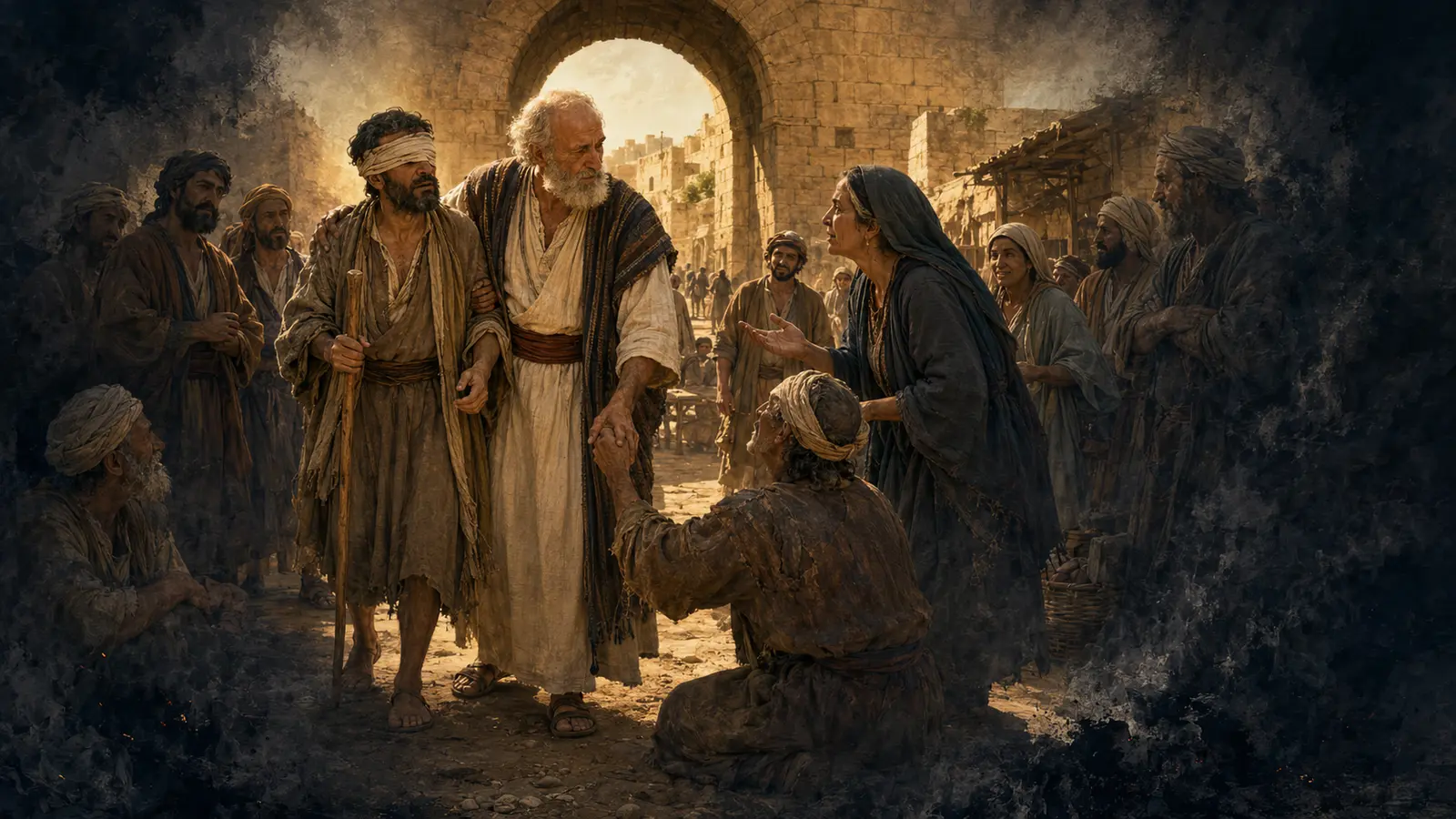
There are memories that heal us, and there are memories that hurt like an old wound reopened by the rain. In Job 29, Job remembers the days when God protected him, when God's lamp shone on his head, when God's friendship spread over his tent, when his children surrounded him, and when his life overflowed like streams of oil from the rock. But Job does not remember comfort alone; he also remembers his calling. He saved the poor, made the widow's heart sing for joy, gave sight to the blind and legs to the lame, and broke the teeth of the wicked. The respect he had was not an empty praise; it was the community's recognition for a life poured out in doing justice.
01
Introduction
There are memories that heal us, and there are memories that hurt like an old wound reopened by the rain. In Job 29, Job remembers the days when God protected him, when God's lamp shone on his head, when God's friendship spread over his tent, when his children surrounded him, and when his life overflowed like streams of oil from the rock. But Job does not remember comfort alone; he also remembers his calling. He saved the poor, made the widow's heart sing for joy, gave sight to the blind and legs to the lame, and broke the teeth of the wicked. The respect he had was not an empty praise; it was the community's recognition for a life poured out in doing justice.
There are times when the past comes back not as sweet old feelings, but as a testimony.
Job 29 is not the story of an old man who remembers only good days. It is not an emotional longing for lost riches nor a decorated image of yesterday. It is Job's testimony before God and men: This is how I was. This is how I lived. This is what was lost. This is the life that my friends have refused to remember.
After the song of wisdom in Job 28, the dialogue gives way to Job's long final testimony in chapters 29–31. These chapters form the main movement of memory, mourning and oath.
In Job 29, Job remembers his past life that was bright and honorable.
In Job 30, he laments his current humiliation and humiliation.
In Job 31, he solemnly swears about his innocence.
Job 29 is the first image in that three-part collection: the remembered light.
But that light is not a superficial achievement. Job really talks about abundance—rich milk, fat, children, friendship, honor—but the heart of the chapter is not luxury. His heart is right. Job remembers being respected because he defended the weak. He sat at the gate of the city not as a tyrant, but as a righteous old man. He used power to protect the powerless. He wore justice as a garment. He became eyes, feet, father, defender and savior.
That is why this chapter responds to the accusations of Eliphaz in Job 22. Eliphaz claimed that Job oppressed the poor, withheld bread, refused to give water, stripped the naked, and oppressed widows and orphans. Job 29 presents the exact opposite picture. Job says: No. I saved the poor. I helped an orphan. I made the widow's heart sing. I investigated the case of a stranger. I broke the teeth of predators and rescued victims from their jaws.
Memory becomes evidence.
However, this chapter is also full of sadness. Every blessing that is remembered deepens the pain of the present loss. To say, "God protected me," is also to say, "Now I don't feel protected." To say, "God's lamp shone on my head," is also to say, "Now darkness has covered me." To say, "The young men hid and the old men stood when I entered the gate," is also to say, "Now I am mocked even by the lowest."
The main question of Job 29 is this: How can we remember the light of the past when we are sitting in the darkness of the present, and how can the memory be a testimony instead of being an empty desire for the past?
This chapter is about the closeness of God that was once felt, the public honor built on justice, the call to use power with justice, and the pain of remembering a life that has collapsed and become ruins.
Job 29 begins Job's last great speech before Elihu appears and before God answers from the whirlwind. Friends have already failed. Their theology has been repetition, accusation and finally silence. The song of wisdom in Job 28 has reminded the reader that God alone knows the way to wisdom, and that human wisdom is to fear the Lord and avoid evil.
Now Job speaks as a man who did exactly that:
Chapters 29–31 work together as Job's declaration of his innocence. Job doesn't just say, "I'm innocent." He provides narrative, social and moral evidence.
Job 29: ancient blessings and righteous service to society.
Job 30: shame, mockery, pain and God's silence now.
Job 31: a formal oath to renounce various sins.
Job 29 itself unfolds in five movements:
God's past blessings and his close friendship (29:2-6).
Job's honor at the city gate (29:7-10).
Job's justice for the weak in society (29:11-17).
His old hope for a long, safe and fruitful life (29:18–20).
His position as a respected counselor, leader and comforter (29:21–25).
The chapter is built on memory. Job repeats looking back: "I wish I had been like in the old months." His past life was not perfect, but it was coherent. God's presence, family life, community respect, moral calling and social influence were woven together.
This is important because Job's losses are not material only. He has lost what gave his life cohesion. He has lost the visible signs of God's approval, the company of children, the respect of society, the ability to serve in public, and the belief that his future would continue under blessings.
In the ancient world, honor was no small ornament of life. It was a social recognition of a person's worth. Losing respect was tantamount to losing your place within the moral community. Job's friends have contributed to the loss by treating him as guilty. Therefore, Job 29 does not only mourn the title. It laments the collapse of the righteous life once recognized by society.
This chapter also provides an important answer to the claim that Job thinks only of himself. His memories are full of other people: the poor, the orphan, the widow, the blind, the crippled, the needy, the stranger, the victim and the abuser. Yes, Job remembers his honor, but he remembers it as honor born of justice.
His former glory was not that people bowed down to him for no reason; His glory was to use strength to serve the weak.
02
3.1 “Would that I were as in the months of old”: The Pain of Remembered Blessings (29:1–2)
Job begins:
"Ayub continued to give his speech, and said: I wish I was like in the old months, like in the days when God protected me." (Job 29:1–2)
The words "old months" have tenderness and pain. Job does not measure his memory by total years, but by the time he lived. There were months ago under the blessing. Time itself felt different. The calendar had carried the warmth of God's care.
The basic words are these: "when God protected me."
This is the deepest loss. Before Job remembers wealth, children, honor or influence, he remembers the presence of God who protected him. His past life was marked by knowing that God's eyes were upon him for protection. God's providence was not just a doctrine; you felt real, close and sheltering.
Now Job feels as if he is not protected.
That is the silent pain of this verse. He doesn't say God doesn't exist anymore. He doesn't say God never cared about him. He says there was a time when God's care felt like protection for his eyes, but that time now seems to be gone.
Many believers know this sorrow. They can remember a time when prayer felt alive, the Scriptures burned like light, doors opened, fellowship was sweet, family was whole, and God's hand was easily seen. Then came the loss. Illness came. Betrayal came. Silence came. And the spirit began to pray, "I wish I were like in the old months."
Job 29 gives us the language to express that sadness. It allows the faithful to remember without pretending that the present feels the same as the past.
Sometimes the first wound of suffering is not what we lose, but the feeling that God no longer protects us as before.
03
3.2 "When His Lamp Shined Upon My Head": Being Guided in the Middle of Darkness (29:3)
Job continues:
"When his lamp shone upon my head, and by his light I walked in darkness." (Job 29:3)
This is one of the most beautiful pictures in the chapter. God's lamp shone on Job. With that light, he was able to walk in the dark.
Realize that even in the old days there was darkness. Job does not describe a life without problems. He describes a life in which God's light made darkness accessible. The difference between then and now is not the absence of darkness, but the presence of light to guide him.
This is spiritually important. God's blessing does not always remove every shadow. Sometimes a blessing is the light that enables us to take the next step. The life of the righteous is not necessarily a nightless road; it is a road illuminated by the presence of God.
The image also repeats the language of wisdom. The word of God is a lamp for the feet and a light for the path. Wisdom provides moral light. In Job's past life, God's guidance seemed to rest on him like a light above his head.
Now he is looking but he does not see God. The contrast with Job 23 is stark. There he went forward and backward, left and right, but he did not see God. Here he remembers when God's light made even the darkness passable.
Remembrance makes God's hiding more manly.
The loss of the light hurts those who once learned to walk by its light.
04
3.3 "God's Friendship Was Above My Tabernacle": Intimacy, Family and Plurality (29:4–6)
Job remembers:
"As I was in the days of my strength, when the friendship of God was above my tent, when the Almighty was still with me, all my children were around me..." (Job 29:4-5)
This is the emotional core of Job's memory.
The words "the friendship of God," or "the secret counsel of God," signify closeness. Job's past life was not only protected by God; accompanied God. God was not a King above him alone, but a Friend who was close to his tent. The house felt the warmth of God's company.
The tent is important. It is a place of home, familiar and intimate. God's friendship did not end at sacrifices or courts. You sat on the scene of family life—when children gathered, meals were shared, servants walked, decisions were made, and daily life went on.
Then comes the thing that hurt him the most: "with all my children around me."
Job's children are dead. Every memory of blessing passes into the sorrow of bereavement. They do not mention it as a property, but as a presence around him. They were like living branches around a tree. Now their absence is a silence that no argument can fill.
Verse 6 adds plural images:
"When my steps were washed with butter, and the rock poured out streams of oil." (Job 29:6)
The pictures are overcrowded. Butter or thick milk washes his steps; oil flows from the rock. These are pictures of abundant fertility, close to the blessings of Eden. The land itself seemed kind. A difficult place gave abundance. Even the rock became a fountain of oil.
But again, the point is not greed. That abundance is seen within the wider memory of God's friendship and the perfection of the family. The blessing was not just to have more; it was living in a seemingly friendly world under God.
The deepest success is not the abundance alone, but the abundance carried in the friendship of God.
05
3.4 “When I Went Out to the Gate”: Public Honor and Weight of Recognition (29:7–10)
Job moves from the tent to the city gate:
"When I went out to the gate of the city, when I prepared my seat in the field..." (Job 29:7)
The city gate was the center of civic life in the ancient world. Businesses were conducted there. Cases were heard there. The elders sat there. Public decisions were made there. Sitting at the gate meant having recognized authority.
Job remembers how the people acted when he entered:
The youth saw him and separated (29:8).
The elders stood with respect (29:8).
The princes stopped speaking (29:9).
The dignitaries were silent, their tongues froze on their palates (29:10).
This is a picture of great public respect. People of all classes recognized the moral and social importance of Job. Young people gave way. The elders stood up. The leaders were silent. The community knew that his presence had meaning.
At first glance, today's readers may be uncomfortable with this description of Job's self. Is he bragging? Is he drunk on status? But the next verses explain why that honor came. It was not just fame. It was not the fear of the bully. It was a fair diagnosis.
However, the chapter does not allow us to avoid the complexity of honor. Respect can be a blessing when society recognizes virtue. It can also be dangerous when the person being honored begins to live for recognition. Job's memory has moral weight because he connects honor and service. But his grief also shows how deeply the loss of honor wounded him.
This has a pastoral meaning. When people are publicly shamed, they don't just lose reputation. They lose their place in the eyes of others. They lose the social mirror that once reflected their worth. Job's friends have contributed to breaking the glass.
Job remembers a time when the silence of the community was respectful. In Job 30, he will describe the time when the words of the community turn into mockery.
Honor is sacred only when it bows down to justice and serves the weak.
06
3.5 “Because I Saved the Poor”: Honor Based on Righteousness (29:11–13)
Now Job gives the reason for his public honor:
"When the ear heard, it called me blessed; and when the eye saw me, it testified that I was good, because I saved the poor who cried for help, and the orphan who had no one to help him." (Job 29:11–12)
The community blessed Job because his justice was heard and seen. The ear heard about his righteousness. The eye saw his actions. His reputation was built on public sympathy.
He saved the poor who cried. He defended the orphan who had no helper. He did not wait for the weak to be useful to him. He heard the need and acted.
Then he says:
"The blessing of the one who was about to die came to me, and I made the widow's heart sing for joy." (Job 29:13)
This is one of the most powerful sentences in the book of Job. Job didn't just give help; he returned the song. The widow's heart, which could be crushed by loneliness, legal weakness and poverty, began to sing.
This directly reverses Eliphaz's charge. Eliphaz said Job returned the widows empty handed. Job says he made the widow's heart sing.
This difference is powerful. The false accusation says, "You left an empty widow." The memory says, "I filled his heart with joy."
This verse also gives a good picture of righteous authority. The goal of justice is not to win cases or to punish wrongdoers only. It is giving back a song to those who have been silenced by oppression. True justice makes room for joy.
For Christian readers, this points us to Jesus, who proclaims good news to the poor, freedom to the captives, sight to the blind, and the year of the Lord's favor. In it, justice turns into a song.
Justice is not done until the widow's heart can sing again.
07
3.6 "I put on righteousness": righteousness as a garment and identity (29:14)
Job says:
"I put on justice, and it clothed me; my judgment of justice was like a robe and a turban." (Job 29:14)
Here are not just actions; it is an identity. Job wore righteousness as a garment. Justice was not a rare act he did when it suited him. It covered him. It marked his public presence as a robe and turban.
The image of clothing has meaning in Scripture. Priests wear vestments for service. Kings wear robes of power. Sometimes prophets use clothing to represent a calling. Job says that righteousness was his garment, and righteousness was a covering for his head.
This means his authority was clothed with moral responsibility. He did not enter the gate adorned only with wealth. He came in properly dressed. His public honor was inseparable from good character.
This is an important word for leaders. Authority must wear justice. Persuasion must wear integrity. Authority without moral clothing becomes oppressive naked rule.
Those words also precede Isaiah's language about the garment of salvation and the robe of righteousness. Finally, Christian readers hear this image in Christ, who clothes his people with righteousness and calls them to show that righteousness to the world.
But in Job's mouth, these claims are evidence: This is what I was. My life did not wear exploitation; they wore justice.
Authority that God respects is authority clothed with justice.
08
3.7 “Eyes to the Blind, Feet to the Lame”: Righteousness Becoming Someone Else's Strength (29:15–16)
Job continues:
"I was eyes to the blind and legs to the lame. I was a father to the needy, and I investigated the case of a man I did not know." (Job 29:15–16)
These words are among the clearest pictures of practical justice in this book.
Job became awake to the blind man. He helped those who could not see a way through danger, courts, decisions or social weakness. He became lame. He gave the ability to move, to reach places and to gain strength to those who could not go freely.
This is a right done with the help of the body. Job did not sympathize with them from afar. In a way, he became what the weak lacked. His strength served their weakness.
Then he says he was a father to the needy. Fatherhood here is not just a sweet feeling; it means protection, provision, defense and responsibility. Job used authority similar to that of the head of the family to provide shelter to those who lacked social support.
The last sentence is very important: he investigated the case of a stranger or a stranger. He didn't just help people in his circle. He investigated cases that were not his own. He spent time searching for the truth. He did not allow ignorance to be an excuse for inaction.
This is an important example of justice. Most people only help those whose stories are close to them. Job followed a case that he did not know. He investigated before passing judgment. He used his influence to reveal the truth.
This is the opposite of the friends, who judged Job without really investigating.
True justice is eyes, feet, father and careful examination for those who cannot defend themselves.
09
3.8 "I broke the teeth of the wicked": Saving the hunters from the hunters (29:17)
Job says:
"I broke the teeth of the wicked, and snatched the prey from his teeth." (Job 29:17)
This picture is intense. The wicked look like beasts of prey, prey in their jaws. Job does not just comfort the victim after the attack. He confronts the bully. He breaks the teeth holding the victim.
This is a powerful adjustment for fairly soft images. Biblical justice is soft on victims but firm on abusers. To save the prey, sometimes you have to face the teeth.
Job's righteousness was not unyielding gentleness. It was a bold move. He used force to interrupt exploitation. He did not claim to be neutral between the abuser and the victim.
This also answers Job 24, where the poor were pushed off the streets, workers were exploited, children were taken, and criminals hid in the dark. Job's past life was a sign against that world. He did not increase the oppression; he opposed it.
For Christian readers, this image points us to Christ's victory over the forces of evil. Jesus does not only sympathize with humans who are under sin and death; he breaks the power of the oppressor and saves the prey from the jaws of the enemy.
Justice is not satisfied with mercy when the prey is still in the teeth of the bully.
10
3.9 “I Will Die in My Nest”: Hope for a Long Blessed Life (29:18–20)
Then Job remembers his past expectations:
"Then I thought, 'I will die in my nest, and I will multiply my days like sand.'" (Job 29:18)
Some translations and interpreters connect this image with a mythical bird called the phoenix, associated with longevity and renewal. Others read "sand," emphasizing countless days. Either way, Job expected a long life, stability and a peaceful death.
He thought he would die in his nest—not to be uprooted by force, not to be publicly shamed, not to sit in the ashes. He hoped to continue to be surrounded by the life he built under God's blessing.
Then he adds:
"My roots spread to the waters, and the dew stayed all night upon my branches. My glory was new with me, and my bow was renewed in my hand." (Job 29:19–20)
The image moves to a tree by the water. The roots reach the river. The dew sits on the branches. The glory continues to be new. Power is renewed like a bow ready in hand.
This is a picture of dynamic forces. Job expected his life to continue to bear fruit. He did not expect the tree to be cut down. He did not expect the nest to be broken. He did not expect glory to rot into shame.
This is the sad part of suffering: it doesn't just hurt in the present; they also break future expectations. Job does not mourn only what was, but what he thought would be. He envisioned a peaceful old age, but found himself in a pile of ashes.
Many sufferers know this grief. They do not lose a loved one, service, marriage, job, health or reputation alone. They lose the future they silently hoped for.
Job 29 gives words to that loss.
Suffering does not only injure the memory behind us; they also hurt the future we thought was waiting for us.
11
3.10 "People Listened to Me and Waited": The Weight of Wise Words (29:21–23)
Job returns to his public influence:
"People listened to me and waited; they kept silent to wait for my advice. After I spoke, they did not speak again, and my word fell on them. They waited for me like rain, they opened their mouths like spring rain." (Job 29:21–23)
Job's words had weight. People waited for his advice. His words concluded the discussion. They received his teachings like rain on dry land.
This is a beautiful picture of wise leadership. Words can be wet. Advice can refresh the thirsty. Speech can feed community life.
Differences with friends are strong. Their words have become the wind. Job's old words were rain. Their advice has dried up the soul; his advice once watered the community.
But this memory also adds to the current disgrace. Job who once spoke and others remained silent, now speaks and is ridiculed. Job, whose advice fell like rain, now receives speeches that scratch like sand.
This shift makes sense. Job's identity as a wise old man is broken. He is not only physically hurt; he has been pushed out of his place socially and in speech. The one whose words once built the community is now struggling to be heard even by friends.
Wise words are rain for the thirsty; foolish words are a wind upon the wounded.
12
3.11 “I smiled upon you”: Leadership as Light, Direction and Comfort (29:24–25)
Job concludes the chapter with a final reference to leadership:
"I smiled at them when they lacked confidence, and they did not extinguish the light of my face. I chose a path for them, I sat as a prince; I lived as a king among his soldiers, as one who comforts those who mourn." (Job 29:24–25)
The light of Job's face encouraged others. His smile restored their confidence. He chose the way forward for the community. He sat as a prince, not only in power, but also in responsibility.
The last comparison is very gentle: "as one who comforts those who mourn."
Job was a comforter in the past.
Those words hurt so much. Friends came to comfort him but failed. Job knows what comfort is because he once gave it. He knows that comfort is not an accusation, difficult rules or doubts. Comfort is a presence that strengthens, a light that keeps a person steady, guidance that directs, and compassion that sits with the mourners.
This last image prepares the reader for the irony of the book. Job, who once comforted mourners, has received comforters in trouble. He used to make the hearts of others sing; now his own heart aches. He once broke the teeth of bullies; now he is treated like prey. He once sat like a king among soldiers; now he sits as one cast out in ashes.
But memory still testifies. Job's past life was not empty. His justice was public, practical and compassionate.
The one who needs comfort now once knew how to comfort others with light.
Job 29 teaches us that justice is not just private values. It is a public call.
Job's righteousness was not limited to avoiding personal sin. You were clearly visible in doing justice to the poor, defending the orphan, restoring joy to the widow's heart, being legs to the lame, eyes to the blind, a father to the needy, and confronting the wicked. His justice had social consequences.
This is important because friends have turned justice into an easy tool to recognize personal success. If you succeed, you must be righteous; if you suffer, you must be guilty. Job 29 shows a broader picture. Justice is a way of living in the world under the eyes of God, for others.
This chapter also provides a detailed theology about blessings. Job's past life had closeness to God, family, abundance, respect, influence and hope of long life. These are real blessings. The book of Job does not pretend to be worthless. Loss hurts because blessings are good.
But the whole book refuses to make the blessing a simple guarantee. Job's righteous life did not protect him from great suffering. This means we must honor the blessing without turning it into a contract to control God. We can thank God for light, family, honor and fruitful work—but let's not think that his presence proves justice or his absence proves guilt.
Job 29 also forces us to think about honor. Job is deeply disrespectful. In our current environment, that may sound like vanity, but in Job's world honor was the recognition of moral value within society. Deprivation of honor without justice was a form of social death. So Job's desire for honor is connected to his desire to be defended. He wants the truth of his life to be recognized.
At the same time, the chapter teaches that honor must be tied to justice. Job was not respected because he ruled over the weak. He was respected because he defended them. Public honor is justified when it is a mirror of public service.
For Christian readers, Job 29 points us to Jesus in a surprising way.
Jesus is the true Righteous One on whom God's favor rests. He is a light to those who walk in darkness. He gives sight to the blind and makes the lame walk. He brings good news to the poor and joy to the widow's heart. He confronts the forces that hunt and rescues the prey from the jaws of sin and death. But he also loses public respect.
He is mocked, stripped of his clothes, falsely accused and thrown out of the gate.
In Jesus, Job's memory and mourning find a deeper fulfillment. A righteous life given for the weak may still be rejected by the world. But God's defense in the resurrection declares that humiliation will not have the last word on the righteous who suffers.
So Job 29 calls us to live with honor without worshiping honor, receive blessings without assuming we can control it, use authority for the weak, and remember the light of the past without letting the memory turn into despair.
13
5.1 Allow Memories to Be Testimony, Not an Empty Desire for the Past
Job remembers the past not only by running away from the present, but by witnessing the truth of his life. When you remember the past seasons of light, ask yourself what they testify about God's faithfulness, your calling, and the goodness you deserve to carry on.
14
5.2 Use Persuasion to Serve the Weak
Job's honor was connected to defending the poor, the orphan, the widow, the blind, the lame, the needy and the unknown stranger. Any influence we have—pastoral, professional, financial, educational, or relational—should be a protection for those with less power.
15
5.3 Investigate Before You Judge
Job investigated the case of a stranger. His friends didn't do that to him. True justice does not depend on assumptions. It listens, investigates and searches for the truth carefully.
16
5.4 Comfort If You Know That One Day You May Need Comfort
Job once comforted the mourners. Later, he needed comfort but received accusations. This should humble us. The comfort we give today may be the comfort we need tomorrow. Let our words be rain, not wind.
17
5.5 Faithfully Lament the Lost Future
Job thought he would die in his nest. Suffering shattered those expectations. Many believers carry the sadness of a future that will not come true. The scriptures give us permission to mourn the loss before God. Faith does not force us to pretend that a broken nest does not hurt.
1. What does Job miss most in Job 29: wealth, honor, family, closeness to God, or his calling? Why?
2. How does Job 29 respond to Eliphaz's accusations in Job 22?
3. What does it mean to "wear righteousness" and have righteousness as a robe and a turban?
4. Where has God given you influence that can be "eyes to the blind" or "feet to the lame"?
5. Why is it important that Job investigated the case of a stranger?
6. How can the memory of past blessings be a testimony of healing or a painful desire?
7. How does Jesus show and add depth to Job's picture about using righteous authority for the weak?
Lord God,
You are the light above our heads
and the Friend next to our tent.
You know the days when the light was bright,
family surrounded us,
the work paid off,
and our steps felt washed with blessings.
Teach us to remember without giving up.
Make our memories true witnesses,
not a place to hide from the present.
When you gave us influence,
let us wear justice.
Make righteous judgment our mantle and turban.
Let us make eyes for the blind,
legs for the lame,
father and mother for the needy,
and defenders of those without a helper.
Break the teeth of evil that hunts.
Save the prey from the teeth of the wicked.
Make widows' hearts sing again.
Let our words fall like rain on dry land.
May our faces bear light for those who have lost courage.
And when our own nests are broken,
when honor leaves us,
and when the old light becomes a painful memory,
hold fast in Jesus Christ,
The Righteous One despised,
crucified outside the gate,
and resurrected in eternal glory.
Amen.
Job 29 remembers the light. Job 30 will explain the darkness.
The twist hurts. A man who was once respected at the gate will now be ridiculed by people who in the past he would not have placed even with the dogs of his livestock. He whose advice fell like rain will become a song of ridicule. He who comforted mourners will not be comforted.
His honor will be torn like a garment, his body will burn with pain, and his cries to God will seem unanswered.
Job 30 is a black mirror of Job 29. Former honor becomes present shame. The old strength becomes a broken body. The old light becomes the silence of God.
The next chapter will ask what happens when the public life of the righteous is completely turned upside down, so that yesterday's honor becomes today's contempt.
Alter, Robert. The Wisdom Books: Job, Proverbs, and Ecclesiastes: A Translation with Commentary. New York: W. W. Norton, 2010.
BibleProject. The Book of Job: Guide with Key Information and Resources. Portland: BibleProject, 2026.
Clines, David J. A. Job 21–37. Word Biblical Commentary 18A. Nashville: Thomas Nelson, 2006.
Hartley, John E. The Book of Job. New International Commentary on the Old Testament. Grand Rapids: Eerdmans, 1988.
Newsom, Carol A. The Book of Job: A Contest of Moral Imaginations. Oxford: Oxford University Press, 2003.
Walton, John H., and Tremper Longman III. How to Read Job. Downers Grove: IVP Academic, 2015.

Be the first to leave a comment.