


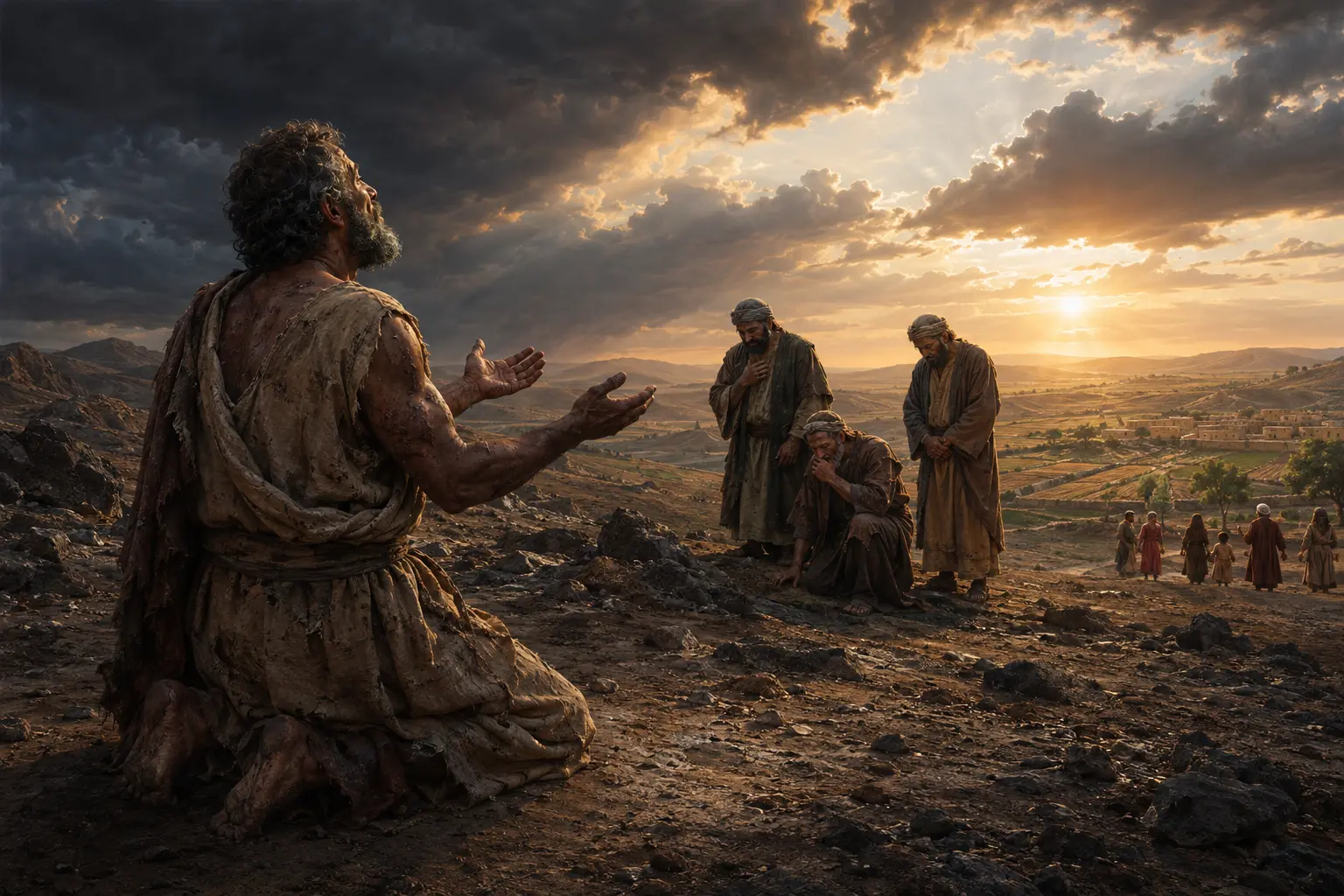
There are chapters where the music changes key so sharply that the heart can hardly follow. In Job 29, Job remembered the days when God’s lamp shone over his head, elders rose in his presence, widows sang because of his justice, and his words fell like rain. But Job 30 begins with a knife: “But now they laugh at me.” The honored elder becomes a mocking song. The comforter of mourners becomes a man without comfort.
01
1.0 Introduction: When Yesterday’s Honor Becomes Today’s Contempt
Few pains are as heartbreaking as public humiliation.
There is physical suffering, when the bones ache, when the skin burns, when the breath becomes weak, and when the night turns into an enemy. There is heartache, when grief is heavy and memory is painful. But there is also the suffering of shame—when people who respected you begin to shun you, mock you, spit on you, or take your fallen state as evidence that you were never righteous at all.
Job 30 is a chapter of humiliation.
In Job 29, Job remembered his past life with bright images. God protected him. The lamp of God shone above his head. His children surrounded him. His life overflowed with abundance. He sat in honor at the gate of the city. He saved the poor, defended the orphan, made the widow's heart sing, and broke the teeth of the wicked.
Then Job 30 begins with these words: "But now..."
Those two words are the hinge that connects light and darkness.
A man who was once respected by the elders is now ridiculed by the youth. He whose advice was received like rain has now been turned into a mocking song. He who comforted mourners now suffers without a comforter. The one who wore justice like a robe now feels caught, disfigured and thrown into the mud. The one whose words set order at the gate now calls out to God, but gets no answer.
This chapter is not just an ordinary complaint. It is mourning. It has the structure and emotional power of lament psalms: enemies mock, the body suffers, God seems silent, and the sufferer asks why help does not come.
But Job 30 is also morally ambiguous. Job describes those who mock him as poor, hungry, nameless, outcasts—people on the margins of life. His language is harsh, even disturbing. We must read it carefully. This chapter does not invite us to look down on the poor or the marginalized. Job has already shown his devotion to the weak. Rather, it shows the depth of the transformation of his social status: a man who was once respected by the nobles is now despised even by people whom society itself had despised. Shame has pushed him lower than the last grade.
The main question of Job 30 is this: How does faith become when respect turns into mockery, when the body becomes a battlefield, and when God seems to remain silent before the cry of the righteous who is suffering?
This chapter is about
the pain of social change, the cruelty of mockery, the pain of physical torture, the painful mystery of God's silence, and the music that turns into mourning.
02
2.0 Historical and Literary Context: The Dark Mirror of Job 29
Job 30 is the second step in Job's final testimony that extends into Job 29–31.
Job 29 recalls the old days of God's closeness, community respect and righteous service.
Job 30 mourns Job's current humiliation, physical suffering and unanswered cry.
Job 31 closes Job's testimony with a formal oath of innocence.
T
The contrast between Job 29 and Job 30 is intentional, and it hurts.
In Job 29, the elders stood when Job entered the gate. In Job 30, the youth mock him.
In Job 29, Job's words fell like rain. In Job 30, his cries go unanswered.
In Job 29, he comforted the mourners. In Job 30, his own harp turns into a lamentation.
In Job 29, he wore righteousness like a robe. In Job 30, his garment is ruined and his body is thrown into dust and ashes.
In Job 29, he broke the teeth of the oppressors. In Job 30, he is treated like prey.
This chapter can be divided into three main parts:
1. Job's current humiliation in front of men who mock him (30:1-15).
2. The pain of Job's body and his accusation against God (30:16-23).
3. Job's mourning over himself and his falling into grief (30:24-31).
Hartley reads Job 30 as a lament that responds to Job 29 in reverse: after recounting the blessings and honor of the past, Job now laments shame, mockery, searing pain, God's strong hand behind his suffering, and God's silence. Clines points out that Job 30 uses the language and images typical of mourning, including human enemies, an attack attributed to God, the absence of a helper, life shed, burning bones and music turned to grief.
This is important because Job is not just recounting feelings. He builds his legal and moral argument. His final testimony moves towards Job 31, where, as it were, he will sign his oath and call God to answer. Job 30 shows the cost of a case that has not yet been resolved. The delay in his confirmation did not leave him unscathed.
It exposed him to public humiliation, physical torture and spiritual terror.
Job 30 teaches us that suffering is not the only event; it can be the environment around a person.
Suffering changes the way people see us, the way we see ourselves, the way our bodies feel, the way the night passes, the way prayer is heard, and the way music flows through the soul.
03
3.1 “But Now They Laugh at Me”: The Collapse of Public Honor (30:1)
Job begins:
"But now they are laughing at me, people who are younger than me in age, whose fathers I would despise even putting them together with the dogs of my group." (Job 30:1)
The words "but now" are the door to sorrow. They show a complete turnaround from the old days. In Job 29, the young men respectfully withdrew when Job entered the gate. Now the young people are laughing at him.
This shift is social, generational and emotional. In the ancient world, young people were expected to respect their elders. In the past, Job was not only respected by young people, but also by nobles and famous people. Now the order of society has been turned upside down. Those who should have respected him have been mocking him.
Job's words about their fathers and the dogs of his flock are harsh. He shows not only contempt, but also humiliation. He means that those who mock him come from such a poor condition that their fathers would not be trusted with even the lowest work among his animals.
We must feel his pain without embracing his contempt. Job speaks from the wound of humiliation. His language shows how shame sees the transformation: I have fallen so low that even those who seemed to be below the margins now treat me as a person below them.
The point is not to say that the poor or marginalized have no value. Job's own righteous life contradicts that idea. The point is that Job's world is turned upside down. The old respectability has collapsed into ridicule.
When shame speaks, it often measures pain by how far the soul has fallen in the eyes of others.
04
3.2 The Emaciated, Rootless, and Outcast: Mockers from the Margins (30:2–8)
Now Job is speaking to the people who are mocking him. They are weak, hungry, emaciated, wandering in desolate places, picking salt plants from the bushes, gathering juniper roots, expelled from society, shouted at as thieves, living in valleys, caves and bushes, crying like animals, nameless and despised.
This information is so clear, it shocks us and makes us unsettled easily.
These people are not the honorable elders of Job 29. They have no land, they are hungry, they wander and are rejected by society. They live on the edge of survival. Not just the poor; they are treated as dangerous, people without roots or respect.
Job emphasizes their low status to show the extent of his humiliation. If such people are now mocking him, then Job has fallen below even those who themselves were pushed to the margins.
But this passage also reveals something sad about society. The world that Job describes is full of the outcast, the shouted at, the hungry, the homeless and the nameless.
Earlier, in Job 24, Job described the poor hiding from the strong, facing the cold and being hungry near the abundance of food. Here the perspective is different, but the theme is the same: human beings living under the weight of social isolation.
The difference is that now Job sees them as mockers, not as victims. Pain can suppress the ability to empathize. The same Job who once investigated the case of the stranger now speaks harshly about the outcasts who have been his persecutors.
This does not make Job evil. It shows him to be human. The Bible allows those who suffer to speak from an open and fresh place; but it also invites readers to see more than what the sufferer can see in that moment.
For us, this passage warns against two mistakes. We should not heroize the marginalized as if they are automatically virtuous; pain can make people cruel. But we should not take away their humanity either. Disappointment and social rejection can distort the human community until the wounded start mocking their fellow wounded.
A broken society can turn victims into mockers and shamers into targets for shamers.
05
3.3 “I Have Become Their Song”: The Cruelty of Mockery (30:9–10)
Job says:
"And now I have become their song; I have become a mocking phrase for them. They hate me; they keep away from me; and they do not hesitate to spit on me when they see me." (Job 30:9–10)
This is public humiliation clothed in poetic language. Job is turned into a song of mockery. His name becomes a proverb of destruction. People don't just sympathize with him; they use his suffering as entertainment.
To be someone's song in this context is to be their joke, their cautionary tale or street show. His suffering has been turned into community music.
This is cruel because ridicule robs the sufferer of his dignity. It turns pain into a show. He says: Your wound is there so that we can laugh.
Then comes the spitting image. In the biblical world, spitting on someone or spitting in front of them showed contempt of the highest degree. Job is not only laughed at from a distance. Her body itself becomes a place for public display of hatred.
Christian readers cannot fail to hear the echo of Jesus. He too was mocked, spat on, beaten, dressed in disgrace and made a public spectacle. The righteous man who suffers in Job becomes a window that points us to the righteous man who suffers in the Gospel. The scorn of the world gathers against the innocent.
This does not erase Job's pain; it gives them status. The Son of God has entered a place where shame spits in the face of the afflicted.
Ridicule is not harmless when it turns another person's pain into a song of contempt.
06
3.4 “God Has Loosened My Bowstring”: Human Cruelty Unleashed and Suffering Attributed to God (30:11–15)
Job continues:
"Since God has loosened my rope and humbled me, they have stopped restraining themselves in front of me." (Job 30:11)
This is a terrifying statement. Job believes that God's action against him has opened the door to human cruelty. When God humbled him, others felt free to dishonor him.
Shame often works this way. When a person loses perceived protection, position, health, money or influence, people who were previously restrained can suddenly speak without fear, openly mock or attack. Human cruelty often waits until a person appears defenseless.
Job then describes the attack as if he were surrounded in battle. A group of young people rises to his right. They push his legs. They build ways to attack his wall.
They destroy his path. They push forward his tragedy. They go through a wide crack. Threats turn to him. His honor is driven away like the wind, and his prosperity vanishes like a cloud.
These images are military and chaotic. Job is not only mocked; his life is invaded. He feels like a city whose walls have been breached by enemies. His path is ruined. His assistant is not there. His honor, once like a cloak, is now being driven away like dust in the wind.
The mention of "threats" is important. In mourning, fear can be felt almost like a force or presence attacking the sufferer. Job's pain is psychological as well as social. The external attack turns into fear within the soul.
His "prosperity" or "salvation" disappears like a cloud. The cloud takes shape for a while, then disappears. That's how hope feels to Job: it appears, then it disappears.
When honor is driven away like the wind, the soul feels like a city with broken walls.
07
3.5 “My Soul Is Poured Out”: Bodily Pain and the Torment of Night (30:16–17)
Job now returns to himself:
"And now my soul is poured out within me; the days of torment have seized me. The night burns my bones, and the pain that gnaws at me does not rest." (Job 30:16–17)
The words "my soul is poured out" is a heavy language of mourning. Job's inner life feels drained, dried up and left empty. He just doesn't get tired. He feels as if he is losing himself drop by drop.
Persecution has taken him captive. The night, which was supposed to bring rest, has become an instrument of torture. His bones are burned or pierced. Pain never sleeps.
This is one of the Bible's great descriptions of long suffering. Job's illness is not a temporary inconvenience. You enter day and night. You touch the skin, bones, nerves, mind and sleep. The previous passages describe sores, itching, scabs, disfigurement, sleeplessness, bad breath, thinning and soul pain. Here the emphasis is on deep bone pain and relentless suffering.
There is great pastoral significance here. The Bible does not make the body something that has no spiritual meaning. Job's lament includes physical pain because the body has value. Faith does not reside in disembodied souls. We pray, we hope, we grieve and endure in bodies that can hurt.
Night pains are uniquely lonely. During the day, one can be distracted by thoughts and sounds as well as various activities. At night the body becomes loud. Job's pain gnaws at him while the world sleeps.
Some sufferings don't just come to visit; it seizes a man, stays all night, and teaches the bones to ache.
08
3.6 “He Has Cast Me into the Mire”: The Body as a Ruined Garment and Dust (30:18–19)
Job says:
"With great force my garment is ruined; it tightens me like the hem of my coat. God has thrown me into the mud, and I have become like dust and ashes." (Job 30:18–19)
These images are difficult, but powerful. Job's garment, perhaps clinging to his diseased body or distorted by his condition, becomes a symbol of humiliation. In the past clothing showed respect. In Job 29, righteousness clothed him like a robe and a turban. Now his real clothes are clinging, twisting, pinching and disfiguring him.
Then Job says God has thrown him into the mud. He has become like dust and ashes.
Dust and ashes are not new images for Job. He has been sitting in the ashes since the beginning. But here the picture becomes more serious. He does not just sit in the dust; he feels reduced to dust. He doesn't just mourn in ashes; he feels like ashes.
This is a collapse of body esteem. A person who is clothed in righteousness now feels clothed in disability and disfigurement. The old man sitting at the gate is now lying in the mud. He whose steps were washed with thick milk is now mingled with dust.
Theologically, this verse hurts because Job points this out to God. He does not say that the disease alone brought him down. He says God did it.
The Bible includes this language because lamentation often speaks from a situation where one feels the hand of God in all that is happening. Job believes that nothing happens outside of God's rule. Therefore, he must bring his pain before God, even if his words tremble on the edge of accusation.
The sufferer doesn't just ask what happened; he asks why the God who gives breath has allowed the dust to bring him back to him while he is still alive.
09
3.7 “I Cry to You, but You Do Not Answer”: The Wound of God’s Silence (30:20–23)
Now Job speaks directly to God:
"I reach out to ask for help, but you don't answer me; I stop, and you just look at me." (Job 30:20)
This is the spiritual center of this chapter.
Ridicule is bad. Physical pain is bad. But God's silence is the deepest wound. Job cries, but no answer comes. He stands, perhaps like a litigant in court or a servant waiting for a response, but God just watches.
Being seen but not being answered can hurt more than not being seen at all. Job does not think that God does not know. He sees God being silent while knowing everything.
Then Job says:
"You have become harsh to me; with the strength of your hand you torment me." (Job 30:21)
This is one of Job's boldest charges. He says God has turned harsh to him. He sees the power of God not as a shelter, but as an enemy.
We must read these words carefully. Job does not give the final teaching that God's behavior is cruel. He speaks the language of mourning from the midst of pain. The Bible allows those words not because every charge is complete theologically, but because God invites true mourning instead of pretending that we have an unhurt faith.
Job continues:
God lifts him above the wind.
God drives him on it.
God throws him into the storm.
Job knows God will bring him to death, a house set aside for all the living (30:22-23).
The image of the wind turns Job 29. There Job's words fell like rain and brought life. Here the wind of God carries it like a piece of garbage. He has no power to guide himself, no place to tread, no home.
For Christian readers, this cry stands next to Gethsemane and Golgotha. Jesus also cried out to God in pain. He too faced silence, ridicule, physical torture and death. However, in Jesus, God's silence is not the absence of love, even though it feels like abandonment. The resurrection reveals something that Job could not see at the time: God can be working even when the righteous sufferer feels unanswered.
But let's not rush into Easter so quickly that we silence Good Friday. Job 30:20 must be allowed to speak.
An unanswered cry is one of the deepest places where faith competes with God.
10
3.8 “Did I Not Weep?”: Job’s Compassion as Evidence (30:24–25)
Job asks:
"Does not a man in ruins wash his hand? Does he not cry for help in his distress?
Did I not feel sorry for the one whose day was difficult? Did not my soul grieve for the needy?" (Job 30:24–25)
These verses are difficult in their explanation, but their moral force is clear. Job reminds us of the common expectation that the afflicted cry and should be helped. He also remembers his own compassion. He wept for those in trouble. His soul grieved for the needy.
This is another piece of his declaration of innocence. Job did not ignore those who suffered. When others were hurt, he mourned with them. When the poor were in distress, his soul was troubled.
Now he is the one in distress, but help does not come.
His pain is twofold. Suffering hurts. But it hurts more when you know that you once helped those who are suffering, but now no one is helping you. The comforter of mourners has become a comforter.
This is also a silent rebuke to his friends. Job knows what mercy looks like because he acted on it. Their words failed because they did not cry with him. They have searched the ruins, but they have not reached out.
The one who once wept for the suffering now asks why no tears are used for him.
11
3.9 “When I Hoped for Good, Evil Came”: The Reversal of Expectation (30:26)
Job says:
"But when I hoped for good, evil came; when I waited for light, darkness came." (Job 30:26)
This paragraph summarizes the entire conversion.
Job hoped for good. He was not careless. He did not sow evil while expecting blessings. He lived righteously, defended the poor and believed in God's order. He expected his righteous life to move towards good.
But the worst came.
He waited for the light. He remembered God's lamp. He knew what it means to walk in the darkness with the light of God. But now darkness came instead.
This is the collapse of the expectation of wisdom. Proverbs often teaches that righteousness leads to life and light. That is a common moral tendency, and it is true. But Job's experience shows that the direction is not a machine. The righteous can wait for the light and meet the darkness.
This verse gives voice to many types of grief: a marriage that was expected to flourish but ended in betrayal; ministry expected to bear fruit but fell under opposition; a child who was prayed for but died; expected healing that did not come; failed justice case; a society turned violent.
Faith must have room for this sentence.
Sometimes the faithful wait for the light, but still have to mention the darkness that has come.
12
3.10 “My Skin Turns Black”: The Body as a Psalm of Sorrow (30:27–30)
Job's body continues to speak:
His internal organs boil and never rest (30:27).
The days of suffering are coming to face him (30:27).
He walks in darkness, but not by the sun (30:28).
He stands in the congregation and cries for help (30:28).
He becomes the brother of the fox and the mate of the ostrich (30:29).
His skin becomes black and eroded.
His bones are burning with heat (30:30).
This is a list of mourning that entered the body. It's boiling inside. The skin becomes black. Bones are burning. The body becomes an instrument that beats sadness from within.
The mention of the fox and the ostrich is a poetic image of loneliness. These creatures live in desolate places. Job feels like a brother to the cry in the desert. His place is no longer among the elders at the gate, but among the animals of the abandoned places.
The congregation is also important. Job stands up and cries, but his crying does not bring him back to his state. In Job 29, the congregation listened to him with respect. In Job 30, he cries out for help in disgrace.
Once again, the turnaround is complete. His body, his voice, his society and his environment all bear witness to suffering.
This should increase our compassion for those living with chronic illness, depression, internal trauma, public humiliation or social rejection. Their suffering is unimaginable simply because we cannot see it all. The body can carry things that words cannot easily express.
When the body becomes a psalm of sorrow, compassion must learn to listen to more than words.
13
3.11 “My Harp Has Turned to Mourning”: Music in the Key of Grief (30:31)
Job closes the chapter:
"My harp has turned into mourning, and my flute into the voice of those who weep." (Job 30:31)
The chapter closes with music.
In Job 21, Job described the wicked enjoying the tambourine, harp and flute. In Job 29, his own words were like rain, his face like light, and his presence like comfort. Now his instruments have changed the tune. The harp is no longer celebrated. The flute no longer leads the dance. The music itself has turned into mourning.
This is not the absence of music. It's music turned sad. Job still has a song, but now it is a lamentation.
This matter is very important in worship. Biblical faith does not just sing songs of victory. It also sings sadness. The Psalms teach us that mourning is part of the prayer book of God's people. Job teaches us that when life is mourning, music can be truer when it cries.
There are times when praise rises through tears, worship is heard in the voice of sorrow, the faithful do not clap but sigh, and the congregation must make room for the flute of those who weep.
Christian worship must learn this. If church music cannot carry Job 30, then it is too small for the Bible and too small for human suffering.
Sometimes faith does not lose its instrument; learn to mourn before God.
14
4.0 Theological Reflection: Shame, Silence, and the God Who Enters Mockery
Job 30 forces theology to confront shame.
Most discussions of suffering focus on pain, loss or explanation. Job 30 adds to the humiliation. Job does not suffer because he only has sores, but also because society has placed him in a new group. People are now studying his body as evidence of guilt. They take his downfall as permission to despise him. He becomes a catchphrase, a song and a target for spitting.
This is important because shame attacks identity. Pain says, "You hurt." Shame says, "You are nothing." Pain begs for relief. Shame asks if a person still deserves to be loved, respected and have a place in society.
Job's humiliation becomes heavier because of the memory. He knows what honor was. He knows the meaning of sitting at the gate, saying words that were like rain and bringing joy back to widows. The gulf between past honor and present derision becomes a deep valley of sorrow.
This chapter also brings us to God's silence. Job calls out to God, but gets no answer. He sees God's power as wind and storm, not as comfort and refuge. The text does not rush to correct him. It allows the mourning to remain standing.
This point is important. The scriptures do not teach us to suppress every accusation we want to bring to God. They teach us to bring even our accusations into the presence of God. Job may not have the whole picture, but his words are directed to the only One who can answer.
A Christian reading of Job 30 must go through Jesus.
Jesus enters into mockery. He is laughed at, spat on, stripped, beaten and humiliated in public. Religious leaders interpret his suffering as rejection by God. The soldiers turn him into a royal joke. Passers-by make a show of his pain. While on the cross, he cries with words of mourning: "My God, my God, why have you forsaken me?"
In Jesus, God does not sit in heaven looking at Job 30 only. God enters into the shame of Job 30 while in the human body.
This does not answer every question about the cause of Job's suffering. But it reveals something surprising about God's character: the Holy One is not ashamed to stand with the humiliated. The Lord of glory enters into public contempt, bears false accusations, and turns shame into resurrection.
The resurrection does not mean that shame was not real; you mean that shame was not the last word.
So Job 30 gives the church a call. We must not be the crowd that mocks the fallen. We shouldn't be friends who give explanations but don't cry. We are to be witnesses of the crucified and risen Christ: people who protect honor, who listen to mourning, who reject public violence, and who make room for songs of mourning in the house of faith.
This chapter also teaches that mourning is not a failed ritual. When Job's harp turns to mourning, he still brings it before God. Grief can be worship when it rejects the lies and directs the pain to the living God.
In a world so accustomed to victory, Job 30 teaches us holy sorrow. It teaches us to sit with those who are mocked, to hear the unanswered cry, to respect the suffering body, and to wait for God who lifts up the righteous who is despised.
15
5.1 Do Not Join the Song of Mockery
It is easy to mock a fallen man. People make jokes, repeat rumors, spread stories, and turn pain into entertainment. Job 30 warns us that sarcasm can increase suffering. Refuse to make another person's destruction a song.
16
5.2 Remember That Shame Is a Real Wound
Some people suffer not only because of what happened to them, but also because of the way others see them now. Public failure, illness, poverty, divorce, accusation, tragedy or trauma can make a person feel socially dead. Service must address a person's dignity, not just their environment.
17
5.3 Make Space for Embodied Lament
Job's pain lives in bones, skin, night and inner turmoil. Faith communities should not treat physical and mental suffering as a distraction that interrupts "real" spiritual things. The body belongs to God, and physical pain has a place in prayer.
18
5.4 Allow People to Cry Out Honestly to God
Job says, "I cry, but you do not answer me." Those words may sound dangerous, but the Scriptures preserve them. Don't rush to correct every lament. Sometimes the most honest thing is to allow the injured person to speak truthfully before God.
19
5.5 Restore Lament to Worship
Job's harp turns to lamentation. Churches need songs, prayers and spaces of sorrow. Not every moment of worship has to sound like a victory. A community that cannot mourn will find it difficult to care deeply for those who suffer.
20
6.0 Reflection Questions
1. How does Job 30 change the images and themes of Job 29?
2. Why is public ridicule a great wound for Job?
3. How can we read Job's harsh description of those who mock him without taking scorn against the marginalized?
4. What does Job's cry in 30:20 teach us about true prayer when God seems to remain silent?
5. Where have you seen people turning another's pain into a "mocking song"?
6. Why is it important that worship has a place for mourning as well as praise?
7. How does Jesus' experience of being mocked, spit on, met with silence and crucified add depth to our reading of Job 30?
21
7.0 Response Prayer
Lord God,
You see them humiliated.
You hear them being mocked.
You know the body that burns at night,
spilled soul,
honor driven like the wind,
and the cry that goes up when the answer doesn't seem to come.
Teach us not to join in the mocking song.
Let us be kind to those whose honor has fallen.
Make us patient with those whose prayers sound raw and painful.
Let us be loyal to those whose harps have turned to mourning.
Forgive us for the hurtful laughter,
with the silence that left others alone,
with explanations that took the place of sympathy,
and with a very light worship that cannot bear sorrow.
Let us meet in Jesus Christ,
mocked and spat upon,
stripped and crucified,
cried from the darkness,
and whom you raised in glory.
Don't let shame be the last word.
Make mourning a prayer.
The sound of the whistle of the mourners is heard in your house
until the day you wipe away every tear.
Amen.
22
8.0 A Window into the Next Chapter: When Job Signs His Oath
Job 30 closes with music that has turned into lamentation. The light remembered in Job 29 has turned into the darkness of public humiliation, physical suffering and God's silence. But Job has not finished speaking.
In Job 31, he will make his most detailed oath of innocence. He will reject sexual desire, lying, adultery, exploiting servants, neglecting the poor, relying on wealth, worshiping celestial bodies, enjoying the destruction of the enemy, not being hospitable to strangers, hiding sins and abusing the earth. He will ask God to weigh him with the scales of justice. He will wish the Almighty to answer. He will give his signature and ask for the indictment to be written.
The next chapter will bring Job's moral testimony to its climax.
Job 31 will ask what it means to stand before God with an examined conscience and say: "Here is my signature; may the Almighty answer me."
23
9.0 Bibliography
Alter, Robert. The Wisdom Books: Job, Proverbs, and Ecclesiastes: A Translation with Commentary. New York: W. W. Norton, 2010.
BibleProject. The Book of Job: Guide with Key Information and Resources. Portland: BibleProject, 2026.
Clines, David J. A. Job 21–37. Word Biblical Commentary 18A. Nashville: Thomas Nelson, 2006.
Hartley, John E. The Book of Job. New International Commentary on the Old Testament. Grand Rapids: Eerdmans, 1988.
Newsom, Carol A. The Book of Job: A Contest of Moral Imaginations. Oxford: Oxford University Press, 2003.
Walton, John H., and Tremper Longman III. How to Read Job. Downers Grove: IVP Academic, 2015.

Be the first to leave a comment.