


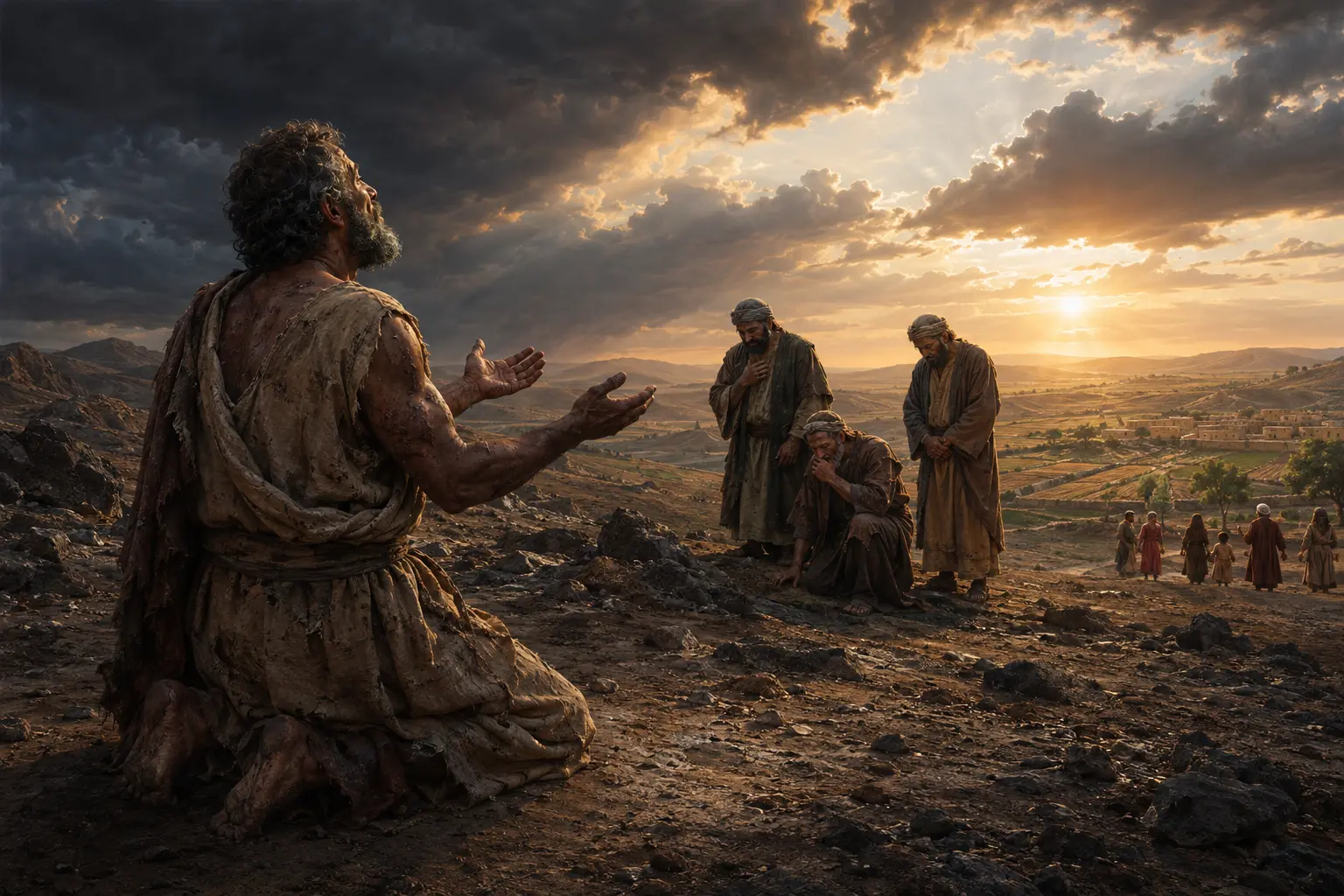
Job’s final word is not a whisper of surrender but a signed testimony: a wounded man opens every room of his life before God and asks heaven to read the record.
01
1. Introduction: When the Sufferer Signs His Name
There are times when words become more than descriptions. They become a testimony. They become the last stone that one places on the true altar before retreating into silence.
Job 31 is such a time.
In Job 29, Job remembered the days when honor sat by his side like the morning light. In Job 30, the dignity he remembered collapsed into the present humiliation: mockery, physical pain, God's silence, and music turned into mourning. Now, in Job 31, Job doesn't just complain. He swears. He examines his own life like a light passing from room to room in the middle of the night. He puts his eyes, his hands, his heart, his wealth, his house, his fields, and his public conduct before God.
This chapter is often called Job's oath of innocence, or his oath to clear himself from accusation. He does not lightly claim that he is a "good man." This is a serious legal and moral testimony, built on repeated "if" sentences: if I have done this evil, then let the judgment come. Job puts himself under the eyes of God that examines everything, then he calls the Almighty to answer.
That's why this look vibrates with courage and danger at the same time. Job is not saying that he is completely sinless in some theoretical sense that does not touch real life. He says that the accusations implied by his suffering are not true. He has not lived like a hideous bully.
He has not built his house on lust, deceit, exploitation, idolatry, cruelty, greed, or injustice. He is not the evil man that his friends' theology forces him to be.
So Job signs his name in the dust.
And with that signature, the long debate of mankind is brought to the edge. Friends no longer have speech. Job has no other defense. The next big step in the book will bring Elihu; and after Elihu, the storm will begin to gather.
Job 31 is the last court document before the silence of heaven begins to shake.
02
2. Historical and Literary Context: The Oath at the End of the Lament
Job 31 completes the three-part course of Job's final speech in chapters 29–31.
First, Job 29 looks back: "I wish I were as in the months of old" [Job 29:2]. In it, Job remembers his friendship with God, public respect, social responsibility, and moral leadership. He was the eyes of the blind, the feet of the lame, the father of the needy, and the one who broke the teeth of the wicked [Job 29:12-17].
Second, Job 30 looks at the current situation: "But now they laugh at me" [Job 30:1]. His dignity has been overthrown. The one who once defended the marginalized is now mocked by people living on the margins. His body is burning. His skin becomes black. His harp turns into the voice of mourning [Job 30:30-31].
Third, Job 31 looks inward and upward. This is the oath. The past he remembers and the pain of the present now become the basis of his final appeal. Job asks: If I am guilty, where is the evidence? If I have wronged, who have I crushed? If I have trusted in gold, where is my idolatry? If I have hidden sin, why am I now exposing myself before God?
This design is powerful. Job's mourning does not end in emotional breakdown. They end in moral testimony.
This is important because his friends have gone from pain to guilt: Job suffers; therefore he must have sinned. Job turns that way. He starts from his life and goes to the truth: search my way; measure my steps; look at my real behavior.
This chapter also reflects the legal practices of the ancient world. The oath of innocence was not an easy one. Swearing a lie before God was calling oneself a curse. So Job does not just say, "I am innocent." In fact, he says, "If I lie, let the consequences fall on me."
His speech is full of judgments that he wants for himself: if I have sinned in this way, let my crops die, let someone else enjoy what I have planted, and let my house be judged.
But this oath is also created by wisdom. It is a picture of a righteous life. According to Job 31, the life of a righteous person is not just pure worship or private piety. They include sexual discipline, honesty, economic justice, caring for workers, compassion for the poor, hospitality to strangers, rejecting idolatry, refraining from enemies, and taking care of the earth responsibly.
Here Job's righteousness becomes amazingly complete. His right has eyes, hands, doors, scales, fields, and memories. It reaches from the bedroom to the court, from the table to the field, from private desire to public justice.
Job 31 teaches us that true righteousness is not a mask worn in public; it is a covenant that is kept in every room of life.
03
3.1 A Covenant with the Eyes: Desire Disciplined Before God (31:1–4)
Job begins where most sins begin: in the eyes.
"I have made a covenant with my eyes" [Job 31:1]. This sentence is shocking. Job speaks as if his eyes are not neutral windows, but living gates.
What enters through the eyes may be desire; what desire invites may be action; and a repeated action can become a habit.
Job's covenant and his eyes are not hostile to beauty. It is respect for people. He refuses to turn another human being into an object to satisfy his secret desire. In this way, Job first shows the deep moral vision that Jesus later gives in the Sermon on the Mount, where adultery does not end only in the body, but is traced to the perspective of the hungry heart [Matthew 5:27-28].
Job's reason is theological: God sees his ways and counts his steps [Job 31:4]. His secret life is lived under the eyes of God. There is no dark room where God is not, nor a secret view that can escape Him who knows the way of the heart.
Righteousness begins when desire learns to live in the eyes of God.
04
3.2 Honest Scales: Truth in Speech, Steps, and Desire (31:5–8)
Then Job goes from the eyes to the legs and arms. If he has walked in a lie, if his foot has moved to deception, if his heart has followed his eyes, then let him be weighed in the balance of justice [Job 31:5-6].
A picture of balance is very important. Job is not afraid of scrutiny. He is asking for the investigation. He asks God to measure him accurately, not by gossip, outward appearance, or the fearful calculation of his friends.
This is a bold request. Many people want God's comfort, but not God's balance. Job wants both. He wants the truth, because only the truth can save him from the false judgment tied to his suffering.
Then he mentions the desire of another's property: if his heart has followed his eyes, if any stain has stuck to his hands, then let the other eat what he has planted [Job 31:7-8]. For Job, sin is not just stealing property from the outside. It is also an inner desire that bends towards what belongs to another.
A clear conscience is not afraid of the scales of justice.
05
3.3 Faithfulness in Marriage: The Fire That Consumes (31:9–12)
Then Job denies the charge of adultery. If his heart was drawn to another man's wife, if he lurked at his neighbor's door, then let the consequences fall upon him [Job 31:9-10].
The tongue is strong because the sin itself is serious. Adultery is not seen as a private crime harmless to society. Job says it is a fire that consumes until destruction [Job 31:12]. You burn the house, trust, honor, and order of the covenant.
In this section, Job shows again that justice is a matter of relationships. His integrity is not just about protecting his own reputation. It's about refusing to disturb the peace of another's home.
In a generation that often calls desire "freedom," even when it injures the covenant, Job's words stand as a guard at the door. Not every hunger deserves a feast. There are fires that must be stopped before they turn the house to ashes.
Loyalty is love protected by sacred moderation.
06
3.4 Servants, the Poor, and the Vulnerable: Justice Under One Creator (31:13–23)
Now the oath looks outward, to the exercise of social power. Job denies that he mistreated his male or female servants when they had complaints against him [Job 31:13]. This is remarkable in the context of the ancient world. Job does not see his servants as silent instruments. They have advice. They can bring complaints. And Job knows that he must respond.
The reason for this is based on the theology of creation: "Did not he who created me in the womb create this one too?" [Job 31:15]. Master and servant have one Creator. Social class does not erase the fact that all are creatures of God. The womb becomes a witness in court. Every human being, regardless of his position, has come from the same hands of the Creator.
Then Job denies that he deprived the poor of their needs, made the eyes of the widow weak by waiting for help, ate his bread alone, failed to clothe the naked, or raised his hand against the orphan because he had influence at the gate [Job 31:16-21]. This is not a thin morality. It is a weighty mercy. Job's righteousness feeds, clothes, listens, protects, and refuses to use influence as a weapon.
The "gate" was the place of public judgment. Job insists that he did not use his status to pervert justice against the weak. Here his previous memory in Job 29 becomes real: he is not only praised as righteous; he did justice when it cost him time, wealth, and power.
This section speaks strongly to every community of believers. One can avoid scandal but still fail to live justly, if the poor are not seen, the workers are not listened to, and influence becomes a shield of privilege instead of a shield to protect the weak.
The God who created us in the womb will ask us how we treated those who were less powerful than us on earth.
07
3.5 Gold, Sun, and Moon: Refusing Beautiful Idols (31:24–28)
Now Job denies that he trusted in gold or said to pure gold, "You are my hope" [Job 31:24]. Wealth is not judged just because it exists. In the beginning, Job was rich, and the narrator did not say that his wealth was evil. The danger is in trusting it. Gold becomes an idol when it becomes a secret throne in the heart.
Job also denies that he boasted because his wealth was great [Job 31:25]. This is a very deep matter. He does not reject greed alone; he also rejects the self-congratulatory spirit that considers the abundance of wealth to be proof of its quality.
Then he turns to the worship of celestial objects. If he looked at the sun shining or the moon moving proudly, then secretly kissed his hand as a sign of worship, that would also be a sin [Job 31:26-28]. The sun and the moon are beautiful, but beauty is not God. Creation may inspire wonder, but it should not be worshiped.
This is one of Job's clearest statements about covenant faithfulness. He will not worship the silver beneath him or the stars above him. He will not bow down to what he can keep in a box or what he can admire in the sky.
Modern idols are often less obvious, but no less powerful: security, success, fame, technology, nationalism, beauty, and wanting to control everything. Job's oath asks us if our hope has quietly shifted from the living God to something created.
Idolatry begins when good gifts become our last hope.
08
3.6 Enemies, Guests, and Hidden Sin: The Open Door and the Open Heart (31:29–34)
Job denies that he enjoyed the misfortune of his enemy [Job 31:29]. This is a very high moral claim. It is one thing to refrain from harming the enemy; it's another thing to deny the secret joy when he falls.
He also refuses to curse his enemy with his mouth [Job 31:30]. Both the heart and the tongue are called to be witnesses. Job will not allow suffering to make him cruel.
Then we come to hospitality. His tent was not closed to the traveler [Job 31:31-32]. In the ancient world, generosity was not an ornament of virtue; you were often the difference between safety and danger, life and death. Job's door was part of his righteousness.
Later Job refuses to hide sin like Adam [Job 31:33]. This is one of the most penetrating sentences in this chapter. Job is aware of the old instinct of man: to cover, to hide, to blame, and to retreat in fear. He insists that he did not live behind a public mask, hiding guilt because he was afraid of the crowd [Job 31:34].
This is not the speech of a man who pretends that he has never needed mercy. It is the speech of a person who rejects hypocrisy. Job's life was not organized around hiding things.
A righteous person does not have a perfect life; the righteous refuses to live a hidden life.
09
3.7 The Signature and the Crown: Let the Almighty Answer (31:35–37)
Now the chapter reaches its burning center: "Behold my sign! May the Almighty answer me!" [Job 31:35].
This is the culmination of Job's desire for a legal hearing. He wants God to issue an indictment. If there is an accusation, let it be written. If there is evidence, let it be shown. Job sees himself taking God's document, carrying it on his shoulder, and wearing it on his head like a crown [Job 31:36].
This picture is amazing. Ayub believes that the indictment would turn into evidence to defend him. If God were to write charges against him, Job is sure he would wear the document as honor, not shame. He would approach God as the leader of the people [Job 31:37].
This is not pride in the simple and superficial sense. It is the courage of conscience buried in lies under torture. Job is not trying to defeat God. He is trying to be heard by God.
But the danger is still there. Job has demanded an answer from the Almighty. Soon the answer will come—but not in the way he expects.
Job asks for an indictment; God will answer from the storm.
10
3.8 The Land as Witness: When the Fields Cry Out (31:38–40)
After that climactic signature, the oath brings one final witness: the land.
If Job’s land cries out against him, if its furrows weep together, if he has eaten its yield without payment or broken the lives of its tenants, then let thorns grow instead of wheat and foul weeds instead of barley [Job 31:38–40].
This ending is profound. Job’s righteousness includes ecological and economic accountability. Land is not mute property to be abused without consequence. Fields can testify. Furrows can weep. The soil remembers injustice.
This last refusal may involve the exploitation of workers, the unjust confiscation of land, the disrespect of those who worked for it, or the misuse of the country's produce. Job knows that justice must reach the ground beneath our feet.
In a world of environmental destruction, labor exploitation, and economic systems that separate our use from our responsibility, this last witness to Job seems painfully modern. The earth is still crying. The workers are still crying. God still hears all.
Then we come to the heavy closing sentence: "The words of Job are finished" [Job 31:40].
This sentence falls like a closing door.
The man who has spoken through grief, anger, memories, accusations, and hope, is now silent.
When Job's words end, the book begins to move towards God's voice.
11
4.1 Job’s Integrity Embraces the Whole of Life
Job 31 provides one of the Bible's richest pictures of righteousness. It's not just personal hygiene, although it involves that. It is not just social justice, although it demands it. It is not just the worship of the true God, although it all rests on Him.
Righteousness is a complete undivided life before God.
Job's oath covers lust, words, money, sexual relations, relations with workers, caring for the poor, public justice, idolatry, loving enemies, generosity, confession, and care of the land. This is a breathtaking moral vision. Justice is not one shining window when the whole house remains in darkness. Righteousness is a whole house opened to the morning light of God.
This helps us reject selective holiness. Others protect sexual purity but exploit workers. Some defend justice but harbor secret greed. Some reject idolatry in doctrine, but in practice worship wealth. Job 31 rejects such a divided life.
The life of the righteous is not an infallible performance; it is undivided loyalty.
12
4.2 Job Does Not Confess What He Did Not Do
There is a kind of false humility that agrees with accusations just to appear spiritual. Job rejects that way.
His friends want repentance without evidence. They want him to confess the sins that will explain his pain. But confessing without the truth is not repentance; it is a false surrender.
Job teaches the church an important pastoral lesson: we must not push the suffering to make up guilt just to make our theology look clean. Sometimes the most honest act is not to confess, but to protest by telling the truth. Sometimes justice demands to say, "I will repent when I have sinned, but I will not lie against my own conscience."
This does not make Job morally perfect. It makes him honest.
13
4.3 The Cry for an Answer Is Itself an Act of Faith
Job's claim that God should answer may sound shocking. But underneath that confidence is faith. Job still believes that there is a Judge who really has meaning before him. He still believes that the reality of life is morally responsible before God. He still takes his advice to heaven instead of completely abandoning heaven.
Biblical faith is not always silent acceptance. Sometimes faith enters the court limping, wearing torn clothes, and saying, "Lord, hear me." The Psalms give us the language of such faith. Prophets live like that. Even the cross carries his cry: "My God, my God, why have you forsaken me?" [Psalm 22:1; Matthew 27:46].
Job's oath stands within that sacred tradition of going to God when we are wounded. He will not talk about God as if God does not exist. He talks to God because only God can judge righteously in the end.
14
4.4 Job 31 Points Beyond Job to the Completely Innocent Sufferer
Within the broader message of the Christian Bible, Job's innocence opens the way to the mystery of Christ. Job is not Jesus, and his suffering does not save the world. But Job helps us realize that suffering is not always a sign of personal guilt.
The logic of friends would misunderstand the cross. They would stand at Golgotha and say, "Surely this man is damned because he has sinned." But the gospel declares that the truly righteous one suffered shame, violence, and was left without personal guilt [Isaiah 53:9; 1 Peter 2:22–24].
In Jesus, the innocent sufferer does no more than demand an answer. He himself becomes the answer in flesh and blood. He enters the place where God's accusation, pain, and silence meet—and through resurrection, God vindicates the righteous and opens a new creation.
Job signs his oath and waits.
Jesus bears the accusation and rises.
The God who seems to be silent before the suffering of the innocent is the God who, in Christ, enters into that suffering and carries it towards resurrection.
15
5. Life Application: Living with Integrity in Private and Public
Job 31 invites us to boldly examine ourselves. Not self-hatred out of fear. Don't seek perfection out of concern. But it is to live with honesty, prayer, and openness before God.
We can ask ourselves:
Where do my eyes need covenant?
Where do my steps need a fair balance?
Where has my desire started towards what belongs to another?
Who is less powerful than me, and how have I dealt with his complaints?
Do the poor see my life as a place of refuge or as a distant wall?
Has wealth become my hope instead of something entrusted to me to manage?
Do I secretly rejoice when my enemy falls?
Is my door open to the stranger, the lonely, and the one who cannot pay me?
Am I hiding sin because I fear people more than God?
Would the land, the workplace, my home, and the weak bless my name—or would they weep against me?
These questions are not meant to crush us. They are meant to bring our lives into God's healing light. In Christ, exposure is not the enemy of grace. Hiding is the enemy. The Gospel does not invite us to pretend that we are Job. It invites us to come faithfully before the One who is greater than Job, who is both Judge and Redeemer.
Practical exercise for this chapter:
Take some quiet time this week and pray through Job 31 slowly. Divide your reflection into four areas: secret desires, public relations, materialism, and hidden fears.
Ask the Spirit to show you where righteousness needs to be built. Where confession is needed, confession. Where fixing what you have damaged is necessary, take action. Where the accusation is false, reject the shame. Where the pain has no explanation, bring it to God without pretending.
A healed life is not an unwounded life; it is a life brought fully into the light of God.
16
6. Reflection Questions
1. Why is Job's oath of innocence an important conclusion to his final speech in chapters 29–31?
2. What does Job 31 teach about the relationship between purity of private life and public righteousness?
3. How can Job's treatment of servants, the poor, widows, and foreigners oppose the modern use of power and privilege?
4. In what ways can property be our "trust" instead of being a guarantee given to us to manage?
5. Why is it dangerous to push sufferers to confess guilt without evidence?
6. Which part of Job 31 examines your life the most: eyes, words, money, righteousness, enemies, generosity, hidden sin, or care of the earth?
7. How does the suffering of the innocent Job prepare us to understand the cross of Christ more faithfully?
17
7. Response Prayer
Lord God, Judge of all the earth,
You see our ways and count our steps.
You know the doors we open,
the desires we feed,
the wounds we hide,
and the people we ignore.
Teach us the righteousness of Job—
not the pride of self-defense,
but the courage of life that is brought into your light.
Make our eyes the keepers of the covenant,
let our hands be clean from exploitation,
let our tables be open to the hungry,
let our doors be open to the stranger,
may our hearts be free from golden idols, the praises of men, and the desire to control everything.
When we sinned, give us repentance.
When we hid, give us courage.
When we were falsely accused, give us the strength to stand in the truth.
When suffering tires us, teach us to bring our advice to you.
And lead us to Jesus,
righteous sufferer,
faithful witness,
The condemned Lamb was then vindicated,
The one in whom mercy and justice meet.
Amen.
18
8. A Window into the Next Chapter: When a New Voice Enters the Ashes
Job's words are over.
But the book is not finished.
After Job signs his testimony and silence falls on the pile of ashes, another voice is heard. Elihu, the youngest of the three friends, burns with anger. He is angry with Job for justifying himself rather than God, and he is angry with his friends because they failed to answer Job while continuing to judge him [Job 32:2-3].
His entrance changes the weather. The old arguments have collapsed, but the storm has not yet arrived. Elihu stands between Job's final oath and God's storm, like the restless wind before the thunder bursts.
Job 32 will ask us to listen carefully: Does Elihu bring the wisdom that his friends lacked, or does he repeat the mistakes of the past with a new voice? Is he preparing the way for God's answer, or is he delaying it?
The pile of ashes settles.
A young man takes a breath.
The calm before the storm begins.
19
9. Bibliography
Alter, Robert. The Wisdom Books: Job, Proverbs, and Ecclesiastes: A Translation with Commentary. New York: W. W. Norton, 2010.
BibleProject. The Book of Job Guide. BibleProject, accessed 2026.
Clines, David J. A. Job 21–37. Word Biblical Commentary 18A. Nashville: Thomas Nelson, 2006.
Hartley, John E. The Book of Job. New International Commentary on the Old Testament. Grand Rapids: Eerdmans, 1988.
Walton, John H., and Tremper Longman III. How to Read Job. Downers Grove: IVP Academic, 2015.

Be the first to leave a comment.