

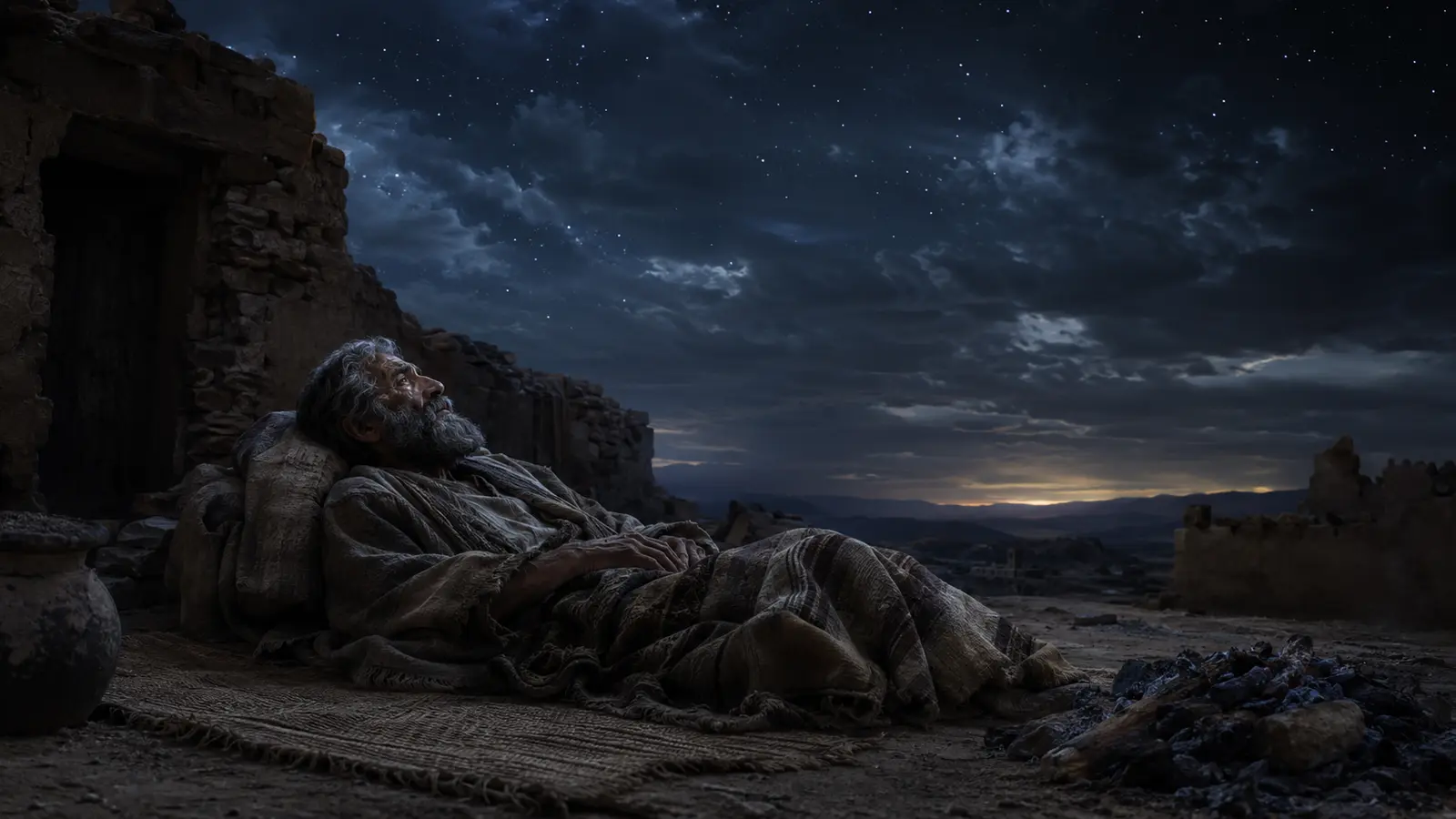
There are times when we ask God to come closer. We pray, "Do not hide your face from me." We sing, "Let your eyes be upon me." We desire the blessing of being seen, remembered, known, and held by God. In the season of joy, God's care feels like sunshine in the field. God sees, and so we are safe.
01
1.0 Introduction: When the Presence We Desire Feels Too Heavy
There are times when we ask God to come closer. We pray, "Do not hide your face from me." We sing, "Let your eyes be upon me." We desire the blessing of being seen, remembered, known, and held by God. In the season of joy, God's care feels like sunshine in the field. God sees, and so we are safe.
But Job 7 is spoken from a darker place. Here, God's perspective does not feel like sunlight. You feel like a strict follow-up. You feel like a guard guarding a prisoner, a hunter tracking an animal, a warrior aiming at a target. The God whose presence once meant protection is now felt, by Job, as the One who will not let him breathe.
Job 6 was aimed mostly at his friends. He asked them to measure his sorrow before judging his words. He accused them of being like dry streams in the desert, promising water but drying up when the thirsty arrive. In Job 7, his speech is upward. Dry streams cannot carry him. So he leaves his friends who do not understand him and turns to God who seems to have injured him.
This chapter is not a civilized prayer. It is a prayer with parted lips. Job compares human life to hard forced labor, his night to misery, his body to a garment of maggots and dust. His days run faster than a weaver's tool and end without hope.
He remembers that life is a breath, a vapor, and he expects to soon disappear like a cloud to Hell (Sheol).
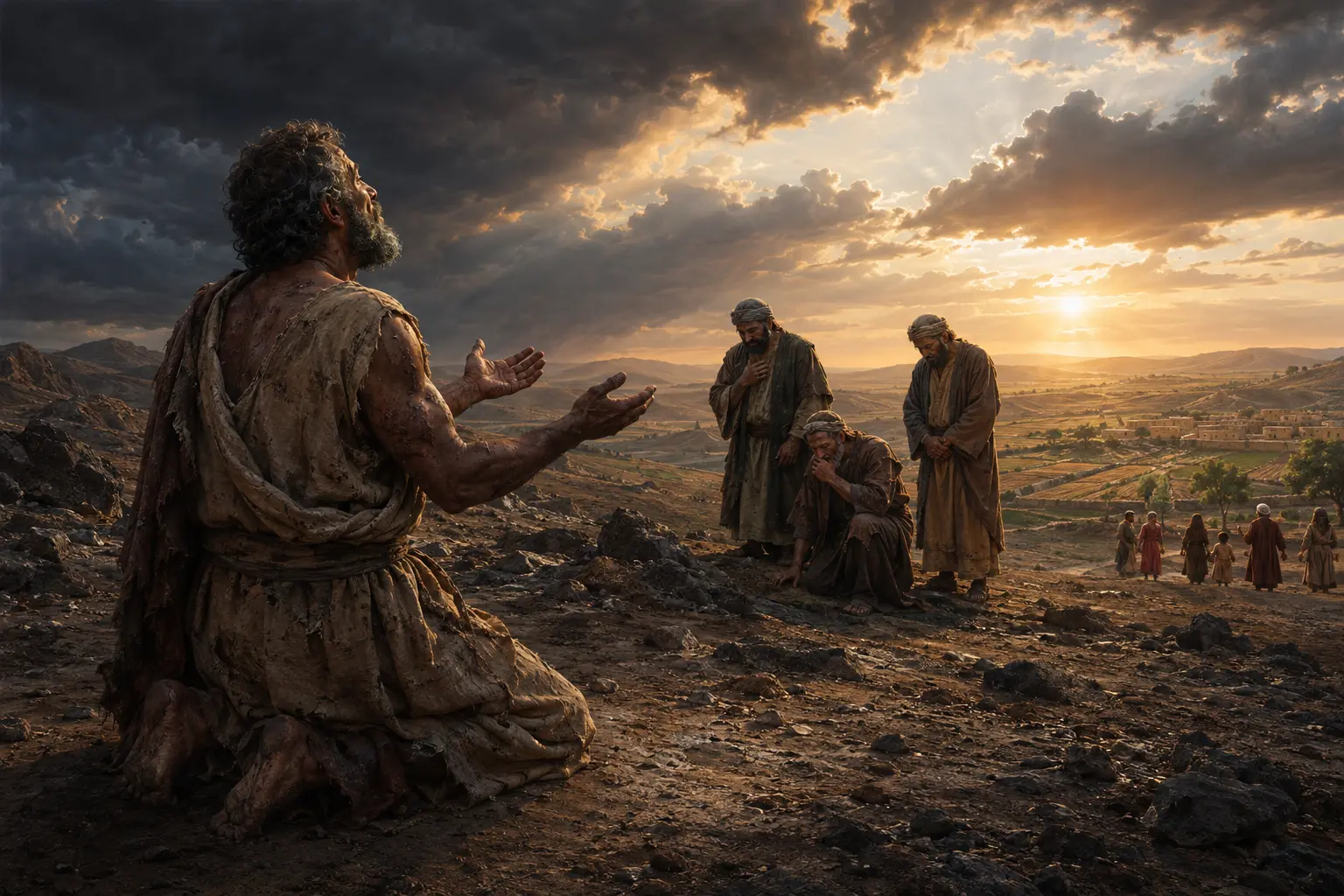
Then comes courage: "I will not stop my mouth." Job will speak in the anguish of his soul. He will complain in the pain of his soul. He asks God why he has made him a target. He turns the language of Psalm 8 upside down: "What is man, that you should consider him so much?" But when the psalmist marvels that God values man, Job cries in pain that God is watching him too closely.
This scripture is about prayer that turns into complaint, because Job teaches us that wounded faith can still turn to God even when God's closeness feels like pressure instead of peace.
Job 7 gives us holy permission to speak the truth about spiritual weariness. It does not give us a complete theology of suffering. It gives us something more immediate: a man in great pain refusing to lie before God.
02
2.0 Historical and Literary Context: From Failed Friendships to Complaints to God
Job 7 is the second half of Job's response to Eliphaz. In Job 6, Job responded to Eliphaz's misused wisdom and confronted his friends for failing to have genuine compassion.
In Job 7, the focus of the speech moves directly to God. Job's grief goes from disappointment with men (horizontal level) to complaint before God (vertical level).
This direction is important within the first cycle of speech. Eliphaz interpreted Job's suffering as discipline and urged him to seek God. Job seeks God—but not by accepting Eliphaz's diagnosis. He seeks God by bringing grievances, accusations, pain, and unanswered questions directly into God's presence.
This chapter unfolds into three main sections:
Job describes human life as tiresome work and sleepless trouble (vv. 1-6).
Job reflects on the brevity of life and his loss toward imminent death (vv. 7–10).
Job turns directly to God, rejecting silence and asking why God looks at him, threatens him, targets him, and does not forgive him (vv. 11-21).
Theologically, Job 7 digs deep into the book's exploration of the suffering of the innocent. Job is not yet demanding a full court hearing as he will later, but he is heading there. He believes God is responsible for his suffering, and therefore only God can answer him. His speech is full of pain, but it also builds relationships. Job does not leave God by remaining silent; he drags his pain before God.
The chapter also uses and inverts familiar biblical language. Psalm 8 celebrates human dignity under God's care: "What is man that you should remember him?" Job uses similar language, but in sorrow: What is man that you examine him every morning and test him at all times? The blessing of being seen becomes a burden to be examined. A song of praise becomes a lament.
This situation reveals one of the most profound truths in the book of Job: suffering can completely change the way words of faith sound. Yesterday's comfort can turn into today's pain, and the truth that was a refuge can feel like a wall that moves you. But instead of throwing away the language of faith, Job fights it tirelessly, until it speaks its truth from the ruins and ashes of its pain.
03
3.1 Life as Hard Work: The Worker Who Waits in the Evening (Job 7:1–3)
Job begins with a question: "Does not man have hard work in this world? Are his days not like days of labor?"
The image being built is strong. Human life is not described as a celebration, a holy journey, or a fruitful harvest. It is military service, forced labor, hard duty under burden. Job feels he has been forced into a life he did not choose, he has been given pain he cannot avoid, and he has been denied a salary to recover.
He then compares himself to a slave who longs for shade and a laborer who waits for wages. These pictures are simple but heavy. The worker can tolerate the heat because the evening is coming. The laborer can endure the day because the pay is coming. A slave can look to the shadow as a small consolation.
But Job has no evening. He has no salary. He has no shadow.
Instead, he says, he is destined for months of futility and nights of misery. This is a painful twist. The day is trouble; the night should be rest. But for Job, the night also becomes trouble.
Life does not give him a cheap cycle.
Here, Job makes clear the extent of the fatigue of body and soul. The great cruelty of long-term suffering is how it blurs the distinction between toil and rest. The sufferer struggles during the day to endure, and then struggles again at night to survive. In these pains, even sleep, which was the last refuge of the poor, is no longer available.
04
3.2 The Night That Will Not End (Job 7:4–5)
Job describes his night with terrifying clarity. As he sleeps, he asks, "When will I wake up?" But the night is long. He tossed and turned until dawn. The hours pass slowly, as they often do for those in pain.
Anyone who has experienced a long night of illness, sadness, fear, or anxiety knows this situation. The clock is getting cruel. Darkness amplifies every thought. The body cannot rest. The mind runs like a frightened animal in a gateless field.
Then Job turns to his body. His body is covered with larvae and soil. His skin hardens, then cracks again. Illness is not just about pain; you are humiliating. His body feels like a ruined garment. Healing seems to begin, then reverse. The scab becomes a false hope. The wound reopens.
This information is important. Job's theology does not hover over his body. His questions are based on ulcers, insomnia, choking, fever, fear, and fatigue. Biblical mourning involves the body. The body also prays—through groans, sleeplessness, loss of appetite, tears, and trembling.
Job doesn't just think about suffering. He wears them.
05
3.3 Days Faster Than a Weaver's Loom (Job 7:6–10)
Job moves from slow night to fast day. His days pass faster than a weaver's tool and reach a hopeless end.
This is the paradox of suffering: time is slow and fast at the same time.
The night drags on, but life is lost. The clock is unbearable, but the days are disappearing. Job feels trapped in a long standstill and, at the same time, is being rushed towards death.
He pleads, "Remember that my life is a breath." This word means vapor, wind, something weak and passing. Job asks God to think about his death. Why crush what is already so short? Why pursue a creature that is already extinct?
Then he says that his eye will no longer see good. The eye that once saw children, fields, feasts, servants, and the morning light now does not look forward to any future light. Those who see him now will never see him again. God's eyes will look for him, but he will not be there.
Job compares death to a cloud that fades away. He who goes down to Hell (Sheol) does not come up again. He does not return to his home; his place no longer recognizes him.
Here we do not see the perfect biblical hope that will later be revealed through the resurrection of the dead. Job speaks of it occurring in the context of ancient mourning, where Hell (Sheol) is viewed as a place from which no one can return—a land from which worldly ties and family identity cease to exist. His pain is fueled by the reality of the limitations of his life. If God does not intervene quickly, his time will be completely over.
The house will forget him. His place will no longer recognize him.
That is one of the great threats of grief—not only that we are dying, but that we are disappearing from the rooms that were once precious to us.
06
3.4 "I will not stop my mouth" (Job 7:11)
In the middle of the chapter comes the declaration of Job: "Therefore I will not stop my mouth; I will speak in the pain of my soul; I will complain in the pain of my soul."
This is not a separatist rebellion. It is a complaint within the relationship. Job refuses to hide the truth.
He will not make his grief more acceptable than it is. He will not speak as if Eliphaz's principle has solved anything. He will not pretend that the language of discipline has comforted him.
The words "soul pain" and "soul pain" are important. Job's complaint is not a cold theory. It is a cry from within the distress. He is not writing an essay about God's justice. He bleeds into his words.
There is a serious pastoral lesson here: mourning should not be forced into silence before it is allowed into prayer. Some prayers tremble. Some prayers condemn. Some prayers sound like a storm before they become faith. If they are spoken towards God, they remain within the dialogue of faith.
07
3.5 Am I the Sea or the Dragon? (Job 7:12–16)
Job asks God, "Am I the sea, or the dragon of the sea, that you set me a guard?"
In ancient thought, the sea was often associated with chaos, danger, and forces beyond human control. The sea dragon evokes the image of great forces that God must restrain in order to maintain order. Job asks, essentially: Am I chaos itself? Am I a global threat? Why does God protect me as if I could flood creation?
This is a painful irony. Job knows he is weak, sick, sad, and close to death. But God seems to treat him as if he should be restrained by divine power. This inconsistency feels unbearable. Why so much pressure on such a weak creature?
Then Job describes another cruelty: when he seeks comfort in his bed, when he hopes that his bed will ease his complaints, God threatens him with a dream and terrifies him with a vision. Even sleep becomes unsafe. The bed, which should be a sanctuary, becomes another battlefield.
That is why Job says that his soul chooses to be hanged by death instead of his bones. He hates his life. He will not live forever. "Leave me," he pleads, "for my days are but breath."
These words must be handled gently. Job's desire to die is not romantic or abstract. It comes from fatigue. It is the cry of a person who feels there is no place to rest—not in the day, not in the night, not in the body, not in friendship, and not even in God's care.
The religious response to such words is not to reprimand. It is presence, protection, compassion, and support. Job's words remind us that discouragement must be taken seriously, not dismissed with theological arguments.
08
3.6 Psalm 8 Turning Inside Out (Job 7:17–18)
Now Job makes one of the boldest turns in the book: "What is man, that you should think of him so much, that you should keep him in your heart, look at him every morning, and test him at all times?"
These words refer to the wonder of Psalm 8, where the psalmist looks at the heavens, the moon, and the stars and asks why God will remember man. There, God's care is mercy and respect. Man is crowned with glory and honor. A small creature is raised in a call.
But Job receives this care of God with a completely different eye. In the furnace of his suffering, being "looked at" by God does not come as a comfort, but is felt as being poked in the eyes for the purpose of finding fault. The "temptation" every waking moment turns out to be a merciless torture. Even the thought of being "remembered" or being in God's thoughts becomes like a heavy, moving, and unbearable investigation that takes his breath away.
See the paradox of this experience: in the furnace of suffering, the truth that once made us sing praises, can turn into the same truth that makes us tremble with fear. The statement "God is watching over me" is usually reassuring. But in the darkness and pain of Job, this feeling moves and turns into suffering: it means that God is an observer who stares endlessly at him, not giving him even a second to breathe or swallow his saliva.
The Bible includes Psalm 8 and Job 7. It gives us a song of praise and a twist to that song. It teaches us that the words of faith must have room for wonder and also hurt.
09
3.7 O Watcher of Humans, Why Do You Make Me Your Target? (Job 7:19–21)
Job asks, "How long will you not take your eyes off me? Will you not leave me alone until I swallow my spit?"
This request is shockingly small. He does not ask first for restitution, wealth, children, health, or protection. He asks for a chance to recover a little—time to swallow. Breathe between beats. A little mercy before death.
Then he asks, "If I have sinned, what have I done to you, O Watcher of mankind?" The name "Observer" could have been comforting in other circumstances. It would mean that God protects mankind with care. But Job uses it bitterly. The overseer is felt like a prison guard.
He asks why God has made him a target. Earlier, in Job 6, he spoke of God's arrows. Now he continues that picture: God is focused on him. God has turned him into a target.
Then, Job cries out asking why God does not forgive his mistakes and wipe out his evil. This is not simply agreeing with Eliphaz's accusations; instead, Job questions with extreme pain: even if there is sin in him, why should these plagues be merciless and endless? If God is truly merciful, why doesn't he just forgive? And since Job's breath is on the verge of being extinguished, why should this wrath continue to pour out on him?
The chapter ends with death facing him: soon he will lie in the dust. God will look for him, but he will not be there.
Job 7 ends without consolation. It ends with someone saying to God: If you have something to do with me, do it quickly. I'm about to leave.
10
4.1 Job Teaches Us That Prayer Can Be A Complaint Without Being A Lack Of Faith
All the messages of Job 7 are addressed to God, even when Job stands up to accuse God himself. This has a very special weight. Job does not speak to God from afar; he speaks directly to her from the depths of her leaking wound. He refuses to be bound by religious silence or to wear a mask of hypocrisy before the Creator, because in his heart, he still values their relationship.
Faith is not always silent obedience and false calm. Sometimes, true faith is the courage to cling to God, and refuse to let him pass without listening to your painful cry.
11
4.2 Suffering Can Change How Familiar Truths Sound
Psalm 8 hears God's care as honor. Job 7 experiences God's care as pressure. Both texts are Scripture. Together, they teach us to be careful and suffer. A line that comforts one person can hurt another at certain times. Wisdom doesn't just ask, "Is this biblical?" but also, "How does this man hear this truth coming from a heap of ashes?"
12
4.3 Human Weakness Should Generate Compassion, Not Harshness
Job repeatedly emphasizes that human life is a breath, a vapor, a fading cloud. He asks God to remember his weakness. This should shape our humanitarian ministry as well. If life is short and bodies are weak, then our words should be gentle.
A theology that knows that we are dust should not speak as if we are metal.
13
4.4 God's Hiding Is Not The Same As God's Absence
Job feels watched but not comforted, examined but not cured, targeted but not answered. The reader knows from the whole book that God is not far away, but Job still does not know how the story will go. This gap between the reader's understanding and Job's experience teaches us patience. We should not use the last chapter of the book to silence the current chapter. Job 7 must be allowed to hurt.
14
4.5 Christ Enters the Prayer of the Targeted One
Job painfully questions why God has made him the target of His arrows. But on the cross, Jesus stands as the innocent Lamb, on whom all the cruelty of men, the attacks of the dark forces, and the weight of the world's sin fell. He also raises a cry from the depths of abandonment. He also descends into the dust of death. He also knows what it means to reach where God's purpose is passing through the furnace of unbearable suffering.
However, Jesus reveals what Job, in his time, could not see: God's final response to suffering is not a judgmental eye but solidarity with the afflicted; not abandonment but resurrection; not an attitude that oppresses and crushes, but a face that shines a great love that has gone through wounds.
15
5.1 Tell God the Truth About How His Presence Feels
Some seasons make God's closeness feel painful instead of peaceful. Don't hide that from him. Job teaches us to bring even that confusion to prayer.
16
5.2 Respect Physical Fatigue
Lack of sleep, illness, anxiety, pain, and sorrow create spiritual experiences. Take care of the body as part of taking care of the soul. Rest, therapy, counseling, fellowship, and prayer go hand in hand.
17
5.3 Don't Use Comfort Lines as Weapons
The message of Psalm 8 is plain truth, but Job 7 warns us that a person in pain can interpret that truth in a different way. For that reason, share the Word of God gently, at the right time, and with respect for the wound your partner is nursing.
18
5.4 Provide Opportunity for Complaints in Apprenticeship
A spiritually mature fellowship of believers will not be broken or disturbed when one of them questions God's purposes or cries in pain. Instead, this community holds the hand of the wounded and helps them to continue to pour out what is in their heart to God. They do this to prevent them from letting their burning pain turn into deep silence and the darkness of despair.
19
5.5 Offer Cheap, Not Just Details
Job is just asking for a chance to breathe. This teaches us that sometimes, the greatest spiritual help is practical: food, medical care, a night of good rest, or a silent presence that eases the suffering.
20
5.6 Take Dying Requests Seriously
When someone reaches the point of speaking Job's language—where he wishes for death or prays to disappear from the world—respond quickly but with the utmost gentleness. Stay close, involve trusted family, spiritual leaders, counselors, and health professionals. In those dark seasons, never leave him alone, especially at night when the shadow of death and loneliness is the heaviest.
21
5.7 Look to Christ When Prayer Feels Like Complaining
Jesus is not hindered by prayers with sores, because He also prayed in great pain. Take your complaints to the crucified and risen Lord. His scars are proof enough that God has entered directly into our pain.
22
6.0 Reflection Questions
Have I ever felt God's care as pressure instead of comfort?
What areas of my life feel like drudgery without the shadow of evening?
How has physical fatigue affected the way I pray or look at God?
Do I allow myself and others to bring complaints to prayer without shame?
How can I give someone a little relief instead of a long explanation?
What does Jesus' suffering teach me about God's presence in the darkest of prayers?
23
7.0 Responsive Prayer
God who sees us when being seen hurts,
We come to you with tired bodies and restless nights.
We bring the parts of life that feel like hard work,
the days go by so fast,
a night that doesn't want to end,
ulcers that open up again,
and the prayers we are afraid to say out loud.
Teach us to pray faithfully.
When your attitude feels like pressure,
help us not to run into silence.
When your closeness feels like fire,
hold us until we can breathe again.
When we feel like a target,
remind us that our pain is not hidden from you,
and that our questions may be borne into your presence.
Forgive us for using the Scriptures without gentleness.
Forgive us for giving the lines before we listen.
Make us gentle to those whose songs of praise have turned into mourning.
Give rest to the sleepless.
Give courage to the despondent.
Give them friends who are alone.
Give wisdom to the wounded.
Give small relief where the load has become too heavy.
Lead us to Jesus,
who came in the night,
he prayed in great pain,
cried from the cross,
he slept in the dust,
and resurrected with mercy in his hands.
Let his wounded love teach us that
your final view is not a judgment on those in it,
but it is grace.
Until the morning comes, enable us to continue talking.
Until the answer comes, keep holding us.
Until the dust gives way to resurrection,
hold our feeble breath in your faithful hands.
Amen.
24
8.0 A Window on What's Next: When Tradition Answers a Cry
Job 7 ends with Job speaking directly to God: Why are you looking at me? Why are you targeting me? Why don't you forgive me before I'm lost in the dust?
Now another friend will answer.
In Job 8, Bildad enters the conversation. His voice will be stronger than Eliphaz's. He will use tradition, the wisdom of past generations, and a moral order that he believes is invincible. Most painfully, he will suggest that Job's children died because they sinned.
The conversation is about to get even more dangerous. Friends no longer provide comfort that misses the mark. They begin to defend the system even when it cuts to the deepest sorrow of the one who is suffering.
Job has asked God for a chance to breathe. Bildad will answer him with the old certainty.
The ash heap turns into a battlefield of wisdom.
25
9.0 References
Alter, Robert. The Wisdom Books: Job, Proverbs, and Ecclesiastes: A Translation with Commentary. New York: W. W. Norton, 2010.
BibleProject. "The Book of Job." Old Testament Overview Guide.
Clines, David J. A. Job 1–20. Word Biblical Commentary 17. Dallas: Word Books, 1989.
Crenshaw, James L. Old Testament Wisdom: An Introduction. Louisville: Westminster John Knox, 2010.
Hartley, John E. The Book of Job. New International Commentary on the Old Testament. Grand Rapids: Eerdmans, 1988.
Walton, John H., and Tremper Longman III. How to Read Job. Downers Grove, IL: IVP Academic, 2015.
Wright, N. T. The New Testament and the People of God. Minneapolis: Fortress, 1992.

Be the first to leave a comment.