

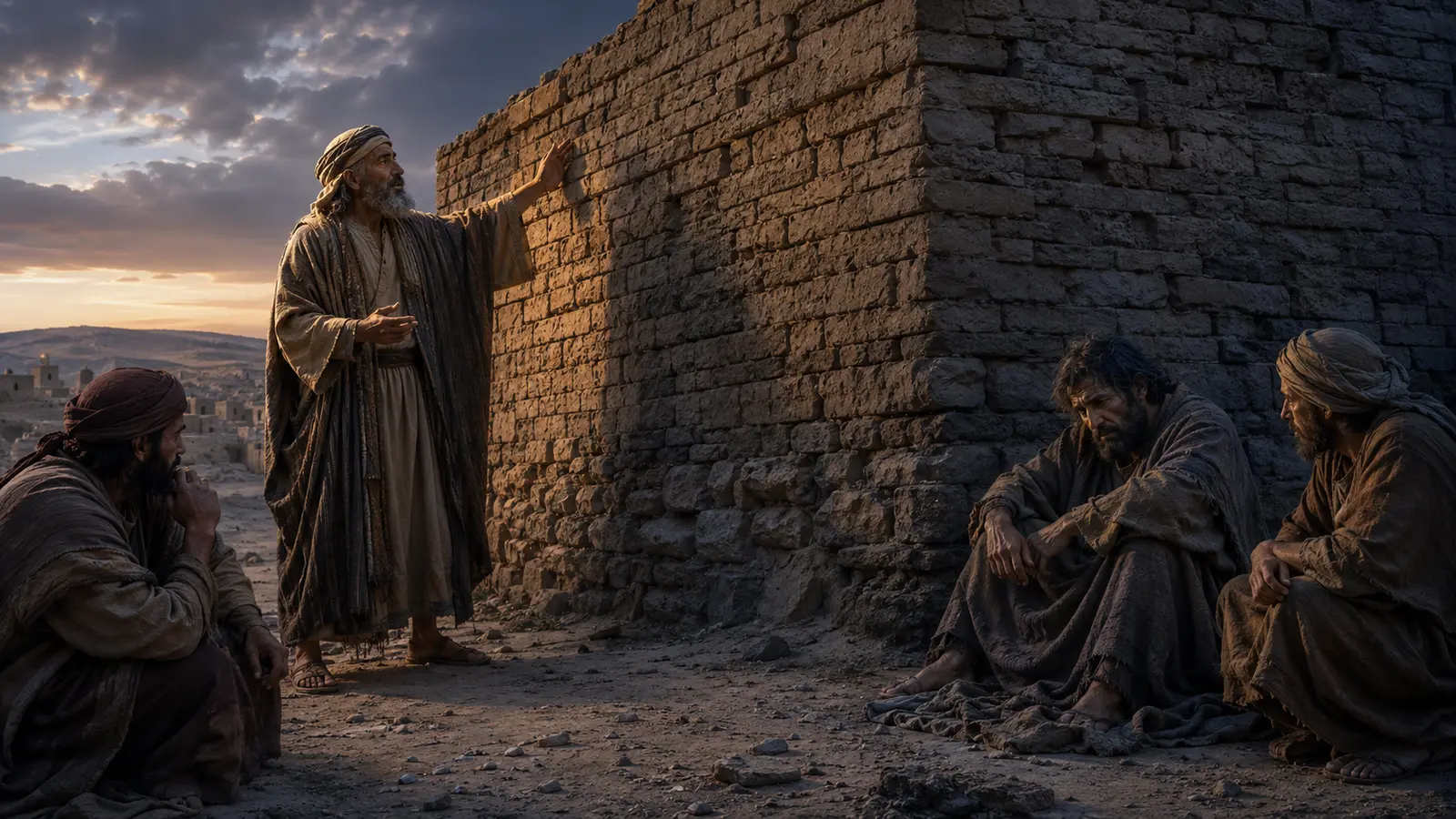
There are times when a suffering person needs a friend to say, "I don't understand, but I won't leave you." Bildad says something else.
01
Introduction
Job has asked for a chance to breathe.
Bildad answers with certainty.
Job has spoken from the desolation of pain.
Bildad answers from the library of the ancestors.
There is truth in ancient passages,
but even ancient truths can turn to stone
when thrown at a mourner.
02
1.0 Introduction: When You Definitely Go Into the Ash Heap
There are times when a suffering person needs a friend to say, "I don't understand, but I won't leave you." Bildad says something else.
Job 8 is the first speech of Bildad Mshuhi. Eliphaz spoke first, with caution, spiritual experience, and a kind of wounded gentleness that gradually turned into accusation. Bildad is more aggressive. He does not surround the wound; he goes straight to the wound. Job's words, he says, are like a strong wind. God does not do justice. If Job's children died, then they must have sinned and were given over to the power of their transgressions. If Job is pure and honest, he should seek God, ask for mercy, and believe that his last days will be greater than his beginning.
Those words are hard to hear after Job 1-7.
We know what Bildad does not know. Job's children did not die because the narrator revealed their secret evil. Job does not suffer because he has abandoned God. The heavenly preface has already told us that Job is perfect and upright, a man who fears God and avoids evil. Bildad speaks from a system that cannot imagine the suffering of an innocent person. He sees the tragedy and immediately looks for the culprit.
However, Bildad is not portrayed as an atheist or a fool in the usual sense. He believes God is just. He respects the wisdom of the ancestors. He believes that the world has a moral order. He believes that evil cannot ultimately flourish and that God will not reject an innocent person. These beliefs are not for nothing. Scripture itself often confirms it.
The problem is not that Bildad is not truthful. The problem is that his truth is too hard for Job's wound.
This article is about tradition (customs and ancient wisdom) turning into a wall, because Bildad shows us how inherited wisdom can defend God's justice but fails to love God's servant who is suffering.
Job 8 teaches us to deal with tradition with humility. Ancient passages are beautiful when they lead us to wisdom, mercy, and faithfulness. But when tradition becomes a system that cannot see the person in front of us, it stops being a lamp and turns into a courtroom.
03
2.0 Historical and Literary Context: The Second Friend Enters
Job 8 forms the first cycle of discourse between Job and his three friends. The arrangement so far is clear. Job cursed the day of his birth in Job 3. Eliphaz responded in Job 4–5. Job responded in Job 6–7, first confronting his friends and then crying out to God. Now Bildad speaks.
Bildad's first speech is shorter and sharper than Eliphaz's. It can be divided into three parts:
God's justice and Job's responsibility (vv. 1-7).
The authority of tradition and lessons from nature (vv. 8-19).
The final assurance that God will not reject the innocent (vv. 20-22).
Bildad's main question is, "Does God pervert justice?" He thinks the answer is clear: no. But from that fact he draws a dangerous conclusion: therefore Job's suffering must resemble a simple arrangement of sin and punishment, repentance and restoration.
Bildad uses three sources of authority. First, he uses moral logic: God is just. Second, he uses ancestral tradition: ask the previous generation. Third, he uses nature: papyrus without water withers, weak hope collapses, plants may look strong but can be uprooted.
All three sources—moral order, tradition, and nature—can teach wisdom. The book of Job itself will later use creation to open Job's understanding of God's vast and wise rule over the earth. But Bildad uses these sources very sparingly. He does not yet learn from the difficulties of creation; he uses selected images from the creation to emphasize the closed system.
This is why Job 8 is so important for theological formation. It warns us that a person can defend God's justice in a way that distorts God's heart. One can quote the ancestors and still fail his friend. One can talk about justice and still be unjust in practice.
04
3.1 "How Long?" — When Grief Is Taken Like Wind (Job 8:1–2)
Bildad begins, "How long will you speak these words, and the words of your mouth become a great wind?"
This is not a soft opening. Job has just described life as hard work, sleepless suffering, and breath leading to dust. He has asked God why he has made him a target. Bildad hears this and calls it wind.
In Job 6, Job pleaded that the words of a desperate man should not be taken as mere wind. Bildad does the very thing that Job feared. He reduces Job's lamentation to noise. Job's grief, for Bildad, is not a wound to be weighed but a storm that should be rebuked.
The phrase "How long?" it also carries the meaning of impatience. Bildad believes Job has spoken too much. The victim has become a burden. His words are not only wrong; it's too much. This is how society often lets down injured people. We can endure sorrow for a short time, but then we tire of it repeating itself. We want pain to be short, neat, and teachable.
But severe pain often recurs because the wound has not yet rested. Job's words are like the wind to Bildad because Bildad does not listen to the weight that is in him.
05
3.2 "Does God Pervert Justice?" — True Teaching, False Recognition (Job 8:3)
Bildad asks, "Does God pervert what is right? Or does the Almighty pervert what is right?"
The answer is no. God does not do justice. God is not corrupt. God is not morally corrupt. In this sense, Bildad's teaching is true.
But a true doctrine can be placed within a false diagnosis.
Bildad thinks that if God is just, then Job's suffering must be deserved. For him, God's justice works with immediate and visible moral precision: the righteous are blessed; the wicked are punished; therefore tragedy reveals guilt.
He cannot imagine that God's justice can be real while the present situation remains secret, delayed, hidden, or more difficult than the human mind can comprehend.
The book of Job does not deny God's justice. It expands the conversation beyond the narrow map of Bildad. God is just, but Job's suffering is not an easy punishment. God rules the world, but not as a machine that immediately translates every moral action into tangible reward or loss.
Bildad's problem is not that he believes too much in justice. It is that he believes too little in the inexplicable mysteries of God.
06
3.3 The Most Cruel Judgment: "If Your Children Have Sinned" (Job 8:4)
Then comes one of the most painful lines in this conversation: "If your children sinned against him, he punished them for their guilt."
This is where Bildad's theology cuts deeper.
Job's children are dead. They died together when a strong wind hit the house where they were having a party. Job has torn his cloak, shaved his head, fallen down, worshipped, and mourned. Bildad now interprets their deaths as justice. If they died, they must have sinned. God gave them what they deserved.
The reader should feel the gravity and brutality of this moment.
Bildad tries to protect God's justice, but he does so by stepping on the father's sorrows. He speaks of Job's children as a theological example, not as beloved children whose absence has torn the family apart.
Here the book warns us about the urgency of providing explanations after a disaster. When disaster strikes, people often ask, "Whose sin caused this?" Jesus himself opposed this view. In John 9, when the disciples asked if the suffering of the man born blind was caused by his sin or the sin of his parents, Jesus rejected that view. In Luke 13, when people were killed by political violence and a fallen tower, Jesus did not allow simple moral calculations.
Bildad's statement is ancient, but the temptation is still there today. We still rush to associate suffering with blame because blame makes the world appear to be in control. But the book of Job stands in our way and says: be careful. You can defend justice when you do injustice with your mouth.
07
3.4 Conditional Hope: "If you seek God" (Job 8:5–7)
After talking about Job's children, Bildad turns to Job: "If you seek God, and plead with the Almighty; If you are pure and upright; Surely he would now wake up for you, and make your righteous abode successful."
This is optimistic and conditional. Bildad has not fully judged Job. He sees a way back. If Job seeks God, if Job is pure, if he prays, then God will restore him. His beginning may be small, but his end will be great.
Again, parts of these words are good. It is good to seek God. It is good to ask for mercy. It is good to believe that God can restore. The problem is his system: Bildad thinks Job's restoration depends on Job accepting a diagnosis that is false.
If Job followed Bildad's advice through Bildad, Job would be admitting that his suffering proves his guilt. He would make godliness a method to get his life back. That would come very close to the accuser's claim in the preface: that men only serve God because blessings follow.
Bildad tries to save Job, but his advice unknowingly compromises Job's integrity. He tells Job to seek God as a way to restore success. But Job must learn to seek God because God is God, even when success is gone.
This is a serious warning: not every call to repentance is sincere. Repentance is holy when sin is real. But when repentance is demanded as payment for relief from unspeakable suffering, it becomes a business—and the gospel is not a business.
08
3.5 Ask the Ancestors: The Power and Danger of Tradition (Job 8:8–10)
Bildad now uses tradition: "Please ask the old generation, and consider what their fathers sought." We are just from yesterday and we don't know a word, he says. Our days on earth are a shadow. The ancestors will teach. From their hearts they will give words.
There is humility here. Bildad knows that one generation is too short. Human life is short. We must not underestimate the wisdom of those who came before us. In a world immersed in new things, Bildad reminds us that we are not the first to seek wisdom. Fathers and mothers of faith are important. Tradition can comfort us when our personal experience is too narrow.
But tradition can also be misused.
Bildad uses the past tense as if that tense speaks with only one voice. He thinks that inherited wisdom solves Job's case. He does not allow Job's suffering to become a new question before tradition. You don't ask if the ancestors themselves could have mourned, fought, resisted, or accepted the hardships of things.
True tradition is not a museum of sayings. It is a conversation between the living and the faithful dead. They give us roots, but not chains. They teach us patterns, but not permission to ignore the injured person standing before us.
Bildad's appeal to tradition turns into a wall because he uses it to stop listening.
09
3.6 Papers Without Water: The Weakness of the Prosperity of the Godless (Job 8:11–13)
Bildad turns to nature. Can papyrus grow without mud? Can grass grow without water? Still fresh, before they are cut, they wither faster than leaves. Such are, Bildad says, the ways of all who forget God; the hope of the godless perishes.
This picture is obvious. The papaya looks very leafy, but it is completely water dependent. Remove the mud, and the freshness crumbles. Bildad's lesson is clear: life without God cannot last. Hope without God is a plant cut from its source.
This is the truth as a principle of wisdom. A life separated from God cannot ultimately flourish. The wicked may look fresh for a while, but their roots are dry.
However, this image is dangerous in this context. Job withers. His house has collapsed. His body is sick. If withering proves godlessness, then Job must be godless. Bildad does not need to state the accusation directly; the puzzle itself does the job.
Nature can teach, but nature should be studied with humility. A wilted plant may indicate a lack of roots, but it may also indicate drought, locusts, extreme heat, or a season of pruning. Bildad chooses the interpretation that fits his system.
The book of Job will later allow God to speak through creation in a much broader way. Creation is not just a class of moral principles; it is a great hall of divine wisdom, full of wild goats, wild donkeys, ostriches, storms, seas, Behemoths, and Leviathan. Bildad's papyrus is too small to hold all the secrets.
10
3.7 The Spider's Web: The Collapse of False Security (Job 8:14–15)
Bildad continues: the hope of the godless is weak, like a spider's web. A man leans on his house, but it does not stand. It holds a lot, but it doesn't last.
Again, this metaphor is wise. False security cannot bear the ultimate weight. Wealth, status, reputation, family systems, human pride, and self-righteousness can be nets that are supposed to be walls. Trust them too much, and they will be cursed.
But Job's house has truly fallen. Her children died in the collapsed house. This puzzle cannot be unusual in this environment. Bildad speaks of a house that cannot stand for a person whose family home has become a grave.
This is what happens when we use images without pastoral thought. The mystery may be true, but the wound before us changes the way it is received.
Bildad wants Job to see the danger of false security. But Job needs his friends to see the ashes of his real house, his real children, his real sorrows.
11
3.8 The Plant in the Garden: Prosperity, Uprooting, and Limits of Appearance (Job 8:16–19)
Bildad's final picture of nature is more complex. He describes a fresh plant in the sun, spreading its branches over the garden, wrapping its roots around the stones, looking strong and concentrated. However, if you are destroyed from its place, that place denies you: "I have never seen you." Others spring from the dust.
This image can be read as another image of the wicked: a surprising growth, sudden uprooting, and loss. It may also hint at the possibility that real life can grow even among stones, depending on how the image resonates within Bildad's grand promise. Either way, Bildad cares about appearances. What seems solid may not last. What seems to be rooted can be denied by the place where it was.
For Job, these are words that touch him deeply. He has been stripped of honor. His place no longer recognizes him. The greatest man of the East now sits in ashes. His identity has been torn from the soil where it once grew.
Bildad reads the uprooting as moral evidence. Job experiences being uprooted as a secret.
The difference between them is the difference between system and soul.
12
3.9 God Will Not Reject the Innocent (Job 8:20–22)
Bildad ends with an assurance: God will not reject a perfect person, nor will he strengthen the hand of evildoers. He will still fill your mouth with laughter, and your lips with joy. Job's enemies will be put to shame, and the tent of the wicked will be no more.
These last lines sound hopeful. In fact, some of them will eventually be fulfilled in a way that Bildad cannot predict. Job will surely be defended. His mouth will know joy again. His friends, not Job, will be exposed as having spoken ill of God.
But Bildad's hope is still not the comfort that Job needs. It is the hope that comes from a wrong diagnosis. It says, "If you enter the group of the perfect, God will restore you." Job needs someone to say, "You are my friend, and I will stand with you when all order collapses."
Bildad cannot provide that. He offers a map with conditions, not covenant faithfulness.
And yet, in God's mercy, this chapter holds an unintended promise. God will not reject the perfect. The reader knows that Job is perfect in the sense set by the preface. So Bildad's own words will one day stand up as evidence against Bildad's use of those words.
Sometimes God uses even insufficient comfort to preserve the seed of hope.
13
4.1 God's Justice Is True, But Our Interpretations Have Limits
Bildad is right that God is not just. But he is wrong to think that he can see exactly how God's justice works in Job's suffering. This distinction is important. Faith can affirm God's justice without pretending to interpret every tragedy. Humility says, "God is righteous." Pride says, "So I know exactly why this happened."
14
4.2 Tradition is a gift when it teaches humility
Bildad's appeal to previous generations is not bad in itself. We need tradition. We need the wisdom of those who came before us. But true tradition teaches piety, patience, mourning, and mercy—not just words. When tradition becomes a way to silence suffering, it is misused. Grandparents should teach us how to listen, not just how to win an argument.
15
4.3 The Death of Children Should Never Be Taken as a Theological Example
Bildad's comment about Job's children is one of the most obvious failures of pastoral dialogue in the book. He speaks when he should have cried. The sufferings of children and the sorrows of parents must be attended to with holy trembling. Any theology that makes us normal in the face of tragedy has lost touch with the God who hears Rachel crying for her children.
16
4.4 Nature Gives Wisdom, But Not Simple Rules
Bildad uses papyrus, spider webs, and plants to teach reward. Later, God will use wild creation to teach secrets. This distinction is important. Creation is not a flat book of moral equations. It is a great sign of divine wisdom beyond our control. We should learn from nature, but not reduce it to a mirror of our concepts.
17
4.5 Christ Breaks the Logic of Simple Payments
Bildad says God does not reject an innocent person. On the cross, Jesus—the truly innocent—seems rejected, condemned, and ostracized. If Bildad had stood at Calvary, his system would have called Jesus a sinner. But the resurrection reveals the deeper justice of God. The innocent sufferer defends, not because suffering always proves guilt, but because God's faithful love goes through suffering and defeats death from within. The cross teaches us to be very slow before we say, "This happened because they sinned."
18
5.1 Don't Call the Lament of the Oppressed "Wind" Too Soon
When someone speaks out of pain, don't dismiss their words as empty. Ask what sorrows those words carry.
19
5.2 Defend God's Justice Without Pretending to Know God's Reasons
It is honest to say, "God is righteous." It can be harmful to say, "I know exactly why God allowed this." Leave room for God's inexplicable mystery.
20
5.3 Never Use Adversity as a Weapon
Do not interpret the deaths of loved ones as evidence in a theological argument. Stay with tears. Respect the loss. Speak slowly, or don't speak at all.
21
5.4 Learn from the Ancestors, But Don't Hide Behind Them
Read about the forefathers and mothers of faith. Receive the tradition. But let tradition make you wiser and more compassionate, not hard and unapproachable.
22
5.5 Beware of Conditional Comfort
"If you do this, then God will restore you" may sound hopeful, but it can crush the innocent sufferer. Offer God's mercy without turning faith into business.
23
5.6 Read Nature with Surprise, Not Control
Nature can teach dependence, vulnerability, and hope. But don't use natural imagery to force people into moral categories. God's creation is greater than our principles.
24
5.7 Let Jesus Teach You How to See the Innocent Sufferer
When you see suffering, remember the cross before you speak. The righteous may suffer. The innocent can be accused. God's defense can come through resurrection, not instant explanation.
25
6.0 Reflection Questions
Have I ever used a true teaching in a way that hurt someone because I used it too quickly?
What traditions have shaped my understanding of suffering, justice, and blessing?
Where can I be tempted to interpret tragedy as evidence of guilt?
How can I honor the wisdom of the ancestors while still listening carefully to the pain of the present?
What does Bildad's speech teach me about the dangers of conditional comfort?
How does the cross of Jesus change the way I respond to the suffering of an innocent person?
26
7.0 Responsive Applications
God of justice and mercy,
We confess that we often want the world to be simpler than it is.
We want every wound to be understood,
let every disaster be put in its own group,
every sorrow should be well placed within the moral framework.
We fear the unknown, so we rush to certainty.
We defend your right to words that sometimes hurt your children.
Forgive us.
Teach us to respect tradition without hiding behind it.
Teach us to love wisdom without turning it into a wall.
Teach us to talk about your justice with humility, and human suffering with tears.
Save us from the cruelty of Bildad.
Avoid giving explanations for deaths that others are still mourning.
Let us avoid calling the cries "wind" when they could be the voice of a faithful soul struggling to breathe. Lead us to Jesus, the innocent victim, rejected by human judgment and defended by resurrection.
Let his cross break our simple principles.
Let his risen life teach us a hope that does not condemn,
comfort that does not trade,
and the truth that kneels beside the wounded.
Make us friends who carry ancient wisdom with living mercy.
Amen.
27
8.0 A Window to What's Next: When Job Sees the Courtroom and the Storm
Bildad has spoken. He has defended the justice of God, he has used tradition, he has taken lessons from nature, and he has given Job conditional hope. But he has also magnified Job's wound by suggesting that Job's children died because of their sins and that Job's future depends on conforming to his theological groups.
Job will answer in chapters 9-10.
In Job 9, he will admit that God is indeed wise and mighty—but the same truth becomes terrifying. How can a man bring a case before God like this? How can Job enter into court with the One who commands mountains, seas, stars, and storms? Job begins to long for an arbiter, someone who could lay his hand on God and man.
The debate is shifting from tradition to legal claims. The ash heap turns into a courtroom, and Job begins to look for an arbitrator in a world where God is seen as both judge and adversary.
The question will no longer be, "Is God just?" It will be, "How can a wounded man meet a righteous God and not die?"
28
9.0 References
Alter, Robert. The Wisdom Books: Job, Proverbs, and Ecclesiastes: A Translation with Commentary. New York: W. W. Norton, 2010.
BibleProject. "The Book of Job." Old Testament Overview Guide.
Clines, David J. A. Job 1–20. Word Biblical Commentary 17. Dallas: Word Books, 1989.
Crenshaw, James L. Old Testament Wisdom: An Introduction. Louisville: Westminster John Knox, 2010.
Hartley, John E. The Book of Job. New International Commentary on the Old Testament. Grand Rapids: Eerdmans, 1988.
Walton, John H., and Tremper Longman III. How to Read Job. Downers Grove, IL: IVP Academic, 2015.
Wright, N. T. The New Testament and the People of God. Minneapolis: Fortress, 1992.

Be the first to leave a comment.