

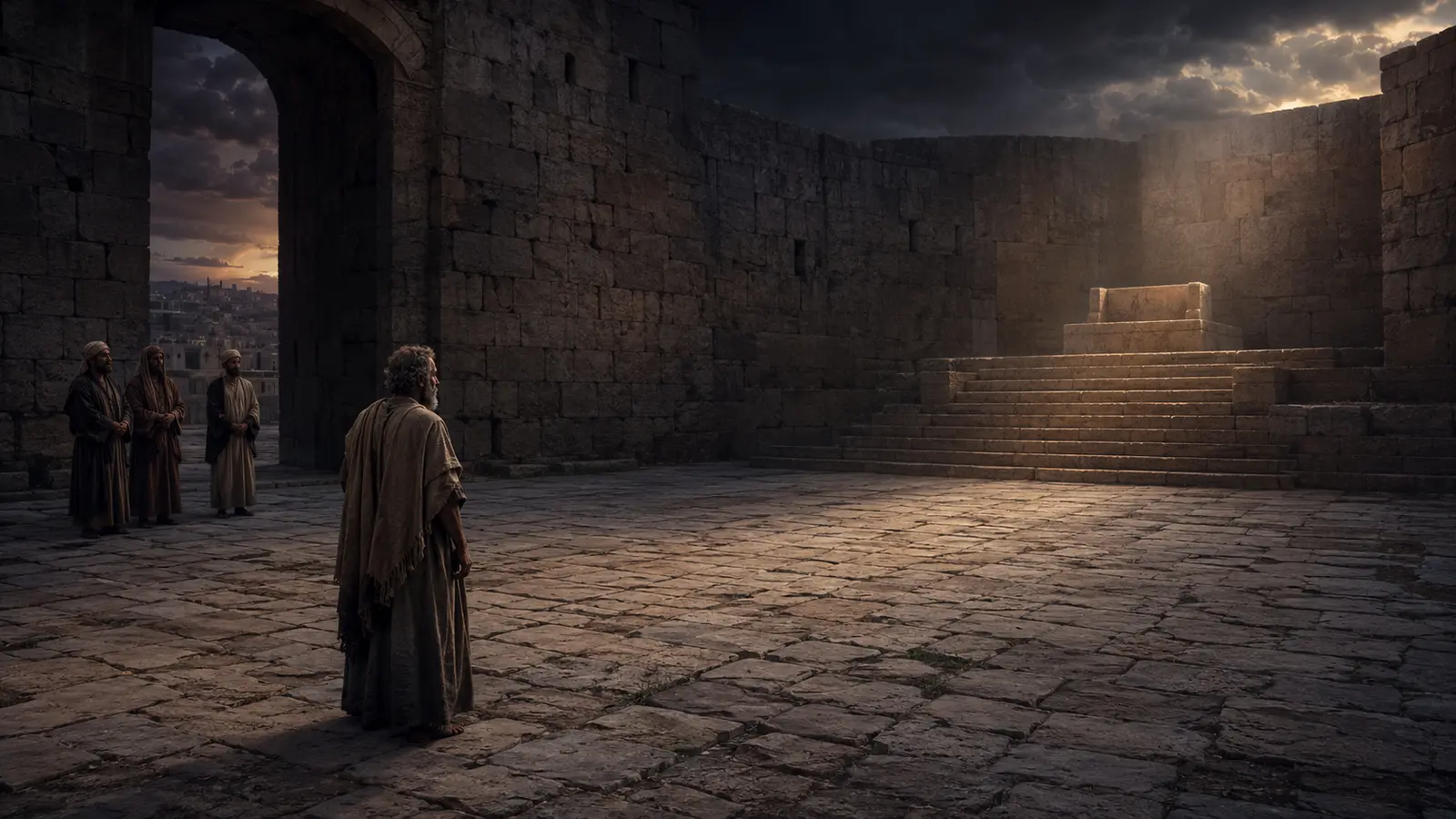
There are times when the question is not whether God has power. The question is whether the powerless can speak before him and live.
01
1.0 Introduction: When the Righteous One Does Not Get the Right Attention
There are times when the question is not whether God has power. The question is whether the powerless can speak before him and live.
Job 9 is one of the main legal and judicial chapters in Scripture. Bildad emphasized that God is not enough for justice. Job agrees—at least in theory. "I really know that's the case," he says. But then he asks a question that turns the whole speech into a painful one: "How can man be righteous before God?"
This is still not Paul's question about justification in the book of Romans. This is Job's question from the ashes. How can an injured person file a lawsuit against the Almighty? How can Job prove his innocence when the one who should answer him is the One who shakes the earth, commands the sun, walks on the sea, and performs unfathomable wonders?
Job does not doubt the greatness of God. He is crushed by them. The attributes that make God worthy of worship—wisdom, power, authority, glory—now make Job feel helpless in court. God is too great to be challenged, too quick to be called, too powerful to be questioned in court, and too scary for Job to speak openly before him.
This chapter is full of tension. Job knows he is not as evil as his friends think. He also knows that he cannot force God to explain himself. He thinks of washing himself to be clean, but he is afraid that God would plunge him into the dirt anyway. He longs for a trial, but he does not see a fair court. He wants to speak, but he believes his own mouth would condemn him under the fear of heavenly glory.
Then, towards the end, passion rises like a candle in the dust: "There is no judge between us, that can lay his hand upon us both." Job needs someone who can stand between God and man, someone who can remove the rod, calm fear, and make it possible to speak.
This text is about how justice turns into a desire for reconciliation, because Job teaches us that a wounded faith may need more than just an argument—it needs someone who can stand between the holiness of heaven and the dust of man.
Job 9 does not resolve that passion. It gives it a name. And once this passion is given a name, the story of the Bible will carry it forward until it finds its most profound answer through the one mediator between God and man, Jesus Christ—not as a shortcut to avoid Job's pain, but as the fulfillment of the cry that Job dared to say.
02
2.0 Historical and Literary Context: Job's Response to Bildad and the Birth of Case
Job 9 begins as Job's response to Bildad, a response that continues into Job 10. Bildad's speech in Job 8 was harsher than Eliphaz's. He defended God's justice, returned to the traditions of the elders, warned through natural images, and pointed out that Job's children died because of their sins. He finished by assuring Job that God will not cast away a perfect man.
Job now responds from a deeper place. Unlike his response to Eliphaz in Job 6–7, where he used a lot of energy to confront his friends and then speak directly to God, Job 9 is dominated by legalistic and secular imagery. The question is: Can Job enter into a legal dispute with God? Can man be declared righteous when God is the one who has to answer him?
This chapter has a clear focus:
Job accepts that God is just, but he asks how man can be set free before him (vv. 1-4).
Job repeatedly describes God's great universal power that surpasses power (vv. 5-13).
Job concludes that he cannot answer God in court (v. 14-20).
Job laments what appears to be the collapse of the moral order (vv. 21–24).
Job laments the speed and despair of his days (vv. 25–31).
Job longs for a judge who would stand between him and God (m. 32-35).
This chapter furthers the direction of the book from lamentation to legal case. Job no longer just cries under pain. He begins to frame his suffering as a legal dispute. He wants his innocence recognized. He wants God to answer. But the whole problem is that God is not another human opponent. God is the Creator, the Judge, and the great Lord. There is no higher court to which Job can appeal.
Job 9 also holds together three languages that are often found in this book: legal language, the language of praise, and the language of lamentation. Job speaks like a litigant in court, sings the glories of the universal God like a worshiper, and grieves like a psalmist in the dark. The combination is a strong part of this look. Job's complaints are not due to ignorance of God's greatness. They are based on the fact that he knows God is great but he cannot reconcile that greatness with his own suffering.
03
3.1 "How Can Man Have Rights Before God?" (Job 9:1–4)
Job begins by admitting: "Truly I know that it is so." He not only rejects Bildad's claim that God is not just. Job knows that doctrine. He knows the confession. He knows that the Almighty is not corrupt.
But the issue is no longer whether God is just in theory. The issue is whether Job can live competing with such a God. "How can man be righteous before God?"
The question is legal. Job does not ask how man can be morally perfect. He asks how man can be declared right when his conflict is against God. If a man wanted to compete with God, Job says, he could not answer him once in a thousand.
God is "wise in heart, and mighty in strength." Who made himself stubborn about God, and he succeeded?
This is not disbelief. It is the fear of inequality. In a regular court, both parties may testify before a judge. But what if one side is the Judge of the whole world? What if the one who should answer Job is the one whose wisdom no human argument can overcome and whose strength no creature can withstand?
Job's question reveals the limits of Bildad's certainty. "God is righteous" is the truth. But for Job, the next question is: How does that justice reach a person who is broken and cannot get attention?
04
3.2 The God Who Moves Mountains and Commands the Stars (Job 9:5–13)
Job now turns to a song-like description of God's power. God moves mountains, and they do not know. He overturns it in his anger. It shakes the earth from its place, and its pillars tremble. You command the sun, and it does not rise. Binds the stars.
The image is universal. The mountains, the earth, the sun, the stars—everything solid and glorious is under God. Job does not imagine a small god in charge of a small corner of life. He is talking about the Creator whose authority reaches to the foundations of the world.
Then the song expands. God alone stretched out the heavens. He treads the waves of the sea. He made the Bear, Orion, Kilimia, and the southern chambers. He does unsearchable great things and innumerable wonders.
In another context, these lines could have been empty praise. It would absolutely deserve to be in a worship psalm. But here it trembles with fear. The glory of God still does not comfort Job; you are overpowering him. The same God who commands the stars cannot be called to court by a man sitting on ashes.
Verse 11 provokes a further problem: God is passing by, but Job does not see him. He continues forward, but Job does not recognize him. God is powerful and hidden. He is there but he cannot be caught. He works but is unavailable.
Then Job says that if God grabs something, who can stop him? Who can say to him, "What are you doing?" Even Rahab's allies—the forces associated with world chaos—kneel before her.
Job's theology is great, but his comfort is small. He knows God rules the world. He does not know how to take his grievance to the administration and be heard.
05
3.3 The Case That Job Can't Win (Job 9:14-20)
Job now returns to court. If God is so wise and powerful, how can Job answer him? How can he choose the words to discuss with him?
Even if Job were right, he says, he could not answer. He could only beg for mercy from his judge. If he called God and he answered him, Job would not believe that God was listening to his voice. The gap seems too wide.
This is one of the loneliest moments in the book. Job longs for answers, but even if answers did come, he fears they would not be true listening. The pain has made him stop believing in the possibility of being accepted.
Then Job describes God as the one who crushes him with a storm and aggravates his wounds for no reason. The phrase "without reason" refers to the prologue, where God himself admitted that Job was destroyed without reason, in the sense that his suffering was not a fitting punishment for any evil. Job does not know what happened in heaven, but his experience reaches the truth: his wounds do not correspond to guilt.
God, Job says, does not allow him to breathe but fills him with pain. If it is a contest of strength, God is strong. If it is a matter of justice, who can call him? If Job defends himself, his own mouth will judge him. If he says he is perfect, his words will make him look perverted.
The court has become impossible. Job has a great fear of speaking without stumbling. God is too powerful to be forced. Justice is needed, but the process is blocked.
This is where Job's suffering becomes more than painful. It becomes a conflict of conversation. How can the injured speak the truth in the face of a force that exceeds their ability?
06
3.4 "He Destroys the Perfect and the Wicked" (Job 9:21–24)
Job now says words that sound dangerous: "I am perfect; I do not care for myself; I hate my life." Then he says, "All are one; therefore I say, he destroys the perfect and the wicked."
This is not a settled philosophy written quietly in an office. It is a cry from someone who believes that moral categories have collapsed in his experience. If the perfect can be crushed like the wicked, then how is the world governed?
Job increases his accusations. When disaster brings sudden death, God mocks the plight of the innocent. The world is given into the hands of the wicked. God covers the faces of his judges. "If not him, then who?"
These are among the boldest words of Job. He is not just saying that injustice is happening. He says that God seems concerned with a world in which injustice occurs without correction. Job still does not see how God's justice and his own experience can be true together.
We must not ignore this. Job is not correct in every sense of his words. Later, God will ask him questions. But Job is also not a false comforter. He speaks from the real scandal that the book wants us to face: the innocent really suffer, sometimes the wicked succeed, and light formulas cannot carry the weight of the world.
Job's complaint is dangerous, but not faithless. They are directed into the moral world of God. Job can sue simply because he still believes justice is important.
07
3.5 Days Like Runners, Boats, and Eagles (Job 9:25–31)
The speech now turns from the world court to personal mourning. Job's days go faster than a runner. They run away and do not see well. They disappear like papyrus boats, like an eagle swooping down on its prey.
Time flies too fast. A case cannot be arranged before life is over. Job's days are running towards death while his case remains unheard.
He tries to imagine a change of attitude: "If I say, 'I will forget my grievances, I will leave my sad face and be cheerful,' I fear all my sufferings, for I know you will not count me innocent." Job can't just choose to be positive. He can't smile as he seeks release. The pain is there, and the fear is there.
Then he says, "I will be judged; then, why should I trouble myself in vain?" If the verdict is already against him, the effort seems pointless.
Job imagines washing himself with snow water and cleaning his hands with soap. This is an image of public innocence, cultural purity, and moral openness. But even then, he says, God would drown him in the pit, and his own clothes would hate him.
This picture is sad. Job feels that no effort to prove his innocence can stand if God decides to shame him. He could wash, but God could make him dirty. He could clean his hands, but the heavens would put him to shame.
Here Job's grief touches a deep human fear: what if the truth about me cannot be seen? What if the public story about my life is false, and I have no way to correct it? What if the one who knows the truth does not speak?
08
3.6 Desire to Have a Judge (Job 9:32–35)
The chapter reaches its painful climax: "For he is not a man, like me, that I shall answer him, that we may meet together in court."
God is not like Job. That is the theological problem. God's sovereignty is not denied; that is the very reason that makes Job feel trapped. There is no impartial tribunal where God and Job can stand as equals.
Then comes the passion: "There is no judge between us, who can lay his hand on both of us."
Job envisions a mediator, an arbiter, a middle man—someone who can reach both sides, someone who can keep one hand on God and one hand on Job, someone who can hold the holy and the offended together. Such a person could remove God's rod from Job and prevent the fear of God from scaring him. Then Job could speak without fear.
This is one of the most important interests in this book. Job is not just asking for information. He is asking for a presence that will reconcile. He needs a way to talk to God without being destroyed by fear. He needs the fear to be calmed so that the truth can emerge.
The chapter ends unresolved: "But it is not so with me." The referee is not there. The courtroom remains empty. The rod is still there. The fear remains. Job still cannot speak freely.
But passion is born. And in a large group of sacred texts, that passion will not be forgotten.
09
4.1 The Majesty of God Can Be Terrifying for the Injured
Job's song of God's universal power is true. God shakes the mountains, orders the stars, treads the seas, and does unsearchable wonders. But in Job's pain, this greatness does not sound like a refuge. You sound like an unanswerable force.
This teaches us pastoral care. Do not think that every declaration of God's authority will immediately comfort every afflicted person. Sometimes a person who suffers needs to know not only that God is great, but that God's greatness is connected with mercy, gentleness, and closeness.
10
4.2 A passion for justice requires more than just principles
Bildad says God does not give justice. Job does not directly deny this. But he asks how justice reaches a wounded man.
The doctrine of justice is insufficient if the injured cannot be heard. Biblical justice is not just an idea in heaven; it must be good news for those who were oppressed, accused, and silenced.
11
4.3 Job's complaints are not the whole truth, but they are the truth about his situation
Job says things in this chapter that are theologically dangerous. He suggests that God destroys the innocent and the wicked together and delivers the world into the hands of the wicked. The entire book will not allow those statements to stand as final truth.
But it also doesn't erase them. Scripture preserves Job's complaint because suffering is often felt in this way. The Bible teaches us to bring these feelings into conversation instead of burying them under compulsive piety.
12
4.4 The Passion of the Judge Opens a Scriptural Door
Job's cry for someone to stand between God and man becomes one of the greatest passions of the book. He needs more than a lawyer. He needs someone who can touch the sky and the dust together.
The story of the Bible will carry this passion through priesthood, prophecy, mourning, and hope until it reaches Jesus Christ, the one who shares God's life with human flesh. In itself, reconciliation is not an abstract legal arrangement. It is the incarnation, the cross, the resurrection, and intercession.
13
4.5 Christ Responds to Job's Passion Without Erasing His Mourning
It would be too quick to say, "Job asked for a mediator; Jesus is the mediator; therefore the pain is resolved." The chapter of Job must first be heard. The court still seems empty to him. Fear still makes it impossible to speak.
But from the other side of the cross, Christians can say with humble hope: God has not remained unreachable. In Jesus, God has entered the human side of the court. The judge has approached like a righteous victim. The one before whom Job trembled has taken on a body, carried wounds, and opened the way for fearful people to speak.
14
5.1 Do not use God's Power to Silence Pain
God's authority is real, but it should not be used to suppress mourning. Talk about the majesty of God as well as his mercy, patience, and wounded love revealed in Christ.
15
5.2 Allow Victims to Ask Legal Questions
Job wants justice, to be heard, to be defended, and to follow due process. These are not unspiritual desires. Communities of faith should be very concerned when people feel they have not been heard, have been falsely accused, or cannot express the truth of their suffering.
16
5.3 Accept When It Appears The Court Is Empty
There are times when prayers seem unanswered and God seems unreachable. Job 9 gives language to that experience without forcing a preconceived solution.
17
5.4 Don't Force Happiness to Be Proof of Faith
Job can't just forget his grievances and put on a happy face. Loyalty is not a joke. Allow sadness to speak honestly before you ask it to smile.
18
5.5 Seek Compassionate Mediators
Although only Christ can stand between God and man in the end, the church is called to make a reconciliation of mercy in action: advocates, intercessors, counselors, pastors, elders of the church, and friends who help those who are afraid to speak and who have not been heard to be given attention.
19
5.6 Bring your fear of God to Jesus
If God's holiness feels scary, come to Christ. You do not make God less holy; it makes God's holiness look like healing love. He places his wounded hand on the human and divine hand on the throne.
20
6.0 Reflection Questions
Have I ever felt that God's power makes him harder to approach, instead of easier?
Where in my life do I desire the right attention?
Do I use true statements about God to silence the true pain of another person?
What does Job's desire to find a judge reveal about man's need for a mediator?
How does Jesus help me speak before God without fear?
Who around me needs a defender, and not an accuser?
21
7.0 Responsive Prayer
God of mountains, seas, and stars,
We come trembling, like dust before the storm. You have wisdom in your heart and power in your strength. You span the heavens. You order in the morning. You do unfathomable wonders.
And yet, sometimes your majesty scares us.
When we feel too small to speak, give us mercy. When the court seems empty, give us hope. When our own words seem ready to condemn us, give us an advocate. When fear causes prayer to fail, calm the fear and help us breathe.
Forgive us for using your power without your gentleness. Forgive us for demanding happiness from the wounded. Forgive us for defending justice in theory while ignoring those who need to be heard in practice.
Point us to Jesus, the mediator we could not create, the righteous sufferer who stands with God and with us. May his wounded hands rest upon heaven and earth. May his cross silence the rod of condemnation. His resurrection should teach us that the last word on the innocent victim is not shame, but defense and life.
Give us the courage to speak the truth, the humility to wait with dignity, and the compassion to stand by those whose case has not yet been heard.
Amen.
22
8.0 A Window to What's Next: When the Creator is Sued by His Creature
Job 9 ends with passion. There is no referee. There is no mediator. There is no one to lay hands on God and Job. The court is still inaccessible, and Job is still unable to speak without fear.
But Job's speech is not over.
In Job 10, he will turn more directly to God and ask him why the Creator has turned away from the creature he carefully created. The language will be more intimate and painful: God's hands created him, clothed him with skin and flesh, joined him together with bones and sinews—why destroy him now?
The court will be a creative workshop. The Judge will be mentioned as the Creator. And Job will ask the question that shakes under every injured life: Why did you give me life if life would be like this?
The passion for reconciliation will turn into mourning over creation itself.
23
9.0 References
Alter, Robert. The Wisdom Books: Job, Proverbs, and Ecclesiastes: A Translation with Commentary. New York: W. W. Norton, 2010.
BibleProject. "The Book of Job." Old Testament Overview Guide.
Clines, David J. A. Job 1–20. Word Biblical Commentary 17. Dallas: Word Books, 1989.
Crenshaw, James L. Old Testament Wisdom: An Introduction. Louisville: Westminster John Knox, 2010.
Hartley, John E. The Book of Job. New International Commentary on the Old Testament. Grand Rapids: Eerdmans, 1988.
Walton, John H., and Tremper Longman III. How to Read Job. Downers Grove, IL: IVP Academic, 2015.
Wright, N. T. The New Testament and the People of God. Minneapolis: Fortress, 1992.

Be the first to leave a comment.