

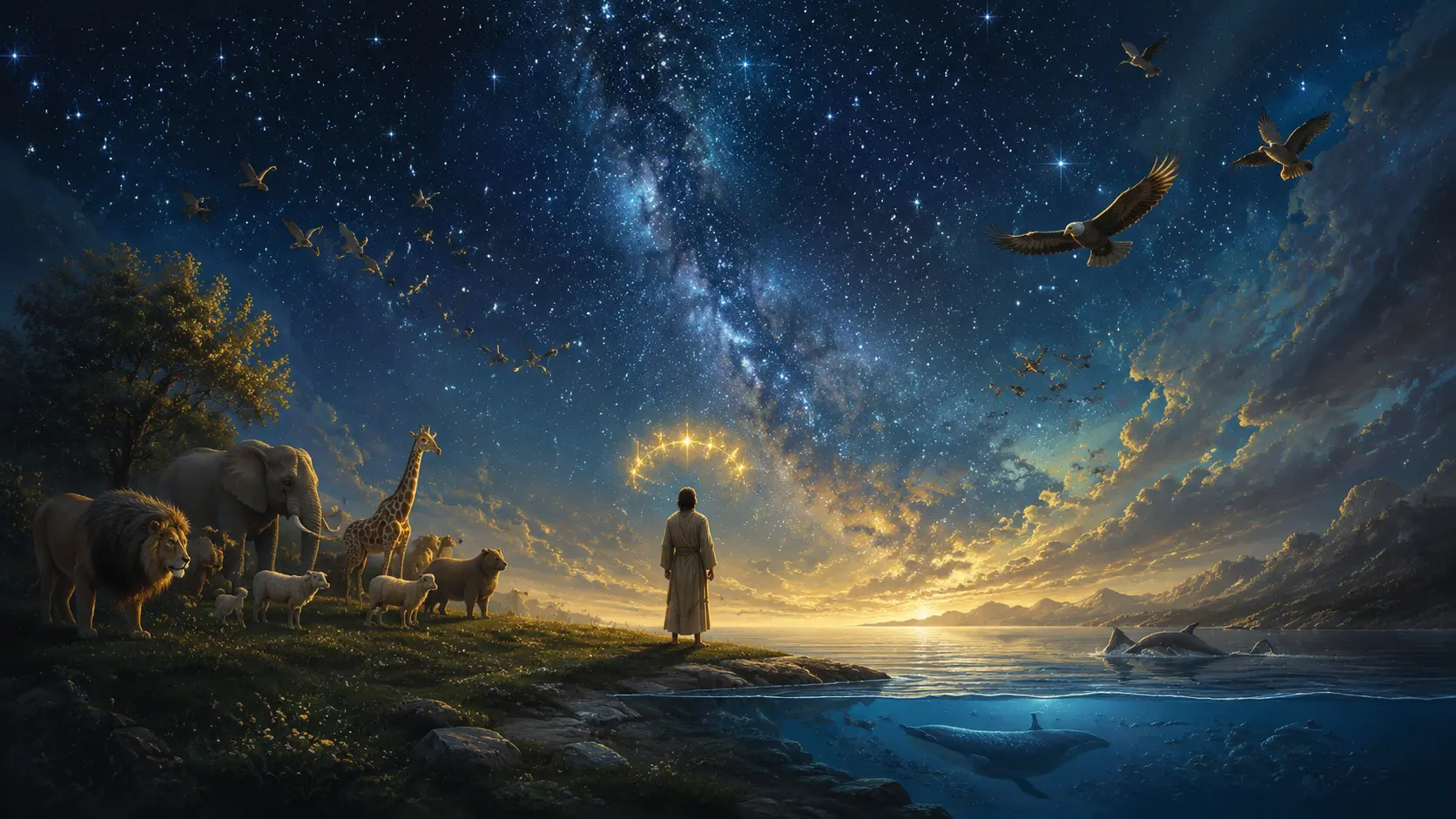
When Human Smallness Becomes Royal Vocation The night sky makes us feel small, yet the Creator places a crown on dust. Babies become a fortress, fragile humans receive a kingdom, and divine majesty shines through entrusted weakness.
01
1.0 Introduction: What Are Human Beings That God Notices Us?
Standing beneath a clear night sky can rearrange our sense of importance. Stars multiply beyond imagination, and the dramas of the day suddenly seem small. Psalm 8 begins inside that tension. Humans look insignificant within creation, yet the Creator remembers, attends to, crowns, and commissions them.
This is not flattery. The poem asks why God cares for creatures so small. Its answer is grace expressed as vocation: God shares responsibility for his world with image-bearing humans. Even more surprising, babies silence enemies. Divine majesty is revealed through the small, vulnerable, and dependent.
This text is about smallness becoming vocation, because the Creator reveals his majesty by entrusting fragile humans with the royal responsibility of reflecting his rule.
Psalm 8 refuses two opposite lies: we are neither accidents without value nor autonomous gods without limits. We are crowned creatures—dust given dignity and responsibility beneath Yahweh’s rule.
02
2.0 Historical and Literary Context: A Song at the Center of Weakness
Psalm 8 is attributed to David and addressed to the musical director. Psalms 1–2 introduce Torah and Messiah; Psalms 3–7 then portray David under pressure, depending on Yahweh rather than raw force. Near the center of Psalms 3–14, Psalm 8 becomes a theological lens: the vulnerable David before it and the poor and afflicted after it reveal a God who elevates the weak for his purposes.
The poem is framed by the repeated confession in verses 1 and 9: “O Yahweh, our Lord, how majestic is your name in all the earth!” This inclusio holds the psalm together. Everything between those lines explains how Yahweh’s majesty appears in creation and through the surprising vocation of small creatures.
The heavens, moon, stars, creatures, and humanity’s rule echo Genesis 1. Psalm 8 is not merely nature poetry; it asks what kind of God creates and what kind of humans he intends us to become.
03
3.0 Walking Through the Text
04
3.1 Psalm 8:1–2 — When Majesty Chooses Small Voices
The poem opens with worship: “O Yahweh, our Lord, how majestic is your name in all the earth!” Yahweh is Israel’s covenant God, yet his name is majestic throughout the land, and his splendor rises above the heavens.
The language is royal, yet “majestic” and “splendor” belong first to Yahweh. Creation displays the Creator’s kingship. Then comes the riddle: from the mouths of infants God establishes strength, even a stronghold, against enemies. Babies embody dependence and lack of conventional power. Yahweh does not need to imitate violence to defeat it. The image also resonates with vulnerable David: God can raise the weak without turning them into copies of their oppressors.
05
3.2 Psalm 8:3–5 — When Dust Receives a Crown
The poet looks upward at heavens, moon, and stars—the work of God’s fingers—then asks, “What is a human that you remember him?” The question marvels at divine attention. Why should the Maker of stars care for fragile humans?
The answer is astonishing: humanity is made “a little lower than elohim” and crowned with glory and honor. Elohim can mean God or heavenly beings; the Greek translation used “angels,” followed in Hebrews 2. Either way, humanity receives high status. The crown is given, not seized. Human dignity comes from God and cannot rightly be denied to others or turned into self-worship.
06
3.3 Psalm 8:6–8 — When Dominion Becomes Stewardship
“You made them rulers over the works of your hands; you put everything under their feet.” The language clearly echoes Genesis 1:26–28, where humans are made in God’s image and commissioned to rule the creatures as God’s representatives.
The creatures of land, sky, and sea are placed under human responsibility. Yet dominion is easily corrupted into exploitation. Psalm 8 cannot authorize such domination because human rule is nested inside Yahweh’s rule. Biblical dominion is stewardship: receiving creation as gift, protecting its fruitfulness, and using power for life rather than limitless consumption.
07
3.4 Psalm 8:9 — When the Crown Returns to Praise
The final line repeats the opening: “O Yahweh, our Lord, how majestic is your name in all the earth!” After babies, enemies, stars, humans, crowns, and creatures, the song returns to God.
The refrain now carries more meaning: the Most High gives dignity to the lowly and commissions earth-creatures to care for his earth. Human vocation reaches its proper end when dominion returns to doxology—when our lives make the Creator’s name, not our own, appear majestic.
08
4.0 Theological Reflection
First, human dignity is gift before achievement. Psalm 8 locates worth in God’s remembering, crowning, and commissioning. Dignity therefore belongs not only to the strong, productive, wealthy, healthy, or socially visible.
Second, human humility and greatness belong together. Looking at the stars should humble us without erasing us. We are creatures, yet creatures entrusted with royal responsibility.
Third, God’s power often moves through weakness. The infant stronghold challenges our instinct to equate authority with volume, violence, status, or control.
Fourth, dominion is accountable stewardship. Humanity is not the owner of creation. Every form of authority—pastoral, parental, political, economic, technological, or ecological—is exercised beneath a greater throne.
09
5.0 Canonical and Christological Horizon
Psalm 8 looks back to Genesis 1 and, within the Psalter, toward the ideal human and king of Psalms 1–2. The question becomes: where will humanity’s royal vocation finally be lived without corruption?
The New Testament answers through Jesus. In Matthew 21, Jesus enters Jerusalem as a humble king, and children praise him in the temple. When leaders object, Jesus cites Psalm 8’s language about praise from infants. The kingdom arrives with a king on a donkey and children as heralds.
Paul uses Psalm 8’s “all things under his feet” language in 1 Corinthians 15 and Ephesians 1 to speak of the risen Messiah’s reign. The deepest enemy placed beneath the true human is death itself.
Hebrews 2 makes the tension explicit: we do not yet see everything subjected to humanity, but we do see Jesus, made lower for a time and now crowned with glory and honor because of suffering and death. Jesus is not an escape from human vocation; he is its faithful fulfillment. In him, true rule looks like self-giving service, suffering love, resurrection life, and authority ordered toward restoration.
The church shares Christ’s mission not by grasping domination but through cruciform service. Humanity’s future is renewed humanity under Christ within God’s renewed creation.
10
6.0 Life Application
1. Refuse the lie that small means worthless. Measure value by God’s attention and calling, not by platform, salary, age, or strength.
2. Give dignity before people prove usefulness. Treat children, the elderly, people with disabilities, the poor, and unnoticed persons as crowned image-bearers.
3. Redefine leadership through stewardship. Ask of every authority you hold, “Whose life is becoming more fruitful because this responsibility was entrusted to me?”
4. Care for creation as royal service. Reduce needless waste, protect shared resources, and cultivate what has been entrusted to you.
5. Make room for weak voices. Churches and families should not hear only the loudest, richest, strongest, or most educated.
6. Let wonder become worship. Look at sky, soil, animals, or sea slowly enough to remember that creation is gift before it is resource.
7. Live inside the “not yet” with Jesus in view. Human rule remains broken, but the risen Christ is already crowned. Practice faithful stewardship now as a sign of the world God will renew.
11
7.0 Reflection Questions
1. Where do I confuse human worth with achievement, status, or usefulness?
2. What authority or influence has God entrusted to me, and whom is it meant to serve?
3. Which weak or overlooked voices have I failed to hear because they did not seem powerful enough?
4. How would my treatment of creation change if I saw dominion as stewardship under Yahweh rather than ownership?
5. What does Jesus’ path from suffering to glory teach me about the kind of power God intends his people to embody?
12
8.0 Response Prayer
O Yahweh, our Lord, how majestic is your name in all the earth. When the stars make me feel small, keep me from despair; when responsibility makes me feel important, keep me from pride. Thank you for remembering dust and crowning fragile humanity with dignity. Teach me to use every gift, position, resource, and relationship as stewardship beneath your throne. Give me ears for small voices, hands that protect rather than exploit, and courage to serve without needing to dominate. Fix my eyes on Jesus, the true human crowned through suffering and resurrection. Let my life return every borrowed crown to praise, until your good rule fills renewed creation. Amen.
13
9.0 Window into What Comes Next
Psalm 8 lifts our eyes to the stars and celebrates humanity’s calling to rule beneath Yahweh. Psalm 9 brings that calling down into a world where human power has become violent and the afflicted need justice. The crown has been placed on humanity, but the next psalm asks what happens when rulers misuse it—and why the oppressed must finally look to Yahweh as Judge and King.
14
10.0 Bibliography
BibleProject. Visual Commentary: Psalm 8 Study Notes. BibleProject.
BibleProject. Visual Commentary: Psalm 8 Script References. BibleProject.
Goldingay, John. Psalms, Volume 1: Psalms 1–41. Baker Commentary on the Old Testament Wisdom and Psalms. Grand Rapids: Baker Academic, 2006.
Kidner, Derek. Psalms 1–72. Kidner Classic Commentaries. Downers Grove, IL: IVP Academic, 2008.
Be the first to leave a comment.