


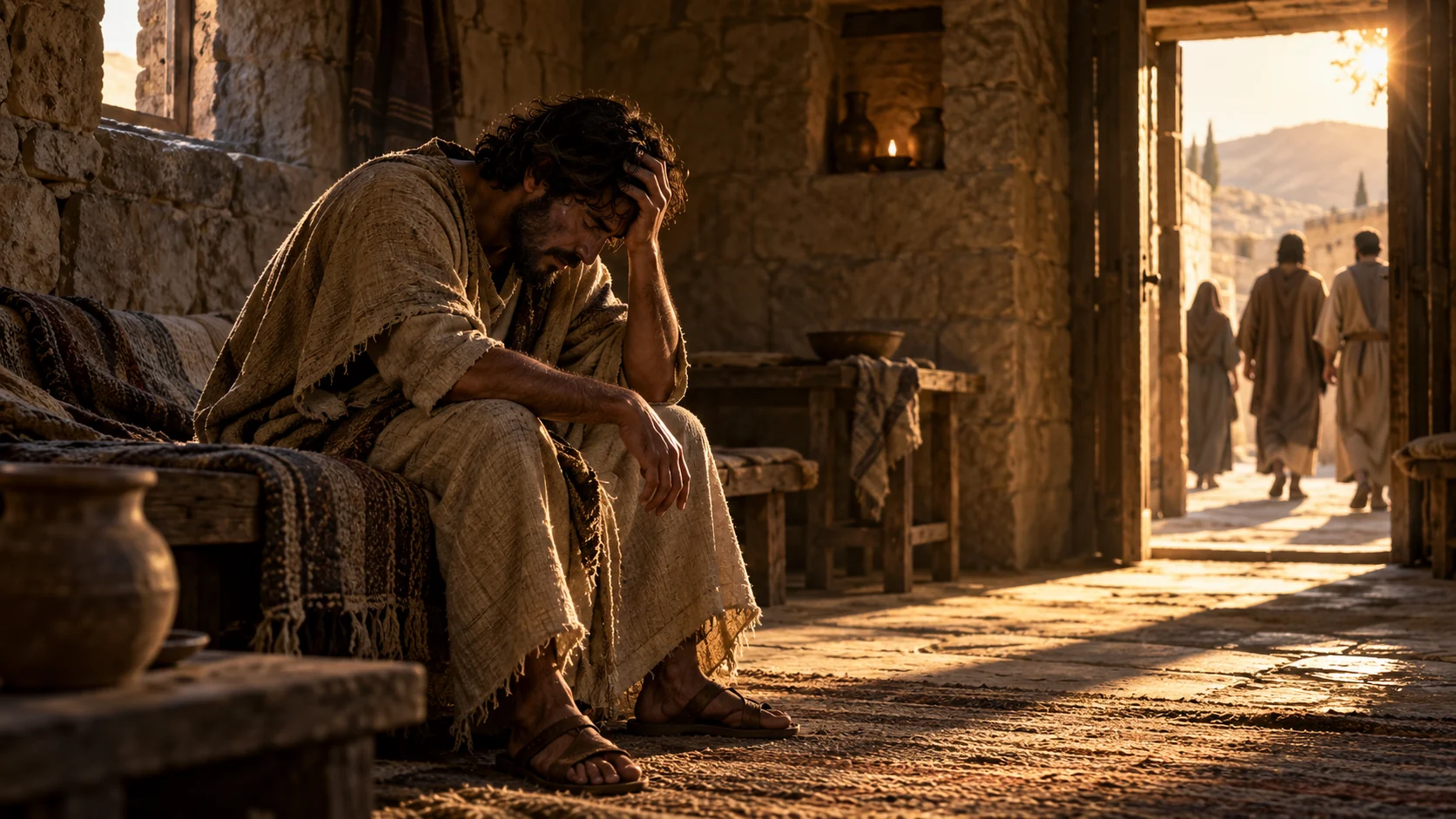
The lion is close, and the hunted man has nowhere left to run. Then the wilderness opens into a courtroom, and heaven takes the bench. Psalm 7 teaches the accused to seek refuge without becoming the avenger, and to place both reputation and heart beneath the judgment of God.
01
1.0 Introduction: Where Do You Go When Your Name Is Under Attack?
An accusation can travel faster than truth. A rumor can enter a family, church, workplace, or phone screen before the accused has found words to answer it. Psalm 7 speaks from that exposed place. The worshiper feels hunted like prey and morally examined as though he is already standing in court.
The heading associates the psalm with David and “Cush, a Benjaminite,” though Scripture tells us nothing certain about Cush. The poem focuses on the case itself: the psalmist faces a serious accusation and is willing to call God as Judge.
The heart-question is: How do I seek vindication without becoming self-righteous, retaliatory, or afraid of honest examination?
This text is about accusation becoming appeal, because biblical faith carries the case upward to the Judge who sees both public actions and hidden hearts.
Psalm 7 gives words to the slandered and misread, yet the one asking God to judge the enemy also asks God to investigate him.
02
2.0 Historical and Literary Context: The Hunted Davidic Figure Enters the Court
Psalms 1–2 introduce the righteous way, Torah-shaped wisdom, and Yahweh’s anointed king. Psalms 3–7 then place that vision inside conflict. BibleProject observes that this cluster repeatedly portrays the Davidic figure threatened by enemies and crying to Yahweh for rescue. Psalm 7 closes that sequence before Psalm 8 widens the view toward humanity and the cosmos.
The title calls the poem a Shiggaion, an uncertain musical or literary term. Kidner notes that nothing more is known of Cush, though David’s story includes Benjamite opposition.
The psalm moves from refuge to oath, from oath to courtroom, from courtroom to warning, and finally to praise. Its controlling tension is simple but searching: the person who wants God to judge must be willing to stand under the same light.
03
3.0 Walking Through the Text
04
3.1 Psalm 7:1–2 — When the Hunted Person Runs into God
“Yahweh my God, in you I take refuge; save me from all who pursue me.” The danger is not imaginary. The pursuer is compared to a lion that can tear the victim apart when no rescuer is near. Fear is given teeth.
Yet refuge exists before visible deliverance arrives. Kidner notes that rescue is still a matter for prayer, but refuge is already a fact because it is located in God. Faith says, “I have placed myself in God’s hands rather than in fear or revenge.”
The worshiper does not begin by setting traps for the hunter. He begins by running toward God.
05
3.2 Psalm 7:3–5 — When Innocence Is Willing to Be Investigated
The prayer becomes an oath: “If I have done this… if there is wrong in my hands…” The psalmist names possible betrayal and wrongdoing and says, in effect, If the charge is true, let the enemy overtake me.
This is not a claim to sinless perfection. Kidner stresses that the psalmist’s “righteousness” answers a particular accusation. A person may have real failures and still be innocent of the charge being used against them. Biblical humility does not require false confession.
But neither does the psalm permit defensive pride. David opens his hands before God. “I am being attacked” does not prove “I have done nothing wrong.” Psalm 7 makes room for truthful self-defense and truthful self-examination at the same time.
06
3.3 Psalm 7:6–11 — When the Personal Case Opens into the Court of the World
“Arise, Yahweh, in your anger.” The psalmist asks God to rise, gather the peoples, take the high seat, and judge. One person’s crisis opens into a vision of universal justice.
The personal appeal rests on confidence that God is Judge of all the earth; Goldingay notes the surprising movement from one threatened individual to an assembly gathered around the divine Judge.
Then comes the dangerous request: “Judge me, Yahweh, according to my righteousness and according to my integrity.” The context is a particular case, yet the verse refuses cheap vindication. God tests hearts and minds. He does not merely compare competing speeches; he examines motive.
That makes divine judgment both comforting and searching. The falsely accused need a Judge who sees beyond appearances. The self-deceived need the same Judge. Verse 10 therefore calls God a shield who saves the upright in heart. The courtroom is not cold bureaucracy. For those under unjust threat, justice becomes refuge.
07
3.4 Psalm 7:12–16 — When Evil Carries Its Own Collapse
The severe language begins with a door: “If a person does not turn…” Repentance stands before the sharpened sword and drawn bow. Judgment is not divine impatience; warning creates space to abandon the road that destroys.
Then evil becomes strangely fertile. The wicked person is pregnant with trouble and gives birth to falsehood. Sin grows inwardly before it appears publicly. James 1:14–15 later uses a similar image when desire gives birth to sin and sin produces death.
The evildoer then digs a pit and falls into it; violence returns upon his own head. God judges, evil bears destructive fruit, and wrongdoing comes home to the wrongdoer.
This is not a promise of instant consequences. The wider Psalter knows that victims may wait painfully long while wrongdoers prosper. Psalm 7 describes the moral direction of evil: what is bent toward death cannot finally become life merely because it survives for a season.
08
3.5 Psalm 7:17 — When the Unfinished Case Becomes Praise
The psalm ends without narrating the enemy’s defeat: “I will give thanks to Yahweh according to his righteousness and sing praise to the name of Yahweh Most High.”
“Most High” lifts the final line above the hunted landscape. The accuser, the crowd, and the psalmist’s own fear do not occupy the highest bench. Praise does not deny the case; it confesses that the case does not define God.
09
4.0 Theological Reflection
First, God’s justice is good news for people who cannot control the verdict. Without righteous judgment, the loudest voice, strongest network, or deepest pocket easily becomes the court.
Second, integrity is not perfection. Psalm 7 permits, “I did not do this,” while leaving the whole self open to God. Grace does not require false guilt, and innocence in one matter does not justify pride about the whole life.
Third, repentance interrupts the road toward judgment. “If he does not turn” reveals that warning is mercy. God’s anger is holy opposition to what destroys people and communities.
Fourth, evil is both judged by God and self-corrupting. The pit and returning violence show that sin reshapes the sinner. Even when consequences are delayed, deceit, exploitation, and vengeance cannot produce the life they promise.
10
5.0 Canonical and Christological Horizon
Psalm 7 belongs to the Bible’s long confidence that “the Judge of all the earth” will do what is just (Gen. 18:25). Israel’s Torah resists partial courts, while the prophets expose systems that protect the powerful and crush the poor. The Psalms turn that theology into prayer.
The Davidic setting creates a forward horizon. Jesus, the faithful Son of David, faces false witnesses, political manipulation, ridicule, and a verdict engineered by threatened power (Mark 14:55–65; 15:1–15).
Yet Jesus does not seize private vengeance. First Peter says that when he suffered, “he entrusted himself to him who judges justly” (1 Pet. 2:23). Psalm 7’s posture reaches messianic fullness: the righteous sufferer places the case in the Father’s hands.
The cross prevents Christians from using judgment as permission for superiority. The innocent one suffers without becoming violent in return. Resurrection vindicates Jesus and announces that unjust verdicts are not final; Acts 17:31 looks toward God’s final righteous judgment through the risen Messiah.
So the church tells the truth, pursues just processes, protects victims, welcomes repentance, and refuses vengeance because the risen Judge will finally set the world right.
11
6.0 Life Application
1. Take the accusation to God before taking it to the crowd. Pray before posting, forwarding, recruiting allies, or answering in anger.
2. Name the charge precisely. Do not defend your entire identity when the real question concerns one action, decision, or statement.
3. Invite honest examination. Ask trusted, wise people whether anything true inside the accusation requires repentance or repair.
4. Do not confess what is false merely to end pressure. Humility is not self-erasure. Answer untrue charges truthfully and without needless cruelty.
5. Use fair processes. In churches, families, and organizations, refuse rumor as a courtroom. Hear evidence, protect the vulnerable, and allow the accused to answer.
6. Leave room for the wrongdoer to turn. Seek safety and justice without needing another person’s destruction as proof of healing.
7. Refuse to become the pit you fear. Do not answer slander with slander or manipulation with manipulation. Let God remain Judge.
12
7.0 Reflection Questions
1. What accusation or misunderstanding am I most tempted to answer through anger rather than prayer?
2. Can I distinguish between being innocent of a particular charge and being beyond correction in general?
3. What would it mean to invite God—and trusted people—to examine my motives as well as my actions?
4. Where have I confused justice with the desire to see another person humiliated or destroyed?
5. How would my response change if I believed that the highest court is neither public opinion nor my self-defense, but God’s righteous judgment?
13
8.0 Response Prayer
Yahweh, righteous Judge and refuge of the hunted, receive the case I cannot carry alone. When accusation follows me like a lion, keep fear from making me cruel. Search my hands, my words, and my heart. Where I am wrong, give me courage to repent and repair. Where I am falsely accused, give me patience to speak truth without hatred. Protect those harmed by injustice, restrain those who refuse to turn, and keep me from digging pits for others. Through Jesus, the falsely accused and risen King, teach me to entrust myself to the One who judges justly. Let your righteousness become my refuge, and let my final word be praise. Amen.
14
9.0 Window into What Comes Next
Psalm 7 ends with Yahweh Most High, the Judge above the conflict. Psalm 8 keeps looking upward as the courtroom opens into the night sky. The question moves from “Who will judge this case?” to “What are human beings that the majestic Creator remembers them?” Next, the Psalter reveals the dignity God gives to small humans beneath the highest throne.
15
10.0 Bibliography
BibleProject. The Book of Psalms: Study Notes. BibleProject.
BibleProject. Visual Commentary: Psalm 8 Study Notes. BibleProject.
Goldingay, John. Psalms, Volume 1: Psalms 1–41. Baker Commentary on the Old Testament Wisdom and Psalms. Grand Rapids: Baker Academic, 2006.
Kidner, Derek. Psalms 1–72. Kidner Classic Commentaries. Downers Grove, IL: IVP Academic, 2008.
Wright, N. T. How God Became King: The Forgotten Story of the Gospels. New York: HarperOne, 2012.

Be the first to leave a comment.