

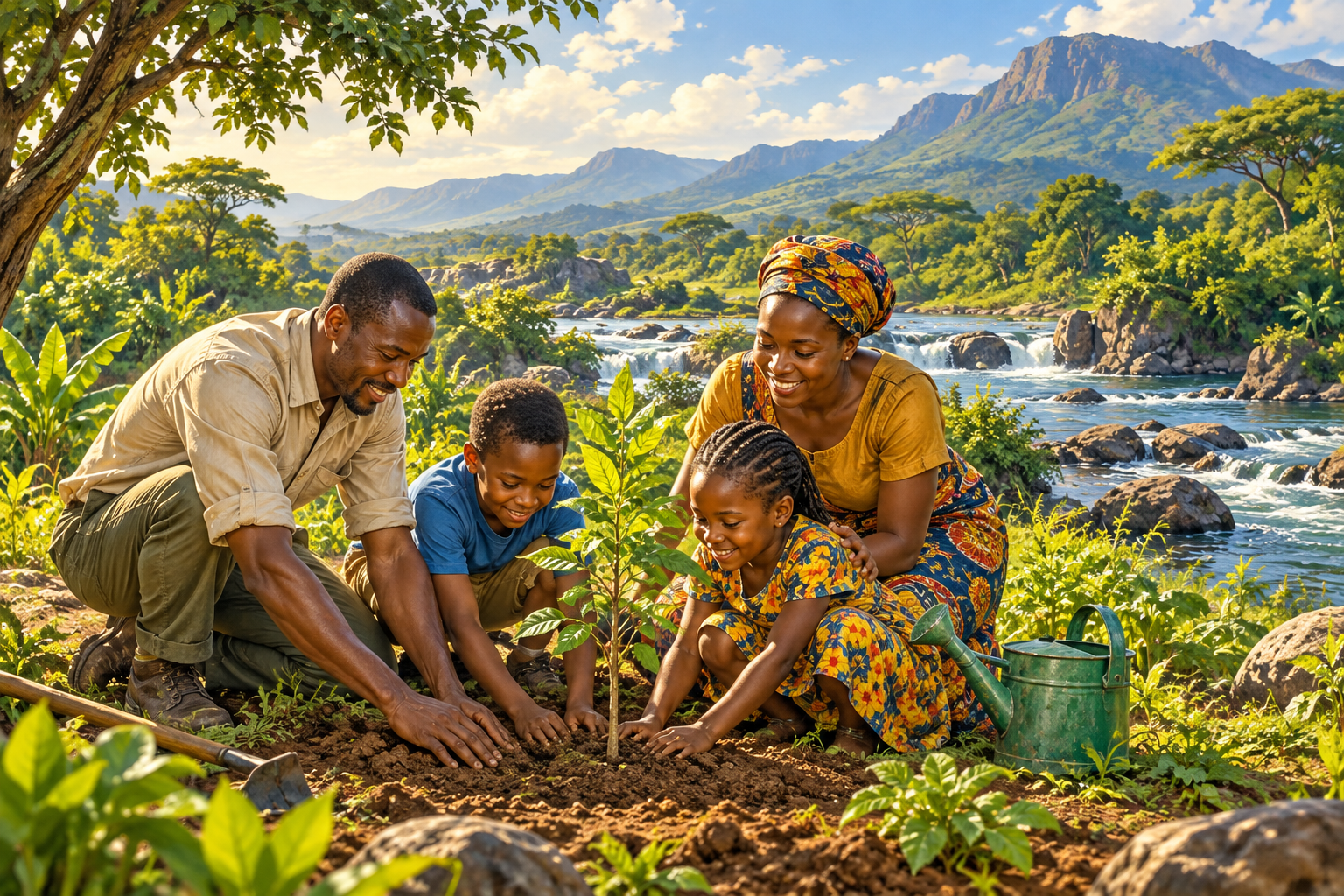
Does the earth matter if believers are waiting for heaven?
01
Introduction
Faith Built on Truth — In Christ, Through Scripture, for Life
Some Christians have been taught to think of the earth as a temporary waiting room—useful for now, but destined to be discarded once believers go to heaven. If that is the story, caring for rivers, forests, soil, animals, and the climate can seem secondary, perhaps even a distraction from more “spiritual” concerns.
But that is not the story the Bible tells.
Scripture begins with God delighting in creation and ends with God renewing it. Human beings are placed within the earth as God’s image-bearers and caretakers, not as owners free to exhaust it. The prophets picture wounded land and deserts blooming again. Paul speaks of creation groaning for liberation. Revelation ends not with humanity escaping the earth, but with God dwelling with humanity in a renewed creation.
Christian care for creation, then, is not a fashionable addition to faith. It grows naturally from the Bible’s teaching about creation, covenant, incarnation, resurrection, love of neighbor, and the hope of new creation.
Here are ten reasons to believe that caring for creation belongs within Christian discipleship.
02
1. Creation Belongs to God, Not to Us
“The earth is the LORD’s, and everything in it” (Psalm 24:1).
That one sentence changes our posture toward the world.
We do not stand over creation as absolute owners. We live within a world that belongs to God.
Genesis repeatedly says that God looked at what he had made and called it good (Genesis 1:10, 12, 18, 21, 25, 31). Mountains, rivers, animals, soil, trees, and seas have value because they are God’s handiwork before they become useful to us.
A tenant treats a house differently when he remembers that it belongs to someone else.
In the same way, Christians should receive the earth with gratitude, humility, and care.
Takeaway: Creation is not disposable property. It is God’s world, entrusted to our care.
03
2. Human Beings Were Created to Cultivate and Guard the Earth
In Genesis 2, the human being is placed in the garden “to work it and take care of it” (Genesis 2:15). The Hebrew verbs carry the sense of serving and guarding.
Humanity’s calling is therefore not domination without limits. It is responsible stewardship under God.
To bear God’s image means representing God’s rule within creation (Genesis 1:26–28). Because God’s rule is generous, life-giving, and protective, human rule should reflect the same character.
A good shepherd does not prove authority by destroying the flock. Authority is shown by helping life flourish.
Takeaway: Biblical dominion means responsible care, not reckless exploitation.
04
3. The Sabbath Teaches Limits to Human Consumption
The Sabbath interrupts endless production.
People rest. Servants rest. Livestock rest. And in Israel’s sabbatical pattern, even the land is given rest (Exodus 20:8–11; Leviticus 25:1–7).
There is deep wisdom here.
Creation is not an engine designed to run without pause. Soil can be depleted. Animals can be overworked. Human desire can become endless.
Sabbath teaches us to say, “Enough.”
It reminds us that the world continues because of God’s faithfulness, not because we extract every possible benefit from it.
Rest is therefore more than stopping work. It is a way of resisting the illusion that everything exists for our consumption.
Takeaway: Faithful creation care begins when we learn that not everything must be consumed.
05
4. God’s Covenant Includes the Wider Created World
After the flood, God’s covenant is not made with Noah alone.
It includes Noah’s descendants and “every living creature” with them (Genesis 9:8–17).
The rainbow therefore stretches wider than humanity.
God’s covenant concern includes animals, the earth, and the rhythms that sustain life.
This does not mean human beings and animals have exactly the same role in Scripture. But it does mean that God’s care reaches beyond our own species.
The Creator remembers creatures that human economies can easily overlook.
Takeaway: God’s covenant concern reaches beyond humanity to the living world he made.
06
5. The Prophets Connect Human Sin with Wounded Land
The Bible often refuses to separate moral failure from damage to the earth.
Hosea describes lying, violence, and unfaithfulness, then says that the land mourns and its creatures suffer (Hosea 4:1–3). Isaiah likewise pictures the earth languishing under human rebellion (Isaiah 24:4–6).
This does not mean that every environmental disaster can be traced to one person’s sin.
The point is larger: human greed, violence, and injustice spill outward into the world around us.
When forests disappear, water is poisoned, soil is degraded, or poor communities bear pollution they did not create, environmental damage becomes a moral issue as well as a technical one.
The condition of the land can reveal something about the way human beings are living within it.
Takeaway: Sin wounds not only relationships between people and God, but also the relationship between humanity and the earth.
07
6. Jesus Reveals God’s Love for Embodied Creation
Christian faith is centered on the incarnation: “the Word became flesh” (John 1:14).
God did not rescue humanity from a distance. In Jesus, he entered physical creation. Jesus ate food, walked roads, touched bodies, calmed seas, suffered physically, died, and rose bodily from the grave.
His resurrection matters deeply for how Christians understand creation.
God did not discard Jesus’ body in order to save his “soul.” He raised him from the dead.
Resurrection is therefore God’s affirmation that embodied life matters and has a future.
In Jesus, dust and glory meet.
Takeaway: The incarnation and resurrection tell us that physical creation is not disposable to God.
08
7. Christ’s Work of Reconciliation Embraces All Creation
Paul’s vision of salvation is astonishingly wide.
Through Christ, God purposes to reconcile “all things” to himself, whether things on earth or in heaven (Colossians 1:15–20).
Elsewhere Paul says that creation itself is groaning, waiting to be liberated from decay (Romans 8:19–23).
The gospel is personal, but it is never merely private.
God is renewing a world.
That means creation care does not replace evangelism. Rather, it is one way of living consistently with the scope of the gospel we proclaim.
If God intends reconciliation and renewal for his creation, Christians should not live as though the created world has no future.
Takeaway: The good news of Jesus reaches farther than individual souls; it points toward the renewal of all things.
09
8. Caring for Creation Is an Act of Love Toward Our Neighbors
Environmental harm is rarely shared equally.
Polluted water, failed crops, extreme heat, soil erosion, disappearing fisheries, and toxic air often strike poor and vulnerable communities first and hardest.
Jesus teaches us to love our neighbor (Mark 12:31), and Scripture repeatedly commands care for those who are vulnerable (Deuteronomy 24:17–22; James 2:14–17).
So Christians cannot discuss creation care without asking who suffers when land, air, and water are damaged.
If a factory poisons the river used by families downstream, the issue is not “the environment versus people.”
It is about people, justice, and creation together.
Protecting creation can therefore become a very practical form of loving our neighbor.
Takeaway: Caring for the earth often means caring for the people whose lives depend on it.
10
9. Christian Hope Is Renewal, Not Escape
The final Christian hope is not that disembodied souls will float away from the earth forever.
Revelation sees “a new heaven and a new earth,” and then the holy city comes down as God dwells with humanity (Revelation 21:1–5).
Peter likewise speaks of new heavens and a new earth “where righteousness dwells” (2 Peter 3:13).
The biblical story moves toward renewal, not abandonment.
Christians do not care for the world because we imagine that we can save it by our own strength. We care for it because God has promised that his future includes creation.
Hope does not make stewardship unnecessary. It gives stewardship meaning.
A gardener tends the soil differently when he knows spring is coming.
Takeaway: Hope in new creation gives us reason to care for this creation now.
11
10. Creation Care Can Become a Sign of God’s Coming Kingdom
Christian discipleship calls us to live today in ways that anticipate God’s promised future.
We forgive because reconciliation is coming.
We pursue justice because God’s kingdom is righteous.
We care for bodies because resurrection is coming.
For the same reason, we care for the earth.
Planting trees, protecting water, reducing waste, farming responsibly, preserving habitats, and resisting destructive greed will not bring God’s kingdom by themselves.
But they can become small signs of the world God intends.
A seed is not a forest.
Yet a forest can begin with a seed.
Takeaway: Faithful care for creation can become a quiet witness to the future God has promised.
12
Truth and Your Decision
The earth matters because it matters to God.
From the first garden to the new Jerusalem, Scripture tells one unfolding story of a Creator who loves what he has made, entrusts it to human care, enters it in Jesus, raises Jesus bodily from the dead, and promises to renew all things.
Christians therefore do not have to choose between caring for souls and caring for soil, between evangelism and stewardship, or between heaven and earth.
The biblical hope is larger:
God intends to restore human beings within a renewed creation.
The question is not whether we can rescue the planet by our own strength. We cannot.
The question is whether our lives will bear witness to the Creator whose world this is and whose promised future is coming.
The river beside your town matters.
The tree outside your home matters.
The farmer’s soil matters.
The air children breathe matters.
The animals God feeds matter.
And because they matter to God, they cannot be meaningless to those who call him Father.
13
A Prayer for Creation
Creator God,
the earth is yours and everything in it.
Forgive us for the ways greed, waste, and carelessness have wounded your world and harmed our neighbors.
Teach us to receive creation as a gift rather than treat it as a possession.
Give us wisdom in what we consume, courage in what we protect, and gratitude for the life around us.
Through Jesus Christ, who entered creation and rose bodily from the dead, make us faithful signs of the new creation you have promised.
Amen.
14
Continue the Journey
What part of creation has God placed within your reach to care for—a garden, water source, neighborhood, farm, workplace, or pattern of consumption?
What is one faithful change you can begin now?
Be the first to leave a comment.