

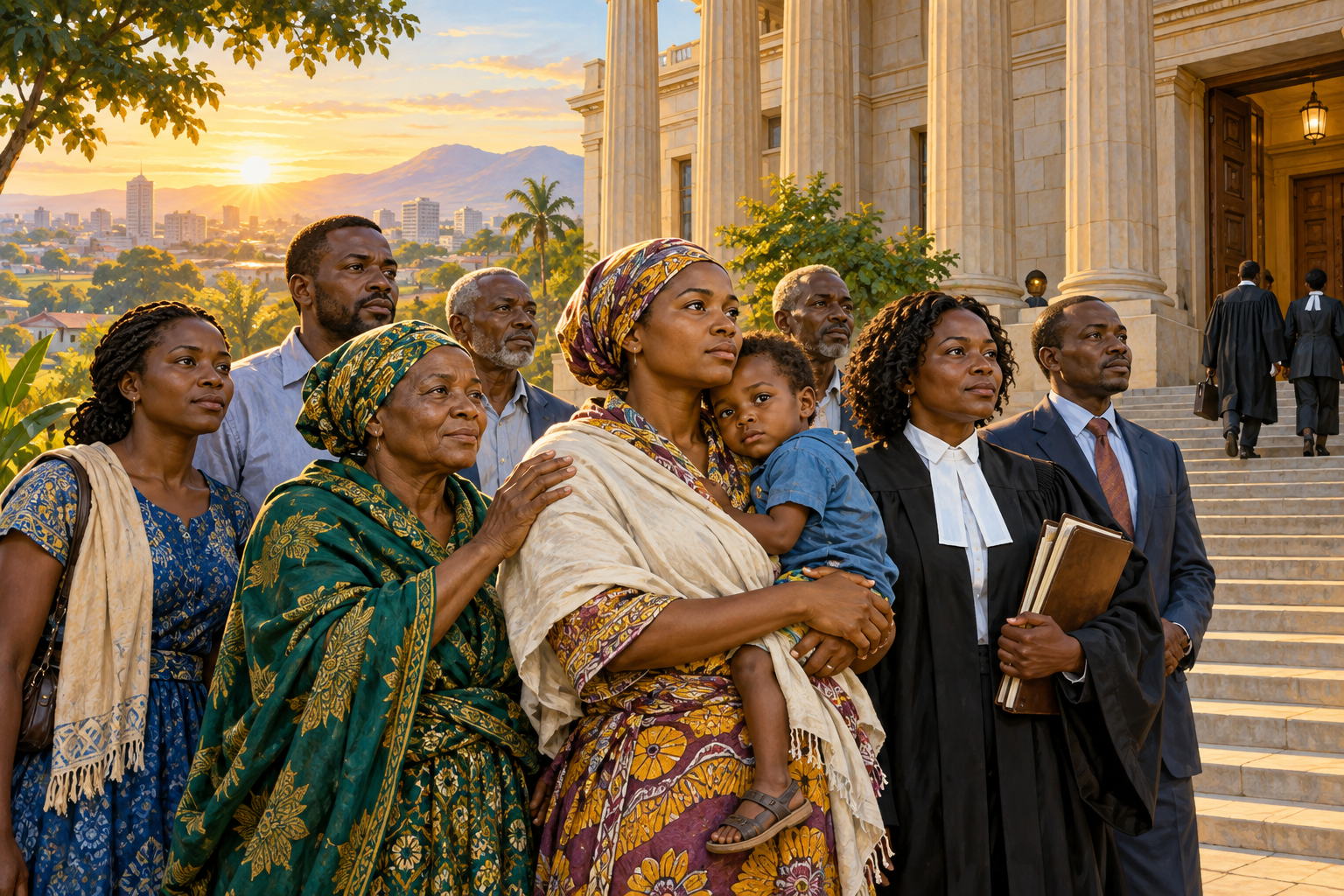
Should believers remain silent when the powerful oppress the weak?
01
Introduction
Faith Built on Truth — In Christ, Through Scripture, for Life
Hope can easily be misunderstood as passivity.
When Christians speak about heaven, resurrection, and the return of Jesus, some people assume that faith teaches believers to endure injustice quietly while waiting for God to put everything right in the future.
But biblical hope does the opposite.
Because God has promised to judge evil, raise the dead, renew creation, and establish justice, believers are freed from both despair and silence. Christian hope does not tell us that injustice is unimportant. It tells us that injustice is temporary, answerable to God, and already condemned by the kingdom revealed in Jesus.
The prophets spoke truth before kings. Jesus confronted hypocrisy and exploitation. The apostles refused to call darkness light. The Church, therefore, is not called to worship power or imitate it, but to bear witness to a different kingdom.
Here are ten reasons to believe that Christian hope gives us courage to confront injustice.
02
1. God Hears the Cry of the Oppressed
The biblical story of liberation begins with a cry.
Israel groaned under slavery in Egypt, and God heard them (Exodus 2:23–25). When God called Moses, he said, “I have surely seen the affliction of my people… and have heard their cry” (Exodus 3:7–8).
This matters because injustice often survives by making those who suffer invisible.
Scripture says they are not invisible to God.
The tears that never reach a courtroom still reach heaven.
Takeaway: Christian hope begins with the conviction that God sees what oppressive power tries to hide.
03
2. Justice Belongs to the Character of God
The Bible does not present justice as a modern social preference. Justice belongs to who God is.
“Righteousness and justice are the foundation of your throne,” says the psalmist (Psalm 89:14).
The prophets repeatedly connect worship with justice. Amos rejects songs and sacrifices offered by people who neglect righteousness: “Let justice roll down like waters” (Amos 5:21–24).
This means worship and justice cannot be separated without distorting both.
We cannot praise a just God while becoming comfortable with injustice.
Takeaway: Caring about justice does not take us away from God; it takes God’s character seriously.
04
3. The Prophets Show That Faith Can Speak Truth to Power
The Bible gives many examples of faithful people confronting those in authority.
Nathan confronted King David after his abuse of power (2 Samuel 12:1–13). Elijah confronted Ahab over Naboth’s vineyard (1 Kings 21:17–24). Isaiah, Jeremiah, Amos, and Micah condemned rulers who crushed the poor while maintaining religious appearances.
The prophets were not enemies of society. They were witnesses reminding rulers that political power itself stands under the judgment of God.
A throne may be high.
But it is never higher than God.
Takeaway: Faithfulness sometimes requires speaking uncomfortable truth to people who hold authority.
05
4. Jesus Announced a Kingdom That Lifts the Lowly
Jesus began his public ministry with words from Isaiah: good news to the poor, release to captives, sight to the blind, and freedom for the oppressed (Luke 4:16–21).
His kingdom did not simply affirm the social order as it was.
Jesus welcomed people others excluded. He warned the rich. He honored children. He touched those considered unclean. He exposed religious leaders who “devour widows’ houses” (Luke 6:20–25; Mark 10:13–16; Mark 12:38–40).
The kingdom of God is good news precisely because it challenges arrangements that treat some human lives as less valuable than others.
Following Jesus therefore changes where we stand and what we learn to notice.
Takeaway: Following Jesus means learning to see society from the side of those pushed to the margins.
06
5. The Cross Exposes the Violence of Unjust Power
Jesus was executed through a convergence of political fear, religious manipulation, false accusation, and imperial violence.
The cross therefore reveals more than human sin in the abstract. It shows what corrupted power can do when truth threatens its control.
But God raised Jesus from the dead.
The resurrection is heaven’s refusal to let the verdict of unjust power stand.
Rome said, “Crucified.”
God said, “Risen.”
The cross exposes what injustice does. The resurrection reveals that injustice does not control the final outcome.
Takeaway: The cross exposes injustice; the resurrection declares that injustice will not have the final word.
07
6. The Resurrection Frees Us from Fear
Oppressive systems often depend on fear.
People fear losing status, income, reputation, safety, freedom, or even life. Fear can make silence look safer than truth.
The resurrection changes the believer’s horizon.
Jesus tells his followers not to fear those who can kill the body but cannot hold the final verdict over life (Matthew 10:28). Paul can ask, “If God is for us, who can be against us?” and then insist that nothing can separate believers from God’s love (Romans 8:31–39).
This does not make Christians reckless.
It makes them harder to silence.
Resurrection hope tells us that earthly powers are real, but they are not ultimate.
Takeaway: Resurrection hope gives courage because earthly powers do not possess the final word over life.
08
7. Christian Love Requires More Than Private Kindness
Biblical love is more than warm feelings or occasional generosity.
John asks how God’s love can remain in someone who sees a brother or sister in need and closes the heart (1 John 3:16–18). James rejects a faith that offers kind words without practical help (James 2:14–17).
Sometimes love means feeding a hungry family.
Sometimes it also means asking why that family has been denied fair wages, land, safety, or equal treatment.
Mercy treats the wound.
Justice asks why the wound keeps being inflicted.
The two belong together.
Takeaway: Christian love serves those who are wounded and also confronts what keeps wounding them.
09
8. The Church Is Called to Become an Alternative Community
The early Church sought to build a shared life in which needs were not ignored and possessions were held with open hands (Acts 2:44–45; 4:32–35).
James condemned churches that gave special honor to the rich while humiliating the poor (James 2:1–9).
This means the Church cannot challenge injustice credibly if it reproduces the same favoritism within its own walls.
Before Christians speak to the city, the gospel must reshape the household of faith.
Church communities should become places where wealth does not determine worth, status does not determine dignity, and vulnerable people are not pushed aside.
Takeaway: A just Church becomes a living sign that another kind of society is possible.
10
9. God’s Final Judgment Gives Moral Seriousness to History
Christian hope includes judgment.
God will not simply shrug at violence, corruption, exploitation, and lies. Scripture looks toward a day when God will judge the world in righteousness (Psalm 96:10–13; Acts 17:31).
That future protects us from two opposite mistakes.
We do not have to despair as though evil will reign forever.
And we do not have to take vengeance into our own hands as though everything depends on us.
Because final judgment belongs to God, believers can pursue justice without allowing hatred to consume them.
We can resist evil without becoming evil ourselves.
Takeaway: Final judgment gives us courage to resist evil without surrendering ourselves to revenge.
11
10. New Creation Gives Us a Picture of What We Are Working Toward
Revelation ends with God wiping away tears, death defeated, and the nations healed (Revelation 21:1–5; 22:1–2).
Isaiah imagines swords being turned into plowshares and people learning war no more (Isaiah 2:2–4).
These visions are not excuses to ignore the present.
They are God’s picture of the future—and therefore a compass for Christian discipleship now.
We work for peace because peace is coming.
We defend human dignity because God’s future honors human beings.
We challenge injustice because injustice has no place in the world God is making.
Christian hope teaches us to live today in the direction of God’s promised tomorrow.
Takeaway: New-creation hope gives us a vision for faithful action in the present.
12
Truth and Your Decision
Christian hope is not a sedative.
It is a trumpet.
It tells the prisoner that Pharaoh is not eternal.
It tells the widow that her cry is heard.
It tells the powerful that their authority is borrowed.
It tells the Church that silence can become complicity.
And it tells the wounded that evil, however deeply rooted, does not own the future.
But confronting injustice requires more than anger.
It requires truth, courage, humility, wisdom, prayer, and the refusal to become what we oppose.
Jesus did not defeat violence by becoming more violent. He confronted evil, bore its force, exposed its lies, and overcame it through resurrection.
So the question is not simply:
“Do you care about justice?”
The deeper question is this:
Will your hope make you brave enough to stand beside the weak, speak truth without hatred, examine your own complicity, and live as though God’s just future has already begun in Jesus?
Hope is not waiting with folded hands.
Hope is planting a tree because tomorrow belongs to God.
Hope is telling the truth because lies do not.
Hope is standing with the wounded because the risen Christ does.
13
A Prayer for Courage and Justice
God of justice and mercy,
open our eyes to suffering we have learned not to see.
Forgive us where fear, comfort, or self-interest has kept us silent.
Give us courage to defend the weak, wisdom to speak truth, humility to examine our own complicity, and love that refuses hatred.
Keep us from despair.
Keep us from revenge.
Teach us to pursue justice without losing mercy, and to resist evil without becoming shaped by it.
Through the risen Jesus, make us people who live now in the light of your coming kingdom, where righteousness and peace embrace.
Amen.
14
Continue the Journey
Where do you see injustice becoming normal around you?
What would one faithful act of courage, truth, mercy, or solidarity look like this week?
Be the first to leave a comment.