

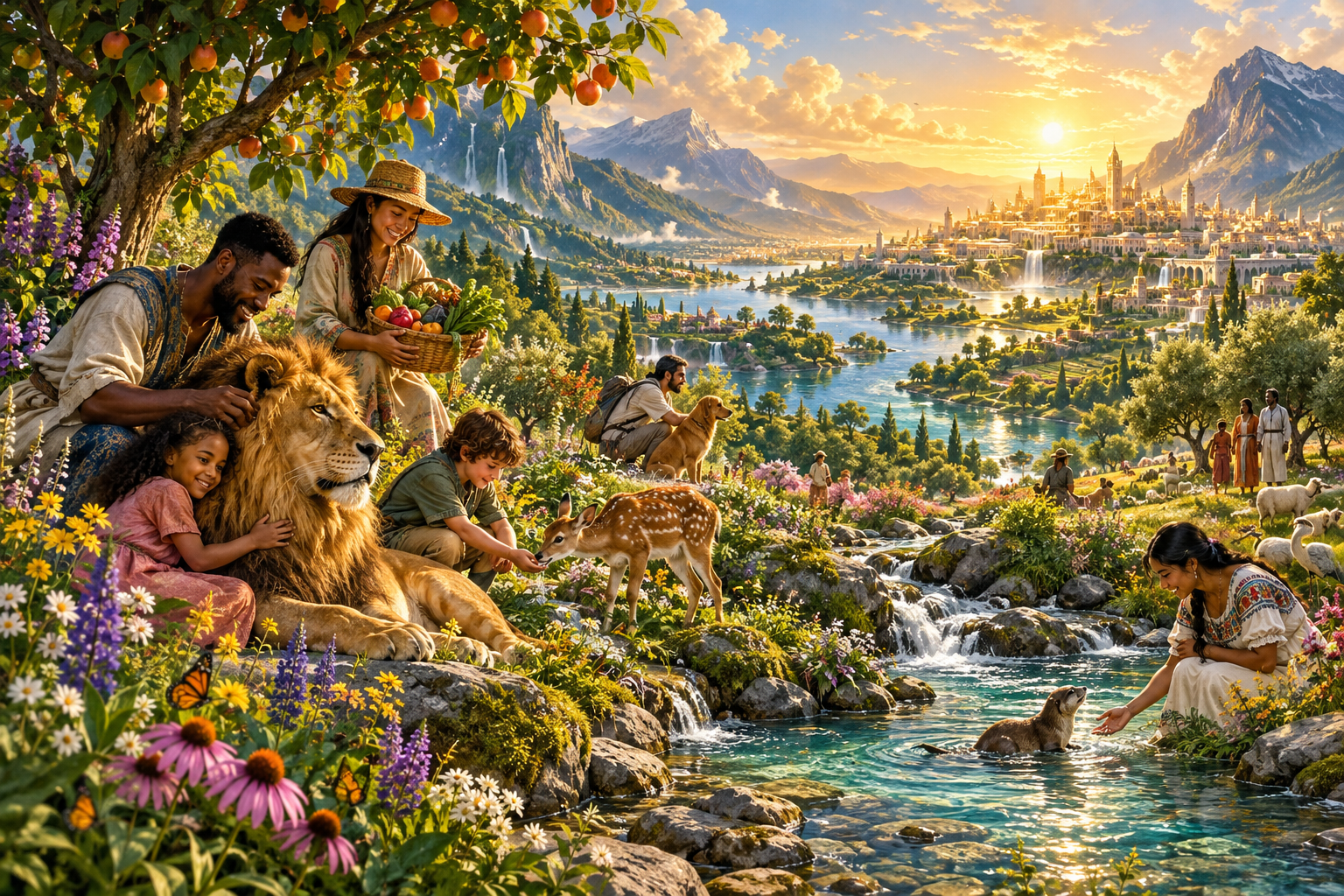
Is our final hope escape from creation or the restoration of creation?
01
Introduction
Faith Built on Truth — In Christ, Through Scripture, for Life
Many Christians have heard the future described mainly as leaving the earth behind and going somewhere else forever. In that picture, creation is only a temporary stage, the body is disposable, and salvation finally means escape.
But the Bible tells a larger story.
Scripture begins with God creating heaven and earth and calling creation good. The story moves through covenant, exile, incarnation, cross, and resurrection. And it ends not with creation abandoned, but with “a new heaven and a new earth” and God dwelling with humanity.
Christian hope, therefore, is not that God will throw away the world he made. It is that he will judge what corrupts it, heal what has been wounded, free creation from decay, and bring all things into the life revealed in the resurrection of Jesus.
Here are ten reasons to believe that God will renew heaven and earth.
02
1. God called creation good from the beginning
Genesis does not present the material world as a mistake or an unfortunate temporary arrangement. Light, land, seas, plants, animals, and human beings are repeatedly called good, and together “very good” (Genesis 1:1–31).
Sin damages creation, but it does not erase God’s original verdict over what he made.
A painting can be vandalized without ceasing to belong to the artist. The damage calls for restoration, not contempt. In the same way, the brokenness of creation does not mean God has abandoned it; it means creation needs the healing only its Creator can give.
Takeaway: God’s final purpose begins with his first declaration: creation is good.
03
2. Human beings were made for life within creation
Humanity is formed from the dust of the ground and placed in a garden to cultivate and guard it (Genesis 2:7–15). From the beginning, human life is earthly, embodied, relational, and connected to the rest of creation.
The Bible does not begin with souls longing to escape bodies. It begins with image-bearers called to reflect God’s wise and life-giving rule within the world he made (Genesis 1:26–28).
Sin wounds that calling. Work becomes painful. Relationships fracture. The ground itself suffers. But Scripture never treats the original human vocation as meaningless. God’s purpose is not to rescue us from being human, but to restore human beings to the life for which we were created.
Takeaway: Our destiny is tied to God’s purpose for embodied human life within creation.
04
3. The prophets expected restoration, not abandonment
Isaiah looks toward a future where God creates “new heavens and a new earth” (Isaiah 65:17; 66:22). The vision includes homes, vineyards, children, peace, and renewed relationships.
This is not a picture of creation being thrown away. It is a picture of creation healed from violence, futility, and grief.
The prophets imagine deserts blooming, ruined cities rebuilt, and creation rejoicing (Isaiah 35:1–10; 55:12–13). Biblical hope has always been larger than escape. It looks toward restoration.
Takeaway: Biblical hope has always carried the language of restoration.
05
4. Jesus taught us to pray for God’s will on earth
Jesus taught his disciples to pray, “Your kingdom come, your will be done, on earth as it is in heaven” (Matthew 6:10).
The direction of that prayer matters. Jesus does not teach us to pray, “Take us away from earth so that heaven alone may remain.” He teaches us to pray for God’s heavenly rule to become fully visible on earth. The prayer imagines heaven and earth brought into harmony under God’s reign.
The gospel announces that this joining has already begun in Jesus. Where the sick are healed, sinners are forgiven, outsiders are welcomed, evil is confronted, and people learn to live under God’s rule, the future begins to appear in the present.
Takeaway: Christian hope longs for earth to come under the life-giving rule of heaven.
06
5. The incarnation shows that God does not despise the material world
“The Word became flesh and dwelt among us” (John 1:14). The Creator entered his creation.
Jesus did not merely appear human. He entered embodied life. He ate, slept, walked dusty roads, touched sick bodies, attended meals, and wept real tears. God’s answer to a broken world was not distance, but incarnation.
In Jesus, heaven touches earth without destroying it. The material world becomes the place where God’s saving presence is revealed. If matter were worthless, the incarnation would make little sense. But the Son of God taking flesh declares that creation is worth entering, healing, and redeeming.
Takeaway: The incarnation is God’s affirmation that creation is worth entering and redeeming.
07
6. The resurrection of Jesus is the first act of new creation
Jesus did not rise as a disembodied spirit. The risen Lord could be seen, touched, recognized, and known as the crucified one made alive (Luke 24:36–43; John 20:24–29).
Paul calls Christ the “firstfruits” of the coming resurrection (1 Corinthians 15:20–23).
His risen body is therefore more than proof that death did not defeat him. It is the first sign of renewed creation: continuity without corruption, embodiment without decay, life beyond the reach of death.
Takeaway: Easter is the beginning of new creation inside the old.
08
7. Paul says creation itself will be liberated
Romans 8 gives one of the clearest visions of creation’s future. Paul says creation is groaning under decay and waiting to be “set free from its bondage to corruption” (Romans 8:19–23).
Notice the language: creation waits for liberation, not disposal.
Human resurrection and creation’s renewal belong together. As God restores his image-bearers, creation itself shares in freedom. Salvation is therefore wider than the rescue of isolated souls.
Takeaway: Salvation is larger than individual souls; God intends to free creation from decay.
09
8. Christ’s reconciliation reaches “all things”
Colossians describes Christ as the one through whom all things were created and through whom God purposes to reconcile “all things” to himself (Colossians 1:15–20).
The scope is cosmic.
The cross is personal enough to forgive a sinner and wide enough to address a fractured creation.
This does not mean every detail of redemption is simple, nor does it erase the seriousness of judgment. But it does mean Christian salvation cannot be reduced to private escape.
Takeaway: The gospel is as wide as the creation Christ made and came to reconcile.
10
9. Revelation ends with heaven and earth joined
The final chapters of Revelation present one of Scripture’s most important images: the holy city comes down from heaven, and a voice declares, “God’s dwelling place is now among the people” (Revelation 21:1–3).
The movement is striking.
Human beings do not finally abandon creation to live forever in a distant heaven. Instead, heaven and earth are brought together under the presence and reign of God.
The biblical story begins in a garden and ends in a garden-city, where the river of life flows and the tree of life appears again for the healing of the nations (Revelation 22:1–5).
Takeaway: The Bible ends with God coming to dwell in a renewed creation.
11
10. New-creation hope gives meaning to faithful work now
If God intends to abandon creation, our work within it can easily seem temporary and meaningless. But Paul connects resurrection hope with present faithfulness: “your labor in the Lord is not in vain” (1 Corinthians 15:58).
Acts of justice, beauty, reconciliation, stewardship, service, truth, healing, and faithful work do not build God’s final kingdom by human strength. Yet they can become signs and anticipations of the world God has promised.
A seed is small compared with a tree, but it belongs to the same future.
Takeaway: Because God will renew creation, faithful work within creation matters now.
12
Truth and Your Decision
The biblical story does not move from earth to escape.
It moves from creation to new creation.
From a garden to a garden-city.
From humanity made from dust to humanity raised in glory.
From God walking with human beings in Eden to God dwelling with humanity forever.
Christian hope is not contempt for the earth. It is confidence that the Creator has not abandoned what he made.
That means our bodies matter.
Our neighbors matter.
Our work matters.
Justice matters.
Beauty matters.
Creation matters.
Not because we can save the world by our own strength, but because God has promised not to abandon it.
The question is not merely, “Will I go to heaven?”
The larger biblical question is:
Am I learning to live now as a citizen of the renewed heaven-and-earth world God is bringing?
The final Christian hope is not that creation disappears.
It is that God says:
“Behold, I am making all things new.”
13
A Prayer for New Creation
Creator and Redeemer, thank you for making the world in goodness and refusing to abandon it in its brokenness. Forgive us where we have treated bodies, neighbors, or creation as though they do not matter. Fix our hope on Jesus, the firstfruits of resurrection. Teach us to live now as people of your coming world—with justice, beauty, holiness, generosity, and care. Until the day heaven and earth are made new, let our lives become small signs of the future you have promised. Amen.
14
Continue the Journey
Where have you treated something in God’s creation as though it were disposable? What would change if you believed that God intends not to abandon creation, but to renew it?
Be the first to leave a comment.