

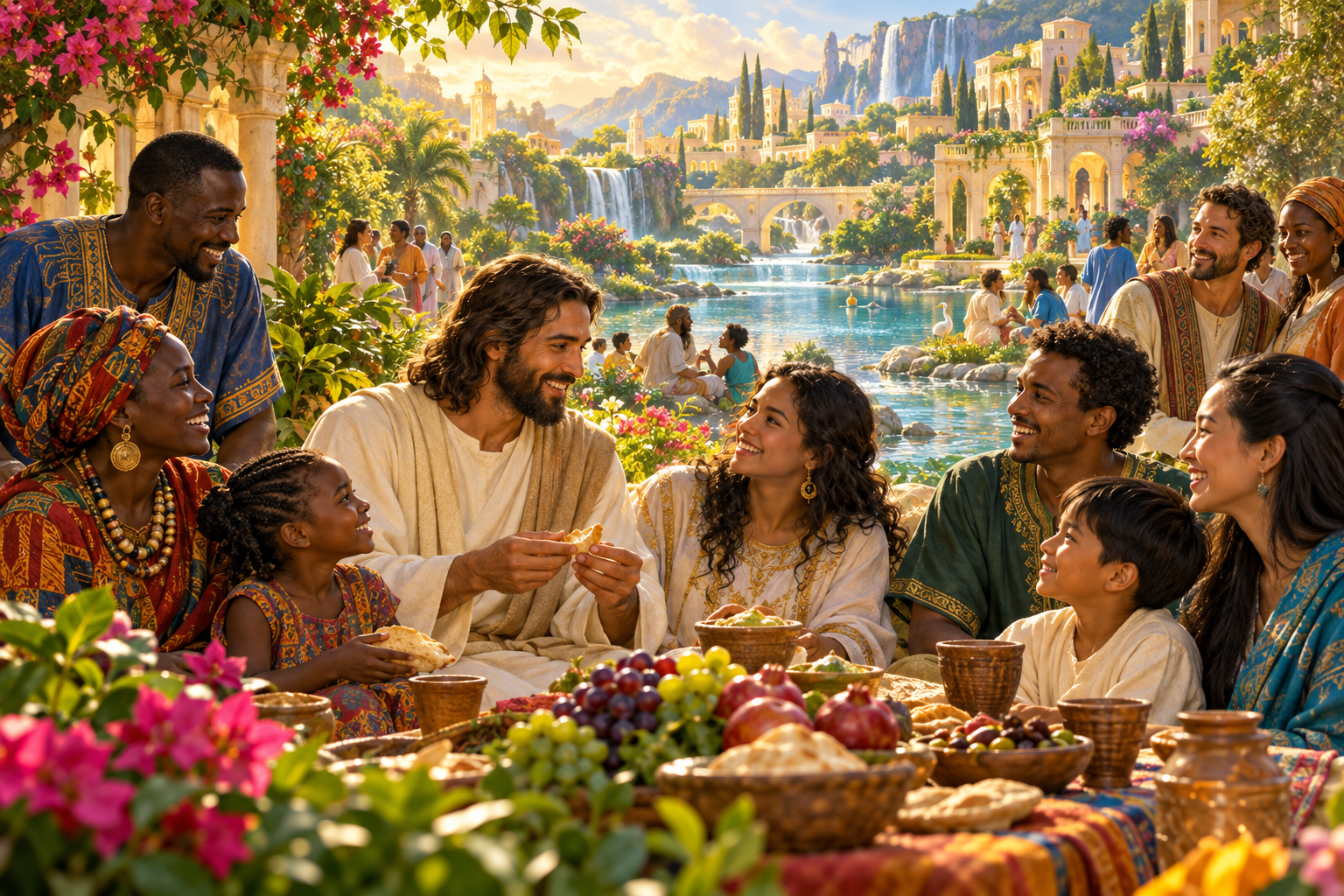
What is eternal life ultimately about?
01
Introduction
Faith Built on Truth — In Christ, Through Scripture, for Life
When people hear the phrase eternal life, they often think first about endless time.
But endless duration by itself is not necessarily good news.
A life that never ends but remains filled with loneliness, injustice, fear, or decay would not be salvation.
The Bible offers a richer vision.
Eternal life is ultimately about God dwelling with humanity.
From Eden to the tabernacle, from the temple to Jesus, from the gift of the Spirit to the New Jerusalem, Scripture tells one unfolding story: God desires to live among his people and to make creation the place of his presence.
The final Christian hope, therefore, is not merely:
“We will live forever.”
It is this:
God will be with us forever.
Here are ten reasons to believe that God will dwell with humanity eternally.
02
1. God’s purpose from the beginning was to dwell with humanity
Genesis presents the garden not only as humanity’s first home, but also as a place of divine presence.
God walks in the garden among the human beings he has made (Genesis 2:8–15; 3:8).
That means the tragedy of sin is deeper than breaking a rule.
Sin fractures communion.
Humanity hides from God.
The garden becomes a place of exile rather than unhindered fellowship.
From that point onward, the biblical story can be read as God’s long work of bringing humanity home.
The goal is not merely to rescue people from punishment.
It is to restore the relationship for which they were created.
Takeaway: Eternal life fulfills the communion with God that humanity was created to enjoy from the beginning.
03
2. The tabernacle showed God’s desire to live among his people
After Israel’s exodus from Egypt, God tells Moses:
“Have them make a sanctuary for me, and I will dwell among them” (Exodus 25:8).
The tabernacle stood at the center of Israel’s camp as a visible sign of a remarkable truth:
Israel’s God did not intend to remain distant.
The wilderness was harsh.
The people were vulnerable.
Their journey was unfinished.
Yet God chose to place his dwelling among them.
His presence transformed an ordinary camp in the desert into holy ground.
The tabernacle revealed that salvation was never only about freedom from Pharaoh.
Israel had been brought out of slavery in order to live with God.
Takeaway: God’s saving purpose has always moved toward presence, not distance.
04
3. The temple continued the promise of divine presence
When Solomon dedicated the temple, the glory of God filled it (1 Kings 8:10–13).
The temple became a powerful sign that the King of heaven desired to dwell among his covenant people.
Yet Solomon immediately recognized a tension.
No building, however magnificent, could contain the God of heaven and earth (1 Kings 8:27).
The temple was therefore both gift and promise.
God was truly present with his people, yet that presence pointed beyond stone walls toward something greater still.
The temple said, in effect:
God has come near—but the story is not finished.
His purpose is larger than one building, one city, or one nation.
Takeaway: God’s dwelling with Israel anticipated a greater and wider presence still to come.
05
4. The prophets promised that God would return to dwell with his people
Exile made the loss of God’s presence feel painfully real.
Jerusalem fell.
The temple was destroyed.
The people were scattered.
It could seem as though the story of God dwelling with humanity had failed.
But the prophets refused to let exile become the final word.
Ezekiel ends his vision of the restored city with a new name:
“The LORD Is There” (Ezekiel 48:35).
Zechariah hears God promise:
“I will return to Zion and dwell in Jerusalem” (Zechariah 8:3).
The deepest promise was not merely the return of land, security, prosperity, or national strength.
The deepest promise was God himself.
Takeaway: Biblical restoration reaches its goal when God is present with his people.
06
5. In Jesus, God came to dwell among us
John writes:
“The Word became flesh and dwelt among us” (John 1:14).
The language deliberately echoes the tabernacle.
The God who once placed his presence in Israel’s sanctuary now comes among humanity in flesh and blood.
Jesus is not merely a messenger who tells us about God’s presence.
He is God’s presence arriving among us.
That is why Jesus can speak of his own body as the true temple (John 2:19–21).
In him, heaven and earth meet.
God is no longer known only through a sacred building.
He comes near in a human face, a human voice, healing hands, shared meals, tears, mercy, and self-giving love.
Takeaway: Jesus is the decisive sign that God intends to live with humanity.
07
6. The Holy Spirit makes God’s people his dwelling place now
After Jesus’ resurrection and ascension, God’s presence does not disappear.
The Holy Spirit comes to dwell within God’s people.
Paul tells believers:
“You are God’s temple and God’s Spirit dwells in you” (1 Corinthians 3:16; 6:19).
He also describes the Church as a living temple being built together into a dwelling place for God by the Spirit (Ephesians 2:19–22).
This means God’s future begins in advance.
The final dwelling of God with humanity has not yet arrived in its fullness, but the Spirit gives us a real foretaste of that future now.
Where God’s people worship, forgive, serve, pursue holiness, practice justice, and love one another, they are called to become signs of his presence in the world.
Takeaway: God’s eternal dwelling begins to be experienced now through the presence of the Holy Spirit.
08
7. Eternal life is knowing God, not merely existing forever
Jesus defines eternal life in deeply relational terms:
“That they know you, the only true God, and Jesus Christ whom you have sent” (John 17:3).
Eternal life, then, is not merely endless biological existence.
It is communion with God.
It is knowing him,
loving him,
worshiping him,
delighting in him,
and sharing life with the One for whom we were made.
This changes the way we think about eternity.
The greatest gift of eternal life is not simply that the clock never stops.
It is that separation from God ends.
Time without God could become emptiness.
Life with God is abundance.
Takeaway: Eternal life is defined first by relationship with God, not by duration.
09
8. The resurrection prepares humanity for embodied life in God’s presence
The biblical hope is not that human souls remain forever in a disembodied state.
God raises the dead and renews human life (1 Corinthians 15:42–49; Philippians 3:20–21).
This matters because God intends to dwell with whole human beings in a renewed creation.
Resurrection says that our final future is not less human.
It is fully human.
Bodies are no longer subject to corruption.
Death no longer tears relationships apart.
Human beings are restored for life in the presence of God.
The future God promises does not erase our humanity.
It heals and completes it.
Takeaway: God’s eternal presence will be shared with resurrected people in renewed embodied life.
10
9. Revelation brings the whole story to its climax: “God’s dwelling is with humanity”
The great announcement of Revelation 21 is not merely that death has disappeared.
It is this:
“Look! God’s dwelling place is now among the people, and he will dwell with them” (Revelation 21:3).
That declaration gathers the whole biblical story into one moment.
The Bible begins with God and humanity together in a garden.
Sin brings exile.
The tabernacle brings God into Israel’s camp.
The temple gives his presence a house in Jerusalem.
Jesus becomes God-with-us.
The Spirit makes God’s people his temple.
And finally, in the renewed creation, no barrier remains.
The long exile is over.
God and humanity dwell together.
Takeaway: The climax of salvation is not simply where we are, but who is with us.
11
10. God’s presence makes eternal life joyful, meaningful, and complete
Revelation says that God’s servants will “see his face” (Revelation 22:3–5).
That image gathers up one of Scripture’s deepest longings.
No temple is needed because God and the Lamb are there (Revelation 21:22).
No created lamp is needed to define the city’s glory because God’s glory fills it (Revelation 21:23).
The gift and the Giver are finally inseparable.
Eternal life is therefore not endless boredom.
It is unbroken communion.
Worship without distance.
Vocation without frustration.
Beauty without decay.
Love without fear.
Joy without the shadow of death.
Everything good finds its fullness because God is present.
Takeaway: New creation is glorious because God himself dwells within it.
12
Truth and Your Decision
The final hope of Christianity is not merely immortality.
It is communion.
Not simply more time.
Presence.
Not merely surviving death.
Dwelling with God.
The biblical story begins with God walking with humanity.
It moves through tabernacle,
temple,
incarnation,
Spirit,
resurrection,
and new creation.
And it ends with one breathtaking declaration:
“God’s dwelling place is now among the people.”
That is what eternal life is ultimately about.
To know God without distance.
To worship without distraction.
To love without fear.
To live without death.
To belong without exile.
So the question is not only:
“Do I want to live forever?”
The deeper question is:
“Do I want God?”
Because the heart of eternal life is not the length of life.
It is the presence of the Living One.
13
A Prayer for God’s Presence
God who desires to dwell with your people,
Thank you for coming near in Jesus and making your people your dwelling through the Holy Spirit.
Forgive us for seeking your gifts while avoiding your presence.
Teach us to know you,
love you,
worship you,
and long for you.
Prepare us for the day when faith becomes sight, death is gone, and your dwelling is fully with humanity.
Until then, make our homes, churches, work, and ordinary lives places where your presence is welcomed and reflected.
Amen.
14
Continue the Journey
When you think about eternal life, what do you long for most?
How would your life change if the greatest promise of eternity were not simply living forever, but living forever with God?
Be the first to leave a comment.