

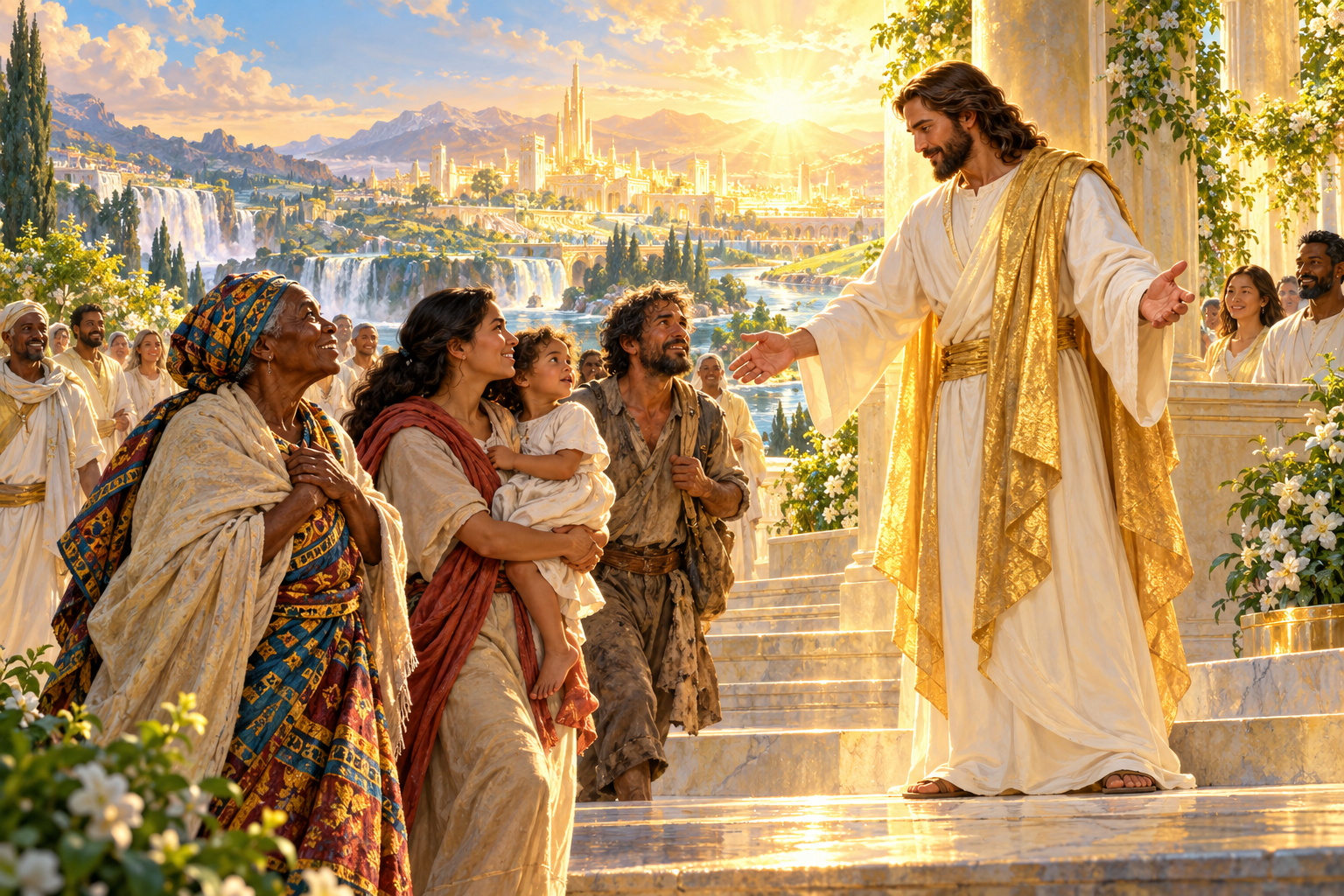
How could a loving God judge the world?
01
Introduction
Faith Built on Truth — In Christ, Through Scripture, for Life
For many people, divine judgment sounds incompatible with love.
If God is compassionate, why would he judge anyone? Why not simply forgive everyone and move on?
But the question begins to sound different when we stand beside the victim rather than the offender.
What should a loving God do with cruelty that was never confessed?
What about corruption that destroyed families, violence that silenced the weak, stolen wages that were never repaid, or lies that ruined lives?
A love that never confronts evil is not mercy.
It is abandonment.
The Bible presents final judgment not as God losing his temper, but as God finally setting the world right.
The Judge is also the Creator who loves what he has made, the God who hears the cry of the oppressed, and the Father revealed in Jesus Christ.
Final judgment means that evil will not be ignored forever, hidden forever, or allowed to rule forever.
Here are ten reasons to believe that God’s final judgment is both necessary and good.
02
1. Love requires God to take evil seriously
If love means anything, it must care about what destroys the beloved.
Scripture repeatedly shows God opposing violence, oppression, deceit, and exploitation because these things wound people made in his image (Psalm 11:5–7; Proverbs 6:16–19).
God’s anger against evil is not the opposite of love.
It is love refusing to become indifferent to what destroys life.
Imagine a parent watching one child abuse another and responding, “It does not matter.”
That would not be love.
Love protects.
Love tells the truth.
Love refuses to call cruelty harmless.
In the same way, God’s judgment reveals that his compassion is not sentimental. He loves his creatures too deeply to make peace with what destroys them.
Takeaway: A loving God must oppose what destroys the people and world he loves.
03
2. Judgment gives dignity to victims
The Bible is filled with the cries of people who have been harmed.
The Psalms ask how long the wicked will prosper and when God will act (Psalm 10:1–18; 94:1–7).
These prayers are not embarrassing interruptions in the biblical story.
They are part of it.
They teach us that God makes room for the cry, “This was wrong. How long will it continue?”
Final judgment declares that those cries have not been forgotten.
It tells the abused person, the cheated worker, the displaced family, the silenced witness, and the forgotten victim that what happened to them matters before God.
Justice is not revenge dressed in religious language.
It is God’s declaration that suffering was real, evil was wrong, and the wound will not be erased simply because the offender was powerful enough to escape human accountability.
Takeaway: Judgment honors victims by refusing to treat their wounds as insignificant.
04
3. God’s judgment is impartial
Human justice can be distorted by money, influence, tribe, social position, fear, or political power.
Some people can afford better lawyers.
Some can shape the story told about them.
Others are ignored before they are even heard.
Scripture insists that God is different.
He “shows no partiality” and judges each person truthfully (Deuteronomy 10:17; Romans 2:6–11).
The poor cannot bribe him.
The wealthy cannot purchase exemption.
The powerful cannot intimidate him.
A respected name cannot hide the truth.
This is good news in a world where some people appear too powerful ever to answer for what they have done.
The courtroom of God cannot be bought.
Takeaway: God’s judgment is trustworthy because no one can purchase exemption from it.
05
4. Judgment brings hidden truth into the light
Jesus teaches that what is hidden will one day be revealed (Luke 12:2–3).
Paul says God will bring to light what is concealed and expose the purposes of the heart (1 Corinthians 4:5).
Final judgment means reality will not remain forever buried beneath propaganda, secrecy, carefully managed reputations, or self-justification.
Truth matters because love depends on truth.
Healing cannot begin where evil is endlessly renamed, excused, denied, or hidden.
A family cannot heal if everyone must pretend the wound never happened.
A society cannot become just if lies remain more powerful than truth.
And a human heart cannot be made whole while it builds its identity around denial.
Judgment is God’s final refusal to let lies define reality.
Takeaway: Judgment is the moment when God’s truth finally defeats every lie.
06
5. God judges through Jesus, the one who gave himself for sinners
The New Testament places judgment in the hands of Jesus (John 5:22–27; Acts 17:31).
That matters profoundly.
The Judge is not a distant tyrant who knows nothing of human pain.
He is the one who wept.
He welcomed sinners.
He touched the excluded.
He confronted hypocrisy.
He forgave enemies.
He carried a cross.
And he bore the violence of the world in his own body.
The one who judges is the one who first gave himself to save.
This means Christian teaching about judgment must always be understood through the character of Jesus.
The Judge knows both the seriousness of evil and the depth of mercy.
He is not indifferent to victims, and he does not delight in condemnation.
Justice and self-giving love meet in him.
Takeaway: Christian judgment is centered on Jesus, where justice and self-giving love meet.
07
6. The cross shows that forgiveness does not mean evil is ignored
At the cross, God does not wave sin away as though it were harmless.
He confronts it, bears its cost, defeats its power, and opens a path toward reconciliation (Romans 3:23–26; Colossians 2:13–15).
Forgiveness is not pretending nothing happened.
A wound can be forgiven and still be named as a wound.
A debt can be released only because its cost is real.
The cross therefore protects us from two opposite mistakes.
One is to treat sin lightly, as though mercy means God simply does not care.
The other is to imagine justice as something separated from God’s saving love.
At the cross, grace is costly precisely because evil is serious.
God does not save us by calling darkness light.
He deals with sin in order to bring sinners home.
Takeaway: God’s mercy does not deny justice; at the cross, mercy confronts evil and opens the way to reconciliation.
08
7. Judgment protects creation from endless evil
Imagine a world where cruelty never ends.
The violent keep ruling.
Corruption reproduces itself forever.
Lies continue to destroy trust.
Death keeps taking those we love.
Such a world would not be heaven.
Biblical hope requires evil to be brought to an end.
Revelation pictures the defeat of death, deception, violence, and every power that destroys God’s world (Revelation 20:10–15; 21:1–5).
Judgment, therefore, is part of renewal.
A surgeon who refuses to remove a deadly infection is not merciful simply because the procedure would be painful.
Sometimes healing requires confronting what is destroying the body.
In the same way, if God is truly making all things new, what endlessly destroys life cannot simply be carried unchanged into the new creation.
Takeaway: For creation to be healed, what destroys creation must finally be stopped.
09
8. Judgment gives moral seriousness to our present lives
If nothing is ever judged, then our choices ultimately carry no final weight.
But Jesus teaches that what we do with our lives matters (Matthew 25:31–46).
Paul says each of us will give an account before God (Romans 14:10–12).
This does not mean salvation is earned through moral scorekeeping.
Grace is not a wage paid to people who perform well enough.
But grace does not make our lives morally meaningless.
It creates accountable people.
What we do with power matters.
What we do with money matters.
How we use truth matters.
How we treat bodies matters.
How we respond to neighbors, opportunities, and the vulnerable matters.
Final judgment gives weight to ordinary faithfulness because God takes human life seriously.
Takeaway: Final judgment tells us that everyday faithfulness is not trivial.
10
9. Judgment restrains revenge by placing final justice in God’s hands
Paul tells believers not to take vengeance into their own hands but to leave final judgment with God (Romans 12:17–21).
This does not mean passivity.
Christians may seek justice.
They may report wrongdoing.
They may protect the vulnerable.
They may confront abuse, challenge corrupt systems, and resist evil.
But they are not required to become consumed by revenge.
There is a difference between seeking justice and allowing hatred to become our master.
When final justice belongs to God, we do not have to carry the impossible burden of making every wrong come out even by our own hands.
We can oppose evil without becoming its mirror.
We can tell the truth without letting vengeance write the rest of our story.
Takeaway: Trust in God’s judgment frees us to pursue justice without becoming consumed by revenge.
11
10. Final judgment clears the way for new creation
The Bible does not end with judgment.
It moves through judgment into renewal.
After evil is defeated, Revelation sees a new heaven and a new earth, tears wiped away, death no more, and God dwelling with humanity (Revelation 21:1–5).
Judgment is not God’s final word.
New creation is.
God’s purpose is not merely to punish what is wrong.
It is to make the world right.
Judgment removes what cannot belong in the healed world God is making.
That is why biblical judgment and biblical hope belong together.
The God who says no to violence, deception, death, and oppression is the same God who says yes to life, truth, healing, peace, and restored creation.
Takeaway: God judges in order to set the world right and bring creation into peace.
12
Truth and Your Decision
A God who never judges may sound comforting—until we remember the mass grave, the abused child, the stolen wages, the trafficked body, the corrupt court, the lie that destroyed a family, and the violence no one punished.
Then the question changes.
Not simply:
“How can a loving God judge?”
But:
“How could a loving God refuse to?”
The Christian answer is not that God enjoys punishment.
It is that God loves his creation too deeply to allow evil to rule forever.
And the Judge is Jesus.
The one who will bring everything into the light is the same one who stretched out his hands on the cross and prayed for his enemies.
That means judgment should not make us arrogant.
It should make us humble.
We are not invited to stand above the world and declare ourselves righteous.
We are invited to come into the light.
To receive mercy.
To repent.
To repair what we can.
And to become people who practice justice now.
Final judgment is good news because lies will end.
Oppression will end.
Death will end.
And what God loves will finally be set right.
13
A Prayer for Mercy and Justice
God of justice and mercy,
You see what we hide, and you hear the cries we ignore.
Forgive us for the harm we have done, the truth we have avoided, and the injustice we have tolerated.
Teach us to receive your mercy without treating sin lightly.
Give us courage to repent, to repair what we can, to defend the vulnerable, and to leave final justice in your hands.
Through Jesus Christ, our Savior and Judge, prepare us for the day when everything hidden is brought into the light and all things are finally set right.
Amen.
14
Continue the Journey
When you think about judgment, do you fear punishment, long for justice, or feel both at once?
What might change if you began to see God’s judgment not as divine cruelty, but as the final setting-right of the world?


Be the first to leave a comment.