

What evidence distinguishes Sunday worship, Sunday rest, and the claim that Sunday replaced Sabbath?
Investigating the evidence from the New Testament to the fifth century
Opening passages: Acts 20:7; 1 Corinthians 16:2. Central question: Where did Sunday worship begin, when did Sunday rest enter the picture, and what can history actually establish about the claim that Sunday replaced the Sabbath?
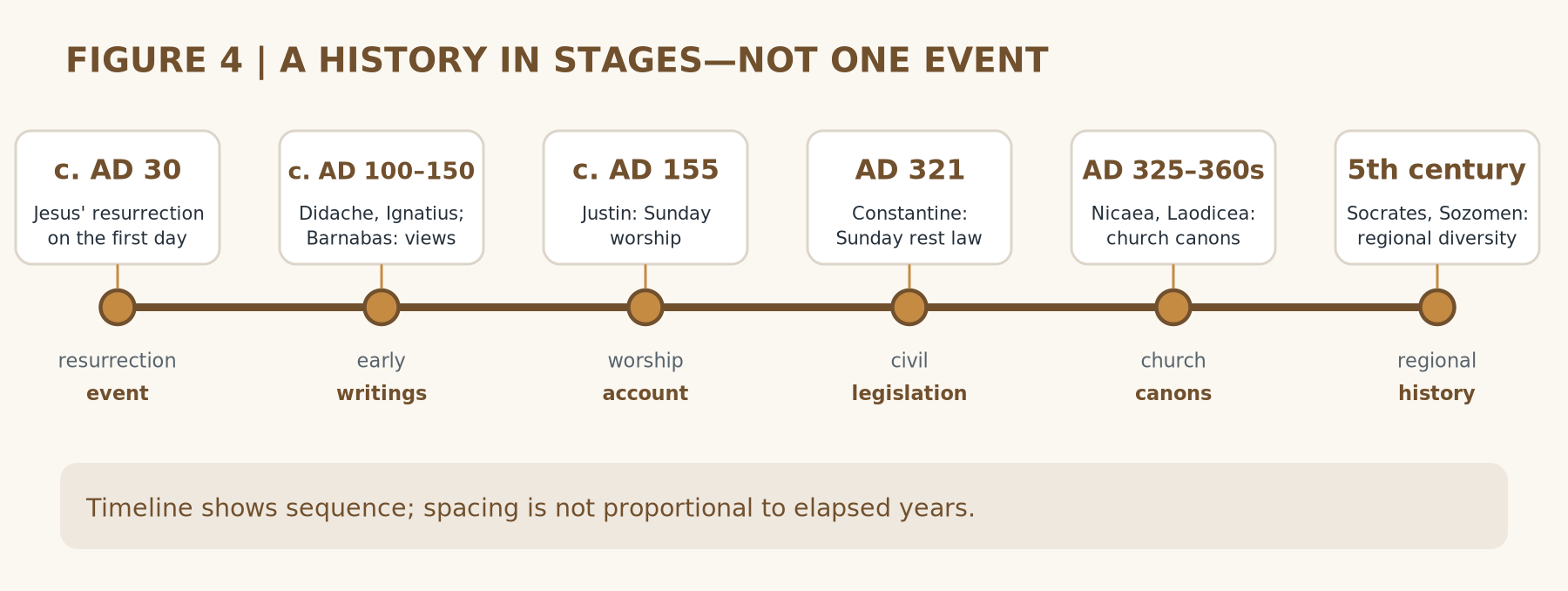
Imagine Rome in the middle of the second century. Christians assemble on the day called Sunday. Scripture is read. A leader encourages a life of goodness. Believers pray, share bread and wine, and collect assistance for widows, orphans, the sick, prisoners, and travelers. This is not a scene invented by a later artist. The picture summarizes Justin Martyr's account in First Apology 67, written around AD 155 [P1].
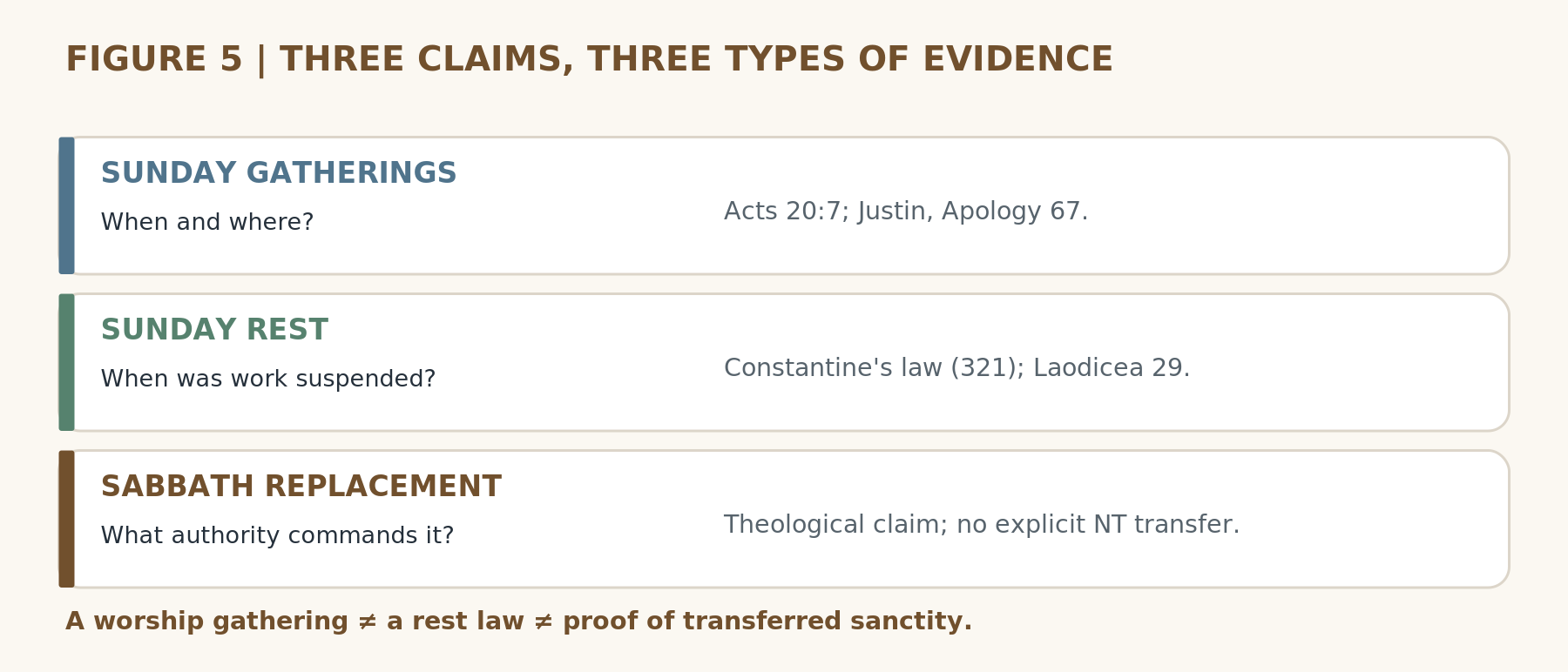
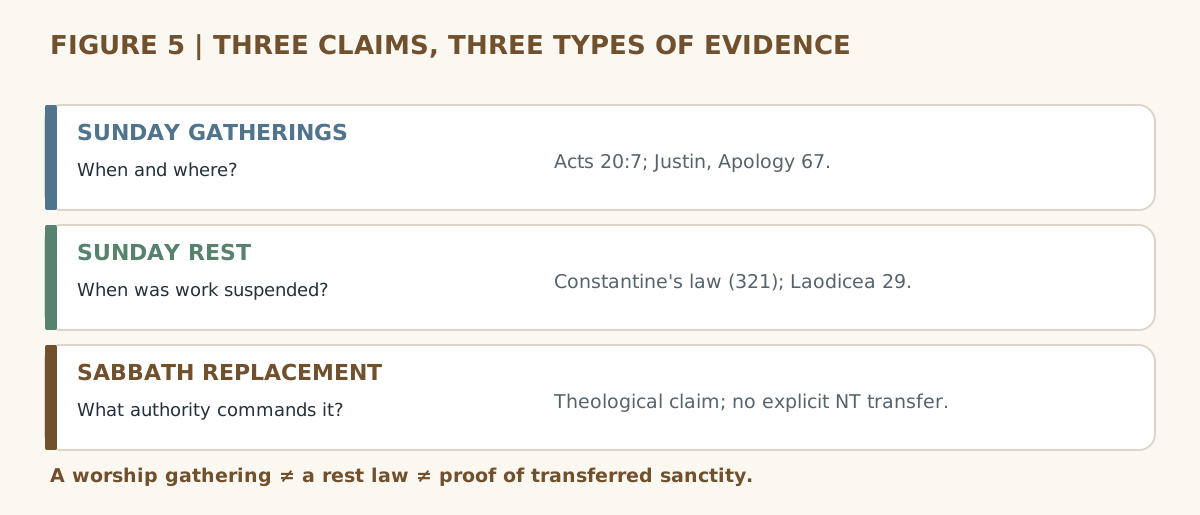
But what does the account establish? It shows Sunday worship before Constantine. It does not, by itself, show that those believers never gathered on the Sabbath, that the church had been commanded to stop working on Sunday, or that Jesus had transferred the sanctity of the fourth commandment. Gathering for worship, resting from work, and changing a Sabbath obligation are three distinct claims.
The Bible: What happened on the first day?
The resurrection accounts name the first day of the week (Matt. 28:1; Mark 16:2; Luke 24:1; John 20:1). This is evidence for an event of supreme importance to the Christian message. Theologically, the first day could become a fitting occasion to celebrate Christ's victory and the beginning of new creation. Yet the resurrection narratives do not themselves command the transfer of the seventh-day Sabbath.
Acts 20:7 describes believers at Troas meeting on the first day to break bread, with Paul speaking at length because of an approaching departure. The passage is significant evidence for a first-day Christian gathering. Nevertheless, the narrative does not settle whether the gathering represented a weekly custom, a special farewell meeting, or both. Whether the meeting took place on Saturday evening or Sunday evening also depends on the system used to reckon the day.
1 Corinthians 16:2 directs believers to set money aside on the first day of each week for Christians in need at Jerusalem. The Greek phrase par' heautō may refer to setting aside a sum privately; the wording does not establish that an offering was being collected during a corporate worship service. The first day matters to the arrangement for giving, but the nature of any meeting is left unstated.
Revelation 1:10 uses the expression “the Lord's Day” without explicitly naming Sunday. Richard Bauckham offers substantial historical and linguistic arguments for identifying the expression with Sunday in light of later early-Christian usage [H1]. Even if that identification is accepted, identifying a day is not the same as commanding the transfer of the Sabbath.
The New Testament therefore gives the first day an identifiable place in early Christian life, but contains no explicit statement that the holiness of the seventh day was transferred to the first. Conversely, the absence of such a statement does not prove every claim about the continuing Sabbath obligation for Gentile Christians. That question belongs to the first article.
Before Constantine: Witnesses from the second century
Each early document contributes evidence, but each also has limits.
Didache 14 calls believers to assemble, break bread, offer thanksgiving, and confess sins. The customary translation connects the gathering with the Lord's Day. However, the dating of the work and the meaning of some Greek expressions remain debated. The evidence is meaningful without answering every historical question [P2].
Ignatius of Antioch, Magnesians 9, contrasts life according to the former order with life shaped by new hope in Christ. A familiar translation refers to living in observance of the Lord's Day. The relevant Greek expression is disputed, however, because the word for “day” does not appear in the crucial phrase; other interpreters understand the wording as living a life belonging to the Lord. A careful study distinguishes the wording of a text from an interpretation supplied by a translator [P3].
The Epistle of Barnabas 15 presents the “eighth day” as a sign of a new beginning associated with the resurrection. This is evidence of a developing theological interpretation, not a record of Jesus issuing a new command to replace the Sabbath in the Gospels [P4].
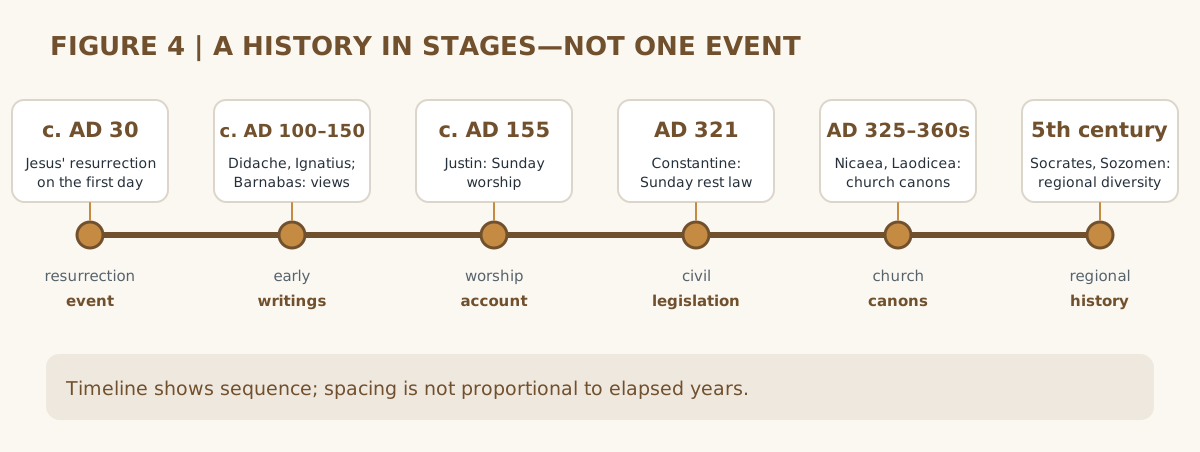
Justin Martyr, First Apology 67, provides the clearest witness. Justin explicitly names Sunday and explains the gathering by appealing to creation and Jesus' resurrection. Justin describes Scripture readings, instruction, prayer, the sharing of bread and wine, and assistance for people in need [P1]. The account establishes that Sunday worship was not invented for the first time in the fourth century. It does not, however, equate a requirement of Sunday rest with the fourth commandment.
Why does that distinction matter? Discussions sometimes isolate Justin's reference to Sunday and overlook the following account of assistance for prisoners and the poor. In Justin's description, the assembly involved the Word and the shared table, but also a helping hand extended to a neighbor.
AD 321: What did Constantine change?
In AD 321, Constantine's law directed magistrates, urban residents, and craftspeople to rest on the day known as the “day of the Sun.” Much agricultural work was excepted, since the season could require timely planting and care of crops [P5].
The law did not begin Sunday worship. Justin had described Sunday gatherings roughly a century and a half earlier. Nor did the law establish universal rest for every person in the Roman Empire; agricultural exceptions remained. Constantine's legislation marked an important step toward making Sunday a matter of civil law within a history of Christian worship practices that had already begun.
The Council of Nicaea in AD 325 is sometimes cited in claims that church leaders changed the Sabbath to Sunday. But Nicaea's Canon 20 addresses posture during prayer on the Lord's Day and during Pentecost, not a transfer of the fourth commandment [P6]. To identify that canon as the decision that “changed the Sabbath” is to read more into the canon than the text says.
Laodicea: Canons reflecting fourth-century tensions
The Synod of Laodicea, usually dated to the AD 360s, offers striking evidence. Canon 16 calls for Gospel readings on the Sabbath. Meanwhile, Canon 29 forbids Christians to rest on the Sabbath in a manner interpreted as adopting Jewish practice; the canon encourages honoring the Lord's Day and resting on Sunday when possible [P7].
Do the canons contradict each other? Not necessarily. The first concerns an assembly for the reading of Scripture; the second concerns rest from work and the boundaries of communal identity. Here the distinction between worship and rest becomes especially clear.
The harsh language directed against practices identified as Jewish also belongs to a wider history of Christian separation from Judaism. That history should be examined without encouraging hostility toward Jewish people today and without assuming that every Sunday custom arose from that one cause.
The fifth century: Had all churches abandoned the Sabbath?
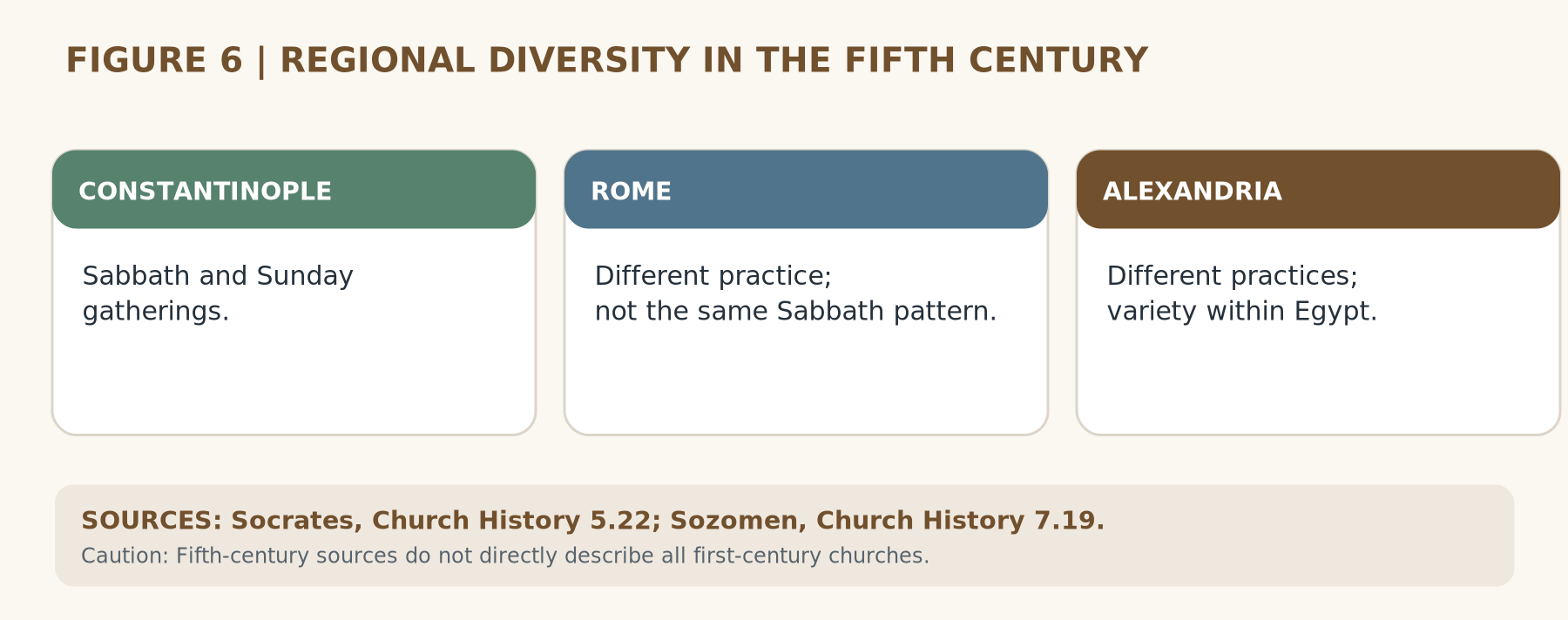
The church historians Socrates Scholasticus (Church History 5.22) and Sozomen (7.19) describe geographical differences. Their accounts indicate that Sabbath gatherings continued in many places alongside gatherings on the first day. Rome and Alexandria followed customs different from those of various other regions. Practices differed even within Egypt [P8–P9].
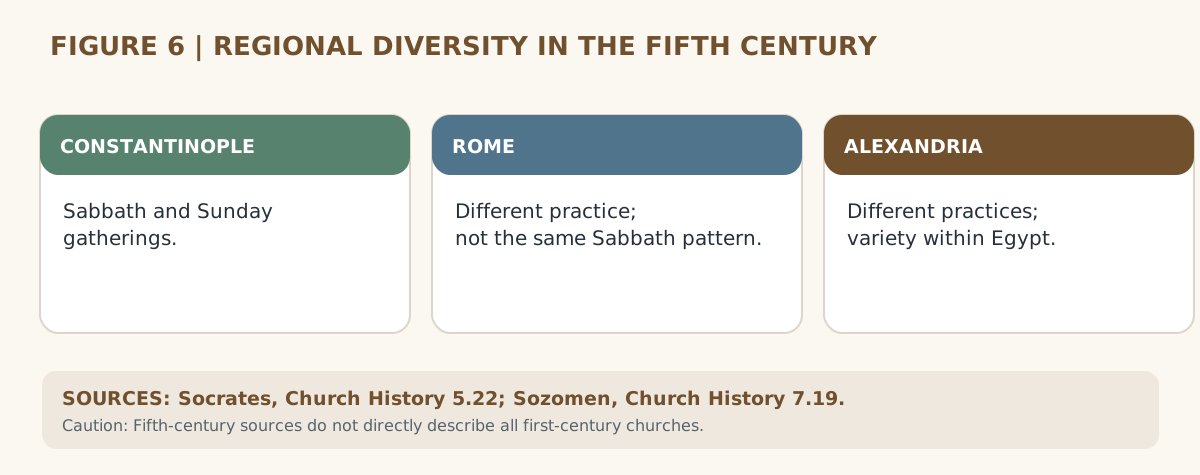
The chronological limits must be respected: these historians describe the fifth century. Their testimony cannot directly prove that every first-century congregation observed the Sabbath in the same way. Nor does a Sabbath gathering necessarily demonstrate a complete cessation of work for the entire day. Responsible history does not ask a source to establish more than it can support.
Why did Sunday spread? Causes that must be kept distinct
Jesus' resurrection. Christians associated the first day with joy and the beginning of new creation. Justin and Barnabas display this line of theological reasoning.
The rhythms of community. Congregations needed regular opportunities to read Scripture, pray, celebrate the Lord's Supper, and care for the needy. A gathering custom did not automatically create a law requiring rest from work.
Identity and relationships with Judaism. Some Christian writings distanced Christian communities from Jewish practices, and discriminatory language sometimes became stronger. Tonstad emphasizes the importance of this history [H2]. Bauckham cautions that the evidence does not justify treating anti-Jewish hostility as the sole explanation for the origin of Sunday gatherings [H1].
Church and imperial authority. Church canons and rulers' laws could strengthen established customs, set limits on conduct, or reshape social relations.
No single cause adequately explains every Christian tradition in every region and every century.
Four claims that require correction
| Common claim | What the evidence supports |
|---|---|
| “Constantine invented Sunday worship.” | Contradicted by Justin's testimony before AD 321. |
| “Acts 20:7 commands the transfer of the Sabbath.” | Acts describes a gathering, not a command transferring the day. |
| “All churches abandoned the Sabbath at the same time.” | Socrates and Sozomen attest to regional diversity in the fifth century. |
| “Because Sunday worship existed, Sunday was also a legally protected day of rest.” | Worship and rest have related but distinct histories. |
Conclusion: history describes what happened; Scripture raises the question of authority
Following the evidence from the empty tomb to Justin's assembly, from Constantine's law to the differing practices of fifth-century churches, a clearer picture emerges: Some Christians worshiped on Sunday before imperial legislation; Sunday rest was strengthened later; the claim that Sunday replaced the Sabbath is a theological conclusion requiring a separate argument.
This conclusion does not devalue Sunday worship or deny the Sabbath's historical importance in the church. It is an invitation to resist telling a simpler story than the evidence allows. In some places congregations met on both days; elsewhere practices reflected regional and cultural differences.
Faithfulness to Scripture calls for three questions: What does the Bible command? What does history describe? And how did the church interpret what began as gatherings of believers? When these questions remain distinct, grace and truth can meet without fear.
Questions for reflection
- What does Justin's testimony reveal about worship and practical care for others? What does Justin's testimony not establish?
- Why is it mistaken to confuse Laodicea's canon on rest with the canon on reading the Gospel on the Sabbath?
- What do fifth-century regional differences teach us about turning a single account into a rule for all Christian history?
A Short Prayer
God of truth, give the church a love for searching the Scriptures and the integrity to listen to history without prejudice. May Christian gatherings be filled with the Word, grace, and works of mercy. Amen.
Continue Learning
The Sabbath After the Cross: Does Christ's Grace Remove the Seventh Day?
Sources and References
- [P1] Justin Martyr, First Apology 67 — Read source
- [P2] Didache 14 — Read source
- [P3] Ignatius, Letter to the Magnesians 9 — Read source
- [P4] Epistle of Barnabas 15 — Read source
- [P5] Constantine's law of AD 321, preserved in Codex Justinianus 3.12 — text and discussion: Read source
- [P6] Nicaea, Canon 20 — collection of canons: Read source
- [P7] Laodicea, Canons 16 and 29 — Read source
- [P8] Socrates Scholasticus, Church History 5.22 — Read source
- [P9] Sozomen, Church History 7.19 — Read source
- [H1] Richard J. Bauckham, “The Lord's Day” and “Sabbath and Sunday in the Post-Apostolic Church,” in D. A. Carson (ed.), From Sabbath to Lord's Day.
- [H2] Sigve K. Tonstad, The Lost Meaning of the Seventh Day, chapters discussing Sabbath history.
- [H3] Christopher John Donato (ed.), Perspectives on the Sabbath: Four Views, contributions by MacCarty, Pipa, Arand, and Blomberg.


Be the first to leave a comment.