

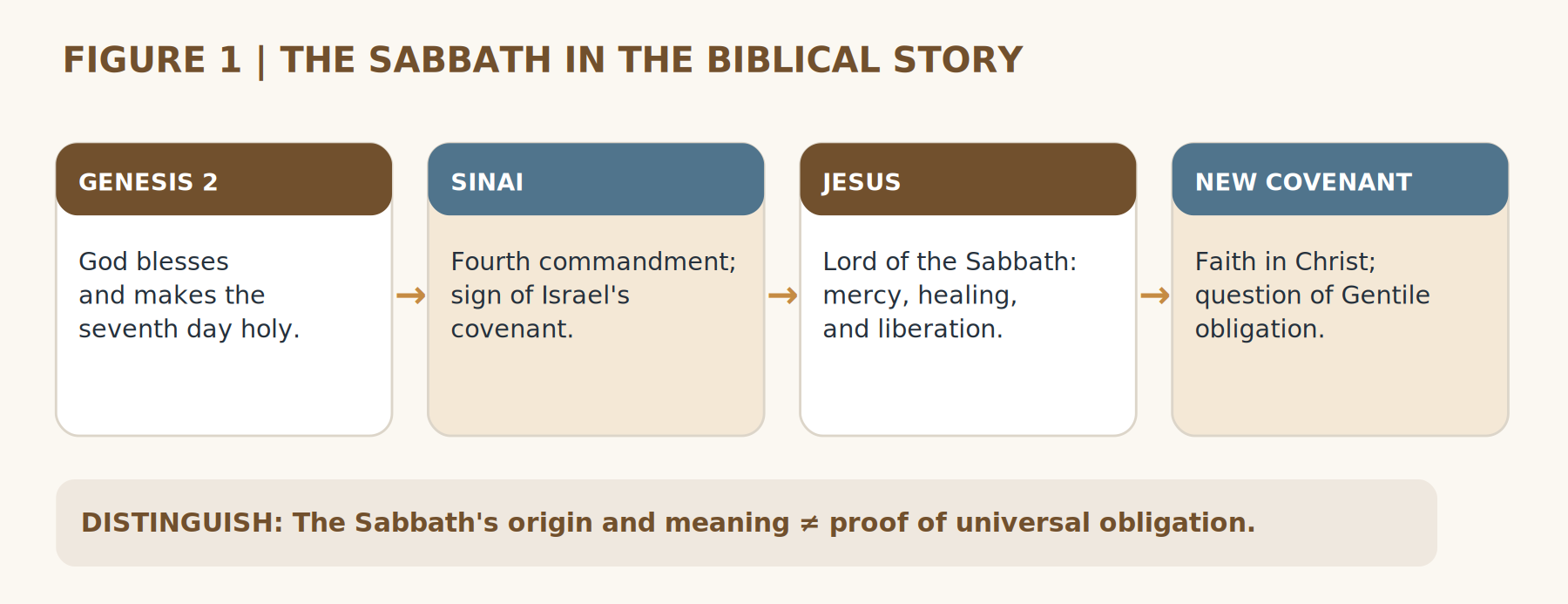
Does fulfillment in Christ remove the obligation of the seventh day, or deepen the meaning of Sabbath?
An investigation of Scripture, the New Covenant, and God's rest
Opening passage: Hebrews 4:9–11. Central question: When Christ brought the rest of salvation, did the seventh-day Sabbath lose its weekly obligation, or did the Sabbath acquire a deeper meaning?
A farmer lays down the hoe on Friday evening, looks across the field, and thanks God for the week's work. Another Christian gathers with fellow believers on Sunday to celebrate the resurrection of Jesus. Both confess Christ as Lord. Yet when the same Scriptures are opened, one reader finds an enduring command to observe the seventh-day Sabbath, while another finds that Christ's rest has removed the obligation to observe a particular day. Why do faithful readers reach different conclusions?
The answer cannot be found by wielding a single verse like a hammer. A careful investigation must distinguish the Sabbath's origin, covenantal obligation, fulfillment in Christ, and freedom of conscience within the Christian community. These distinctions stand at the heart of the exchange between Skip MacCarty, Sigve K. Tonstad, Thomas R. Schreiner, and Craig L. Blomberg, alongside commentaries by Keener, Dunn, Moo, and Cockerill [1–8].
Before Sinai, God blessed the seventh day
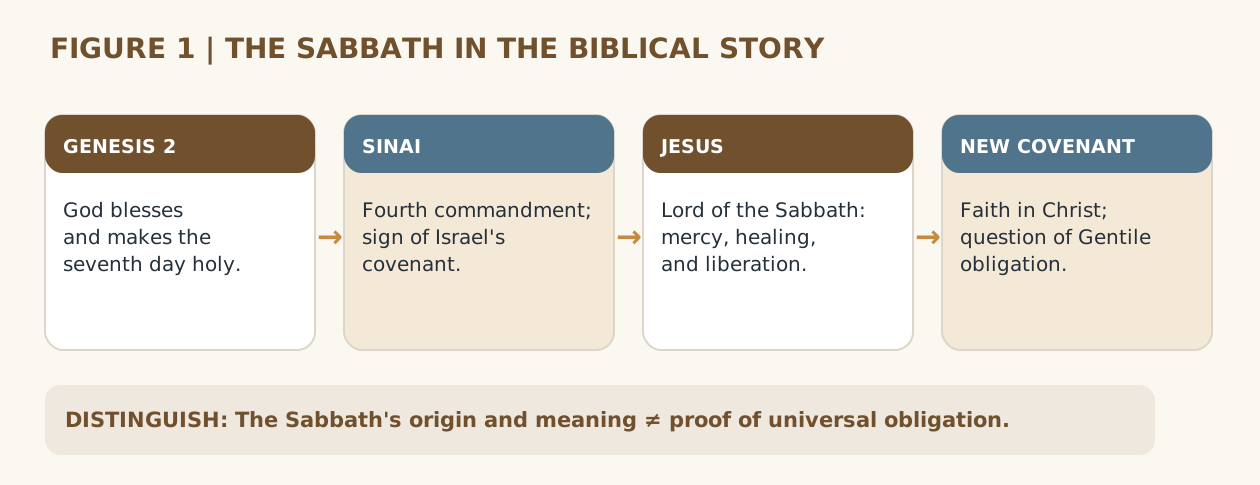
Genesis 2:1–3 does not say that God became tired. God ceases the work of creation, blesses the seventh day, and makes the day holy. For Tonstad, the passage opens a window into the Creator's character: God grants the world time to delight in creation rather than pursue production without end [2]. MacCarty sees the creation setting as evidence that the Sabbath cannot be confined to Israel alone [3].
Yet an important question remains: Does Genesis 2 directly command Adam and Eve to observe the seventh day? No. The passage describes God's action. Exodus 20:8–11 later appeals to that action as the foundation of the fourth commandment. The Sabbath's pre-Israelite origin is therefore a substantial argument, but not, by itself, conclusive proof of an identical obligation under every covenant.
Exodus 31:12–17 calls the Sabbath a sign between God and Israel. Deuteronomy 5:12–15 recalls Israel's slavery and deliverance. Schreiner emphasizes this connection with the Sinai covenant and argues that the New Covenant changes the legal authority of that covenantal framework [1]. MacCarty replies that Sinai did not invent the seventh day; the covenant gave further meaning to a day already sanctified at creation. Both arguments engage genuine biblical evidence.
Isaiah 56:3–7 welcomes foreigners who hold fast to the covenant and keep the Sabbath. The passage challenges the idea that the Sabbath was solely a matter of ethnic ancestry. Yet these foreigners participate in Israel's covenantal setting; the place of Gentile believers under the New Covenant still requires investigation.
Jesus did not turn the Sabbath into humanity's enemy
In Mark 2:23–3:6, Jesus confronts disagreements over hunger and healing on the Sabbath. The declaration that the Sabbath was made for humanity (Mark 2:27) discloses the purpose of the gift. The declaration that the Son of Man is Lord even of the Sabbath (2:28) announces Jesus' authority. In Luke 13:10–17, the healing of a woman held in suffering for many years portrays the Sabbath as a day when bonds are loosened.
MacCarty reads these actions as a restoration of the Sabbath's original purpose. Blomberg and Schreiner point out that Jesus lived under the law of Moses (Gal. 4:4). Consequently, Jesus' practice during the earthly ministry does not, by itself, settle the requirements of the New Covenant for Gentile believers [1, 3].
Still, Mark 2 does not say that Jesus abolished the seventh day or ordered the transfer of the day. Nor does Mark 2 give a complete statement of Gentile believers' obligations after the resurrection. The question calls for reading the whole New Testament.
A further caution matters. It would be unfair to portray all Jewish people in Jesus' day as enemies of compassion. Jesus' disputes arose within a diverse Jewish conversation about the law, human need, and the saving of life. Honoring Christ does not require disparaging Judaism.
When Paul discusses days, what exactly is at issue?
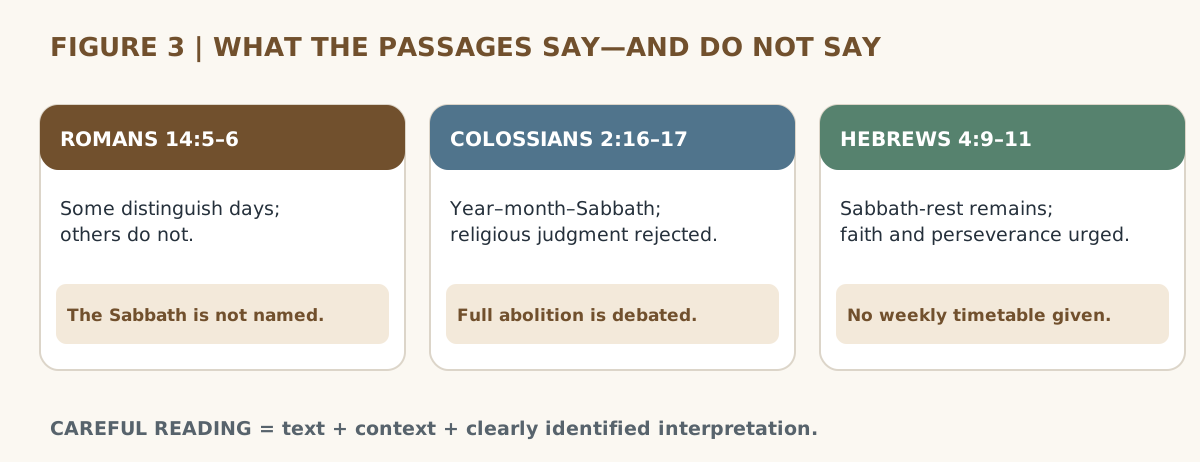
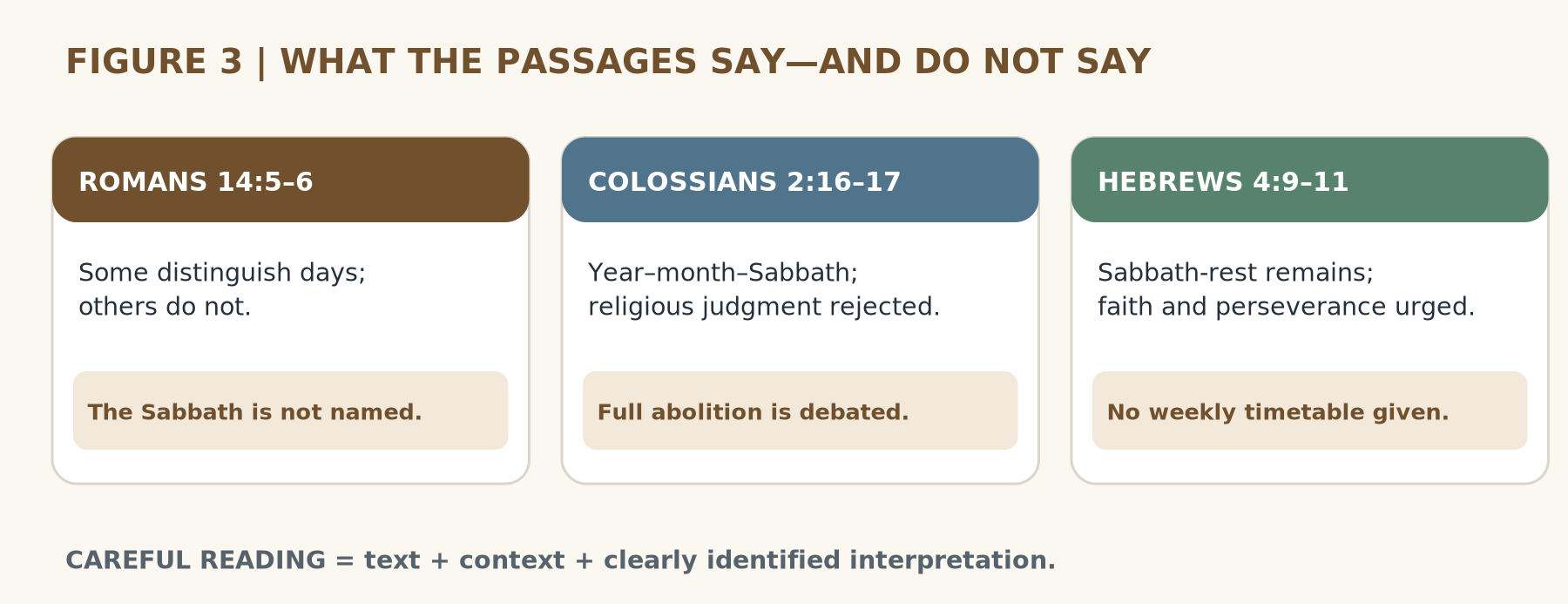
Romans 14:5–6. Paul explains that some believers distinguish one day from another, while others regard all days alike. Keener places this disagreement within the tensions surrounding food and days among believers of different backgrounds in Rome [5]. The word Sabbath does not appear in these verses. The days in question may include the weekly Sabbath, but scholars also discuss fasting days and other practices.
Schreiner argues that if Paul permits differences over days, Sabbath observance cannot be mandatory for every Christian. MacCarty responds that Paul is addressing disputed customs rather than the fourth commandment. Schreiner's argument must establish that the weekly Sabbath belongs to the category Paul is discussing. MacCarty's argument must establish that the weekly Sabbath cannot belong to that category. Romans 14 should not become a shortcut to a predetermined verdict.
Colossians 2:16–23. Here the challenge becomes more pointed. The sequence of festivals, new moons, and Sabbaths resembles the Old Testament pattern of yearly, monthly, and weekly observances. Dunn and Moo find strong grounds for including the weekly Sabbath in this language [6, 7]. It is therefore unsafe to defend seventh-day observance by insisting that Paul must mean annual ceremonial sabbaths alone.
Paul forbids believers to accept judgment over food and days, describing such matters in relation to a shadow whose reality belongs to Christ. Moo sees evidence that the day itself no longer binds Christians [7]. Tonstad resists the conclusion that Paul's criticism of the Colossian requirements and judgments automatically abolishes the Sabbath of Genesis 2 [2]. Does Paul reject the use of the calendar as a measure of standing before God, or does Paul also remove the obligation to observe the same weekly day? The distinction cannot be resolved by hiding evidence from either side.
Galatians 4:8–11. Paul warns against returning to spiritual bondage through the observance of days, months, seasons, and years. The larger discussion concerns religious practices that could lead believers to depend on observances rather than grace. It cannot simply be assumed that the passage refers only to a pagan calendar; the letter also addresses conflict over Jewish law. Yet claiming that Paul forbids every practice of setting apart a day for the Lord goes beyond what the passage explicitly states.
Hebrews 4:9 — The rest that still remains
Hebrews leads readers from the wilderness back to Genesis 2, and from Psalm 95 forward to a promise still awaiting fulfillment. Israel failed to enter rest because of unbelief (Heb. 3:18–19). Joshua did not bring the promise to its final fulfillment, for Psalm 95 still said today long after Israel entered Canaan (4:7–8). In 4:9, the author uses sabbatismos, a word associated with Sabbath, and announces that a Sabbath-rest remains for God's people.
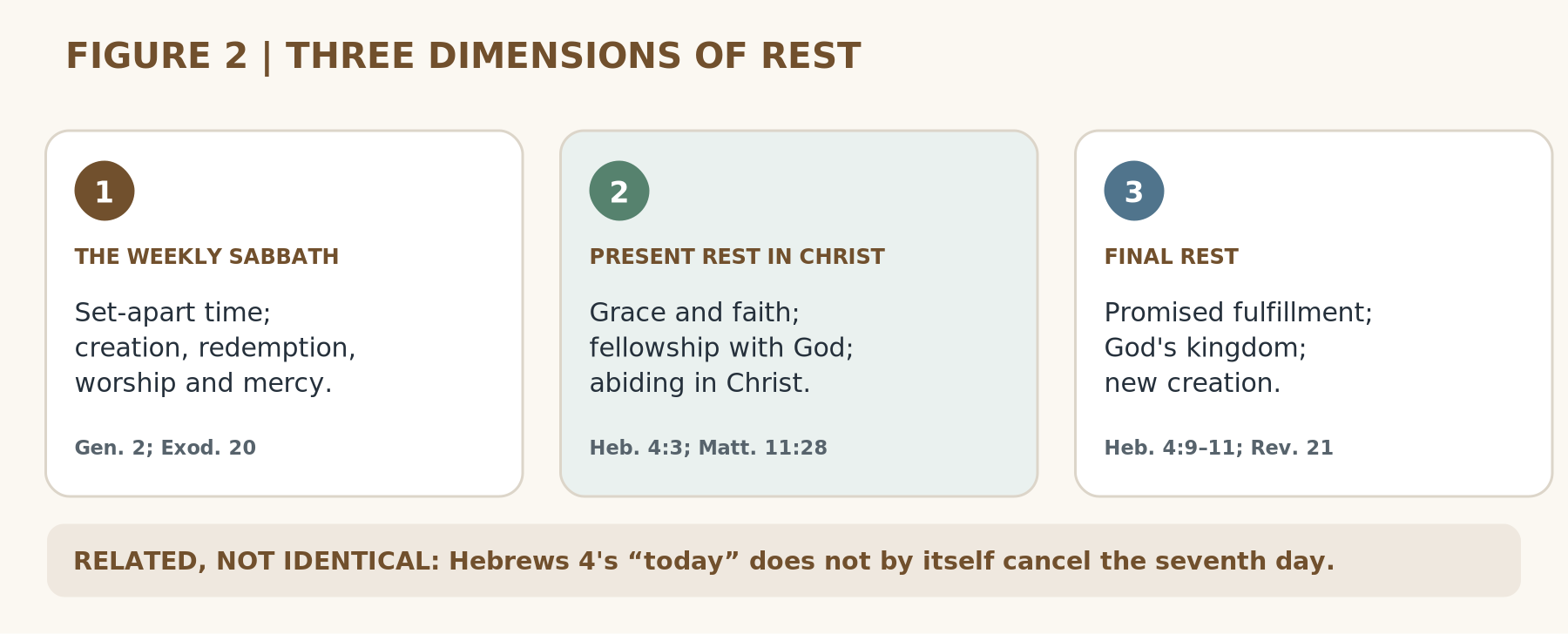
But what kind of rest is in view? Lincoln emphasizes present participation in God's rest through faith; Cockerill emphasizes the inheritance and final celebration of God's rest; Tonstad connects the completed creation, faith in the present, and future hope [2, 4, 8].
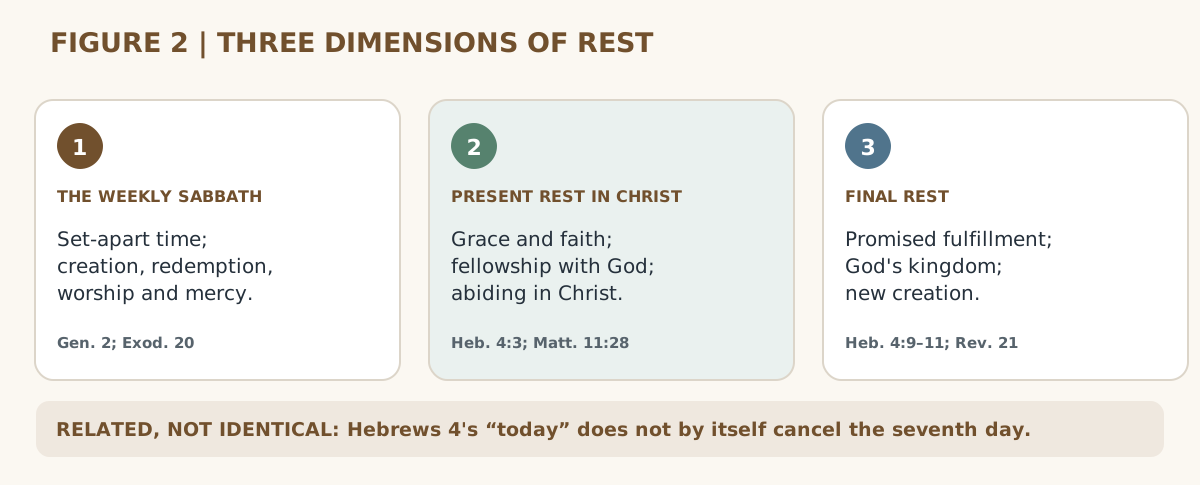
Hebrews 4:11 urges believers to strive to enter that rest. The exhortation calls for persevering faith, not an attempt to purchase salvation through works. Hebrews 4:9 is not an explicit command spelling out a weekly Sabbath schedule. Equally, rest in Christ is not an explicit declaration that the seventh day has been abolished. Any responsible use of the passage must respect both limits.
Does the New Covenant write the law on hearts—or change the law?
Jeremiah 31:31–34 promises that God's law will be written on the heart. Hebrews 8 quotes that promise. Yet Hebrews 7:12 and 10:1–18 also describe profound changes in priesthood and sacrifice. For MacCarty, the promise of the law written on hearts supports the continuing Sabbath commandment. For Schreiner, the sign of the Sinai covenant cannot simply be declared an unchanged New Covenant obligation without further evidence [1, 3].
Acts 15 adds another question. The Jerusalem council did not include the Sabbath among the conditions given to Gentile believers. That omission weighs against treating Sabbath observance as an entrance requirement for salvation or fellowship. Still, the council did not provide an exhaustive list of Christian moral responsibilities. Silence alone cannot settle every question.
The distinction worth preserving is this: The Sabbath may retain enduring meaning without necessarily being demonstrated to be a universal legal requirement for every believer. Likewise, those who interpret the day-specific obligation as fulfilled in Christ do not thereby remove the responsibilities of worship, justice, compassion, and rest.
A test of faithfulness: grace is not the price of the Sabbath
Salvation is God's gift, not wages earned by keeping a religious calendar (Eph. 2:8–10). If Sabbath keeping remains an obligation, obedience must flow from grace. If Christ has fulfilled the obligation of the day, Christian freedom must not become an excuse for endless work, exploitation of workers, or neglect of gathering with the church.
Jesus' Sabbath ministry releases people from suffering. Every interpretation of the Sabbath should therefore face a searching question in homes, hospitals, prisons, and workplaces: Does this interpretation reveal Christ's grace and God's justice, or lay another burden on those who are already weary?
Conclusion: gift, obligation, and hope
Genesis 2, Exodus 20, and Mark 2 provide a weighty biblical and theological basis for the seventh-day Sabbath. Romans 14, Colossians 2, and changes associated with the covenants present genuine challenges to the claim that weekly observance is mandatory for every Christian. Hebrews 3–4 places Christ at the center of God's rest, both in the present and in the world to come.
The case for Sabbath observance can be made with biblical seriousness without turning the day into the price of salvation. The case for fulfillment in Christ must likewise explain why fulfillment removes a day-specific obligation without erasing the witness of creation, mercy, and freedom.
The investigation now opens a second question: How did the church develop Sunday worship and Sunday rest? History must be allowed to speak in its own voice, without being turned into a biblical command.
Questions for reflection
- In Genesis 2, what is the difference between God's sanctification of the seventh day and a command for all humanity to observe the day?
- What does Colossians 2 explicitly state, and which conclusions depend on interpretation?
- Can Sabbath obedience be understood as a fruit of grace rather than a condition for earning salvation?
A Short Prayer
Lord Jesus, Lord of the Sabbath, teach the church to receive God's grace, hear God's voice today, and live with a faithfulness that offers rest and hope to others. Amen.
Continue Learning
How Did Sunday Gain Its Place in the Church? Between the Resurrection, Tradition, and Imperial Law
Sources and References
- [1] Thomas R. Schreiner, 40 Questions About Christians and Biblical Law, especially questions 9, 14, 31, and 36–37.
- [2] Sigve K. Tonstad, The Lost Meaning of the Seventh Day, especially chapters 2, 14–16, and 22–27.
- [3] Christopher John Donato (ed.), Perspectives on the Sabbath: Four Views, contributions and responses by Skip MacCarty and Craig L. Blomberg.
- [4] D. A. Carson (ed.), From Sabbath to Lord's Day, chapters by D. A. Carson and Andrew T. Lincoln.
- [5] Craig S. Keener, Romans: A New Covenant Commentary, on Romans 14:1–15:7.
- [6] James D. G. Dunn, The Epistles to the Colossians and to Philemon, on Colossians 2:16–19.
- [7] Douglas J. Moo, The Letters to the Colossians and to Philemon, on Colossians 2:16–17.
- [8] Gareth Lee Cockerill, The Epistle to the Hebrews, on Hebrews 3:7–4:13.


Be the first to leave a comment.