

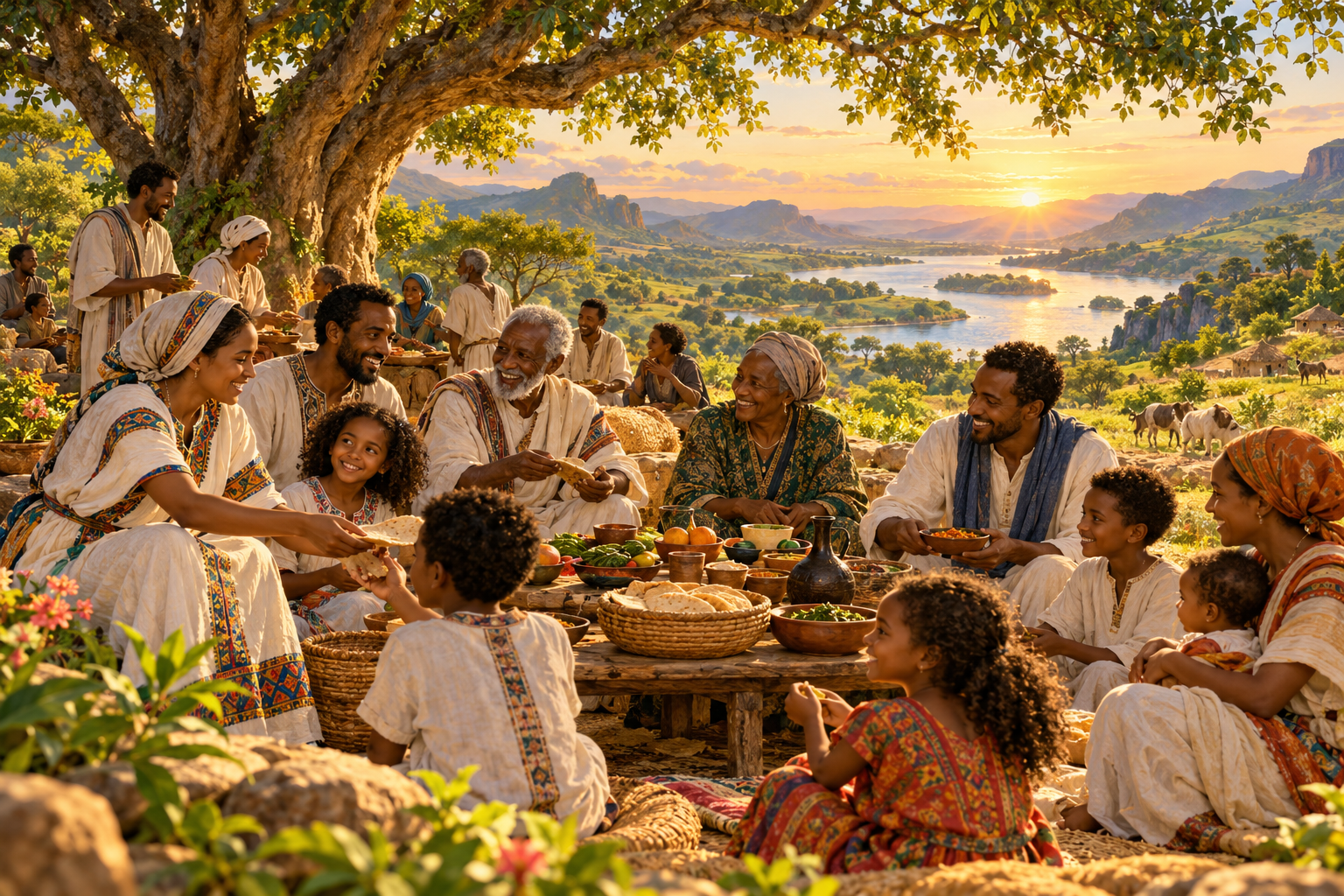
What if one day each week could become more than a break from work?
01
One Day a Week to Live the Future God Has Promised Creation
What if it could become a small rehearsal for the world God has promised?
A day when we stop proving ourselves through productivity. A day when meals are allowed to linger, prayers are not hurried, children are not interruptions, the elderly are not forgotten, the poor are not invisible, and creation is received rather than exploited. A day when we remember that the world does not turn because we keep pushing it.
The biblical Sabbath begins with something remarkably simple:
God stopped.
“By the seventh day God had finished the work he had been doing; so on the seventh day he rested from all his work.” — Genesis 2:2
Yet as the biblical story unfolds, that seventh day becomes much more than recovery after six exhausting days. It becomes a sign of creation as God intended it, a protest against slavery, a school of trust, a foretaste of Jubilee, a stage upon which Jesus performs acts of restoration, and finally a window opening toward God's renewed world.
For Christians living under the New Covenant, difficult questions naturally follow.
Must the seventh-day Sabbath still be observed exactly as commanded under Moses?
Did Sunday replace Saturday?
Does Christ's fulfillment of the Sabbath mean Christians no longer need a weekly rhythm of rest?
Or could a weekly day of ceasing still carry profound wisdom—not as a way of earning salvation, but as a way of practicing the future God has promised creation?
The biblical answer is richer than either “the Sabbath was abolished” or “nothing changed.”
The Sabbath does not disappear in Jesus.
It reaches toward its destination.
02
1. Before There Was Sinai, God Rested
The Sabbath story does not begin with Moses.
It begins with creation.
Genesis tells us that after six days of ordering the world, God ceased from his work:
“Then God blessed the seventh day and made it holy, because on it he rested from all the work of creating that he had done.” — Genesis 2:3
That matters.
The seventh day appears before Abraham, before Israel, before Sinai, before circumcision, and before the giving of the Torah.
Yet we should also be careful.
Genesis 2 describes God's rest, but it does not explicitly record God commanding Adam and Eve to keep every seventh day as Israel would later be commanded to do.
This is one reason Christians have disagreed about whether Genesis 2 itself establishes a universal Sabbath command for every human being.
What Genesis unquestionably gives us is a creation pattern.
Six and then seven.
Work and then cessation.
Labor and then delight.
Creation moving toward communion with God.
Later, when Israel receives the Sabbath command, Scripture deliberately looks backward to this creation pattern.
“For in six days the LORD made the heavens and the earth... but he rested on the seventh day.” — Exodus 20:11
The Sabbath is therefore more than legislation appearing suddenly at Sinai. Israel's command is rooted in a story older than Israel itself.
And that story makes a profound claim about human life:
We are creatures, not the Creator.
We work.
But we are not the ones holding the universe together.
03
2. Sabbath Says, “You Are No Longer Pharaoh's Slave”
Exodus 20 looks backward to creation.
Deuteronomy 5 looks backward to Egypt.
When Moses repeats the Sabbath command to Israel, he gives another reason for keeping it:
“Remember that you were slaves in Egypt and that the LORD your God brought you out of there with a mighty hand and an outstretched arm.” — Deuteronomy 5:15
This changes the meaning of rest.
Under Pharaoh, Israel's value had been measured by bricks.
Produce more.
Work faster.
Gather your own straw.
Meet the quota.
Pharaoh's empire had no Sabbath because slaves are valuable only while they are producing.
Then Yahweh rescues Israel.
And one of the first things God teaches former slaves is how to stop.
The Sabbath therefore says two things at once.
From Genesis:
You are not God.
From Exodus:
You are not Pharaoh's slave.
That combination is still powerful.
Many people today are no longer making bricks beside the Nile, but Pharaoh's voice has learned new languages.
You are what you produce.
You are what you earn.
You are what you achieve.
Keep going.
Answer one more message.
Take one more job.
Make one more sale.
Build one more thing.
Never stop.
Sabbath interrupts that voice.
For one day, Israel was commanded to live as though liberation were true.
Even servants rested.
Foreigners rested.
Animals rested.
The household head could not enjoy leisure while forcing everybody beneath him to keep producing.
Sabbath was therefore not merely private spirituality.
It reshaped economics.
It limited power.
It gave rest to people who might otherwise have had no authority to demand it.
04
3. The Seventh Day Grows into Jubilee
The Sabbath pattern expands as the biblical story develops.
Six days lead to the seventh day.
Six years lead to the seventh year, when the land itself receives rest (Lev. 25:1–7).
Seven cycles of seven years lead toward Jubilee.
Then liberation enters economics even more deeply.
Debts, land, slavery, poverty, and property all come under God's concern.
The point is not that ancient Israel always practiced these commands faithfully. The biblical prophets make clear that Israel often failed.
The point is theological:
God's rest is larger than taking a nap.
It concerns the restoration of right relationships:
between humanity and God,
between people and their neighbors,
between rich and poor,
between human beings and the land.
Biblical Sabbath gradually becomes a picture of creation being put back into balance.
05
4. Then Jesus Walks into the Sabbath Story
This is where the Gospels become especially important.
Jesus repeatedly enters disputes about the Sabbath.
But we should not imagine the story too simplistically:
Judaism loved rules.
Jesus hated rules.
That picture does not do justice either to Jesus or to first-century Judaism.
Jewish teachers themselves debated what could appropriately be done on the Sabbath, especially when questions of human need, healing, danger, and mercy were involved.
Jesus enters that conversation—and then makes an astonishing claim.
“The Sabbath was made for man, not man for the Sabbath. So the Son of Man is Lord even of the Sabbath.” — Mark 2:27–28
Notice what Jesus does not say.
He does not say:
“The Sabbath was a foolish mistake.”
He says:
The Sabbath was made for humanity.
Gift before burden.
Then throughout the Gospels, Jesus does remarkable things on Sabbath days.
He heals.
He releases.
He restores.
A withered hand opens.
A bent woman stands upright.
People imprisoned by sickness experience freedom.
And Jesus asks:
“Is it lawful on the Sabbath to do good or to do evil, to save life or to kill?” — Mark 3:4
The Sabbath controversies therefore reveal something deeper than an argument about calendars.
Jesus is showing what God's rest looks like when it becomes flesh and blood.
God's Sabbath brings life.
It straightens what has been bent.
It releases what has been bound.
It restores what has been broken.
Jesus does not merely explain Sabbath.
He begins doing what Sabbath had always been pointing toward.
06
5. Jesus Announces God's Great Jubilee
Luke makes this connection especially powerful.
Jesus enters the synagogue in Nazareth on the Sabbath and reads from Isaiah:
“The Spirit of the Lord is on me, because he has anointed me to proclaim good news to the poor. He has sent me to proclaim freedom for the prisoners and recovery of sight for the blind, to set the oppressed free, to proclaim the year of the Lord's favor.” — Luke 4:18–19
“The year of the Lord's favor” carries strong Jubilee echoes.
Release.
Restoration.
Freedom.
Return.
This does not mean Jesus simply gives his followers a detailed program for reproducing every regulation of Leviticus 25 in every modern economy.
Nor should Jesus' Jubilee be reduced to private inward spirituality.
His kingdom concerns actual people:
the poor,
the sick,
the excluded,
the indebted,
the imprisoned,
the sinner,
the stranger.
Even the Greek word aphesis, often translated “forgiveness” or “release,” can carry both ideas.
The kingdom Jesus announces is God's great release.
Sin is forgiven.
Captives are freed.
Bodies are restored.
Outcasts return.
The powers that enslave God's creation begin losing their grip.
Sabbath has started walking through Galilee.
07
6. Then Comes the Question Christians Still Debate
If Jesus fulfilled the meaning toward which Sabbath pointed, what happens to the seventh-day command under the New Covenant?
Christians have answered this differently.
Some Christian traditions understand the seventh-day Sabbath as a continuing moral command and therefore believe Christians should still observe the seventh day.
Others believe the Sabbath command belonged specifically to Israel's Mosaic covenant and that its covenantal obligation reached fulfillment in Christ.
Still others believe the moral principle continues but that Sunday, the resurrection day, has become the Christian Sabbath.
These differences should not be hidden.
But neither should disagreement prevent us from seeing several important New Testament developments.
08
7. Paul Refuses to Let Sacred Days Become Weapons
Romans 14 says:
“One person considers one day more sacred than another; another considers every day alike. Each of them should be fully convinced in their own mind.” — Romans 14:5
The precise identity of these “days” is debated.
Some interpreters believe Paul includes Jewish Sabbath observance.
Others argue that he may have particular fasting practices or other religious days in mind.
Romans 14, therefore, should probably not bear the whole weight of the Sabbath debate.
But Paul's pastoral principle is unmistakable.
Believers must not turn differing religious practices into reasons for condemning one another.
Colossians 2 is even more explicit:
“Therefore do not let anyone judge you by what you eat or drink, or with regard to a religious festival, a New Moon celebration or a Sabbath day. These are a shadow of the things that were to come; the reality, however, is found in Christ.” — Colossians 2:16–17
Many scholars understand the sequence “festival, new moon, Sabbath” as an annual-monthly-weekly pattern and therefore see the weekly Sabbath included.
Some Sabbath-observant interpreters disagree and argue that the text refers to ceremonial Sabbaths rather than the weekly seventh day.
That debate deserves fair acknowledgment.
Yet Paul's larger point remains clear:
Christians must not use calendar observance as a basis for judging who truly belongs to God's people.
Galatians sounds a similar warning when observance of “days and months and seasons and years” becomes entangled with returning to religious bondage (Gal. 4:9–11).
Acts 15 also deserves attention.
When the Jerusalem council decides what requirements should be placed upon Gentile converts, Sabbath observance is not included among the instructions sent to them (Acts 15:19–29).
That fact does not by itself settle every Sabbath question.
But it belongs in any serious New Testament discussion.
09
8. Hebrews Takes Sabbath Somewhere Even Larger
Then Hebrews 4 opens an extraordinary door.
The writer returns all the way to Genesis.
God rested on the seventh day.
Israel was promised rest.
Israel entered the land under Joshua.
And yet, centuries later, Psalm 95 still says:
“Today, if you hear his voice, do not harden your hearts.”
The conclusion is striking:
“There remains, then, a Sabbath-rest for the people of God.” — Hebrews 4:9
The Greek word used here, sabbatismos, has generated considerable debate.
Some interpreters understand it as supporting continuing Sabbath observance.
Others understand it primarily as participation in God's eschatological rest.
The second reading fits the larger movement of Hebrews especially well, because the author's argument does not end simply with a weekly calendar.
It moves through:
God's creation rest → Israel's promised rest → Psalm 95's invitation “Today” → present participation through faith → the rest still awaiting God's people.
Hebrews therefore does something breathtaking.
It turns Sabbath into a horizon stretching across the entire biblical story.
Believers already enter God's rest through faith (Heb. 4:3).
Yet they are also told:
“Let us, therefore, make every effort to enter that rest.” — Hebrews 4:11
This is the familiar New Testament tension:
already and not yet.
The dawn has arrived.
But noon has not.
God's future has entered history through Jesus.
But creation is not yet completely healed.
10
9. Sunday Is the Resurrection Day—but the New Testament Never Simply Says, “Sunday Is the New Sabbath”
The resurrection of Jesus transformed Christian time.
Jesus rose on the first day of the week.
Christians soon gathered on that day.
Acts 20:7 mentions believers assembling to break bread on the first day of the week.
Paul instructs believers in Corinth to set aside contributions on the first day (1 Cor. 16:2).
By the middle of the second century, Justin Martyr describes Christians gathering on Sunday to read Scripture, pray, celebrate the Eucharist, and share resources with those in need (First Apology 67).
Justin connects Sunday both with the beginning of creation and with the resurrection of Jesus.
That is important historical evidence.
But another fact is equally important:
The New Testament never explicitly says that the fourth commandment was transferred from the seventh day to the first day.
Early Christian Sunday gathering and later Christian Sunday rest are not exactly the same historical development.
Many early Christians were slaves, laborers, and ordinary workers living within the Roman economy.
They did not have the power to declare Sunday a public holiday.
Their gatherings could therefore occur before or after the normal working day.
Only much later did civil law begin creating Sunday as a broader day of cessation from work.
In AD 321, the emperor Constantine ordered many urban occupations and courts to cease work on the “venerable day of the Sun,” though agricultural work was permitted when necessary (Codex Justinianus 3.12.2).
Historically, therefore, the sequence is better understood as:
Resurrection → first-day Christian gathering → developing Sunday tradition → later civil Sunday rest.
It is too simple to say:
“Saturday was Sabbath, then Christianity moved the whole institution unchanged to Sunday.”
The history is more complicated.
11
10. So Should Christians Still Take One Day in Seven?
Here we should distinguish between covenant obligation and creation-shaped wisdom.
Consider two different claims.
The first says:
“Unless Christians cease work on the seventh day according to Mosaic Sabbath legislation, they are outside faithful New Covenant obedience.”
Christians remain divided over that claim.
But consider another:
“Human beings are embodied creatures rather than machines, and God's biblical story repeatedly forms human life through rhythms of work, cessation, worship, trust, mercy, and delight. Christians are therefore wise to build substantial weekly rest into their lives.”
That second claim is much easier to establish across the whole biblical story.
Jesus himself said:
“The Sabbath was made for man.” — Mark 2:27
That sounds like gift.
And perhaps this is where New Covenant practice can recover something beautiful.
We do not rest because resting purchases God's favor.
We rest because God's favor has already found us.
We do not stop because the world has stopped mattering.
We stop because the world belongs to God.
We do not cease work because work is evil.
We cease because work is not God.
We do not rest to prove that we are New Covenant people of God.
We rest because we are creatures.
And creatures are allowed to sleep.
12
11. What Would a New-Creation Day Look Like?
Perhaps the wrong first question is:
“What am I forbidden to do?”
A better question may be:
“What becomes possible when productivity stops ruling this day?”
Imagine one day shaped by the world Jesus is bringing.
Cease
Put ordinary economic striving down.
Let unfinished work remain unfinished.
Refuse, as much as your circumstances allow, to let the demands of production dominate every hour.
Stopping becomes a confession:
God is God, and I am not.
Worship
Gather with God's people.
Receive Scripture.
Pray.
Sing.
Remember the resurrection.
Reorient the week around God's story rather than your anxieties.
Delight
Eat slowly.
Laugh.
Listen to music.
Walk.
Make art.
Read.
Enjoy your spouse, your children, your friends.
Notice trees again.
Look at the sky.
Biblical rest is not boredom.
It is delight freed from the pressure to turn everything into productivity.
Restore
Jesus repeatedly filled Sabbath with mercy.
Therefore a Christian rhythm of rest should have room for healing.
Visit someone who is sick.
Call someone lonely.
Feed someone.
Encourage the discouraged.
Make peace.
Help a neighbor.
Rest does not mean becoming indifferent to another person's suffering.
The Lord of the Sabbath showed us otherwise.
Release
Allow other people to rest too.
This may be one of Sabbath's most neglected ethical implications.
It is easy to create leisure for ourselves by requiring somebody else to work relentlessly for us.
Deuteronomy's Sabbath vision refuses that arrangement.
Your servant rests.
Your worker rests.
Even your animals rest.
Sabbath teaches us to ask not only:
“Am I resting?”
but:
“Does the way I live make rest possible for others?”
13
12. The Final Sabbath Is Not Eternal Inactivity
The Bible's last chapters finally reveal where this entire story has been moving.
Revelation does not end with human beings abandoning creation and floating forever in a disembodied heaven.
Instead:
the holy city comes down.
God dwells with humanity.
Death disappears.
The curse disappears.
The river of life flows.
The tree of life returns.
The nations are healed.
God's servants worship him.
And they reign.
“Look! God's dwelling place is now among the people.” — Revelation 21:3
This matters enormously for understanding Sabbath.
God's final rest is not a world where nobody does anything.
Revelation contains worship.
Service.
Reigning.
Life.
Culture.
Creation.
What disappears is not meaningful human vocation.
What disappears is the curse.
Work is finally freed from futility.
Human labor is no longer bent beneath exploitation, anxiety, decay, injustice, and death.
That is where Sabbath has been pointing.
14
13. The Whole Story Comes Together
Look at the biblical movement.
Genesis 2: God rests with creation.
Exodus 20: Israel remembers the Creator.
Deuteronomy 5: former slaves learn to stop living like slaves.
Leviticus 25: rest expands toward land, debt, liberation, and Jubilee.
The Prophets: Israel longs for restoration.
Luke 4: Jesus announces the Lord's great year of release.
The Gospels: the Lord of the Sabbath heals what is broken.
The Cross: evil is confronted at its deepest level.
The Resurrection: new creation begins.
Hebrews 4: God's rest remains open before his people.
Revelation 21–22: heaven and earth are renewed and God dwells with humanity.
The seventh day was never merely an empty square on Israel's calendar.
It was a window.
And through that window God's people could glimpse another world.
A world without Pharaoh.
A world without slaves bent beneath endless production.
A world without land exhausted by greed.
A world where the sick are restored.
A world where debts do not define human worth.
A world where people sit at God's table.
A world where creation is finally at peace with its Creator.
15
Practice Tomorrow Today
Perhaps, then, Christians need not begin the Sabbath conversation by asking:
“Which rules must I reproduce?”
Perhaps we should first ask:
“What future has God promised?”
And then:
“How might I practice that future now?”
For one day each week, as circumstances allow, step away from Pharaoh's brickfields.
Turn down the noise.
Stop measuring yourself by output.
Worship.
Eat.
Sleep.
Walk.
Sing.
Listen.
Forgive.
Visit.
Give.
Play.
Help someone.
Let someone else rest.
Receive creation without trying to own it.
And when anxiety whispers,
If you stop, everything will fall apart,
answer it by stopping anyway.
Because Sabbath is ultimately an act of faith.
The world has a Creator.
History has a Lord.
The kingdom has begun.
The tomb is empty.
Creation has a future.
And one day God will make all things new.
Until then, perhaps one of the most quietly revolutionary things a Christian can do is to set aside one day and begin living as though that future were already on its way.
Because it is.
For one day, practice tomorrow today.
Practice the world without Pharaoh.
Practice the world beyond the curse.
Practice creation reconciled to its Creator.
Practice, for one day, the future God has promised creation.

Be the first to leave a comment.