

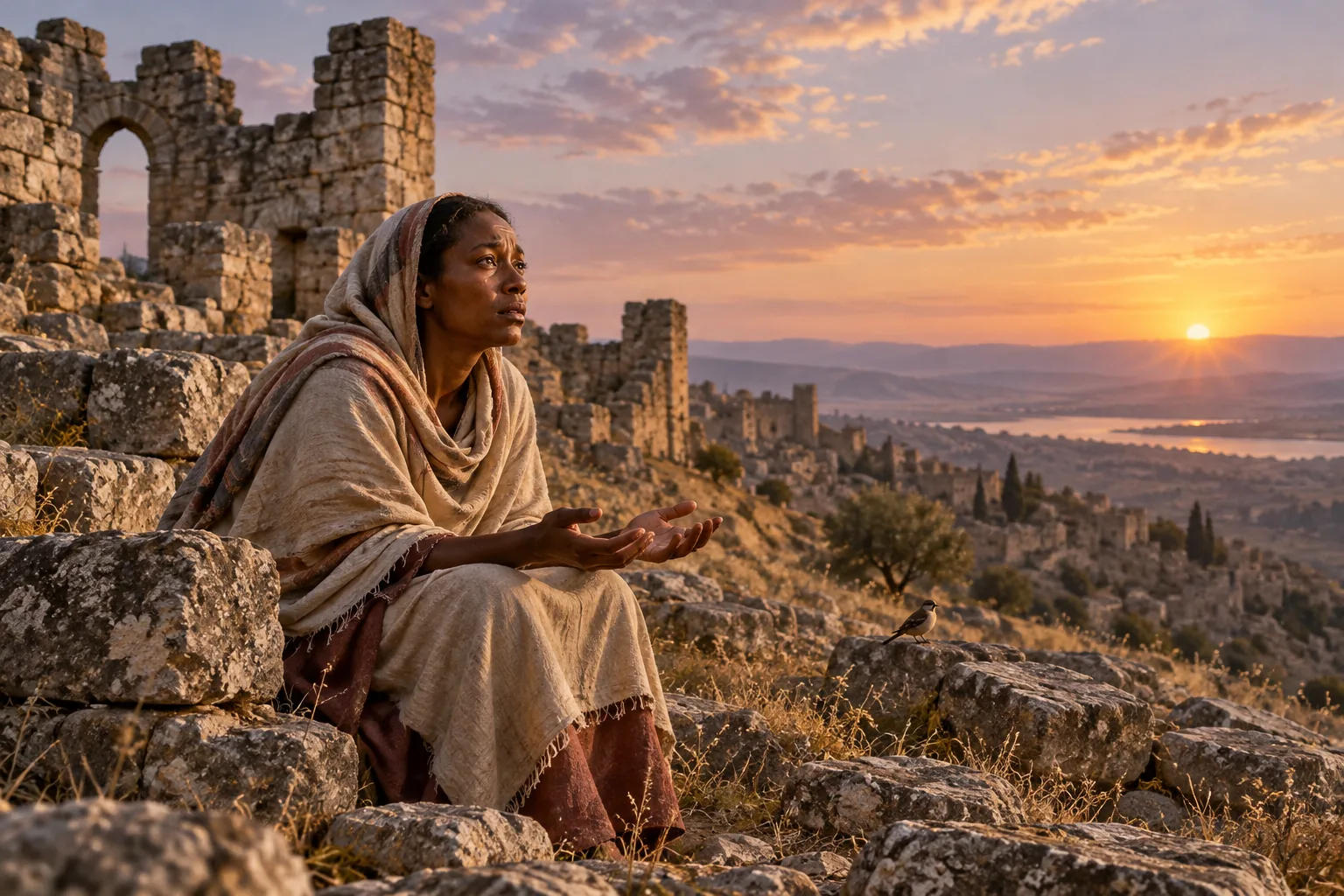
When our days fade, how do God’s enduring years give us hope?
01
Overview
An exhausted prayer, the ruins of Zion, and hope held within the everlasting faithfulness of the Creator
Key text — Psalm 102:11–12, 27–28 (study rendering): My days are like a lengthening shadow; I wither like grass. But you, LORD, remain forever. Your years do not end; may the children of your servants live securely before you.
There are seasons when time feels different. A sleepless night stretches on, yet the months seem to vanish. The body grows tired, the appetite disappears, and the future once imagined so clearly begins to feel impossibly distant. At such times, someone may not have the strength to offer polished words of praise. The only prayer that remains is, “LORD, hear me.”
Psalm 102 begins there. Its speaker is frail, isolated, mocked, and afraid that life will end too soon. Yet the prayer does not remain inside one person's suffering. It turns toward Zion, a wounded city whose stones lie in ruins, and dares to ask whether God will still give his people a future. At the end, the speaker looks even farther: beyond a short human lifetime and beyond the changing heavens and earth, to the One whose years do not end.
This is not a psalm that dismisses grief. It is a prayer that places human vulnerability inside the longer story of God's faithfulness.
02
1.0 Introduction
Psalm 101 pictured a ruler promising honesty, integrity, and justice in his household and city. Psalm 102 shifts abruptly from the responsibilities of leadership to the vulnerability of someone who can scarcely endure another day. The sequence invites a necessary recognition: human beings are not only people who make decisions and exercise responsibility; they are also creatures who break, grieve, need help, and eventually die.
Psalm 102 has a rare and striking heading: it is a prayer for an afflicted person when faint and pouring out a complaint before the LORD. The heading does not identify an author or a specific crisis. It offers words for someone who no longer knows how to carry the weight of suffering.
The poem's movement is best heard in three major parts:
- Verses 1–11 — My days: A desperate appeal for God to listen, with images of bodily exhaustion, loneliness, humiliation, and life fading like an evening shadow. - Verses 12–22 — Zion's future: Confidence that the LORD will show compassion to his devastated city, hear the vulnerable, and raise up a coming generation whose praise will reach the nations. - Verses 23–28 — God's years: The prayer returns to the shortness of the sufferer's life, but finds its final ground in the Creator who outlasts all things and can secure a future for his servants' children.
John Goldingay sees a distinctive interweaving of my time, our time, and God's time. Derek Kidner similarly names the contrast between “my days” and “thy years” (Goldingay 2008, Psalm 102; Kidner 2014, 392–96).
Central message: Our lives are fragile, and even communities we love can lie in ruins. Yet our suffering can be spoken truthfully before God, whose life does not expire with ours, whose compassion reaches the powerless, and whose faithfulness gives future generations grounds for hope.
03
2.0 Historical and Literary Context
Psalm 102 stands in Book Four of the Psalter (Psalms 90–106), where Israel is learning to confess the LORD's enduring kingship after the painful questions concerning David's throne in Psalm 89. Psalm 90 had already contrasted human mortality with God's life from everlasting to everlasting. Psalm 102 returns to the same question of time, but speaks from within a personal crisis and the devastation of Zion.
The heading is unusual because it describes the condition of the worshiper rather than naming an author, musician, or historical event. In later Christian liturgy Psalm 102 was classed among the traditional seven penitential psalms. Nevertheless, the poem contains no explicit confession of personal wrongdoing or request for cleansing. It is primarily a lament and plea for help. Both Goldingay and Kidner warn against confusing its later liturgical classification with its actual literary emphasis (Goldingay 2008, “Heading”; Kidner 2014, 392–93).
The ruined stones of Zion (v. 14), the plea for its rebuilding (vv. 13, 16), and concern for captives (v. 20) make an exilic or postexilic setting plausible: Jerusalem had been destroyed, and even after some returned, the community faced continuing weakness and subjection. But the psalm does not name Babylon, a king, or a rebuilding decree. We cannot fix its date with certainty. Another interpretive possibility is that the individual speaker draws upon Zion's distress to find hope for a personal affliction. Conversely, the personal “I” may be a representative voice for the suffering community, as in Lamentations. Goldingay regards both readings as legitimate ways of hearing the completed poem (Goldingay 2008, “Interpretation”).
The structure also matters. Verses 1–11 follow familiar patterns of personal lament: a cry, a request for attention, and a vivid account of distress. Verses 12–22 proclaim confidence in God's compassion for Zion, using two overlapping movements that anticipate future praise. Verses 23–28 return to the individual's shortened life before widening the horizon to God's enduring existence as Creator. The shifts need not be treated as evidence that unrelated poems were clumsily joined. The language of shortened days, enduring generations, and continuing life binds the poem together.
The psalm has strong connections with Lamentations 3 and 5, Isaiah 40–66, Psalm 90, and later Hebrews 1:10–12, which applies verses 25–27 to the Son. Each connection illuminates a different horizon; none should be allowed to erase the first speaker's suffering or the poem's specific concern for Zion.
04
3.0 Walking Through the Text
3.1 Psalm 102:1–2 — The plea to be heard
The psalm begins with successive appeals: hear my prayer; let my cry reach you; do not hide your face; bend your ear; answer quickly. The repetition is deliberate. The speaker is not asking God to admire elegant poetry. This is the language of a person afraid that help will come too late.
“Do not hide your face” recalls a relationship in which God's attention and presence matter deeply (Ps. 27:9; 69:17). To ask God to incline his ear is a bold human image for divine attentiveness. The petitioner speaks as someone who believes that God can respond, even when God's response is not presently apparent.
Goldingay notes how these lines echo phrases used elsewhere in the Psalter, such as Psalms 18, 39, 56, and 69. The sufferer may feel utterly alone, but the very language of prayer places that person within a community of sufferers who have cried out before (Goldingay 2008, Psalm 102:1–2). Kidner similarly observes that these words give later readers a way to share the burden of a person whose pain they may not be able to experience themselves (Kidner 2014, 393).
The request “answer me quickly” is not spiritual immaturity. In the context of failing strength, urgency is honest. The Bible makes room for a prayer spoken without calmness or certainty that relief is near.
3.2 Psalm 102:3–5 — Smoke, scorched bones, and a body losing strength
The speaker's days vanish like smoke. Bones seem to burn like a hearth; the heart is struck down and withers like grass. Food has been forgotten, and groaning accompanies visible wasting. These images portray suffering that affects the whole person—body, appetite, emotion, and sense of time.
We should not force a single medical diagnosis from this poetic language. It may describe serious illness, grief, deprivation, or the bodily effects of sustained anguish. Goldingay explores the way references to burning bones, lost appetite, and wasting convey devastating strain without identifying an exact disease (Goldingay 2008, Psalm 102:3–5).
Two images deserve special attention. Smoke can be visible one moment and gone the next; grass seems alive but soon dries under the heat. The prayer does not offer an abstract lecture about mortality. It tells us what mortality feels like to someone whose strength is disappearing.
This passage can also help families and congregations care for those experiencing exhaustion. When a suffering person stops eating well, sleeps poorly, or withdraws from companionship, these signs should not automatically be treated as failures of faith. Physical care, compassionate presence, and appropriate medical support can be faithful responses to a whole-person crisis.
3.3 Psalm 102:6–7 — The solitary bird among ruins
The speaker compares himself to birds associated with desolate places—often translated pelican, owl, or desert bird—and then to a lone bird on a roof. The precise identification of the Hebrew bird names is uncertain; translators choose different species. The poetic point is more stable than the zoology: a creature is pictured as isolated in a place emptied of company.
The speaker also describes staying awake. Sleeplessness intensifies loneliness. Others may have settled into rest, but this person remains alert, alone with thoughts that will not quiet.
The roof image is painfully concrete. A bird perched apart from its flock is exposed against the sky. What should be a place of ordinary habitation becomes a place where loneliness can be seen. The images may also resonate with ruined urban spaces, preparing for the explicit appearance of Jerusalem's broken stones in verse 14.
Neither the ancient poet nor a modern reader should have to turn this solitude into a spiritual success story before being heard. Lament is already an act of turning toward God, even when the speaker feels abandoned.
3.4 Psalm 102:8–11 — Mockery, ashes, and the shadow of a shortened life
The pain is intensified by other people. Enemies taunt the speaker day after day and use the speaker's plight as a negative example in their speech (v. 8). The language of oaths or curses in this verse has some interpretive complexity; the essential point is that another person's suffering has become material for mockery (Goldingay 2008, Psalm 102:8–9).
The psalmist then speaks of eating ashes like bread and mingling drink with tears. These are mourning images. Food and drink, normally signs of shared life, have become inseparable from grief.
Verse 10 is theologically uncomfortable: the speaker experiences suffering as though God has lifted him up only to throw him away, and describes being under divine anger. We need not turn this into a verdict that the speaker's suffering was caused by a specific sin. The psalm gives the person's perception of distress without offering a complete explanation for why it happened. Kidner compares the unexplained anguish to Job's situation (Kidner 2014, 392–93).
Finally, life is compared to an evening shadow, growing long just before the light fades. The grass image returns. Days vanish, strength collapses, and death feels near. The speaker has neither recovered nor found a tidy answer when the next section begins.
3.5 Psalm 102:12–14 — “But you, LORD”: hope turns toward Zion
Verse 12 opens with a decisive contrast: “But you, LORD...” The speaker's days fade; the LORD endures. This is the central turn of the poem, but it is not an instruction to forget the earlier grief. Rather, the sufferer remembers a truth that can bear weight when personal strength cannot.
God is pictured enthroned forever, with a name or renown enduring through generations. Then the speaker turns to Zion: the LORD will arise and have compassion; the appointed time has come to show grace (v. 13).
The declaration “the time has come” should not be made into a private technique for predicting God's timetable. It is the bold speech of prayer. The petitioner sees devastation and pleads that the God committed to his people act now. Goldingay compares its urgency to the widow who repeatedly asks a judge for justice (Luke 18:1–8). The prayer confidently appeals to God's character without pretending the restoration has already been fully seen (Goldingay 2008, Psalm 102:12–14).
Verse 14 gives the appeal emotional weight: God's servants love Zion's stones and feel compassion even for her dust and rubble. This is not nostalgia for expensive architecture. The stones represent a wounded community, its history, worship, and place of belonging. In a biblical world of exile, a broken city means broken households, displacement, vulnerability, and interrupted communal life.
The petitioner is saying: We still care for what lies in ruins; will you, LORD, show compassion as well? Loving a damaged place can become an act of hope, provided it also means caring for the people who must live among the ruins.
3.6 Psalm 102:15–22 — A future generation, prisoners, and the nations
The horizon widens. When God restores Zion, the nations and their kings will revere his name (v. 15). What Israel receives is not meant to remain a private possession. As in Psalms 96–100, the LORD's action toward his people becomes a witness with worldwide significance.
Verses 16–17 speak as though the rebuilding and divine response have already happened. In context, this can be confident anticipation expressed in the language of completed action, rather than a report that Jerusalem's restoration is finished. Kidner calls attention to this poetic effect, often described as a “prophetic perfect” (Kidner 2014, 394).
God has not despised the prayer of the destitute. The word can evoke someone stripped bare of resources and security. The poem has moved from a solitary sufferer to an entire wounded people without abandoning the person who needs help. The God enthroned forever hears those who have no earthly protection.
Verse 18 calls for the story to be written for a coming generation, so that a people yet to be created may praise the LORD. The phrase goes beyond a casual reference to children not yet born: the verb of creating can evoke God's power to form or renew a people after apparent collapse (Kidner 2014, 394–95). Suffering does not have the authority to cancel the future generations' right to hear of God's faithfulness.
Verses 19–20 describe the LORD looking from his holy height to hear the groaning of prisoners and to free those appointed to die. God's heavenly exaltation is not presented as remoteness. His height permits the widest vision; his mercy reaches the lowest places. The scene may evoke Israel's political subjection and captivity, but its language can also support prayer for captives and people threatened by death in many settings.
The final result is communal praise in Zion when peoples and kingdoms gather to serve the LORD (vv. 21–22). What begins as one person's desperate “Hear me” expands into a vision of nations who have heard what God has done. Divine restoration is not merely repairing buildings; it involves freedom, worship, truthful memory, and a future for the vulnerable.
3.7 Psalm 102:23–24 — The lament returns: “Do not take me away halfway”
After the sweeping vision of Zion and the nations, the speaker returns to a painfully personal need: strength has been broken on the way, and the days of life seem cut short. The prayer becomes explicit: “My God, do not take me away in the midst of my days” (v. 24, sense).
This return is important. The psalm does not suggest that because the community has a future, an individual should stop caring whether they live to see it. Hope for Zion and concern for one's own life belong together. The sufferer longs for more time, and that longing is neither selfish nor unfaithful.
There is a textual difference worth noting. In the Hebrew Masoretic tradition, verses 23–24 continue the human speaker's lament and plea. The ancient Greek translation reads the consonants and voices somewhat differently, producing a more complicated exchange of speech. Kidner discusses how this Greek textual form influenced later Christian readings, particularly the use of the psalm in Hebrews (Kidner 2014, 395–96). The clearest reading of the Hebrew passage itself is a suffering person's plea for life amid the contrast with God's enduring years.
This passage also guards against turning the psalm into a simple formula of immediate rescue. The person is still suffering after affirming a glorious future. Biblical faith allows that tension to remain visible.
3.8 Psalm 102:25–28 — The heavens may change, but the Creator remains
The prayer now stretches from the individual's short life to the beginning of creation. God laid the foundation of the earth; the heavens are the work of his hands (v. 25). Yet even the cosmos does not possess God's uncreated permanence. The heavens and earth are compared to clothing that can wear out and be changed, while the LORD continues to be the One whose years have no end (vv. 26–27).
We should not force this poetry into a literal scientific forecast. Its purpose is to contrast the Creator's endurance with the creaturely world's dependence. Some translations state definitively that heaven and earth will perish; Goldingay notes that the Hebrew wording can express their capacity to pass away rather than a timetable for inevitable annihilation. The image of changing clothing can also leave space for renewal, though the immediate stress is on God's greater permanence (Goldingay 2008, Psalm 102:25–27).
Verse 27 is often rendered “you are the same.” Goldingay argues for the fuller force of “you are the One”: the LORD's identity is incomparable and his years do not run out. The two renderings converge in emphasizing divine permanence, though they do so with different nuances.
The psalm does not end by asking that the speaker become immortal through personal strength. Its final concern is for the children of God's servants and their descendants: may they live securely, established before the LORD (v. 28). It is an appeal that later generations receive a future under the care of the God who outlasts individual lives, ruined cities, and even the changing created order.
The answer to fading days is not denial of mortality. It is hope anchored in the living God whose faithfulness is longer than our years.
05
4.0 Theological Reflection
4.1 Lament is faithful speech, not failed worship
Psalm 102 gives an afflicted person permission to pray from exhaustion rather than certainty. It includes accusations about divine anger, a plea for quick attention, and a body worn down by sorrow. This belongs inside Scripture, not outside acceptable prayer. Worshiping communities should therefore make room for honest complaints, illness, disability, bereavement, and fear (Pss. 13; 22; 88).
The heading invites repeated use: someone overwhelmed today may borrow words first spoken in a different century. The psalm is a shelter of language for those who cannot yet compose their own prayers.
4.2 The life of the individual and the future of the community belong together
The afflicted person's grief is inseparable from Zion's ruin. Community trauma can inhabit an individual body, and private suffering can be eased by knowing one's life belongs to a longer story. The church should not use community vision to minimize individual pain; neither should it imagine spiritual care can remain purely private while neighborhoods and institutions are breaking.
The poet's love for stones and dust challenges sentimental faith. Restoration concerns actual places and people: homes, worship, justice, work, freedom, and the conditions that allow communities to flourish.
4.3 God's eternity is presence through time, not indifference to time
The contrast between “my days” and “your years” could suggest a God too distant to understand human urgency. Yet Psalm 102 moves in the opposite direction: because God endures, he can arise, show compassion, hear prisoners, and secure a future for children not yet born. Goldingay stresses that divine eternity is not removal from history; God is present across past, present, and future, and can act within them (Goldingay 2008, “Theological Implications”).
Thus “the appointed time has come” is the language of bold trust, not a calendar that believers can control. We may pray urgently without claiming to know every detail of God's schedule.
4.4 God's steadfast commitment reaches the powerless
The poem's deepest picture of divine glory is not an untouched palace or a spectacular victory parade. It is the LORD looking down to hear the destitute and the imprisoned. Worship that praises this God should not treat vulnerable people as disposable. Prison ministry, care for the dying, advocacy for the wrongfully confined, and attention to displaced families are appropriate expressions of the biblical vision—but none requires us to claim that every sufferer will be released or healed immediately.
4.5 Hope is something we hand forward
Verse 18 asks that testimony be written so that coming generations may praise God. This places a responsibility on teachers, parents, elders, and preachers: tell the truth about both the suffering and the mercy. A community that passes on only triumphal stories may leave the next generation unable to pray when life collapses. A community that passes on only despair forgets the One who can restore.
06
5.0 Canonical and Christological Horizon
Psalm 102 continues a biblical conversation about human mortality and divine permanence. Psalm 90 opens Book Four with the contrast between mortal human life and the LORD who is God before the mountains were born. Lamentations 5:19 likewise confesses that the LORD's throne endures while Zion's suffering remains unresolved. The prophets Isaiah and Jeremiah link the restoration of God's people with his continuing commitment to justice, mercy, and the nations (Isa. 40:6–8; 49:13–18; 52:7–10; 60–62).
Christian readers also encounter Psalm 102 in a distinctive New Testament setting. Hebrews 1:10–12 cites Psalm 102:25–27 in its argument concerning the Son's exalted status. In Hebrews, words originally addressed to the everlasting Creator are applied to the Son: the created order can change, but he remains. This is a significant part of the New Testament's high Christology (Heb. 1:1–14).
The textual and interpretive issues deserve clarity. Kidner develops a strong messianic reading of the entire psalm, aided by the Greek wording around verses 23–24. Goldingay reads the psalm in its first context as an afflicted person or a suffering community addressing the LORD, and observes that Hebrews reappropriates the Creator language christologically. These are different interpretive judgments. We should not present the first speaker as if they were plainly and explicitly naming Jesus in every verse (Kidner 2014, 395–96; Goldingay 2008, Psalm 102:23–28).
Within the wider Christian canon, Jesus nevertheless enters the world of Psalm 102's suffering. The Gospels portray him in anguish, betrayed and rejected, praying in distress (Mark 14:32–36; 15:34). He also announces God's reign and promises restoration, while his death and resurrection become the foundation of Christian hope beyond death (Luke 4:16–21; 24:44–47; 1 Cor. 15:20–26). These are theological connections between biblical texts, not evidence that Psalm 102's afflicted petitioner described every detail of Jesus' life beforehand.
The promise of a people yet to be created finds a Christian resonance in the formation of a community from many nations (Eph. 2:11–22; 1 Pet. 2:9–10). Yet Israel's own hope for Zion and for its descendants must not be erased. Christian participation in the promise is possible through the Messiah of Israel and should foster gratitude rather than replacement or contempt (Rom. 11:17–24).
Finally, Revelation 21–22 imagines a renewed heaven and earth, God dwelling with humanity, the end of death and mourning, and the healing of the nations. That future helps Christians hear the hope of Psalm 102: the Creator's unending years do not make created lives insignificant. They make it possible to hope for the restoration of a world whose present form remains subject to grief and change.
07
6.0 Life Application
- Pray honestly when strength has run out. If all you can say is “LORD, hear me,” begin there. Psalm 102 does not demand eloquence, cheerfulness, or an explanation of why you are suffering before you may speak to God.
- Attend to the body as well as the soul. The speaker has lost appetite and sleep. Offer practical help, meals, companionship, medical attention when needed, and patient listening to those under prolonged strain. Avoid turning physical or psychological distress into an accusation of weak faith.
- Love people amid the ruins. If a community has been damaged by conflict, displacement, economic pressure, or institutional failure, ask what restoration would look like for those who live there. Loving “Zion's stones” must include the people whose lives those stones once sheltered.
- Turn private grief into compassionate solidarity. The psalm moves from personal weakness to concern for captives and people facing death. Let your own experience of vulnerability increase your care for prisoners, the sick, the bereaved, and those whose voices are seldom heard.
- Pass on an honest record of faithfulness. Write down one testimony that names a real difficulty and a real sign of God's care without exaggeration. Share it with a younger person who may need such words in a future crisis.
- Hold your plans with humility and hope. Human days are limited. Make responsible plans and seek help promptly when needed, but remember that your worth and the future of God's work do not rest entirely on how long you live or how much you accomplish.
08
7.0 Reflection Questions
- What does Psalm 102 teach us about praying when God seems silent and time seems to be running out?
- Which images of the sufferer's pain—smoke, scorched bones, birds among ruins, tears, or lengthening shadows—best express experiences people in our community may be afraid to name?
- Why does the poem turn from “my days” to the rebuilding of Zion? How can personal care and communal restoration support one another?
- What difference does it make that God looks from heaven not only to display glory but also to hear prisoners and the destitute?
- How should Hebrews 1:10–12 shape a Christian reading of the psalm without erasing its first historical voice?
- What truthful witness should we record for the generations still to come?
09
8.0 Response Prayer
LORD, hear our prayer when words are few and our strength is almost gone. When nights are long, food loses its taste, and the days seem to disappear like smoke, do not turn your face away from us.
You know those who sit alone, those mocked for their suffering, and those whose bodies and hearts are worn down. Send us people who will listen, and make us people who listen to others.
Remember communities whose homes and hopes lie in ruins. Look with mercy upon displaced families, prisoners who groan for freedom, and those who fear they will not live to see another season. Teach us to love what is broken without abandoning the people who must live there.
Our days are brief, but your years have no end. Do not let this truth make us careless about life. Let it give us courage to ask for healing, to work for restoration, and to leave an honest witness for our children.
Through Jesus Christ, our suffering and risen Lord, hold us within your faithfulness, until every sorrow is met by the goodness of your presence.
Amen.
10
9.0 Window into What Comes Next
Psalm 102 begins with a person asking God to listen before life slips away. It moves through Zion's rubble and the hope of nations gathering to worship, before ending with the Creator whose years have no end. The central question is whether the suffering present can be entrusted to the God whose faithfulness exceeds every human lifetime.
Psalm 103 answers with a personal summons to remember: “Bless the LORD, O my soul, and forget not all his benefits” (Psalm 103:1–2, sense). Where Psalm 102 names frailty, Psalm 103 celebrates the LORD who forgives, heals, redeems, shows compassion, and remembers that we are dust.
The transition does not imply that the lament of Psalm 102 was unnecessary. Instead, the two songs belong together: the prayer of the exhausted person prepares us to hear the praise of the soul that remembers God's mercy. The God whose years endure is also the God who draws near to people whose days are few.
11
10.0 Bibliography
- Scripture: Psalm 102; Psalms 13, 22, 27, 39, 56, 69, 88–90, 101, 103; Exodus 2:24; Lamentations 3; 5:19; Isaiah 40:6–8; 49:13–18; 52:7–10; 60–62; Jeremiah 29:22; Ezra 9; Nehemiah 4; 9; Luke 18:1–8; Mark 14:32–36; 15:34; Luke 4:16–21; 24:44–47; Romans 11:17–24; 1 Corinthians 15:20–26; Ephesians 2:11–22; Hebrews 1:1–14; 1 Peter 2:9–10; Revelation 21–22. The key text above is an original study rendering, not a verbatim quotation from a named Bible translation.
- BibleProject. The Book of Psalms: Study Notes. Project resource discussing the Psalter's five-book arrangement and the theological significance of Book Four.
- Goldingay, John. 2008. Psalms, Volume 3: Psalms 90–150. Baker Commentary on the Old Testament Wisdom and Psalms. Grand Rapids, MI: Baker Academic. Commentary on Psalm 102, “My Time, Our Time, and Yhwh's Time.”
- Kidner, Derek. 2014. Psalms 73–150. Kidner Classic Commentaries. Downers Grove, IL: InterVarsity Press. Originally published 1975. Commentary on Psalm 102, “‘My days’ and ‘thy years’,” pp. 392–96.

Be the first to leave a comment.