

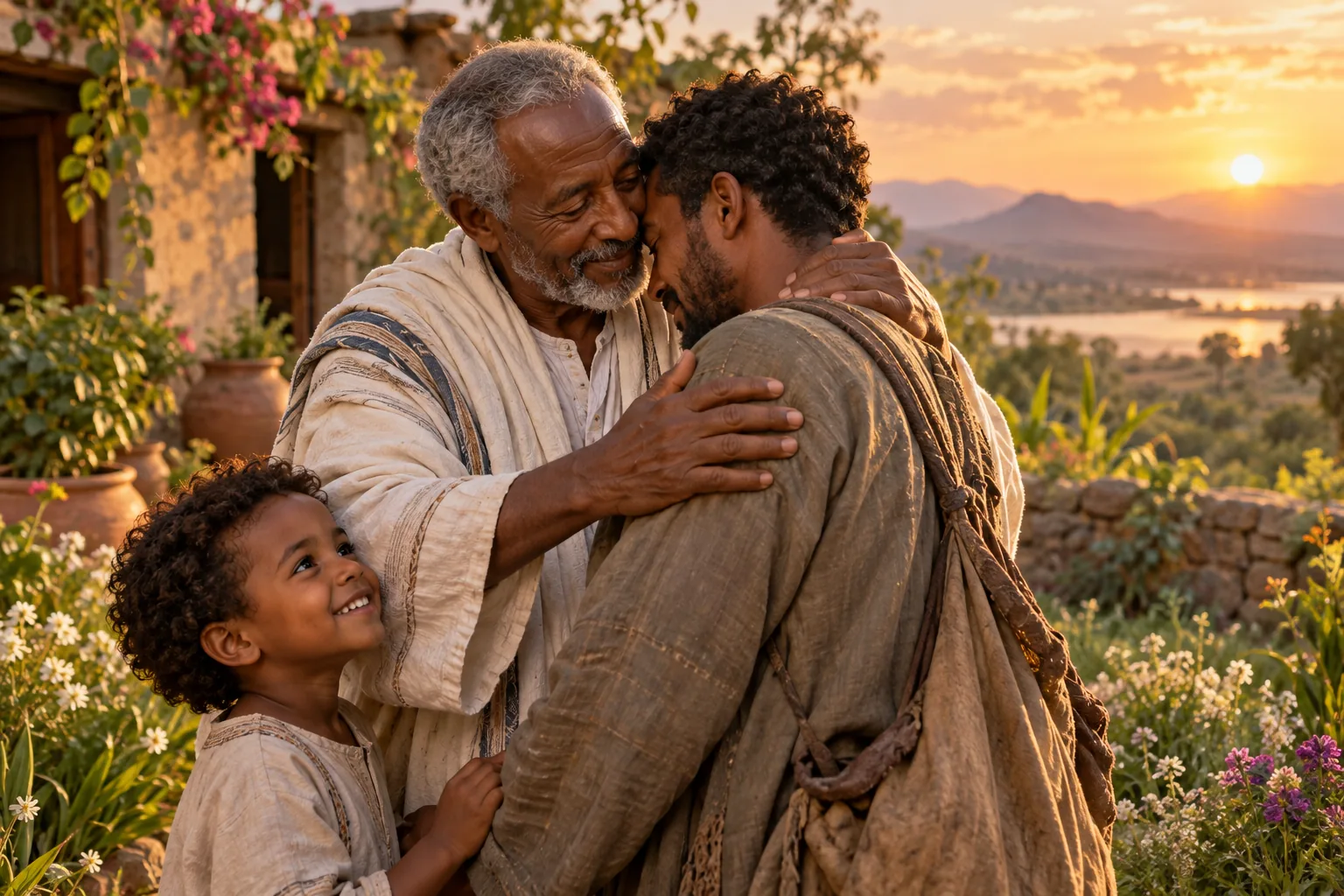
How does God’s mercy teach us to live when our strength fades?
01
Overview
The God who forgives, remembers our dust, and surrounds fragile lives with steadfast love
Key text — Psalm 103:13–14 (study rendering): As a father has compassion on his children, so the LORD has compassion on those who revere him. For he knows how we are formed; he remembers that we are dust.
Some days, praise comes naturally. On others, we have to speak to our own hearts before we can speak to anyone else. Our memories are crowded with disappointment. Our bodies feel their limitations. We know both the hurt others have caused and the harm we ourselves have done.
Psalm 103 begins precisely there—not with an order to the world, but with an invitation addressed to one's own soul: Remember who the LORD is. Do not forget his goodness. From that small beginning, its horizon expands until angels and every work of creation are summoned to praise.
Between the first and last calls to worship stands an astonishing claim: God knows our frailty better than we know it ourselves, and his compassion is not exhausted by it.
02
1.0 Introduction
Psalm 102 gave voice to a sufferer whose days seemed to be disappearing like smoke. The sufferer looked toward Zion's restoration, yet still faced the brevity of personal life. Psalm 103 opens with a strikingly different voice. It is not a petition, but a celebration. The movement from lament to praise, however, does not imply that Psalm 102's pain has been cancelled or that every sick person has recovered. Rather, Psalm 103 names the character of the God to whom sufferers entrust themselves.
The poem moves through widening circles:
- Verses 1–5: The speaker summons the whole self to remember forgiveness, healing, rescue, compassion, and renewal. - Verses 6–14: Personal testimony is grounded in God's dealings with Israel: justice for the oppressed, revelation to Moses, patient mercy, and fatherly compassion. - Verses 15–18: Human life is brief like grass, but God's covenant love remains across generations. - Verses 19–22: God's throne encompasses all; heavenly servants and all creation are invited into praise, before the voice returns to the speaker's own soul.
The psalm's great achievement is to hold together what we often separate: mercy and holiness, forgiveness and justice, human mortality and lasting hope, personal experience and the community's memory.
Central message: The LORD is worthy of whole-hearted praise because his compassion is greater than our failures, his patience takes our frailty seriously, and his steadfast love continues beyond the span of our lives. To remember that grace is also to respond in reverent, faithful living.
03
2.0 Historical and Literary Context
Psalm 103 carries the Hebrew superscription “Of David.” That traditional association is important to its reception in worship, but it does not provide a verifiable date or a specific incident from David's biography. The psalm itself names no episode in the king's life. Goldingay notes linguistic and literary features, including connections with Isaiah 40–66 and Israel's communal prayers, that may point to a later setting; these are considerations rather than proof of a precise date (Goldingay 2008, commentary on Psalm 103, “Interpretation”). Kidner regards it as notably less concerned with David's individual enemies than many other Davidic psalms: a personal summons becomes praise on behalf of a people (Kidner 2014, 396–97).
The decisive historical memory is Exodus 32–34. After the golden calf, Moses intercedes for Israel, and the LORD reveals his character as compassionate, gracious, slow to anger, and abundant in steadfast love (Exod. 34:6–7). Psalm 103:7–8 deliberately returns to that story. Its celebration is therefore not naïve. It arises from the knowledge that God's people have been seriously unfaithful and yet have experienced mercy.
The psalm is framed by repeated calls to bless or worship the LORD (vv. 1–2, 20–22). The Hebrew nephesh, translated “soul,” describes the living person rather than an isolated, immortal component detached from the body. The parallel phrase “all that is within me” makes clear that the speaker summons the entire self—memory, understanding, desire, and bodily life—to worship (Goldingay 2008, Psalm 103:1–2).
Goldingay describes the work as a blend of personal testimony and communal hymn. Its movement of pronouns makes that possible: “you” in self-address (vv. 1–5), Israel's story (vv. 6–9), “us” (vv. 10–14), humanity's fleeting life (vv. 15–18), and finally the cosmos (vv. 19–22). Personal gratitude is not self-enclosed. It finds its meaning inside God's long relationship with his people.
Psalm 103 also forms a notable literary pair with Psalm 104. Both begin and end by summoning the soul to bless the LORD. Kidner calls them companion songs: Psalm 103 praises the God who redeems and shows mercy; Psalm 104 praises the Creator who sustains the living world (Kidner 2014, 396–97). Together they resist the separation of spiritual salvation from God's concern for embodied creation.
04
3.0 Walking Through the Text
3.1 Psalm 103:1–2 — Speaking truth to your own soul
The opening is a command addressed inward: “Bless the LORD, O my soul.” The speaker does not wait passively for emotion to rise. He calls upon the whole self to remember and respond. Another command follows: do not forget all his benefits.
The word rendered benefits is related to God's dealings or what he has done for someone. It does not mean that worship is a business transaction through which we purchase further favors. Indeed, verse 10 will insist that God has not treated the people as their sins deserve. The benefits of this psalm are mercies, not wages.
Kidner observes that forgetting God's kindness may sometimes involve more than faulty memory; pride can make us unwilling to acknowledge how much we have received (compare Deut. 8:11–18; 2 Chr. 32:25). Goldingay adds that worship engages mind and will as well as feeling (Kidner 2014, 397; Goldingay 2008, Psalm 103:1–2).
This matters when praise is difficult. We need not pretend to be cheerful. We can remember truthfully: Who has carried me? Where have I encountered grace? Which promises remain even when present circumstances are painful? The psalm begins with the discipline of remembering, not the denial of suffering.
3.2 Psalm 103:3–5 — Forgiven, healed, rescued, crowned, renewed
The poet now names God's merciful deeds in a rapid series: forgiving iniquity, healing disease, redeeming life from the pit, surrounding the person with steadfast love and compassion, satisfying with good, and renewing strength like an eagle.
The verbs need careful reading. Forgiveness of sin is not identical to recovery from physical illness. The Bible does not teach that every disease results from an individual's particular wrongdoing (John 9:1–3). Nor should the paired statements “forgives all” and “heals all” be turned into a guarantee that every believing person will recover from every sickness immediately. This is a hymn celebrating the character and scope of God's gracious action, not an individualized timetable for medical outcomes.
Kidner gives a particularly sober example: after David's sin involving Bathsheba, he was forgiven, yet the child for whom he prayed was not healed (2 Sam. 12:13–23). Goldingay likewise treats healing and rescue as testimony to God's characteristic care without reducing the psalm to a promise of uninterrupted health (Kidner 2014, 398; Goldingay 2008, Psalm 103:3–5).
To redeem life from the pit can describe rescue from imminent death; read alongside other biblical passages, it can also open onto a deeper hope that death will not have the final word (Pss. 49:15; 102:23–28). The first setting does not require us to turn the verse into a detailed description of resurrection, but its language is rich enough to join the Bible's developing hope.
The picture of being crowned with steadfast love and compassion is remarkable. Instead of a crown earned by power or success, the worshiper receives the adornment of God's covenant mercy. The final image, strength renewed like an eagle, recalls the soaring vigor of Isaiah 40:31. It does not require a myth that eagles literally become young again. Also, the Hebrew wording of verse 5 concerning what is satisfied—variously rendered “desire,” “mouth,” “life,” or “years”—is difficult; commentators propose different readings. The central claim remains that God supplies life-giving good and renewal (Kidner 2014, 398; Goldingay 2008, Psalm 103:5).
3.3 Psalm 103:6–9 — The God of justice revealed to Moses
After the language of personal benefits, verse 6 broadens the focus: the LORD performs righteousness and justice for all who are oppressed. Mercy is not merely the comfort of a private soul. It includes God's concern for those injured by the abuse of power.
Then the poet looks back to Moses and the people of Israel. God made his ways known to Moses and his deeds to the Israelites (v. 7). This includes the exodus and the difficult journey of formation through the wilderness. The people did not merely witness signs of power; they were taught what their God was like.
Verse 8 nearly reproduces the great divine self-description at Sinai: compassionate and gracious, slow to anger, abounding in steadfast love (Exod. 34:6). The background is crucial. Israel had just worshiped the golden calf. God's compassion is displayed not because the people were faultless, but because he remained committed to them in the face of grave wrongdoing.
Verses 9–10 add that he does not remain in perpetual accusation or cling to anger forever. These verses do not trivialize injustice. The same God who rescues the oppressed (v. 6) cannot be imagined as indifferent to their suffering. The point is that his just displeasure is not a petty grudge or uncontrolled resentment. Kidner contrasts divine restraint with human habits of nursing quarrels; Goldingay emphasizes God's refusal to let contention define the covenant relationship permanently (Kidner 2014, 399; Goldingay 2008, Psalm 103:6–9).
This gives communities a demanding pattern. Justice must be sought, harmed people protected, and wrongdoing named. Yet anger need not become the final ruler of the heart.
3.4 Psalm 103:10–12 — Mercy greater than what we deserve
Verse 10 states the astonishing contrast: God has not dealt with us according to our sins or repaid us according to our iniquities. That is not because wrongdoing is unreal. It is because God's response is not confined to a strict calculation of deserts.
Two immense comparisons follow. As high as the heavens stand above the earth, so great is his steadfast love toward those who revere him. As far as east is from west, so far does he remove transgressions from us. One image measures height; the other imagines an immeasurable horizontal distance.
These images invite wonder rather than arithmetic. The purpose is not to calculate the physical distance between directions but to announce how thoroughly God can separate repentant people from the guilt of their rebellion (compare Mic. 7:18–19; Isa. 55:6–9).
That separation is not permission to deny responsibility. A forgiven person may still need to confess honestly, make restitution, protect those harmed, and accept appropriate consequences. Psalm 99:8, immediately preceding this hymn, explicitly held forgiveness and accountability together. Grace removes the need to purchase God's acceptance; it does not make the truth about our actions unnecessary.
3.5 Psalm 103:13–14 — A father's compassion and the memory of dust
The psalm now brings the immeasurable heavens into the intimacy of family life: as a father has compassion on his children, so the LORD has compassion on those who revere him. The Hebrew language of compassion is tender and deeply relational; it does not depict a distant monarch reluctantly signing a pardon.
But human fathers differ, and some have caused deep harm. We must not force wounded people to imagine God as a magnified version of an abusive parent. The psalm uses good parental compassion to illuminate God's character; the divine reality is the standard by which every human parent is judged. Other biblical texts use maternal imagery for God's care (Isa. 49:15; 66:13).
Why such compassion? He knows our formation; he remembers that we are dust. This takes us back to Genesis 2:7 and 3:19. The Creator understands that human life is embodied, vulnerable, and passing. He knows the limits of our strength, how grief affects us, and the difference between a proud rebellion and a creature's exhausted need.
Goldingay notes how this knowledge of humanity's physical frailty prepares the movement into verses 15–18; Kidner emphasizes that God knows his children more fully than they know themselves (Goldingay 2008, Psalm 103:13–14; Kidner 2014, 399).
God's remembering our dust is not contempt for human life. It is a reason for compassion. He does not demand that dust pretend to be stone.
3.6 Psalm 103:15–18 — The flower fades, but love remains
Human life is compared to grass and a flower of the field. It flourishes briefly; then the wind passes over it, and its place no longer recognizes it. The picture is painfully realistic. A person may be known and needed today, yet one day the earth will go on without their visible presence.
These images recall Psalm 90, the lament of Psalm 102, and Isaiah 40:6–8. They also echo the vulnerability of people who live amid illness, displacement, labor, and the ordinary passage of years. The psalm does not mock human achievements. It places them within their true limits.
The decisive word is “But”: the LORD's steadfast love is from age to age upon those who revere him, and his righteousness extends to their children and grandchildren. What endures is not our ability to preserve every institution or every memory of ourselves. What endures is the character of God.
Verse 18 clarifies that revering the LORD is not simply feeling religious awe. It includes keeping his covenant, remembering his commands, and doing them. This is not a business arrangement in which perfect obedience buys forgiveness. Goldingay stresses that divine initiative and human response belong together in a covenantal relationship, not a commercial contract (Goldingay 2008, “Theological Implications”). God's compassion gives rise to reverent faithfulness.
Nor should we read the generational promise as a guarantee that the children of faithful parents will automatically believe or prosper regardless of their choices. The text calls each generation to receive and embody the covenant memory. Our time is short, but we can leave behind a living witness to the mercy that outlasts us.
3.7 Psalm 103:19–22 — From my soul to the whole creation
The final movement widens the scene to its furthest horizon: the LORD has established his throne in the heavens, and his kingdom rules over all. The person who began by addressing an anxious or forgetful soul now speaks of the governance of the entire cosmos.
The poet calls on angels, strong servants who heed God's word, then on his heavenly hosts, and finally on all his works in every place of his dominion to bless the LORD. The repeated summons does not make angels or created things competitors with God. It places all of them among those whose proper response is obedience and praise.
There is a subtle tension. God's reign is universal, yet much of what happens on earth visibly resists his will. Psalm 103 does not claim that every person already obeys God or that injustice is impossible. It announces the rightful King and summons the world toward the worship and obedience that fit his rule.
The hymn ends exactly where it began: “Bless the LORD, O my soul.” After the widening invitation, the speaker does not disappear into the crowd. The personal voice still matters. No one can sing the whole world's song alone, but everyone has a part to offer.
Psalm 104 will begin in the same way and move toward the wonder of God's creative and sustaining work. The two poems invite us to praise the Redeemer who forgives and the Creator who gives life, without imagining these are different gods.
05
4.0 Theological Reflection
4.1 Grace is God's initiative, not a reward for spiritual success
The psalm begins with God's actions: he forgives, heals, rescues, and crowns with love. Verse 10 insists that his mercy is not the payment our behavior has earned. To praise God for grace is to stop pretending that we saved ourselves. Yet this does not make the covenant's call to obedience irrelevant. Grace awakens and sustains a life that responds in faithfulness (Exod. 34:6–7; Eph. 2:8–10).
4.2 Forgiveness and healing must be distinguished
Psalm 103 celebrates both, but the experiences are not identical and should not be turned into a formula. A believer with chronic illness has not thereby proved a lack of faith or an unforgiven sin. Prayer for healing belongs with proper medical care, patient accompaniment, and the hope that God's purposes extend beyond the limits of our present bodies (John 9:1–3; Rom. 8:23).
4.3 Compassion does not weaken justice
The God who is slow to anger also acts for all the oppressed (v. 6). Divine kindness is not indifference to corruption or violence. In ministry, family life, and public leadership, mercy should create truthful spaces where the vulnerable are heard and those who have caused harm are called to account. A forgiving community need not be a careless community.
4.4 Our fragility belongs inside God's care
Remembering that we are dust can free us from the exhausting demand to appear invulnerable. Work matters, service matters, and faithfulness matters, but we are not infinite. Rest, grief, aging, and asking for help need not be signs of spiritual failure. The Father knows our formation (vv. 13–16; Ps. 90:12).
4.5 Personal gratitude needs the story of a people
Goldingay emphasizes that the individual's experience of mercy makes deeper sense inside Israel's memory of Exodus, Sinai, and covenant. A church should likewise be more than a collection of private success stories. Scripture, intergenerational teaching, honest testimony, and shared care help people recognize God's faithfulness when their own circumstances are difficult (Deut. 6:4–9; Ps. 78:1–8).
06
5.0 Canonical and Christological Horizon
Psalm 103 draws directly on God's self-revelation in Exodus 34:6–7, after the golden calf. Its portrait of compassion and slow anger carries forward into the prophets, especially Hosea 11 and Isaiah 40–55. The psalm also remembers the human being shaped from dust (Gen. 2:7), the fleeting flower of Isaiah 40:6–8, and the covenant hope extending across generations. Its vision is therefore firmly rooted in Israel's history, not a detached meditation that begins with the New Testament.
For Christian readers, Jesus Christ reveals this merciful God in the history of Israel. Jesus declares forgiveness and heals a paralyzed man in Mark 2:1–12, but the story does not justify equating all disease with personal sin. In John 9:1–3 Jesus explicitly rejects a simplistic link between disability and blame. He welcomes the wounded and calls people into restoration rather than treating weakness as shame.
Jesus' teaching about a father welcoming his lost son (Luke 15:11–32) resonates with Psalm 103's image of compassion. The comparison should be made carefully: the psalm celebrates God's fatherly mercy for covenant people, while Jesus' parable unfolds the surprising welcome of God's kingdom. The Christian reading deepens an existing biblical portrait rather than cancelling its original meaning.
Christ's death and resurrection also widen the horizon of redemption from the pit. What was experienced in Israel's story as rescue from peril becomes, in apostolic proclamation, the hope that death itself will be overcome (1 Cor. 15:20–26; Rom. 8:23). This is a canonical development; Psalm 103:4 should not be presented as though it were originally a detailed prediction of Jesus' resurrection.
The language of unmerited mercy also connects with the New Testament insistence that God acts in grace before human beings can claim achievement (Eph. 2:4–10). Yet grace produces transformed lives, as Psalm 103:17–18 already expects faithfulness within the covenant. Finally, the invitation for all creation to praise points forward to the worship envisioned in Revelation 5:11–13 and the healing of creation in Revelation 21–22.
The Christian hope is not merely that souls escape bodily life. It is that the God who remembers our dust will bring life through the risen Messiah and ultimately renew his world. The Redeemer of Psalm 103 and the Creator praised in Psalm 104 belong to the same biblical story.
07
6.0 Life Application
- Practice honest remembrance. Write down three concrete expressions of God's care—perhaps strength during grief, forgiveness after confession, help from another person, or hope sustained through uncertainty. Thank God without exaggerating what has happened.
- Refuse to shame people for illness. Pray for healing, support treatment, accompany the sick, and reject claims that every disease proves hidden sin or weak faith. Compassion reflects the Shepherd's character.
- Let mercy lead to accountability. If you have caused harm, tell the truth, seek forgiveness, make reasonable restitution, and accept appropriate safeguards. If someone else has been harmed, protect their safety and do not demand instant reconciliation.
- Honor human limits. Make time for rest and relationships. Acknowledge grief and aging without shame. You are a creature loved by God, not an endless source of energy.
- Teach mercy across generations. Share a family or church testimony that admits difficulties as well as help received. Encourage younger people to recognize covenant faithfulness through both biblical history and lived integrity.
- Join praise to justice. Identify someone burdened by unfair treatment or exploitation. Let the declaration that the LORD acts for the oppressed move you to fair, lawful, compassionate action.
08
7.0 Reflection Questions
- Why does the poet begin by commanding his own soul to bless the LORD rather than waiting for spontaneous emotion?
- How can we celebrate God's healing power while speaking responsibly to people who remain chronically ill or disabled?
- How does the account of Moses and Israel in Exodus 32–34 deepen our understanding of forgiveness in Psalm 103?
- What difference does it make that the Father knows we are dust, particularly for those who feel exhausted or inadequate?
- How do God's steadfast love and our call to keep his covenant belong together without turning faith into a contract?
- What changes when the song moves from “my soul” to angels, heavenly hosts, and all creation?
09
8.0 Response Prayer
LORD of compassion, when my memory grows crowded with fear, teach my soul to remember your faithfulness. When I see only my failures, remind me that your mercy is larger than my record.
Forgive what I need to confess, and give me courage to repair what I have damaged. Where sickness or grief remains, do not let me turn your promises into accusations against those who suffer. Make us a community that prays, cares, and tells the truth.
You know our bodies and remember our dust. Give us wisdom to accept our limits, kindness toward those whose strength is fading, and hope that reaches beyond our brief days.
Let your compassion shape our dealings with the oppressed. Let your covenant faithfulness be remembered by our children. Through Jesus Christ, our risen Lord, join our small voices to the praise of your creation, until your renewing work is complete.
Bless the LORD, O my soul. Amen.
10
9.0 Window into What Comes Next
Psalm 103 begins with the singer urging the soul to remember God's mercy and ends by inviting angels and all creation to join the praise. Its central question is: What has the LORD done for people who sin, suffer, and return to dust? The answer is forgiveness, compassion, rescue, and steadfast love extending across generations.
Psalm 104 opens and closes with the same call, “Bless the LORD, O my soul.” But it turns from the redemption of God's people to the remarkable world he continuously sustains: light and clouds, springs and mountains, birds and animals, human labor, and the life of the sea. It praises the Creator who gives food and breath to his creatures.
Together the poems teach that the One who forgives our sins is also the One who feeds and sustains our lives. Mercy and creation care are not separate religious worlds. The good God we praise for redemption is the same God whose wisdom fills the earth.
11
10.0 Bibliography
- Scripture: Psalm 103; Genesis 2:7; 3:19; Exodus 32–34; Deuteronomy 6:4–9; 8:11–18; 2 Samuel 12:13–23; 2 Chronicles 32:25; Psalms 49:15; 78; 90; 99–104; Isaiah 40:6–8, 28–31; 49:15; 55:6–9; 66:13; Micah 7:18–19; Hosea 11; John 9:1–3; Mark 2:1–12; Luke 15:11–32; Romans 8:23; 1 Corinthians 15:20–26; Ephesians 2:4–10; Revelation 5:11–13; 21–22. The key text is a study rendering, not a verbatim quotation from a named modern Bible translation.
- Goldingay, John. 2008. Psalms, Volume 3: Psalms 90–150. Baker Commentary on the Old Testament Wisdom and Psalms. Grand Rapids, MI: Baker Academic. Commentary on Psalm 103, “Restoration, Individual and Communal.”
- Kidner, Derek. 2014. Psalms 73–150. Kidner Classic Commentaries. Downers Grove, IL: InterVarsity Press. Original edition 1975. Commentary on Psalm 103, pp. 396–400.
- BibleProject. The Book of Psalms: Study Notes. Project resource on the Psalter's five-book composition, Book Four, and Israel's story of divine kingship.

Be the first to leave a comment.