

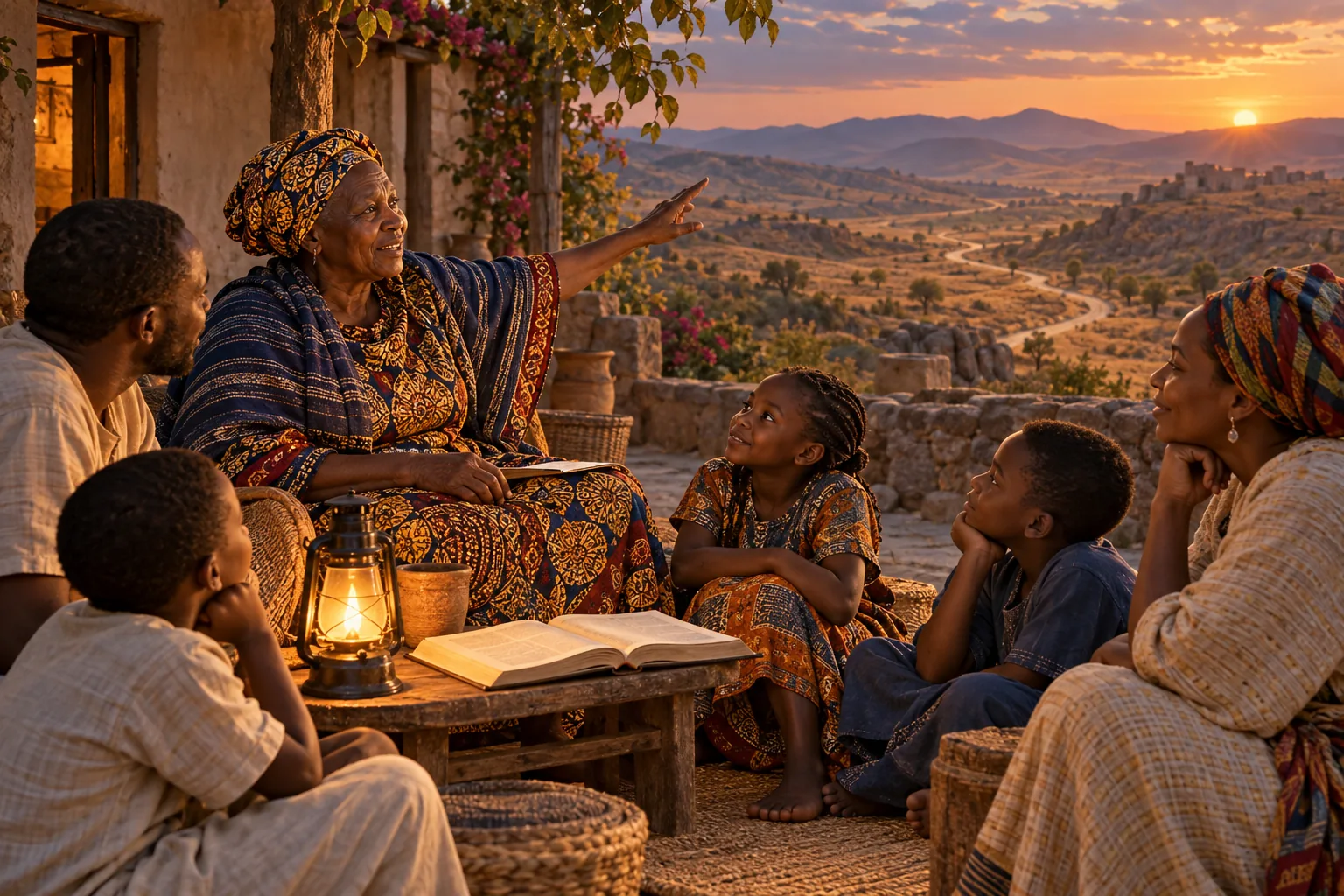
How does remembering God’s promises change how we tell our story?
01
Overview
From Abraham's fragile beginnings to the Exodus: a history of covenant faithfulness told for people who still need hope
Key text — Psalm 105:8, 42–45 (thematic study rendering): He remembers his covenant always, the promise he gave across generations. He remembered his holy promise to Abraham, brought his people out with joy, and gave them a place to live so that they might keep his instruction. Praise the LORD!
A family begins with a promise but has no land of its own. One of its sons is sold into slavery. A later generation becomes vulnerable to forced labor under a foreign empire. Then comes hunger, rescue, a journey through the wilderness, and a home they could never have secured by their own strength.
Who holds this broken-looking story together?
Psalm 105 answers: the LORD who remembers his covenant. It invites God's people to look back—not because yesterday was easy, and not because every ancestor behaved well, but because God remained faithful through dangers that might have ended their story. The psalm teaches a wounded community to remember where its hope comes from.
It also confronts us with a surprising truth: the gift of grace is meant to form a people who live differently. Israel was delivered not simply to celebrate its freedom, but to practice the instruction of the God who freed it.
02
1.0 Introduction
Psalm 104 celebrates the God who creates and sustains the world: watering the ground, feeding animals, ordering the seasons, and renewing life by his Spirit. Psalm 105 narrows the camera from creation to history. The same God who sustains the earth also acts within the changing, often violent, story of a people.
The psalm retells much of the narrative from Genesis through the Exodus and the entry into Canaan. Yet it is not a neutral chronological summary. It chooses particular scenes and tells them from a deliberate perspective: the LORD remembered, protected, sent, multiplied, rescued, guided, and provided.
Its movement can be traced in six parts:
- Verses 1–7 — The summons: Give thanks, sing, seek the LORD, and remember his works. - Verses 8–15 — The covenant: God's promise to Abraham, Isaac, and Jacob endures when the family is small and vulnerable. - Verses 16–22 — Joseph: What looks like abandonment becomes part of a long and costly preservation of life. - Verses 23–38 — Egypt: The people multiply, face oppression, and witness God's intervention through Moses, Aaron, and the signs of judgment. - Verses 39–42 — The wilderness: God gives guidance, food, and water because he remembers his promise. - Verses 43–45 — The goal: Deliverance leads to joyful possession of the land and to obedience to God's teaching.
Central message: The God who fulfilled his word through generations of vulnerability and suffering remains trustworthy. Remembering his grace is meant to inspire present trust and a life shaped by his instruction.
03
2.0 Historical and Literary Context
Psalm 105 belongs to Book Four of the Psalter (Psalms 90–106). This book follows Psalm 89's anguish over the downfall of the Davidic kingship. It repeatedly draws Israel back to the sovereign LORD who remains King even when human institutions fail (Pss. 90; 93–100). Psalm 105 contributes a different kind of evidence: the story of God's long fidelity to the ancestors and their descendants.
The Hebrew text supplies no named author or definite occasion. The first fifteen verses occur, with some differences, in the great hymn of 1 Chronicles 16:8–22, associated by the Chronicler with David's celebration when the ark was brought to Jerusalem. The combined song in 1 Chronicles also draws from Psalms 96 and 106. This shows how the material was used in worship, but it does not prove Psalm 105 as a whole was written on the day described in Chronicles (Goldingay 2008, Psalm 105, “Interpretation”; Kidner 2014, 407).
Its vocabulary has resonances with Isaiah 40–66, and the song would have been especially powerful to people living during or after the Babylonian exile. They too felt diminished, vulnerable, and uncertain of their future. Goldingay reads the retelling as encouragement for a community tempted to doubt that the God of its ancestors was still acting on its behalf. A precise date nevertheless remains uncertain.
Two literary details are decisive.
First, the psalm is selective. It devotes much space to God's actions but virtually none to Israel's wilderness rebellion. Sinai is not narrated, although the final verse insists that God's teachings matter. Joseph's suffering is remembered, but many of the failures recorded in Genesis and Exodus are left aside. Such selection is not proof that the poet did not know those events. It serves the poem's purpose of encouraging praise by concentrating on God's faithfulness (Goldingay 2008, Psalm 105, “Interpretation”).
Second, Psalm 106 completes the picture. Kidner describes Psalms 105 and 106 as complementary accounts of sacred history: Psalm 105 foregrounds God's unwavering action; Psalm 106 foregrounds Israel's recurring unfaithfulness and God's mercy despite it. Neither psalm should be made to cancel the other (Kidner 2014, 407, 411).
Psalm 105 is therefore history preached as worship. It does not merely say what happened. It teaches God's people how to remember what happened so that they can trust him now.
04
3.0 Walking Through the Text
3.1 Psalm 105:1–6 — Remember, seek, sing, and tell the nations
The opening verses sound like a series of urgent invitations: give thanks, call on his name, make his deeds known, sing, rejoice, seek, and remember. They do not begin with an account of what Israel should achieve. They begin with the God who has acted.
These actions belong together. To give thanks is to acknowledge the Giver; to tell the nations is to refuse to keep his deeds as private property; to seek his face continually is to recognize that yesterday's deliverance does not make present dependence unnecessary (vv. 1–4).
The call to remember in verse 5 includes God's wonders, signs, and judgments. In this setting “judgments” are not only condemnations but decisive acts expressing God's governing will. Some of those acts will expose the claims of oppressive power (vv. 26–36).
Goldingay notes that the repeated language of seeking the LORD speaks particularly to communities in reduced circumstances that might reach for political or religious substitutes. Kidner observes that the psalm's opening turns the jewel of worship in several directions: praise for who God is, gratitude for what he has done, and renewed dependence on him (Goldingay 2008, Psalm 105:1–6; Kidner 2014, 407).
There is also a question of identity. Verse 6 addresses the offspring of Abraham and descendants of Jacob, God's chosen people. This is Israel's particular story. But the invitation to make God's deeds known among the nations (v. 1) ensures that the remembrance has an outward purpose.
Remembering is not an escape from present responsibility. It is the discipline of bringing God's faithfulness into present view.
3.2 Psalm 105:7–11 — The covenant remembered across generations
Verse 7 begins with a confession: He is the LORD our God; his judgments extend through all the earth. The local history of Israel is placed beneath the universal government of its Creator. Then the poet speaks repeatedly of remembering, covenant, promise, oath, and the pledged land.
The LORD made a covenant with Abraham, confirmed his oath to Isaac, and established his pledge to Jacob/Israel (Gen. 12:1–3, 7; 15; 17; 26:2–5; 28:13–15). The promised land of Canaan is named explicitly. The psalm refuses to turn this promise into something vague: God's faithfulness has taken concrete form in a historical family and its future.
“He remembers his covenant forever” (v. 8, sense rendering) does not mean God once forgot it and suddenly recalled the details. Biblical “remembering” is active: he brings what he promised into effect. Kidner underlines this distinction and stresses that a divine covenant begins in God's gracious initiative, not an equal bargain between God and human beings (Kidner 2014, 408).
The language of “a thousand generations” is poetic language for enduring commitment; it is not a mathematical countdown to the covenant's expiry. Yet the territorial imagery must be handled responsibly. The psalm recalls Israel's ancient covenant story, not a transferable authorization for modern religious communities to seize land or injure their neighbors. The wider Scriptures insist that possession of land never releases God's people from justice, obedience, or accountability (Lev. 19:33–34; Deut. 10:18–19; Jer. 7:5–7).
A promise that endures through generations is not a blank cheque for whatever its beneficiaries want to do. It calls forth fidelity to the One who made it.
3.3 Psalm 105:12–15 — A small family protected in a dangerous world
When the ancestors were few, weak, and strangers traveling from one kingdom to another, God did not let powerful rulers destroy them (vv. 12–14). The Genesis narratives tell of vulnerable encounters with Pharaoh and Abimelech, and of God intervening despite the patriarchs' own fear and mistakes (Gen. 12:10–20; 20:1–18; 26:6–11).
Verse 15 includes the memorable warning: do not touch my anointed ones; do no harm to my prophets (short study paraphrase). In its immediate context the “anointed ones” are the patriarchs—the small, migrating covenant family. Abraham is explicitly called a prophet in Genesis 20:7. This is not a command granting present-day preachers or leaders freedom from criticism, safeguarding, investigation, or lawful accountability. No human office is above God's own justice (Deut. 16:18–20; Acts 17:11; 1 Pet. 5:2–3).
Neither is divine protection a guarantee that all faithful people will avoid harm. The next section tells us that Joseph, a member of this very family, was sold into slavery and imprisoned. The psalm's purpose is not to claim that suffering never happens. It is to show that no danger succeeded in cancelling God's covenant purpose.
The contrast is extraordinary: worldly kingdoms appear strong, and the promised family appears almost insignificant. The psalm locates the future not in the strongest ruler but in the faithfulness of God.
3.4 Psalm 105:16–22 — Joseph: the person sent ahead through suffering
The song moves suddenly from divine protection to famine. Verse 16 speaks boldly of the LORD summoning hunger on the land. Verse 17 then says he sent a man ahead of the people—Joseph, who was sold as a slave.
Genesis describes the actions that brought Joseph to Egypt: his brothers' jealousy, his sale, his service in Potiphar's household, a false accusation, prison, and eventual release (Gen. 37; 39–41). Psalm 105 views that complex story from the perspective of God's capacity to bring preservation through it. Joseph later gives this theological interpretation himself: what others intended for harm, God turned toward the preservation of life (Gen. 45:5–8; 50:20).
That claim should not become an excuse for cruelty. Joseph's brothers were responsible for their betrayal. To say God brought good out of the ordeal is not to say slavery was good or that perpetrators should escape accountability.
Verse 18 makes Joseph's suffering tangible: his feet were restrained by fetters; iron pressed upon his life. A famous traditional English rendering speaks of iron entering his soul, but Kidner notes that this reverses the direction of the Hebrew wording. The sense may include an iron collar or the restraint of Joseph's whole person (Kidner 2014, 408–09). Whatever the exact physical picture, the poem refuses to turn his imprisonment into a minor inconvenience.
Verse 19 adds that Joseph waited until his word came true, while the LORD's word tested or refined him. Commentators differ on whether “his word” refers to Joseph's dreams and interpretations or to God's promise; the verse can remind us how a promised future may be experienced as a long delay (Gen. 37:5–11; 40–41).
Eventually the king releases Joseph and places him over the royal household. The poem moves from iron restraint to public responsibility. He becomes an instrument of wisdom and provision in a time of regional famine. God's faithfulness is not measured by how quickly hardship disappears, but here it is displayed through a life that was nearly destroyed and yet used to save others.
3.5 Psalm 105:23–25 — Israel multiplies; Egypt becomes hostile
Jacob's family comes to Egypt, which the poem also calls the land of Ham, a traditional poetic designation (compare Ps. 78:51). Under God's care the people multiply and become strong. What had been refuge in Joseph's lifetime becomes, generations later, the setting of oppression (Gen. 47:27; Exod. 1:7–14).
Then comes one of the psalm's most difficult sentences: God turned the Egyptians' hearts to hate his people and deal craftily with his servants (v. 25, sense rendering). This reflects the strong language of divine sovereignty used in Exodus, where Pharaoh's hardening and God's judicial purposes are described in interwoven ways (Exod. 4:21; 9:12; 14:4–8).
We should not soften the verse until its tension disappears. The poet wants to insist that hostile empires are not beyond God's rule. But neither does this mean hatred, slavery, ethnic prejudice, or state violence become righteous when powerful people commit them. Exodus portrays Pharaoh's oppression as evil, and his regime is judged for its actions. Divine sovereignty must not be used to erase human responsibility.
For any community that has experienced exclusion or persecution, this passage can speak of a hope larger than the hostile power it faces. It cannot rightly be used to tell victims that their oppressors deserve unquestioning obedience or that abuse is a sacred gift.
3.6 Psalm 105:26–36 — Moses, Aaron, and the signs against Egypt
When Israel is oppressed, the LORD sends Moses and chooses Aaron. The signs that follow confront Egyptian power: darkness, blood in the waterways, frogs, swarms of insects, hail and lightning, destroyed fruit trees, locusts, and the death of the firstborn (Exod. 7–12).
Psalm 105 does not reproduce the Exodus narrative in exact order. It places darkness first, though Exodus narrates it near the end; it also omits some of the plagues. Kidner and Goldingay explain that the psalm is a poetic retelling, emphasizing the LORD's decisive action rather than supplying a replacement chronological report (Kidner 2014, 410; Goldingay 2008, Psalm 105:25–38).
The repeated verbs matter: he sent, he spoke, he turned, he struck. Pharaoh's status does not give him the final word. The God who seemed absent to people under forced labor confronts the system that held them.
Still, the plagues are grave events, particularly the death of the firstborn. The poem's praise of deliverance must not make readers indifferent to suffering or eager to imitate divine judgments. Scripture does not authorize believers to use this narrative as a mandate for private revenge, ethnic hostility, or violence against present-day groups. The Exodus story includes a moral seriousness toward oppression and toward the reality of judgment (Exod. 3:7–10; 12:29–32).
For the vulnerable, the psalm's comfort is not that every oppressor will be punished on a timetable we can predict. It is that God hears and acts in history, and even empires must finally answer to him.
3.7 Psalm 105:37–42 — Deliverance, covering, bread, and water
Israel departs with silver and gold, and the poet pictures the people coming out without collapsing in weakness (vv. 37–38). The gold and silver recall the Exodus account of valuables received on departure (Exod. 12:35–36). They do not promise automatic wealth to every faithful person. The subject is a particular deliverance from slavery, not a universal prosperity formula.
The wilderness becomes the next scene. God provides cloud and fire for guidance, quail and heavenly bread for food, and water from a rock for dry ground (vv. 39–41; Exod. 13:21–22; 16; 17:1–7). Goldingay notes that the description of a cloud spread over the people may also echo the covering presence associated with the sanctuary; the underlying image is of a God who stays with the travelers even when their surroundings are dangerous (Goldingay 2008, Psalm 105:39–45).
The tone is deliberately positive. The Exodus and Numbers narratives recount hunger, complaint, fear, and disobedience. Psalm 105 largely leaves those details aside, highlighting the provisions that kept a vulnerable people alive. It is a particular angle on the story, not a denial of other biblical testimony.
Verse 42 explains why provision continues: God remembered his holy promise to Abraham. The promise introduced in verses 8–11 has not disappeared amid famine, bondage, or wilderness. It drives the story forward.
The image of water in dry places can speak profoundly to believers in seasons of scarcity. But it does not guarantee that every drought will end immediately or that everyone who prays will be spared hardship. Its promise is about the God whose faithfulness remains the ground of hope, not our ability to command circumstances.
3.8 Psalm 105:43–45 — The gift of freedom is meant to form faithful people
The closing verses return to joy. God brings out his chosen people with gladness and gives them land in keeping with his promise. Yet the final purpose clause changes the whole tone: “so that they might keep his statutes and observe his teaching” (v. 45, study rendering).
This is the goal of grace. Israel was not rescued merely to be free from an oppressive master. It was freed for a covenant life under the LORD—one marked by worship, justice, care for neighbors, and obedience to the instruction given through Moses (Exod. 19:4–6; Deut. 6:4–9; 10:12–19).
Goldingay draws attention to the surprise: the psalm has barely narrated Sinai or the people's wrongdoing, but now God's instruction appears as the point of the deliverance. Kidner likewise stresses that grace is not an excuse to multiply sin. God's gift creates the possibility and responsibility of faithful living (Goldingay 2008, Psalm 105:39–45; Kidner 2014, 410–11).
The land language must remain in its ancient covenant setting. It should not be detached from the larger biblical witness to justice, the treatment of strangers, and the moral demands placed on Israel. Nor does it grant modern Christians a license to conquer territory, displace communities, or treat God's favor as a guarantee of political dominance.
The psalm ends with “Praise the LORD!” In the Masoretic tradition the closing Hallelujah belongs to Psalm 105; the ancient Greek textual tradition handles this boundary differently. Regardless, the psalm has led its worshipers from remembered promise to the praise that should flow from living in God's grace.
05
4.0 Theological Reflection
4.1 Remembering is an act of covenant faith
In this psalm, remembering is not nostalgia or a refusal to face present difficulty. The worshiper revisits the past to learn what kind of God can be trusted now. Israel's story includes long waits, endangered lives, and the collapse of ordinary securities. God's faithfulness holds the story together without making its painful chapters insignificant.
Churches and families need such truthful remembrance. Testimony becomes unhelpful when we remove every sorrow in order to sound victorious. Psalm 105 lets us remember Joseph's chains even as we praise God's saving purposes. Honest memory can nourish hope without editing away the wounded.
4.2 Election carries a responsibility to witness and serve
The community is called Abraham's offspring and God's chosen ones. But it is also commanded to make God's deeds known among the nations (v. 1). Biblical election is not a medal proving inherent superiority. From Genesis 12 onward, God's blessing of Abraham is bound up with blessing the families of the earth (Gen. 12:1–3; Isa. 49:6).
This challenges tribalism, cultural pride, and any claim that God exists to secure the success of one religious faction. The redeemed are meant to become witnesses to mercy and agents of faithful living.
4.3 Providence does not absolve human cruelty
Psalm 105 speaks forcefully about God's rule over famine, Joseph's journey, and Egypt's hostility. Genesis and Exodus also show human actors choosing betrayal, injustice, and violence. Both truths must be heard. God can work through and against evil without turning evil into good.
No leader may appeal to “God's plan” to excuse mistreatment. Those harmed by exploitation deserve safety, truth, justice, and appropriate redress. Hope in providence supports moral courage; it does not demand passivity from victims.
4.4 Salvation is liberation toward a new way of life
The psalm does not end at the escape from Egypt. It ends with God's teaching (v. 45). The Exodus creates a people with obligations: worship the LORD, reject other gods, protect the vulnerable, love the neighbor, and judge fairly (Exod. 20; Lev. 19; Deut. 16:18–20).
This is not the claim that obedience purchased the Exodus. The order is the reverse: grace comes first, and faithful living answers it. In Christian language, good works are the fruit of salvation rather than the price paid to obtain it (Eph. 2:8–10).
4.5 The two history psalms must be heard together
Psalm 105 remembers God's goodness. Psalm 106 will confess the people's resistance. We need both. A congregation that only rehearses its victories risks denial and self-righteousness; one that only repeats its failures may forget the God whose mercy makes repentance possible. Read together, the psalms teach hope without denial and repentance without despair.
06
5.0 Canonical and Christological Horizon
Psalm 105 stands within the Bible's larger story of promise, threatened life, rescue, and responsibility. Genesis announces God's commitment to bless Abraham and, through him, the families of the earth (Gen. 12:1–3). Joseph's story shows a family preserved through the very betrayal that endangered it (Gen. 37–50). Exodus reveals a God who hears slaves and challenges imperial power (Exod. 2:23–25; 3:7–10). Deuteronomy then calls the liberated people to remember and practice justice (Deut. 6:20–25; 10:12–19).
The New Testament begins with this same history. Mary praises God for remembering mercy to Abraham's descendants, and Zechariah celebrates God's remembrance of the covenant (Luke 1:54–55, 68–75). Stephen retells the patriarchal and Exodus narratives to show both God's continuing purpose and the recurring tendency of people to resist him (Acts 7:2–53). Paul describes Abraham's promise in relation to God's purpose to bless the nations through Christ (Gal. 3:6–14, 26–29).
For Christians, Jesus is Israel's Messiah, the one through whom the covenant story opens toward its promised worldwide blessing. The Gospel writers place Jesus' life within Israel's experience of exodus, testing, and faithfulness (Matt. 2:13–15; 4:1–11). Through his death and resurrection, Christians confess that God's saving purpose reaches beyond bondage to any one empire and confronts sin and death themselves (Rom. 6:3–11; 1 Cor. 15:20–26).
Such a reading must be careful. Psalm 105 does not explicitly name Jesus, and it should not be treated as a secret prediction in which every detail of Joseph or the plagues stands for one event in his life. The Christian connection is canonical and theological: the same God whose covenant with Israel sustained its history is understood to act decisively in Israel's Messiah.
The final verse also resonates with the New Testament's vision of a redeemed life. Paul rejects the idea that grace makes moral transformation unnecessary (Rom. 6:1–4), while Ephesians describes salvation as God's gift that forms people for good works (Eph. 2:8–10). Jesus likewise links love for God with a transformed manner of life (Matt. 22:34–40; John 13:34–35).
The psalm's hope is therefore neither a promise of untroubled lives nor a religious claim to privileged power. It is confidence that God's faithfulness precedes us, accompanies us, and calls us to become a people who bless others.
07
6.0 Life Application
- Remember with specificity. Write down one event in which you experienced God's sustaining grace. Include the unanswered questions and hardships rather than polishing away the difficult parts. Honest testimony is stronger than exaggerated success stories.
- Seek God's face continually. Psalm 105:4 calls for an ongoing posture, not an emergency ritual. Build regular time for Scripture, prayer, and listening, while refusing the temptation to use prayer as a substitute for necessary action.
- Do not misuse “Touch not my anointed.” Honor spiritual leaders, but do not make anyone untouchable. If wrongdoing is alleged, protect vulnerable people, seek credible evidence, and insist on appropriate accountability. God's covenant fidelity never excuses abuse.
- Look for ways to preserve life during scarcity. Joseph's story urges wise preparation, fair stewardship, and help for those facing hunger or economic insecurity. Refuse to turn another person's need into an opportunity for exploitation.
- Retell stories across generations. Invite children and younger believers to ask questions about the biblical story and about your community's experience. Pass on both the testimonies of grace and the warnings learned from failure.
- Let freedom bear ethical fruit. In business, marriage, church administration, or public responsibility, ask how God's grace should change the way you handle money, tell the truth, make decisions, and protect people with less power.
- Hold Psalm 105 beside Psalm 106. Celebrate God's deeds without claiming your community has never failed. Confess failures without concluding that God's faithfulness has ended.
08
7.0 Reflection Questions
- Why does Psalm 105 tell Israel's history mainly through God's actions rather than through a complete record of the ancestors' behavior?
- What does it mean for God to remember his covenant, and how is this different from human forgetfulness?
- How does Joseph's imprisonment challenge simplistic claims that God's protection guarantees an easy life?
- How should Psalm 105:15 be interpreted in its original setting, and why must it not be used to prevent accountability for religious leaders?
- How can we speak about God's sovereignty in verse 25 without excusing human oppression or violence?
- Why does the psalm end with obedience to God's instruction rather than with material prosperity or political victory alone?
- Which part of your community's story needs to be remembered with gratitude, and which part needs to be examined honestly when you read Psalm 106?
09
8.0 Response Prayer
Faithful LORD, God of Abraham, Isaac, and Jacob, teach us to remember what you have done. When our present troubles make your promises seem distant, bring your steadfastness back into view.
You watched over a small and wandering family. You did not abandon Joseph in his chains. You heard the cries of people living under oppression, and you provided for your people on an uncertain journey.
Forgive us when we turn your gifts into our own glory, when we excuse injustice by calling it your plan, or when we seek security in powers that cannot save. Give courage to those facing exploitation and fear. Make us people who tell the truth and protect the vulnerable.
Through Jesus Christ, Israel's Messiah and the world's hope, form in us gratitude that becomes obedience, and freedom that becomes love of neighbor. May our remembering lead to praise, and our praise to faithful living.
Amen.
10
9.0 Window into What Comes Next
Psalm 105 ends with the gift of the land and the purpose of living by God's instruction. It has celebrated God's actions across generations, deliberately leaving most of Israel's rebellion outside the frame. That makes its final call to obedience both beautiful and searching.
Psalm 106 tells the other side of the same history. It remembers the sea, wilderness, golden calf, recurring disobedience, and the mercy of a God who hears again and again. Where Psalm 105 repeatedly shows God remembering his word, Psalm 106 repeatedly shows the people forgetting his works.
Both are necessary. Psalm 105 teaches the heart to trust the faithful God; Psalm 106 teaches that same heart to confess its failures without abandoning hope. Together they bring Book Four toward its closing prayer for restoration and praise.
11
10.0 Bibliography
- Scripture: Psalm 105; Psalms 78, 89–90, 96, 100, 103–106; Genesis 12–17; 20; 26; 28; 37–50; Exodus 1–20; 32–34; Leviticus 19; Deuteronomy 6; 10; 16; Joshua 24:13; 1 Chronicles 16:8–22; Isaiah 40–55; Jeremiah 7:5–7; Luke 1:54–55, 68–75; Acts 7; 17:11; Romans 6; 1 Corinthians 15; Galatians 3; Ephesians 2:8–10; 1 Peter 5:2–3. The key text is an original thematic study rendering, not a verbatim quotation from a specified modern translation.
- BibleProject. n.d. The Book of Psalms: Study Notes. Project resource on the five-book arrangement and the theology of Book Four.
- Goldingay, John. 2008. Psalms, Volume 3: Psalms 90–150. Baker Commentary on the Old Testament Wisdom and Psalms. Grand Rapids, MI: Baker Academic. Commentary on Psalm 105, “Yhwh Is Still the Same.”
- Kidner, Derek. 2014. Psalms 73–150. Kidner Classic Commentaries. Downers Grove, IL: InterVarsity Press. Originally published 1975. Commentary on Psalm 105, “Not one thing has failed,” pp. 407–11.
Be the first to leave a comment.