

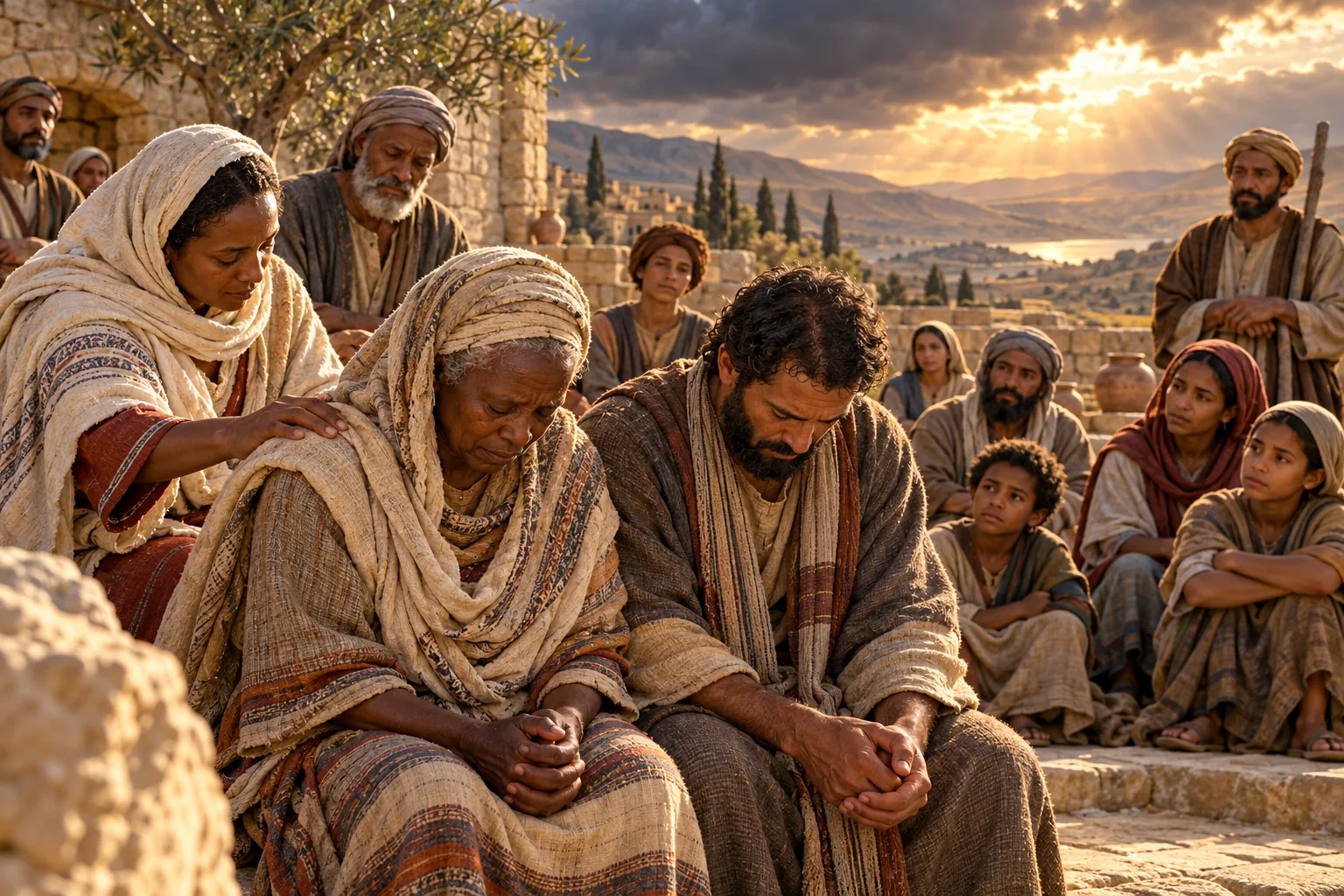
When we forget God’s faithfulness, how can confession open us to mercy?
01
Overview
An honest confession of Israel’s failures, the judgment that followed, and the covenant mercy that keeps hope alive
Key text — Psalm 106:44–45 (study rendering): Yet he looked upon their distress when he heard their cry. He remembered his covenant for their sake and, according to his abundant steadfast love, relented.
There are stories families tell because they are proud of what happened. There are others they would rather leave untold. The first kind remembers triumphs. The second remembers the damage caused by decisions no one wants to defend.
Psalm 106 insists that a community of faith must tell both kinds of story. The song begins by praising the goodness of the LORD, then walks through a long record of unbelief, rivalry, idolatry, injustice, and violence. Surprisingly, the repeated failures of the people do not make God disappear from the story. Again and again, God rescues, listens, remembers, and shows compassion.
The psalm does not say that wrongdoing is harmless. It says that God's covenant faithfulness is deeper than his people's failure—deep enough to make honest confession and renewed hope possible.
02
1.0 Introduction
Psalm 105 invited Israel to remember the LORD's marvelous deeds from Abraham and Joseph through the exodus and the wilderness. Psalm 106 revisits much of that history from another direction. It asks what the people were doing while God was faithfully fulfilling his promises. The answer is uncomfortable: they often forgot, rebelled, and exchanged God's glory for something else.
Yet Psalm 106 is not simply an accusation. Its first word is praise, its central confession is “We have sinned” (v. 6), and its final petition is “Save us ... gather us from among the nations” (v. 47). The poem teaches people to bring the truth about themselves into the presence of the God whose mercy endures.
The argument can be followed in five movements:
- Verses 1–5: Praise, the blessing of justice, and an individual's desire to share in the people's restoration. - Verses 6–23: Confession of rebellion at the sea, dissatisfaction in the wilderness, jealous resistance to leadership, and the golden calf; Moses stands in intercession. - Verses 24–33: Rejection of the promised land, apostasy at Peor, and the failure associated with the waters of Meribah. - Verses 34–46: Compromise and violence in the land, repeated oppression, and God's willingness to remember his covenant even under judgment. - Verses 47–48: Prayer for gathering and a blessing that also closes Book Four of the Psalter.
Central message: To praise the LORD truthfully is to remember not only his saving acts but also our failures to live as his people. Confession refuses excuses; covenant mercy refuses despair; repentance must become a new way of life.
03
2.0 Historical and Literary Context
Psalm 106 closes Book Four of the Psalter (Psalms 90–106). Book Three ended with the apparent collapse of the Davidic kingdom and the painful questions of Psalm 89. Book Four has repeatedly affirmed that the LORD remains King, regardless of the failures of earthly rulers. It began with the prayer of Moses (Psalm 90) and ends by remembering how Israel repeatedly refused the guidance of the God who had delivered it. The arrangement creates a remarkable pastoral movement: hope in divine kingship is inseparable from confronting the history of human unfaithfulness.
Psalms 105 and 106 are companion retellings. Psalm 105 foregrounds divine faithfulness and does not dwell on Israel's failures. Psalm 106 foregrounds those failures but repeatedly recalls divine mercy. They do not compete; they correct incomplete ways of remembering. Kidner calls Psalm 106 the dark counterpart of its predecessor, while emphasizing that God's patience becomes the song's deepest subject (Kidner 2014, 411–16). Goldingay describes the contrast as one between accounts of how God rescued people in trouble and how people brought trouble on themselves yet were rescued (Goldingay 2008, Psalm 106, “Interpretation”).
The psalm has no explicit Hebrew heading naming an author. The prayer to be gathered from the nations (v. 47) strongly suggests a community shaped by displacement and exile. That may reflect the Babylonian exile or a later time when many Judeans remained scattered even after some had returned. The specific date is uncertain. Ancient literary relationships complicate a simple historical reconstruction: 1 Chronicles 16:34–36 includes versions of Psalm 106's opening and closing words within a liturgical scene associated with David. This might reflect later use of familiar liturgical material; it cannot by itself establish that the whole present psalm was written during David's lifetime.
The poem is also part of a broader biblical practice of confessing the nation's history (Neh. 9; Dan. 9; Ezra 9; Ezek. 20; Ps. 78). It does not follow the events in strict chronological order. Its arrangement is a theological retelling designed to expose recurring choices, not a replacement for the narratives in Exodus, Numbers, Deuteronomy, Judges, and Kings.
Verse 48 deserves separate notice. It blesses the LORD from everlasting to everlasting and calls the people to say Amen and Praise the LORD. Its wording resembles the doxologies concluding Books One, Two, and Three (Pss. 41:13; 72:18–19; 89:52). Goldingay treats it separately as the coda to Book Four (Goldingay 2008, “Psalm 106:48: Coda to Book IV”). The psalm can therefore be heard both as a prayer arising from Israel's troubled story and as a fitting close to an entire book of the Psalter.
04
3.0 Walking Through the Text
3.1 Psalm 106:1–5 — Praise, justice, and the desire to share in restoration
The song begins with “Praise the LORD” and a familiar confession: the LORD is good, and his steadfast love endures forever (v. 1; compare Pss. 107:1; 136:1). The word translated steadfast love points to God's loyal, persevering commitment rather than a passing mood. This opening is deliberately bold. The poem will soon recount painful judgment, but it refuses to reduce God to the disasters being remembered.
Verse 2 asks who can adequately recount God's mighty acts. Verse 3 immediately blesses those who maintain justice and practice righteousness continually. Goldingay sees these lines as more closely related than a casual reading might suggest: genuine praise needs more than an inventory of divine wonders; it calls for the practice of what is right. Kidner likewise reads the blessing as a challenge to the misconduct that the psalm will expose (Goldingay 2008, vv. 1–3; Kidner 2014, 412).
Verses 4–5 change to the first-person singular: the worshiper asks God to remember me when he shows favor to your people, so that the individual can share in their good and gladness. The shift is significant. The person does not retreat into a private spirituality detached from the community. Nor does the community erase an individual's desire for grace. Personal well-being and the restoration of God's people belong together.
That is a needed word wherever faith is reduced either to individual success or to slogans about collective identity. The psalmist wants to rejoice with the people whom God restores.
3.2 Psalm 106:6–12 — “We have sinned”: the sea and the grace that came first
The confession in verse 6 is the hinge of the poem: “We have sinned, even as our ancestors did.” The worshipers do not say, “Those earlier generations were wicked, but we are different.” They identify themselves with the recurring pattern of the community's failures. This is not a claim that every present individual personally committed every ancient deed. It is an acknowledgment that later generations can inherit, repeat, benefit from, or perpetuate patterns of injustice and unbelief.
At the sea, Israel failed to understand the significance of the wonders already witnessed in Egypt. Instead of trusting the LORD's steadfast love, the people rebelled (vv. 7–8; Exod. 14:10–12). The Hebrew text refers to the Sea of Reeds, traditionally called the Red Sea in many Bible translations. The exact geography is debated; the psalm's emphasis is the divine rescue, not the modern identification of a particular shoreline.
God delivered them for the sake of his name (v. 8). Grace came before their fear had been transformed into faithful confidence. The waters were rebuked; the people passed through; their pursuers were overwhelmed (vv. 9–11). Only then do the people trust and sing (v. 12; Exod. 15).
The sequence exposes an uncomfortable human habit: we may praise God immediately after rescue without yet having learned to trust him in the next crisis. The song is genuine, but it needs to become a durable way of life.
3.3 Psalm 106:13–15 — The danger of wanting without waiting
The next scene begins abruptly: they quickly forgot God's deeds and did not wait for his counsel (v. 13). Having escaped slavery, they now demanded a different life on their own terms. In the wilderness they craved food and tested God (Num. 11). Their bodily need should not be mocked—food really matters. The problem is the insistence that God must satisfy appetite immediately, in precisely the way demanded, regardless of his wisdom.
Verse 15 is famously difficult in translation. The LORD gave them their request but sent a wasting sickness or leanness among them. An older English rendering describes leanness entering their soul, and that expression has become a memorable warning about receiving what we desire without receiving what is good. Yet the historical reference includes the serious disaster associated with the craving for meat (Num. 11:18–20, 31–34). We should not treat “spiritual emptiness” as though it were the only literal meaning.
The lesson is subtler than the maxim “Never ask God for anything.” Scripture repeatedly encourages prayer for daily bread. Psalm 106 warns against a demanding spirit that confuses immediate gratification with a life ordered by God's wisdom.
3.4 Psalm 106:16–18 — Jealousy disguised as a dispute over leadership
The people become jealous of Moses and Aaron. The reference recalls the rebellion of Dathan, Abiram, and the company associated with Korah (Num. 16). The psalm names Dathan and Abiram, recounts the earth swallowing rebels, and mentions fire consuming others (vv. 17–18). Korah is not named directly here, though the wider Numbers narrative helps explain the two kinds of punishment.
The ancient account concerns a specific revolt in Israel's wilderness history. We should not use it to imply that every criticism of a pastor, church board, or government official is rebellion against God. Accountable leaders can and must be questioned. Indeed, the same Bible reports grave failures by Moses and Aaron and places kings under God's law (Num. 20:7–13; Deut. 17:18–20).
What the psalm exposes is envy masquerading as principle. Where genuine concerns about injustice exist, they should be heard and examined. Where the driving desire is simply to seize status or power, a different sort of repentance is needed. This passage searches both the heart of the critic and the integrity of the leader.
3.5 Psalm 106:19–23 — The golden calf and Moses in the breach
At Horeb, where Israel had received the revelation of the LORD, the people made an image of a calf and bowed before it (Exod. 32). The contrast is intentionally humiliating: they exchanged their glory for the likeness of an animal that eats grass (vv. 19–20). The divine name and saving acts were replaced by a manageable object.
The tragedy is described as forgetting God their Savior, the one who had done great things in Egypt and at the sea (vv. 21–22). Idolatry begins when creatures, possessions, political systems, or sacred symbols are granted the allegiance owed to the living God. The problem is not material things as such but the exchange of ultimate loyalty (compare Rom. 1:22–25).
Verse 23 contains one of the psalm's most powerful images. Destruction is threatened, but Moses stands “in the breach” before God. The phrase pictures a defender stepping into a gap through which disaster might enter. The historical narrative is Exodus 32:7–14, where Moses intercedes for the very people who have rebelled.
Intercession here is not a performance in which Moses is more merciful than an unmerciful God. Scripture also depicts the LORD as seeking those who will stand in the breach (Ezek. 22:30). Moses' prayer belongs to God's larger commitment to his people. Kidner warns that this vivid language must not be flattened so that prayer becomes meaningless, or interpreted as though God had no concern for mercy (Kidner 2014, 414).
This scene presses a question upon every believer: When someone fails, do we delight in exposing them, excuse their harm, or seek the difficult path of truth, accountability, and intercession? The psalm invites the third response.
3.6 Psalm 106:24–27 — The promised land despised
Israel rejected the desirable land, did not believe the LORD's promise, and grumbled inside the tents (vv. 24–25). This echoes the refusal to enter Canaan after the spies' report (Num. 13–14; Deut. 1:26–33). The central issue was not mere nervousness in the face of military danger. The people had become unwilling to trust the God who had promised to lead them.
God's raised hand signifies an oath of judgment: a generation would fall in the wilderness, and a threat of scattering would hang over its descendants (vv. 26–27; compare Lev. 26:33; Deut. 28:64). The psalm connects earlier rebellion with the later national experience of displacement. This is a theological interpretation of Israel's covenant history, not a formula that allows us to diagnose every exile, sickness, disaster, or political defeat as punishment for a particular sin.
The contrast with Psalm 105 is striking. There God remembers the land promised to the patriarchs (Ps. 105:8–11); here the people refuse to trust him concerning that same gift. A promise may be truly given yet resisted by those called to receive it.
3.7 Psalm 106:28–31 — Peor, Phinehas, and the danger of misusing sacred violence
At Peor the people attached themselves to Baal of Peor and participated in forbidden sacrificial practices (Num. 25). The psalm speaks of food offered to the dead, a detail not expressed in quite that form in the Numbers account; it may refer to rites connected with the dead or express contempt for idols without life. The precise ritual background remains uncertain. What is clear is that Israel compromised its covenant worship, and a plague struck the community (vv. 28–29).
Phinehas intervened, and the plague was stopped (vv. 30–31). Numbers 25:6–13 narrates his intervention as an act of violent zeal and speaks of God's covenant with him. Psalm 106 says the act was reckoned to him as righteousness through generations, language that recalls the description of Abraham's faith (Gen. 15:6), even though the circumstances are dramatically different.
This text must be taught responsibly. It belongs to a particular ancient Israelite covenant setting, under a specific narrative of divine judgment. It does not grant a church member, minister, political movement, or individual the right to use violence against alleged sinners or those of another faith. The New Testament calls Christ's followers away from vengeance and toward patient witness, reconciliation, lawful accountability, and overcoming evil with good (Rom. 12:17–21; Matt. 5:43–48).
Kidner explicitly distinguishes the example of Abraham's faith from imitation of Phinehas's violent zeal when discussing the theological resonance of righteousness (Kidner 2014, 415). Christian reflection must also remember the innocent people who suffer when religious passion is turned into private punishment. Zeal must be judged by truth and love, not simply by its intensity.
3.8 Psalm 106:32–33 — Meribah and the responsibility of Moses
At the waters of Meribah, the people again provoked the LORD. But the psalm adds a sobering admission: trouble came upon Moses because of them, and he spoke rashly (Num. 20:1–13). Depending on how the Hebrew pronouns are understood, verse 33 may describe the people's rebellion against God's Spirit or their provocation of Moses' spirit. Either way, the verse moves from communal provocation to Moses' damaging response.
Moses' responsibility does not disappear because others angered him. The community bears responsibility for its complaints; the leader remains responsible for what he says and does under pressure. This is a lesson for pastoral care, public office, teaching, and family life. Provocation can help explain a failure without making it right.
The psalm holds two truths together: leadership is difficult when a community is unfaithful, and even the most trusted leader needs correction. Moses' example should make religious leaders humble, not defensive.
3.9 Psalm 106:34–39 — When compromise turns into the shedding of innocent blood
The poem now moves into Israel's life in the land. The people failed to carry out what they understood as God's command, mixed with surrounding nations, adopted their practices, and served idols (vv. 34–36). We must distinguish the psalm's critique of idolatrous practices from ethnic contempt. The Bible includes faithful outsiders who become part of Israel's story, including Rahab and Ruth; the danger here is worship that normalizes injustice and cruelty, not contact with people of another ancestry.
The denunciation reaches its moral climax with the sacrifice of sons and daughters, the shedding of innocent blood, and the pollution of the land (vv. 37–39). These are severe charges. The Hebrew term often rendered demons (šēdîm) occurs in connection with false worship (compare Deut. 32:17). Whatever interpretive questions remain about ancient religious practices, the psalm is unequivocal that children must not be offered up for the sake of religious power. The blood of the vulnerable exposes the bankruptcy of worship divorced from compassion.
The image of the land polluted by innocent blood links devotion, ethics, and creation. A culture's practices can damage human beings and the shared place in which they live. For a contemporary church, the application is not fear of other ethnic groups; it is vigilant protection of children, women, the vulnerable, and anyone sacrificed to the reputation or interests of the powerful (Jer. 7:5–7; Matt. 18:5–6).
3.10 Psalm 106:40–46 — Judgment is real; covenant mercy is not exhausted
The anger of the LORD burns against his people. They are handed over to hostile powers, suffer oppression, and again and again turn from the way they should follow (vv. 40–43). The language recalls the repeated cycles of the book of Judges, along with the later calamities of monarchy and exile. Consequences matter. A faithful confession does not rewrite the past so that abuses and rebellion seem harmless.
But verses 44–46 contain the decisive turn: God saw their distress, heard their cry, remembered his covenant, and moved their captors to show compassion. Notice the asymmetry. The people had failed to remember God's steadfast love at the sea (v. 7); God remembers them even after repeated failures. Their forgetting does not force his forgetting.
The psalm says God relented according to his abundant steadfast love. That does not mean God discovered he had made a moral mistake in judging injustice. The language portrays genuine divine responsiveness to human misery and covenant obligation. Goldingay underscores that even the people's cry need not prove perfected repentance before God hears; compassion is grounded in his own character (Goldingay 2008, vv. 40–47).
We should also avoid the claim that every suffering person has brought misfortune on themselves. Job, Psalm 44, and Jesus' response to a man born blind (John 9:1–3) forbid such careless judgments. Psalm 106 interprets particular patterns of communal history and calls worshipers to recognize their responsibility where wrongdoing can genuinely be named. It is not permission to accuse victims.
3.11 Psalm 106:47–48 — Gather us, and let the people say Amen
The story ends with an urgent petition: “Save us, LORD our God, and gather us from among the nations.” The people ask to be restored so that they may give thanks to God's holy name and rejoice in his praise. The psalm has not reached an easy conclusion in which every painful consequence has already disappeared. Confession has become petition; hope remains an act of faith.
The final verse blesses the LORD, the God of Israel, from everlasting to everlasting. The people are called to answer Amen and Hallelujah—Praise the LORD. This verse serves as the doxology closing Book Four, echoing the endings of the first three books of the Psalter (Pss. 41:13; 72:18–19; 89:52).
This is a fitting ending precisely because it refuses two extremes. Israel cannot claim innocence; neither does it have to abandon hope. The people say Amen not to the goodness of their behavior, but to the faithfulness of the God whose mercy still invites them to pray.
05
4.0 Theological Reflection
4.1 Truthful worship requires truthful memory
Psalms 105 and 106 make a pair. One says, Remember what God has done; the other says, Admit what we have done. Either song is distorted if sung without the other. Praise without confession can become public relations for a religious institution. Confession without remembered grace can become despair. Biblical worship permits a community to celebrate genuine gifts while naming genuine wrongs.
4.2 Collective confession is not collective scapegoating
The word “we” in verse 6 prevents worshipers from placing every failure safely in the past. A generation may inherit harmful customs, unjust structures, and selective memories. But confessing communal patterns should never become a pretext for attributing identical guilt to every individual or for blaming unrelated people for another person's wrongs. Biblical confession leads to responsibility and repair, not indiscriminate accusation (Neh. 9; Ezek. 18:1–20).
4.3 Mercy is not the denial of judgment
The LORD's goodness does not mean evil has no consequences. Psalm 106 recounts devastating results of greed, injustice, idolatry, and violence. Yet judgment does not cancel God's covenant commitment. The purpose of confession is therefore neither self-excuse nor hopelessness, but a return to the God whose mercy can begin genuine transformation (Exod. 34:6–7; Lam. 3:22–23).
4.4 Intercession and accountability belong together
Moses stands in the breach. A faithful intercessor does not minimize idolatry; neither does he abandon people to destruction without pleading for them. This offers a pattern for spiritual care: tell the truth, protect those harmed, call wrongdoers to repentance, and pray for reconciliation where possible. Forgiveness is not a shortcut past restitution or safety.
4.5 The test of worship includes protection of the vulnerable
The most horrifying scenes in the psalm concern innocent blood and children sacrificed in the service of false worship. In Christian communities, this requires more than condemning ancient paganism. It requires strong safeguarding, transparent handling of abuse reports, responsible finances, and refusal to sacrifice vulnerable people to a leader's reputation or the success of an institution. A congregation cannot claim to honor a merciful God while refusing to protect those he loves.
4.6 God's covenant faithfulness is the ground of hope across generations
The final prayer is made by a community still awaiting fuller deliverance. It trusts not in its ability to promise that it will never fail again, but in the character of the LORD. Goldingay observes that the covenant commitment which preceded Israel's worthiness remains the basis of hope after unfaithfulness (Goldingay 2008, “Theological Implications”). This grace is not an invitation to repeat harm. It is a reason to return, learn, and live differently.
06
5.0 Canonical and Christological Horizon
Psalm 106 is part of a broader biblical way of narrating Israel's history. Exodus 32–34 holds together the scandal of the golden calf, Moses' intercession, God's self-disclosure as merciful and faithful, and the seriousness of wrongdoing. Deuteronomy 9 recalls rebellion so that the people will not confuse divine gifts with their own moral superiority. Psalm 78, Nehemiah 9, Ezekiel 20, and Daniel 9 likewise remember failure and appeal to the character of God.
The psalm's phrase “stood in the breach” (v. 23) resonates with Ezekiel 22:30, where the LORD searches for someone to stand before him on behalf of the land. Intercession is not the refusal to confront evil. It is a form of costly solidarity that appeals to God's mercy while refusing to call wrong right.
For Christian readers, Jesus Christ becomes the central horizon for that costly intercession. The New Testament portrays him as the one who intercedes for believers (Rom. 8:34; Heb. 7:25) and whose self-giving confronts sin rather than ignoring it (Rom. 3:23–26; 2 Cor. 5:18–21). This is a canonical Christian development, not a claim that the ancient psalmist explicitly predicted Jesus by name in every episode.
Paul also retells Israel's wilderness failures for Christian communities in 1 Corinthians 10:1–13. His conclusion is not that Christians may despise Israel. Instead, he warns his own congregation against overconfidence, idolatry, craving, and presumption. The examples are given for self-examination. Romans 11 similarly warns Gentile believers against arrogance toward Israel and testifies that God's gifts and calling should not be treated as disposable (Rom. 11:17–29).
Psalm 106's language of gathering people from among the nations (v. 47) first belongs to the hope of scattered Israel. Christians may see resonances with the bringing together of divided peoples in Christ (Eph. 2:11–22), but that wider reading must not erase the original prayer for Israel's restoration.
Finally, the biblical story looks beyond cycles of rescue and renewed rebellion toward a world made new. The risen Christ calls people to follow him in transformed life, and Revelation 21–22 anticipates God's dwelling with humanity in a creation from which death and destructive evil are banished. The psalm's unfinished prayer keeps hope open for that future without pretending the wounds of history have already closed.
07
6.0 Life Application
- Tell the complete story. In family, church, or community history, acknowledge both the blessings received and the harms done. Gratitude is more credible when it does not depend on selective memory.
- Move from “they failed” to “what must we change?” Identify a recurring pattern of pride, favoritism, dishonesty, neglect, or abuse. Confession should lead to a specific and accountable change in behavior.
- Do not turn another person's suffering into an accusation. Before claiming that disaster is God's punishment, remember Job, Psalm 44, and John 9. Offer care first; investigate wrongdoing only where there is actual evidence.
- Stand in the breach responsibly. Pray for people who have failed while protecting those harmed, telling the truth, and supporting appropriate consequences. Mercy and safeguarding are not opposites.
- Reject violence justified by religious zeal. The ancient narrative of Phinehas cannot authorize attacks on alleged sinners or people of other beliefs. Pursue peace, lawful justice, and nonviolent witness.
- Protect children and other vulnerable people. Review the practices of your congregation or ministry. Make reporting channels clear, avoid secrecy around abuse, and refuse to prioritize reputation over safety.
- Turn remembrance into prayer. The final verse before the doxology asks God to gather his people. Name a real broken relationship, a scattered family, or a wounded community, and pray and act toward restoration without pretending the task is already complete.
08
7.0 Reflection Questions
- Why are Psalms 105 and 106 more faithful to Israel's story when read together than when either is isolated?
- What changes when the confession is “We have sinned” rather than merely “Our ancestors sinned” (v. 6)?
- How do forgetting God's saving acts and refusing his counsel reinforce one another (vv. 7, 13, 21)?
- What does Moses' intercession teach about speaking truth and seeking mercy at the same time (v. 23)?
- Why should the Phinehas story be read within its ancient setting instead of used to justify contemporary religious violence (vv. 28–31)?
- What specific institutional habits might sacrifice the vulnerable to the interests of the powerful, and how can they be changed (vv. 37–39)?
- How does God's remembering his covenant create hope without denying the consequences of past wrongdoing (vv. 40–47)?
09
8.0 Response Prayer
LORD our God, we praise you because you are good, and your steadfast love does not come to an end.
We confess that we often remember the gifts and forget the Giver. We tell stories that honor us and hide the wounds we have caused. We have sometimes sought comfort without listening for your counsel, defended our own status instead of doing justice, and failed to protect those who needed our care.
Give us courage to tell the truth. Where there has been wrong, lead us to confession, restitution, and responsible action. Keep us from using the language of mercy to conceal harm, or the language of holiness to justify cruelty.
As Moses stood in the breach, teach us to intercede with humility. Let our prayers never become excuses for avoiding accountability. Remember those who are scattered, displaced, grieving, or waiting for justice. Make our congregations places where the vulnerable can find safety and where the repentant learn to live differently.
Through Jesus Christ, our faithful intercessor, draw us toward reconciliation and the renewing work of your Spirit.
Gather us in your goodness. Teach us to praise you with truthful lives as well as thankful voices.
Amen. Praise the LORD.
10
9.0 Window into What Comes Next
Psalm 106 closes Book Four with a confession of failure, a plea to be gathered from among the nations, and a great Amen to the enduring God. The people have not yet seen the full answer to their prayer, but they have remembered enough of God's character to keep asking.
Psalm 107 opens Book Five with a familiar declaration: the LORD is good, and his steadfast love endures forever. It then calls those redeemed and gathered from distant lands to speak of what God has done. Wanderers find a home; prisoners are brought out of darkness; sufferers cry out and are delivered; sailors discover that the sea is not beyond God's reach.
The literary transition is profound: Psalm 106 prays, “Gather us”; Psalm 107 summons the gathered and redeemed to give thanks. The lament and confession of Book Four do not disappear. They become the background against which Book Five begins to tell new stories of rescue and steadfast love.
11
10.0 Bibliography
- Scripture: Psalm 106; Psalms 23, 41:13; 44; 72:18–19; 78; 89:52; 90; 105; 107; 136; Exodus 14–15; 32–34; Leviticus 18:21; 26; Numbers 11; 13–16; 20; 25; Deuteronomy 1; 9; 17; 28; 32:17; Judges 2–3; 1 Kings 8:46–50; 1 Chronicles 16:34–36; 2 Kings 16; 21; Nehemiah 9; Ezra 9; Isaiah 63; Jeremiah 7; Ezekiel 18; 20; 22:30; Daniel 9; John 9:1–3; Matthew 5:43–48; 18:5–6; Romans 1:22–25; 3:23–26; 8:34; 11:17–29; 12:17–21; 1 Corinthians 10:1–13; 2 Corinthians 5:18–21; Ephesians 2:11–22; Hebrews 7:25; Revelation 21–22. The key text is a study rendering, not a verbatim citation of a named contemporary translation.
- BibleProject. n.d. The Book of Psalms: Study Notes. Discussion of the Psalter's five-book literary shape, Book Four, and the movement from lament toward renewed praise.
- Goldingay, John. 2008. Psalms, Volume 3: Psalms 90–150. Baker Commentary on the Old Testament Wisdom and Psalms. Grand Rapids, MI: Baker Academic. Commentary on Psalm 106, “Recognizing Yhwh's Judgment”; and “Psalm 106:48: Coda to Book IV.”
- Kidner, Derek. 2014. Psalms 73–150. Kidner Classic Commentaries. Downers Grove, IL: InterVarsity Press. Originally published 1975. Commentary on Psalm 106, “Not one lesson was learnt,” pp. 411–16.

Be the first to leave a comment.