

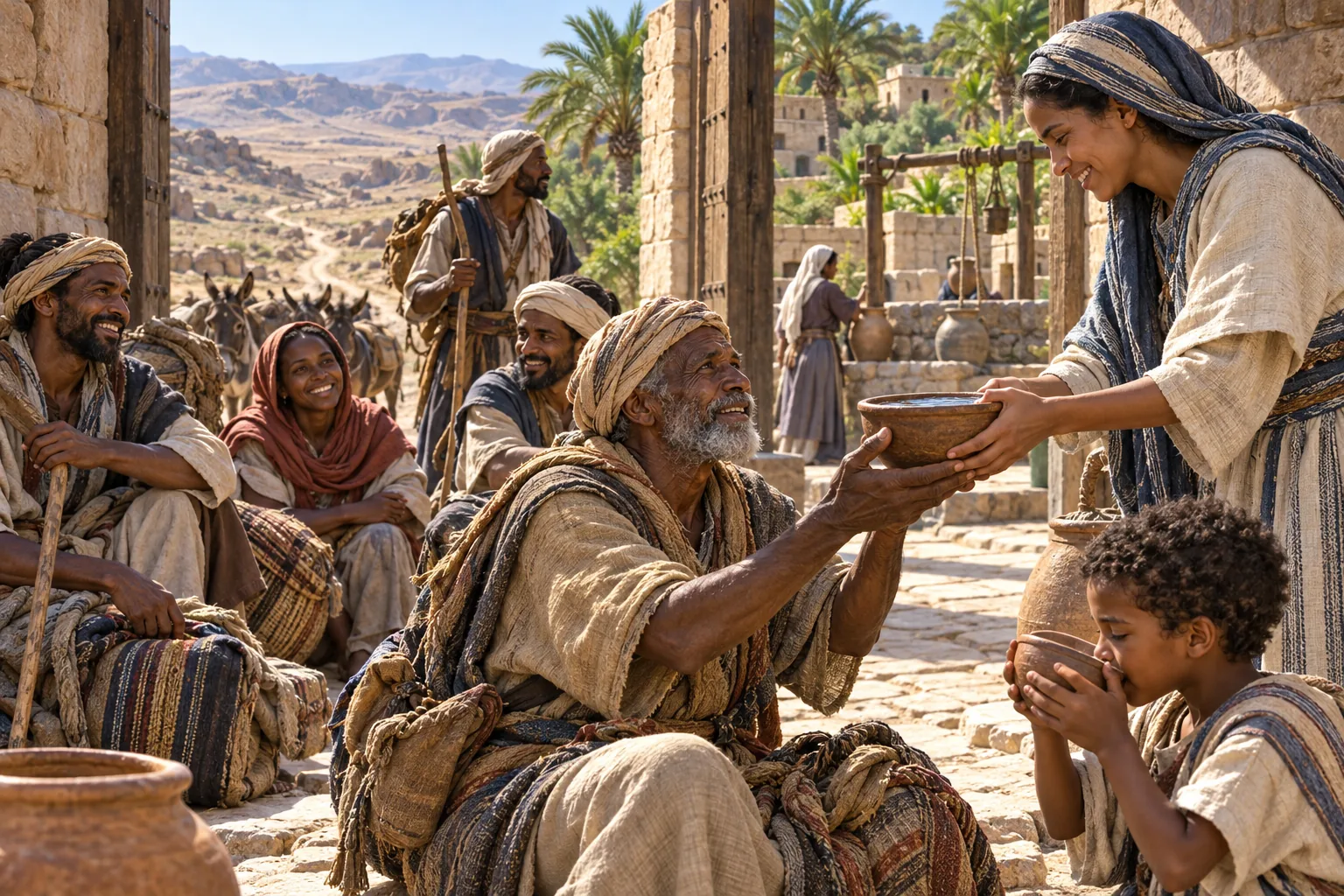
When the redeemed tell their stories, what hope can those in distress find?
01
Overview
Four journeys through danger, one enduring mercy, and the wisdom to recognize God's faithful love
Key text — Psalm 107:1–2, 43 (study rendering): Give thanks to the LORD, for he is good; his steadfast love endures forever. Let those whom the LORD has redeemed say so. Whoever is wise should pay attention to these things and consider the LORD's acts of steadfast love.
A traveler loses the road and cannot find a town. Someone else sits behind locked doors and feels the weight of chains. Another person is so ill that food has become unbearable. Far away, sailors watch their small vessel rise and fall beneath waves they cannot control.
The circumstances differ, but their stories turn on a repeated moment: in their distress, they cry to the LORD, and he brings them out.
Psalm 107 does not ask us to pretend that danger is small. The wilderness is deadly, the prison is dark, sickness threatens life, and the sea overwhelms human skill. Nor does it promise that every person who suffers will immediately experience the ending described in the song. It trains us to recognize the mercy of God in acts of rescue, to speak truthfully about what we have received, and to become wise enough to see more than our own present circumstances.
The first words of Book Five of the Psalms are therefore not instructions to build a reputation or secure a throne. They are an invitation: let the rescued tell their story.
02
1.0 Introduction
Psalm 106 ended Book Four with a confession of Israel's repeated failures and a prayer: “Save us, LORD our God, and gather us from among the nations” (Ps. 106:47, thematic rendering). Psalm 107 begins as though that prayer has received an answer. The LORD has redeemed people from the adversary's power and gathered them from distant lands (107:1–3). Now their first responsibility is to give thanks.
The psalm has a distinctive design:
- Verses 1–3 — The invitation to the redeemed: God's enduring love is the foundation of testimony, and the scattered are gathered. - Verses 4–9 — Travelers without a home: The hungry and thirsty find a straight path to a settled city. - Verses 10–16 — Prisoners in darkness: Those held in misery cry out, and God breaks their bonds. - Verses 17–22 — People near death: The suffering call for help; God sends his word, heals, and draws them back from destruction. - Verses 23–32 — Sailors in the storm: The mighty sea humbles human skill until God brings the travelers to their desired haven. - Verses 33–42 — The reversal of fortunes: God turns fruitful places barren and wastelands fruitful, humbles rulers, and raises the needy. - Verse 43 — The wisdom invitation: Readers must discern what these stories reveal about the LORD's steadfast love.
The four central portraits are linked by a refrain in verses 6, 13, 19, and 28: the distressed cry to the LORD and receive deliverance. A second refrain follows in verses 8, 15, 21, and 31: they are summoned to thank the LORD for his steadfast love and wonders for humankind. The repetition is not filler. It invites readers to recognize a pattern amid different kinds of suffering.
Central message: The LORD's steadfast love does not vanish when his people lose their way, their liberty, their health, or their security. God acts within history to restore life, and wisdom responds by remembering his goodness, giving public thanks, and practicing hope and justice.
03
2.0 Historical and Literary Context
Psalm 107 opens Book Five of the Psalter (Pss. 107–150). The break between Books Four and Five is marked by the doxology of Psalm 106:48, yet the literary connection is unusually strong. Psalm 106 asks to be gathered; Psalm 107 addresses those gathered. Psalm 106 confesses that the people brought trouble on themselves and nevertheless experienced divine compassion; Psalm 107 retells a range of human predicaments to celebrate the LORD who rescues.
Derek Kidner sees Psalm 107 as a song of divine rescue, its four scenes capable of evoking both real human emergencies and the experience of Israel's return from exile. He notes that Psalms 105–107 can be understood as a broad sequence: God's faithfulness, Israel's failures, and God's restoration (Kidner 2008, 417–21). John Goldingay, though cautious about treating the Psalter's book divisions as the controlling key to interpretation, stresses the explicit verbal answer to Psalm 106's prayer and describes Psalm 107 as a call for restored people to testify (Goldingay 2008, “Psalm 107: Yhwh Has Indeed Restored Israel”).
The mention of people gathered from east and west, from north and from the sea (v. 3, close study rendering) evokes the dispersal and return of Israelites, especially against the background of the Babylonian exile and the promises of Isaiah 40–55 (Isa. 35:10; 43:5–7; 49:12; 62:12). A number of English Bibles render the fourth direction as south, yielding the familiar four points of the compass. The Masoretic wording, however, reads “sea”; its geographical significance is debated. We can affirm the picture of gathering from widely separated places without pretending that every directional detail is settled.
Neither a named author nor a precise composition date appears in the Hebrew text. The psalm may reflect a community celebrating actual returns and new beginnings while recognizing that restoration remained incomplete. Goldingay connects its language especially with promises made in Isaiah and fulfilled, at least in part, after exile. However, the four scenes are also recognizable outside Israel's national history: people everywhere can become displaced, imprisoned, seriously ill, or endangered at sea. Their ability to convey both historical memory and widely shared experience is part of the poem's power.
Literarily, the psalm is both testimony and instruction. Much of the poem speaks about people in the third person, not “I cried out and God saved me.” The storyteller urges others to acknowledge publicly what the LORD has done. By ending with a call to wisdom (v. 43), it asks worshipers to examine the relationship between suffering, mercy, the abuse of power, and restoration.
Importantly, the four scenes do not operate as exact copies of one another. The first and fourth do not explicitly say that the sufferers caused their own trouble; the second and third describe defiance or folly. We must not combine these different causes into the claim that all suffering is punishment for personal sin. The biblical wisdom tradition—including Job and John 9:1–3—rejects that simplistic conclusion.
04
3.0 Walking Through the Text
3.1 Psalm 107:1–3 — Let the redeemed speak
The poem opens with a confession heard repeatedly in Israel's worship: the LORD is good, and his steadfast love endures forever (compare Pss. 106:1; 118:1; 136:1). The Hebrew word ḥesed refers to committed, reliable kindness, often within covenant relationship. The worshipers begin not with a dramatic human achievement but with a declaration about God's character.
Then comes an imperative: let the redeemed of the LORD say so. The verb related to redemption (gāʾal) recalls the action of a family redeemer who intervenes on behalf of a vulnerable relative (Lev. 25:25, 47–49). Applied to the LORD, it expresses his personal commitment to rescue those who belong to him. Redemption in this setting has historical substance: people are delivered from the power of an enemy and gathered from distant places.
The passage is not an order for every worshiper to produce a spectacular conversion story. Some testimonies involve deliverance from particular dangers. Others involve God's sustaining presence while distress continues. The invitation is to tell the truth about mercy rather than compete for the most dramatic account.
It is also a communal invitation. The scattered are gathered, not simply rescued into isolated private lives. Redemption creates the possibility of renewed belonging, shared memory, worship, and responsibility for others (Isa. 43:5–7; Eph. 2:11–22).
3.2 Psalm 107:4–9 — Travelers searching for a city
The first group wanders through wilderness wastelands, unable to find a city in which to dwell. Hungry, thirsty, and exhausted, they have reached the limits of their strength. Their problem is not merely a shortage of directions. They lack reliable food, water, shelter, and community.
Then comes the refrain for the first time: they cry out to the LORD in their trouble; he delivers them from their distress (v. 6, study rendering). God guides them by a straight road toward a settled city. The place of arrival matters. He does not merely offer enough water for one more day and then abandon them in the desert. The poem imagines a real home and a future where lives can be rebuilt (vv. 7, 9).
Goldingay notes important connections with Isaiah's promises of a road through wilderness and provision for returning exiles (Isa. 40:3; 43:19; 49:10–11). Kidner highlights the movement from being lost and deprived to enjoying the security of a place to live (Kidner 2008, 418–19).
Verse 8 responds with the first thanksgiving refrain: let them thank the LORD for his steadfast love and wonderful deeds for humankind. The language is deliberately broader than Israel alone. The God who has rescued a particular people is worthy of recognition by human beings everywhere.
The theological center is not a secret method for avoiding every uncertainty. It is the confession that God can guide the disoriented and provide for those who lack the necessities of life. This calls believers to practical hospitality toward people uprooted by war, poverty, disaster, or displacement. Prayer for guidance becomes more credible when we also help others find food, safety, and belonging.
3.3 Psalm 107:10–16 — Prisoners in darkness and iron
The scene changes from open wilderness to confinement. These people sit in darkness and the shadow of death, imprisoned in affliction and iron. Their hardship involves more than emotional gloom. The reference to iron evokes the reality of chains and coercive labor.
Unlike the first scene, this one explicitly identifies wrongdoing: they rebelled against God's words and despised the counsel of the Most High (v. 11). The poem interprets their confinement in relation to defiance. In its exilic horizon, national disobedience and the catastrophe of captivity are linked (compare Isa. 42:22–25). That does not make Psalm 107 a justification for every human prison system or for assuming that every incarcerated person deserves the treatment received. Biblical justice commands fair judgment and condemns oppression (Isa. 1:17; 58:6).
Once again the people cry to the LORD. Once again he brings deliverance: he leads them out of darkness and breaks their chains (vv. 13–14). The imagery culminates in shattered bronze doors and broken iron bars (v. 16), language echoing Isaiah 45:2 and the promised liberation of captives. The power that held them appears formidable, but it is not stronger than their Redeemer.
The repetition offers something deeper than reassurance: those who have acted foolishly are not beyond mercy. Repentance and grace remain possible. Yet this should never be used to tell imprisoned or exploited people simply to wait passively. Deliverance has an ethical shape in the Bible: truth, due process, human dignity, and the ending of unjust bonds.
The second refrain (v. 15) turns freedom into testimony. Freedom is a gift to be celebrated—and a responsibility not to make new captives of others.
3.4 Psalm 107:17–22 — The suffering near the gates of death
A third scene takes us to the sickbed. The people are described as fools, afflicted because of their rebellious ways, so unwell that they recoil from food and approach the gates of death. Here foolishness is moral and practical refusal to heed wisdom, not low intelligence or the inability to understand a medical diagnosis (Prov. 1:7, 22–32).
The psalm does describe suffering related to wrongdoing in this particular scene. That must be stated honestly. But it does not establish a universal rule that illness results from sin. In John 9:1–3, Jesus rejects the disciples' attempt to trace a man's blindness to a specific person's sin. Job likewise exposes the cruelty of assuming that suffering proves hidden guilt. Sickness has many causes, and people require care, not suspicion.
At the threshold of death, the people cry out. God sends his word and heals them, rescuing them from destruction (vv. 19–20). This does not require us to imagine that the psalmist is prescribing one medical technique. It is a confession that divine speech is effective and life-giving (compare Isa. 55:10–11). God can act beyond what sufferers are able to arrange for themselves.
For Christian readers, the New Testament's healing narratives are a rich canonical connection, but healing accounts must not be turned into guarantees that every faithful patient will recover immediately. Responsible pastoral care welcomes prayer and medical treatment, offers companionship, and refuses to shame those whose healing has not come.
The third thanksgiving refrain is expanded: the rescued are to offer sacrifices of thanksgiving and tell of God's works with songs of joy (vv. 21–22; Lev. 7:11–15). Gratitude is spoken, enacted, and shared. The worshiper does not merely feel relieved. The community hears what has happened and learns to hope.
3.5 Psalm 107:23–32 — Sailors when their skill is exhausted
The fourth portrait carries us onto the sea. People travel in ships, conducting work on great waters. They have experience and practical knowledge; their livelihood depends on the sea. But suddenly a storm rises, waves lift their boat toward the sky and plunge it toward the depths, and they stagger like drunk people (vv. 23–27).
One line is especially revealing: all their skill or wisdom comes to nothing (v. 27, interpretive rendering). The psalm does not mock skill; sailing requires it. Rather, it recognizes that human expertise remains finite in a world larger than our capacity to manage. Kidner aptly stresses the inability of even capable sailors to master forces of that magnitude (Kidner 2008, 420).
Goldingay offers a useful caution. Although God is sovereign over creation, the text should not be read as if the LORD deliberately launches every storm as a targeted punishment for the people aboard. Powerful natural events belong to the world God sustains; the sailors here are not accused of personal sin. Their danger reveals vulnerability, not necessarily guilt (Goldingay 2008, Psalm 107:23–32).
They cry out, and the LORD stills the tempest until the waves are quiet. He then brings them to their desired haven (vv. 28–30). The psalm joins rescue from immediate danger to safe arrival. Once again, God does not merely remove a threat; he provides a place in which life can continue.
Here the thanksgiving refrain returns for the fourth time (v. 31), now with a call to exalt the LORD in the congregation and praise him among the elders (v. 32). The people whose lives have been preserved have something worth telling publicly.
Christian readers naturally hear this scene alongside Jesus stilling the storm (Mark 4:35–41; Luke 8:22–25). The Gospel stories portray Jesus' authority over threatening waters and awaken the question of his identity. This is a theological connection in the Bible's larger narrative, not proof that Psalm 107 was originally written as an explicit prediction of a particular Galilean crossing.
3.6 Psalm 107:33–38 — The desert and the garden exchange places
The poem now leaves its carefully repeated sequence. There is no fifth group beginning with a cry for rescue. Instead, we hear a meditation on dramatic reversals in the conditions that sustain communities.
The LORD can turn rivers into desert and springs into dry ground. Fruitful land can become a salt waste because of the wickedness of its inhabitants (vv. 33–34). Conversely, he can turn wilderness into pools and dry ground into springs (v. 35). Hungry people settle, build a city, sow fields, plant vineyards, and enjoy the harvest (vv. 36–38).
These images resonate with covenant warnings and prophetic promises (Deut. 28; Isa. 35:6–7; 41:18–20; 65:21–23). They link the well-being of land and people, moral responsibility, and divine restoration. Yet they are poetry and theological testimony, not a method for determining why every drought, crop failure, or flood occurs. Environmental harm can result from human wrongdoing, but not every disaster proves divine punishment against the affected community.
Notice that God provides water and a place to settle, while the people build, sow, and plant. Divine provision does not cancel human labor. The picture invites thanksgiving for rainfall and harvest alongside wise stewardship, fair access to resources, and efforts to prevent preventable suffering.
3.7 Psalm 107:39–42 — Rulers humbled, the needy raised
Prosperity is not the poem's final word. People may decrease and be brought low through oppression, trouble, and sorrow (v. 39). The next verse speaks of contempt poured on princes, who wander without a path. The LORD then raises the needy from affliction and makes their families flourish like flocks (vv. 40–41).
These reversals recall Hannah's song (1 Sam. 2:1–10), Mary's Magnificat (Luke 1:46–55), and Job's reflections on the humiliation of rulers (Job 12:21–24). Goldingay argues that the princes may include a community's own leaders rather than only foreign oppressors. When leaders profit from wrongdoing, the humiliation of their power belongs to the psalm's vision of justice (Goldingay 2008, Psalm 107:39–41).
The upright see these changes and rejoice; wickedness falls silent (v. 42). This is not permission to mock the suffering of every unsuccessful public figure or to declare that every person who prospers has God's approval. The central issue is whether power is exercised responsibly and whether those whose voices are ignored receive justice.
God's restoration does not merely replace poor circumstances with wealth. It challenges the moral arrangements that allow the powerful to flourish by exploiting the vulnerable.
3.8 Psalm 107:43 — Wisdom is learning how to remember
The last verse changes the audience again: Whoever is wise should give attention to these things and consider the LORD's steadfast love (study rendering). This is not a casual closing line. The word wise moves the poem toward biblical wisdom, which asks how people interpret experiences and order their lives (Prov. 1:7; Hos. 14:9).
A careless reader can seize on a single episode and make it a universal formula: “If you are sick, you sinned,” or “If you pray, danger always ends immediately.” The wise reader instead sees the variety of circumstances and the constancy of God's character. Some suffer because of wrongdoing; others face dangers beyond their control. Some experience rescue; other biblical texts give voice to people still waiting (Pss. 44; 88; 102). Faithful discernment has room for all of them.
The Hebrew closes not with a command to solve every mystery, but with a summons to consider God's acts of steadfast love. Wisdom remembers honestly, tells stories responsibly, makes room for lament, and refuses to let present suffering become the final definition of God.
05
4.0 Theological Reflection
4.1 One refrain can hold very different human stories
The repeated cry, rescue, and thanksgiving tie together experiences that have different causes. The wanderers are lost. The prisoners have defied God's counsel. The sick are described as suffering from folly. The sailors encounter a storm without being charged with moral failure. The psalm thus gives a vocabulary for prayer without making blame the prerequisite for compassion.
Christian pastoral care should learn from this restraint. Ask what a person needs; do not begin by inventing a hidden sin. Where someone has genuinely caused harm, truth and repentance matter. Where suffering is unrelated to the person's fault, protection and accompaniment matter. In both settings, the LORD hears the distressed.
4.2 Rescue aims at restored life, not merely the end of pain
In each portrait, the conclusion is more than momentary survival. Travelers reach a settled city. Prisoners gain freedom. The sick are brought away from death. Sailors arrive at harbor. Divine deliverance opens a path toward community, dignity, responsibility, and the possibility of fruitful life.
The church should therefore resist defining ministry solely by emergency relief, important though relief is. Helping people find safe homes, sustainable livelihoods, fair institutions, and supportive relationships also belongs to the human horizon of the psalm. God gives a road; people must still walk, build, and care for one another.
4.3 Thanksgiving is public truth-telling
The rescued are repeatedly told to thank the LORD for his steadfast love and wonderful deeds for humanity. Public testimony is neither self-promotion nor denial of unfinished pain. Its purpose is to help others see a pattern of mercy and become more capable of trust.
A truthful witness says what happened without exaggeration, including what remains unresolved. The community should honor quiet accounts of endurance as well as extraordinary stories of escape. Thanksgiving becomes a service to future generations when it is honest.
4.4 God's sovereignty should not become fatalism
The psalm describes the LORD acting within natural and social history, bringing reversals that overwhelm human certainty. Yet the rescued cry out, travelers follow the road, settlers plant fields, and congregations speak. God is active, and human action matters.
It is therefore mistaken to use this psalm to discourage medical care, disaster preparedness, safe navigation, legal protection, or relief for displaced people. Faith in divine providence invites wise action rather than replacing it (Prov. 22:3; Jas. 2:14–17).
4.5 The LORD's love challenges oppressive leadership
Verses 39–42 insist that God's concern for the needy cannot be separated from his evaluation of power. Worship that thanks God for deliverance while tolerating exploitation contradicts the song's concluding vision. Communities should examine how leaders handle money, resolve complaints, treat workers, and protect people who lack influence.
The needy being lifted up is good news, not a threat to social order that must be suppressed. The psalm invites those with authority to recognize that power is entrusted for service, not for private advantage (Ps. 72:1–4; Mark 10:42–45).
4.6 Restored people still need wisdom
The poem is not finished when the rescue stories are complete. The final verse asks readers to reflect. Gratitude alone can fade; wisdom sustains memory and shapes future conduct. A person can survive one crisis and still exploit others afterward. A community can celebrate return from exile yet remain vulnerable to injustice.
This is why the psalm ends not with triumphal boasting but with a summons to pay attention. God's acts call for learning, humility, covenant faithfulness, and ongoing justice.
06
5.0 Canonical and Christological Horizon
The biblical storyline behind Psalm 107 reaches back to the exodus: God heard the cries of his enslaved people, brought them out, guided them through wilderness, and formed them into a community (Exod. 2:23–25; 14–16; Deut. 8:2–10). Later prophetic writings used the language of a new exodus to promise restoration after Babylonian exile. Isaiah speaks of a path through desert places, the return of redeemed people, release of prisoners, and renewed land (Isa. 35:1–10; 40:3–5; 42:6–7; 43:16–21; 49:8–12).
Psalm 107 stands within that hope. It does not deny the historic suffering of exile; it declares that God has already acted in ways that deserve testimony, even while restoration remains incomplete. Goldingay sees the psalm as insisting that partial fulfillments of God's promises must not be dismissed as though they were nothing (Goldingay 2008, “Theological Implications”).
In the New Testament, Christians discern related themes in Jesus, Israel's Messiah. Jesus speaks of providing life-giving bread and water (John 4:13–14; 6:35), proclaims release and good news for those oppressed (Luke 4:16–21), heals the sick without turning every illness into an accusation (John 9:1–3), and calms dangerous waters (Mark 4:35–41). He also welcomes the excluded into a renewed community.
These parallels make Psalm 107 fruitful for Christian reading. Yet they should not erase its first horizon: the LORD's restorative work in the story of Israel and in the crises of real communities. The psalm is not an ancient catalogue explicitly predicting four separate episodes of Jesus' ministry. Rather, Christians recognize in Jesus the character and saving purposes of Israel's God made visible in a decisive way.
The cross and resurrection broaden the theme of deliverance beyond temporary escape from danger. Christian hope names sin and death as enemies God acts to defeat (1 Cor. 15:20–28, 54–57). Resurrection promises more than a return to a familiar routine; it promises the renewal of embodied life. That future is pictured in Revelation 21–22 as a dwelling place of God with humanity, with healing, life-giving water, and the end of death. The safe city, broken chains, healing word, and desired harbor of Psalm 107 can therefore be heard as signposts, not exhaustive descriptions, of the world God intends to restore.
This future hope does not excuse indifference now. Those who have been welcomed by grace should practice hospitality. Those forgiven should reject the bondage of exploitation. Those who pray for healing should care for the sick. Those who have reached safety should not close the harbor to people still at sea.
07
6.0 Life Application
- Listen for the four cries around you. Who is disoriented or displaced, confined or oppressed, ill or exhausted, or overwhelmed by danger? Meet the person before assuming you know the cause. Help connect them with real sources of safety, food, care, and support.
- Give testimony without exaggeration. Share a concrete example of God's mercy, stating honestly what happened and what remains difficult. Avoid claiming divine promises that make others feel condemned when their circumstances are different.
- Join prayer to practical action. Pray for a sick person and support access to appropriate medical treatment. Pray for a prisoner and advocate for humane treatment and fair process. Pray for displaced families and assist with safe housing and belonging.
- Recognize the limits of expertise without rejecting expertise. Prepare responsibly for journeys, storms, disease, and financial hardship. The sailors' experience teaches humility, not carelessness.
- Make room for the gathered. Ask whether your congregation provides welcome to migrants, newcomers, former prisoners, the bereaved, and people trying to rebuild their lives. Rescue should lead toward a community, not merely an isolated survival story.
- Examine power from the perspective of the needy. Review whether institutional decisions protect the vulnerable, whether finances are accountable, and whether people can report misconduct safely. The God praised in Psalm 107 raises the needy and brings arrogant rulers low.
- Practice wise remembrance. Keep a record of answered prayers and sustaining mercies. Also remember unresolved grief. Read both kinds of story together, asking what they teach about God's faithfulness and your responsibility to others.
08
7.0 Reflection Questions
- How does the movement from Psalm 106:47 to Psalm 107:1–3 deepen the significance of the call, “Let the redeemed of the LORD say so”?
- Which details show that the four portraits of distress are not all explanations of the same kind of suffering?
- What is added to the meaning of salvation when the wanderers arrive in a city and the sailors reach a harbor?
- How can congregations tell stories of healing and deliverance while caring sensitively for those who have not experienced the same outcome?
- What do verses 33–42 teach about the relationship between God's provision, human responsibility, and justice for the needy?
- Where do the Gospels echo Psalm 107's language or imagery, and how can these connections be made without ignoring the psalm's original setting?
- Why does the poem end by asking for wisdom rather than ending after the fourth thanksgiving refrain?
09
8.0 Response Prayer
LORD our Redeemer, we thank you because you are good, and your steadfast love endures forever.
You see the traveler who cannot find a home, the prisoner who has lost hope, the sufferer too weak to eat, and those caught in waves beyond their strength. You also see those whose pain we have overlooked.
Teach us to cry out honestly when we are afraid. Keep us from pretending that every trouble is deserved, and keep us from refusing to confess the harm we truly have caused. Where people are lost, open paths toward safety. Where they are bound unjustly, strengthen those who work for their freedom. Where bodies and hearts are wounded, grant care, endurance, and healing according to your mercy.
When we are rescued, teach us to give thanks without boasting. When we are still waiting, help us trust without pretending that all is well. Make our churches welcoming places for the displaced, responsible places of leadership, and compassionate places for those who are sick or struggling.
Through Jesus Christ, our risen Lord, let our hope reach beyond the next crisis toward the healing of your world. Give us wisdom to recognize your faithful love and courage to reflect it in our actions.
Amen.
10
9.0 Window into What Comes Next
Psalm 107 begins Book Five with an invitation to those redeemed and gathered to testify. It turns four stories of danger into a common confession: the LORD's steadfast love is worthy of public thanksgiving. Then it widens the horizon, showing how God transforms barren places, opposes oppressive power, and asks his people to become wise observers of his deeds.
Psalm 108 takes up material from two earlier Davidic psalms, Psalms 57 and 60. Its opening sings with a heart made ready to praise; its later verses claim God's promises in the face of national challenge. The movement is meaningful: from remembering rescues already experienced in Psalm 107 to seeking courage to act on God's promises when the next challenge lies ahead in Psalm 108.
The redeemed do not merely look backward. Their memory of mercy becomes a source of faithful action in the future.
11
10.0 Bibliography
- Scripture: Psalm 107; Psalms 23; 44; 57; 60; 72; 88; 102; 105–108; 118; 136; Genesis 21:14–19; Exodus 2:23–25; 14–16; Leviticus 7:11–15; 25:25, 47–49; Deuteronomy 8:2–10; 28; 1 Samuel 2:1–10; Job 12:21–24; Proverbs 1:7, 22–32; 22:3; Isaiah 1:17; 35:1–10; 40:3–5; 42:6–7; 43:5–7, 16–21; 45:2; 49:8–12; 55:10–11; 58:6; 62:12; 65:21–23; Hosea 14:9; Mark 4:35–41; 10:42–45; Luke 1:46–55; 4:16–21; John 4:13–14; 6:35; 9:1–3; 1 Corinthians 15:20–28, 54–57; Ephesians 2:11–22; James 2:14–17; Revelation 21–22. The key text is an original study rendering, not a verbatim quotation from a named contemporary Bible translation.
- BibleProject. n.d. The Book of Psalms: Study Notes. Project resource on the Psalter's five-book design, the exile-to-restoration movement, and Book Five.
- Goldingay, John. 2008. Psalms, Volume 3: Psalms 90–150. Baker Commentary on the Old Testament Wisdom and Psalms. Grand Rapids, MI: Baker Academic. Commentary on Psalm 107, “Yhwh Has Indeed Restored Israel.”
- Kidner, Derek. 2008. Psalms 73–150. Kidner Classic Commentaries. Downers Grove, IL: InterVarsity Press. Originally published 1975; digitally reissued 2014. Commentary on Psalm 107, “God to the rescue,” pp. 417–21.

Be the first to leave a comment.