

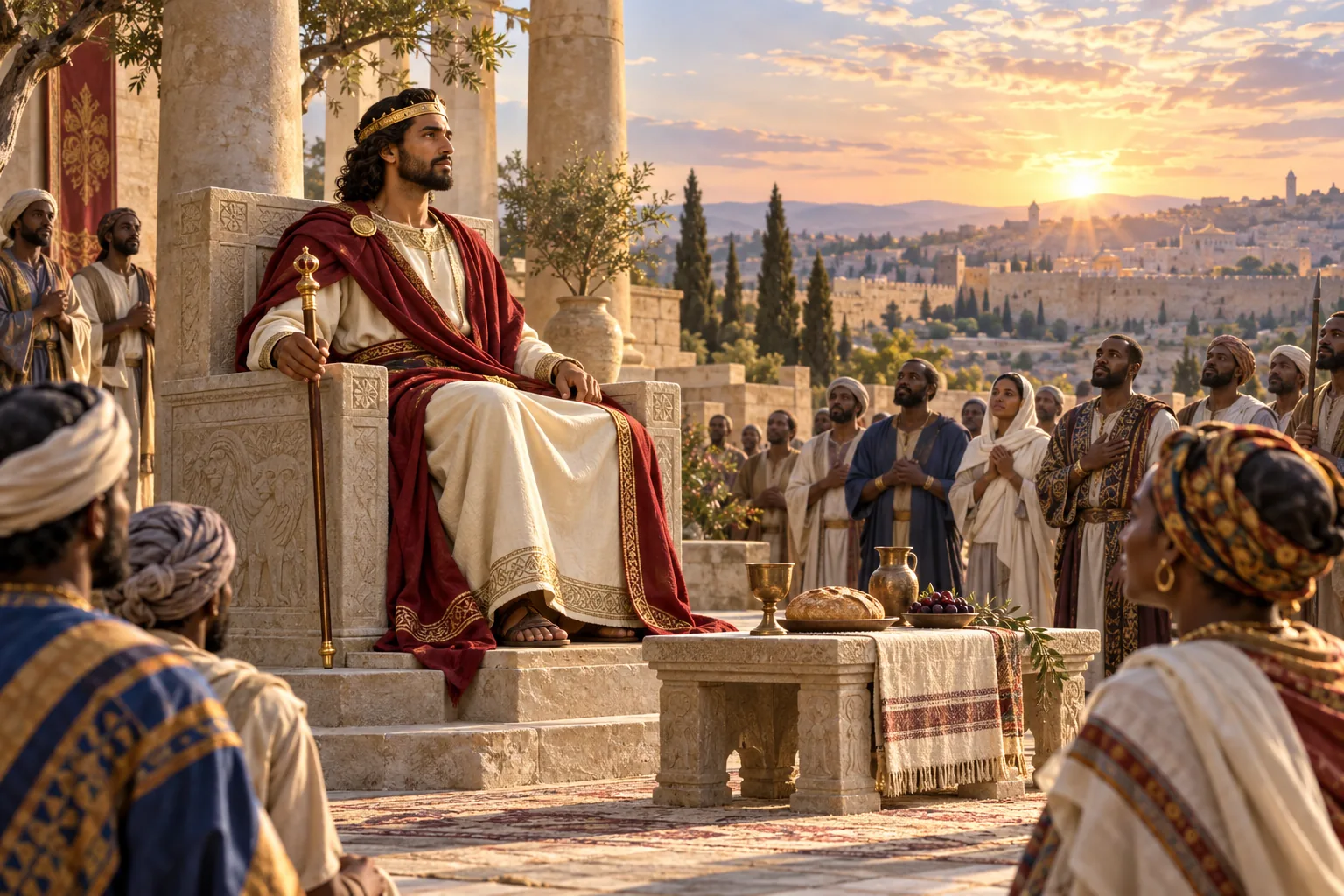
How does a king who is also a priest reshape our hope for authority and justice?
01
Overview
Royal authority, a priesthood beyond inheritance, and the hope of a kingdom that sets the world right
Key text — Psalm 110:1, 4 (study rendering): The LORD declares to my lord: “Sit at my right hand until I place your enemies beneath your feet.” The LORD has sworn and will not withdraw his word: “You are a priest forever, in the manner of Melchizedek.”
Imagine hearing a promise so large that no existing throne could contain it. A king is told to sit in the place of divine favor until his enemies are subdued. The same king is then addressed as a priest—although he does not belong to the ordinary hereditary priesthood of Israel. What kind of ruler is this? Why do political authority and priestly mediation appear in the same seven-verse poem? And why does the New Testament return to these lines when explaining who Jesus is?
Psalm 110 is brief, mysterious, and demanding. It has nourished Jewish discussions of royal hope and profoundly shaped Christian language about Jesus' exaltation and intercession. Yet its final images are also violent. A responsible reading must listen to the poem as ancient Israelite royal poetry before exploring the larger biblical hope Christians find fulfilled in Christ.
The central question is not simply, Who has power? It is, Whose authority does that power serve, and how can God's people trust his promise when the world has not yet been put right?
02
1.0 Introduction
Psalm 109 ended with the assurance that the LORD stands at the right hand of the needy to save the accused from condemnation (Ps. 109:31). Psalm 110 opens with a related but transformed image: someone called “my lord” is invited to sit at the LORD's right hand. In the first scene God vindicates a suffering person; in the second God publicly authorizes a king. Read together, they pose a question about the kind of authority God approves.
Psalm 110 belongs to Book Five of the Psalter (Pss. 107–150). In its received Hebrew form, the heading links it to David. It is a royal psalm containing two unusually solemn divine declarations:
- Verses 1–3 — The royal oracle: The LORD grants the king a position of honor, commissions rule from Zion, and promises the support of his people. - Verse 4 — The priestly oath: God establishes a priestly identity associated with Melchizedek, the priest-king of Salem in Genesis 14. - Verses 5–7 — The scene of judgment and victory: The poem returns to the severe imagery of kings, nations, and a ruler whose head is lifted after conflict.
The poem's confidence is striking, but it is not easy. Verse 3 contains some of the most disputed Hebrew wording in the Psalter. Verse 5 changes the expression for “Lord,” and interpreters discuss whose right hand and whose action the lines describe. Verse 7 ends abruptly with an image of drinking from a stream. These uncertainties call for careful attention rather than artificial certainty.
Central message: The LORD, not human ambition, is the source of legitimate royal authority. The promised king is also connected with priestly service, placing rulership within God's purposes for his people. Christians read this royal pattern in light of Jesus' resurrection, exaltation, and continuing intercession, while allowing the ancient psalm's historical claims and difficult imagery to be heard on their own terms.
03
2.0 Historical and Literary Context
The heading is traditionally translated “A Psalm of David.” The Hebrew expression leDavid can mark association with David and has often been understood as indicating authorship. The psalm does not name a specific event in David's life, however, and its speaker is not explicitly identified. It begins with someone reporting the LORD's words to a person respectfully called “my lord.” Goldingay suggests the reporting speaker could be a royal or temple representative, and he treats “my lord” in its original setting as the king receiving the oracle. Kidner takes the Davidic heading and Jesus' use of the psalm as substantial reasons to understand the words prophetically in reference to the Messiah (Goldingay 2008, Psalm 110, “Interpretation”; Kidner 2014, 426–31).
Scholars have proposed royal enthronement, worship connected with warfare, and various periods of Israel's and Judah's history. None of these settings can be established with certainty from the poem. Its royal language fits a world in which a king rules under the LORD and looks to divine support. Its priestly declaration is more unusual. Genesis 14:18–20 introduces Melchizedek, king of Salem and priest of God Most High, who blesses Abram. Psalm 110 invokes that earlier combination of offices without giving a biography of Melchizedek or explaining exactly how later royal and priestly functions operated in practice.
Within Israel's ordinary institutions, priestly service was closely associated with Aaron's descendants (Exod. 28; Num. 18). Kings could lead worship, pray, and bless the people, but they were not normally members of that hereditary priesthood. Psalm 110 therefore asks us to imagine a royal vocation with priestly significance. We should not use the verse to pretend that all ancient Israelite kings routinely performed the duties of an Aaronic priest. The unusual promise is part of what makes this psalm memorable.
Its placement is equally important. Psalm 89 raised devastating questions about the Davidic covenant after the downfall of the monarchy. Psalms 90–106 turned attention to the LORD himself as the enduring King. Book Five renews hope for a ruler through whom God's purposes will be fulfilled. Psalm 110 echoes Psalm 2 in presenting the LORD's support of a royal figure, and its mention of a priest-king adds a feature Psalm 2 does not develop. BibleProject's study notes read the five-book Psalter as a movement through royal promise, exile, renewed trust in the LORD, and messianic expectation. That is a useful canonical frame, though it does not identify a precise historical occasion for Psalm 110 (The Book of Psalms: Study Notes, sections on Books Four and Five).
One final historical caution is essential. Psalm 110 uses the language of ancient royal warfare. Its enemies, staffs, conquered kings, and battlefield are not metaphors that can be transferred directly into instructions for the church to seize political power or destroy opponents. We need to understand the poem's world before asking how its truth speaks to ours.
04
3.0 Walking Through the Text
3.1 Psalm 110:1 — “The LORD said to my lord”
The opening begins with an authoritative utterance: the LORD speaks. The Hebrew word often translated “oracle” (neʾum) is especially familiar from prophetic declarations. The one reporting it distinguishes the divine name, YHWH, from the person addressed as “my lord” (ʾadoni), a customary respectful designation for a human superior. That distinction matters in the psalm's original royal setting. The words do not simply name two identical figures; they depict God addressing and authorizing a king.
The command to sit at God's right hand conveys honor, closeness, and delegated authority. The right hand was a place of particular distinction (compare 1 Kgs. 2:19). The text need not require the Israelite king literally to sit on a second chair in heaven or inside the temple. As Goldingay argues, a poetic royal oracle can use the language of position to express the reality of divine authorization without prescribing its physical architecture.
God will make the king's enemies a footstool for his feet. In an ancient royal setting, the image signifies decisive defeat and subjection. It is not a polite image, and we should not soften it so thoroughly that we miss what the poet says: the king's authority is established amid real opposition. But notice the subject of the promise. The LORD is the one who brings the royal commission to its appointed outcome. The king does not make himself sovereign by sheer self-assertion.
Read alongside Psalm 109:31, the contrast is illuminating. The God who stands by the powerless also places limits upon those who use power. Both poems resist the claim that human authority is ultimate.
3.2 Psalm 110:2 — The scepter from Zion
The LORD sends forth a mighty scepter or staff from Zion. A scepter represents royal authority (Gen. 49:10; Ps. 2:9), and Zion identifies the place connected with the LORD's covenant presence and royal rule. The king is told to rule in the midst of enemies. This is not the image of a conflict-free kingdom that has already won universal acceptance.
In the Hebrew, the verb translated “rule” can express exercising authority over resistance rather than simply administering an established peaceful realm. The psalm holds together divine authorization and active royal responsibility. God grants authority; the king is not excused from acting.
Yet the same royal staff that symbolizes kingship must be read within the rest of Scripture's moral vision. Psalm 72 portrays the ideal ruler defending the poor and delivering the oppressed. Isaiah 11 connects the promised ruler to righteousness and judgment for the vulnerable. Psalm 110's power cannot legitimately become a blank cheque for contempt, corruption, or personal domination.
3.3 Psalm 110:3 — Willing people and the mystery of morning dew
Verse 3 presents perhaps the greatest translation difficulty. A common interpretation of the Hebrew text is that the king's people volunteer freely on the day of his power, arrayed in holy splendor, with youthful vitality pictured as dew born with the dawn. Goldingay compares the voluntary participation with Deborah's song, in which people willingly offer themselves for battle (Judg. 5:2). Kidner likewise emphasizes the picture of a willing host gathered around its leader.
But several elements remain disputed: whether the opening describes the king's volunteers or his noble status; whether the setting is “holy splendor” or “holy mountains”; and whether the references to the womb of dawn and the dew of youth describe the king, his warriors, or royal birth. The ancient Greek translation reads portions differently, and some later Christian traditions have heard here language of divine begetting. No single neat translation resolves every textual question.
What can be said with some confidence is that the oracle evokes vigor, splendor, and the support of a people associated with the king's mission. The volunteers' willingness contrasts with the enforced submission of enemies in verses 1–2. The poem distinguishes loyal participation from opposition.
Modern discipleship should not reproduce an ancient battle muster as a recruitment plan for religious violence. A meaningful canonical connection is the call for willing devotion: followers of Jesus offer their lives to God in service and love, not as an army authorized to harm neighbors (Rom. 12:1; Mark 10:42–45).
3.4 Psalm 110:4 — An oath that joins king and priest
The center of the psalm changes the form of divine speech. The LORD no longer merely gives an oracle; he swears an oath and will not change his mind. The content is extraordinary: “You are a priest forever, after the manner of Melchizedek.”
Melchizedek appears briefly in Genesis 14:18–20 as both king of Salem and priest of God Most High. He blesses Abram and receives a tenth of the spoils. The text does not give his parentage or later life story. Psalm 110 takes up that rare combination of royal and priestly identities, presenting a priestly status not defined by membership in Aaron's descendants.
The Hebrew phrase often translated “according to the order of Melchizedek” can be understood as referring to his manner, pattern, or standing. It does not require us to imagine a historically documented succession of Melchizedekite priests through every generation. The psalm refers to the figure whose joining of kingship and priesthood was already part of Israel's remembered story.
The word “forever” adds solemn weight. In the ancient royal context it speaks of God's enduring commitment; it also raises the difficult question of how an everlasting royal promise relates to the collapse of historical kingdoms. Goldingay notes that the oath and Israel's later political reality cannot simply be harmonized by ignoring failure. The Christian reading of Hebrews will return to the promise and connect its permanence to the risen Christ.
There is an ethical implication here too: royal power is not separated from the worship and service of God. But that does not make a modern pastor a monarch, or grant a minister unquestionable authority. The priestly vocation is directed toward mediation, prayer, and service—not the sanctification of personal control.
3.5 Psalm 110:5 — Which Lord stands at whose right hand?
Verse 5 moves abruptly from enthronement to battle: “The Lord at your right hand” defeats kings in the day of anger. An important change in Hebrew is often obscured in translation. Verse 1 distinguishes YHWH and “my lord” (ʾadoni). Verse 5 uses Adonai, a form commonly used for the divine Lord.
For that reason, Goldingay understands verse 5 as speaking of the LORD beside the king, supporting him in battle. Kidner similarly presents the LORD and the king acting in united purpose, while allowing that the poem's perspective has shifted. Other readers take the line as referring to the enthroned king acting with God's authority. The grammar and imagery invite discussion.
This is especially resonant after Psalm 109. There the LORD stands at the right hand of the needy (109:31). Here the Lord stands beside the one commissioned to govern. The repeated image shows divine support in different circumstances, though it does not mean that every ruler or military campaign can claim God's endorsement.
The anger described here is the anger of the divine warrior in the poetry of ancient Israel. We must take its seriousness into account without granting contemporary believers the right to act as God's appointed executioners.
3.6 Psalm 110:6 — The disturbing judgment among the nations
Verse 6 speaks in graphic language of judgment among the nations, bodies in the battlefield, and rulers struck down. Some translations render the final object as “the head over a wide land” or a singular ruler; others refer to heads across the earth. The precise syntax is debated. The scene is nevertheless unmistakably one of violent victory.
Two distortions must be resisted. The first is to pretend the passage is merely a gentle allegory and that ancient Israel never expressed hope in military deliverance. It did. The second is to make its images a modern religious program for killing opponents. The psalm is not addressed to pastors, church committees, or private believers as a license to attack other communities.
In the wider biblical story, divine judgment is connected to the defeat of evil, not ethnic hatred or private revenge (Ps. 72:12–14; Isa. 11:1–9). The New Testament complicates the picture further: Jesus rejects domination as the pattern for his disciples, suffers rather than taking revenge, and calls them to love enemies (Matt. 5:43–48; Luke 22:49–51; 1 Pet. 2:21–23). Christian hope in final justice cannot be used to bypass these teachings.
The passage still presses an unsettling question: What becomes of violence, oppression, and arrogant power when God's judgment comes? A world healed from evil cannot simply declare that cruelty does not matter. Yet the forms through which God brings final justice are God's prerogative, not ours to seize.
3.7 Psalm 110:7 — Drinking from the stream and lifting the head
The poem closes with a scene that can seem surprisingly ordinary after its great divine oath: someone drinks from a stream beside the road and then raises his head. A natural reading pictures a royal warrior briefly refreshing himself during a campaign, gaining strength to continue. Kidner recalls the image of Gideon's weary but pursuing force (Judg. 8:4). The raised head signals renewed energy and victory rather than defeat or humiliation (compare Ps. 3:3; 27:6).
Goldingay considers another possibility: that the stream evokes the Gihon spring, associated with Solomon's anointing (1 Kgs. 1:38–40). He also notes the grammatical difficulty of determining whether the final subject remains the LORD portrayed as warrior or becomes the human king. This is a suggestive proposal, not an established identification.
The final verse leaves the drama in motion. The psalm ends neither with a detailed peace treaty nor with a description of the restored creation. It ends with strength for the ongoing task. The promised rule is assured by God's word, but its working out remains part of a contested history.
For readers who know the New Testament, that unfinished quality becomes significant. Jesus' exaltation is proclaimed, but the world still waits for the destruction of the last enemy, death (1 Cor. 15:20–28). Hope can be certain of God's purpose without pretending the struggle has already disappeared.
05
4.0 Theological Reflection
4.1 Authority begins with the word of God
Psalm 110 is not a song of a king congratulating himself on his ambition. Its decisive events are initiated by God: the LORD declares, sends, and swears. The ruler's calling depends on someone greater than the ruler. Political and spiritual leadership become dangerous when those who exercise them forget that they are accountable to God and neighbor.
Human beings may be entrusted with authority, but none possesses a divine blank cheque. The biblical king is meant to submit to the LORD's instruction and protect those under his care (Deut. 17:18–20; Ps. 72:1–4). A leader's character and treatment of vulnerable people matter more than impressive titles.
4.2 God's promise can precede its visible fulfillment
The promise that enemies will become a footstool is given before the poem describes final victory. Israel's history, especially the disruption of Davidic kingship, exposed the gap between promise and experience. Psalm 110 does not explain away that tension. It gives the worshiping community words of confidence while they face it.
Faith does not mean producing immediate visible results to prove God has spoken. It means holding his purposes in view while telling the truth about what remains undone. The promise should lead to humble persistence, not exaggerated claims of present power.
4.3 Royal authority and priestly service belong in conversation
The unusual priest-king image joins two kinds of responsibility: governing among people and approaching God on their behalf. Neither should be isolated from moral accountability. Political action is not beyond divine judgment; worship is not an escape from the community's real needs.
This does not authorize theocratic rule by today's churches or allow religious leaders to combine every office in their own hands. Rather, the Christian horizon points to Jesus, who exercises authority through faithful service and intercession (Heb. 7:24–27; Mark 10:45).
4.4 Judgment is serious; revenge is not our vocation
The psalm's battlefield imagery can make worshipers uncomfortable. That discomfort is useful if it prevents us from turning opponents into disposable human beings. Scripture does not regard oppression as harmless. Yet the Christian response to injury is not to claim the authority of divine judgment for ourselves (Rom. 12:17–21).
Justice may require courageous resistance, truthful testimony, lawful accountability, and protection of victims. It does not require hatred or a violent imitation of ancient royal poetry. God's promise of judgment calls us to trust his righteousness, not to bypass Jesus' commands.
4.5 The king's unfinished victory teaches patient hope
Psalm 110 speaks with confidence while leaving the story in motion. This pattern is important for Christian hope: Christ reigns, and yet Christians still encounter injustice, sickness, persecution, and death. The resurrection announces a new reality without denying the world's unfinished wounds (1 Cor. 15:20–28; Heb. 10:12–13).
Hope makes people neither passive nor triumphant. It strengthens them to serve, intercede, tell the truth, and wait for God to finish what human effort cannot complete.
06
5.0 Canonical and Christological Horizon
Psalm 110 has an unusually prominent place in the New Testament. But we understand that use more clearly when we distinguish what an ancient royal oracle communicates in its Israelite context from what the apostles announce after Jesus' death and resurrection.
First, Psalm 110 speaks to the royal hopes already established in the Psalter. Psalm 2 presents God's anointed king in conflict with the nations; Psalm 72 describes royal justice for the poor; Psalm 89 asks how the Davidic promise can survive national disaster. Psalm 110 adds the proclamation that the royal figure is honored by God and associated with priestly ministry. It speaks into hopes that no ordinary king fully satisfied.
Second, Jesus uses Psalm 110:1 to provoke a question about the Messiah's identity. In Mark 12:35–37 (compare Matt. 22:41–46; Luke 20:41–44), he asks how David can address the Messiah as “lord” if the Messiah is understood only as David's descendant. In the Gospels the question unsettles a too-small account of the coming king. Interpreters disagree on the extent to which the argument settles the psalm's original historical authorship; the importance for Christian confession is Jesus' claim that the Messiah cannot be reduced to an ordinary successor.
Third, the resurrection and exaltation give verse 1 its apostolic force. Peter cites Psalm 110:1 in Acts 2:32–36, announcing that the risen Jesus has been exalted by God. Hebrews 1:13 contrasts the enthroned Son with angels; Ephesians 1:20–23 places Christ above rival powers; and 1 Corinthians 15:20–28 draws on the enemies-under-feet motif to describe the final defeat of death. The right hand here denotes royal honor and authority; the language need not be reduced to the spatial question of where God sits.
Fourth, Hebrews 5–7 develops verse 4 at length. Jesus' priesthood is not traced through Levitical ancestry; it is associated with God's oath and the pattern of Melchizedek. Genesis 14 supplies the priest-king of Salem. Hebrews 7 uses the sparse information about Melchizedek's ancestry and death as a literary basis for comparison; it is not necessary to claim that the historical Melchizedek was secretly Jesus or biologically immortal. Hebrews' decisive point is that the risen Christ's priestly ministry endures and that he intercedes for those who approach God through him (Heb. 7:23–28). Hebrews 10:11–14 contrasts repeated priestly sacrifices with Christ's completed offering and heavenly session.
Fifth, the New Testament does not turn Psalm 110's ancient battle scenes into permission for Christian aggression. The crucified Messiah is the one whom God exalts. He teaches his followers to serve rather than dominate (Mark 10:42–45), confronts evil without becoming its mirror image (1 Pet. 2:21–23), and entrusts final judgment to God. Revelation's depictions of judgment employ apocalyptic imagery that must also be read through the Lamb who has been slain (Rev. 5:5–10; 19:11–16).
Goldingay and Kidner make different judgments about the relationship between the psalm's original meaning and its christological interpretation. Goldingay argues that it began as an oracle about an Israelite king and that the New Testament reads it anew in the light of Jesus. Kidner emphasizes that its language ultimately points to the Messiah in a way no ordinary king can exhaust. Both perspectives help readers attend to the historical poem and the Christian canonical claim, without pretending there is no interpretive debate.
07
6.0 Life Application
- Treat power as a responsibility, never as proof of your superiority. Whether you lead a home, workplace, congregation, or public institution, ask whether your authority protects people, tells the truth, and remains open to correction (Ps. 110:1–2; Deut. 17:18–20).
- Follow the King through service, not intimidation. In the light of Jesus' teaching, willing allegiance is seen in mercy, courage, integrity, and care for others—not in the coercion of religious outsiders (Mark 10:42–45).
- Let worship and public ethics speak to each other. The priest-king image reminds believers that prayer cannot be separated from justice. Bring the community's injuries, economic pressures, and needs into intercession and practical service (Isa. 1:16–17).
- Resist the temptation to call personal opponents God's enemies. Psalm 110 does not authorize using Scripture to threaten colleagues, critics, other faith communities, or political rivals. Seek fair processes, truth, and safety when wrong is done (Rom. 12:17–21).
- Remember Christ's continuing intercession. When guilt, failure, or fear overwhelms you, Christian hope rests not in a flawless spiritual résumé but in Jesus, who is described as living to intercede (Heb. 7:25).
- Read difficult verses with humility. When Hebrew, history, and theology permit more than one interpretation, be honest about what is certain and what is debated. Good biblical teaching does not need to manufacture confidence.
- Hope beyond the immediate outcome. If injustice persists, do not call the unfinished world God's final verdict. Pray, work for what is right, and remember the promise that death itself will not have the last word (1 Cor. 15:25–28).
08
7.0 Reflection Questions
- What difference does it make that Psalm 110 begins with the LORD's word rather than the king's self-promotion?
- What can the image of a ruler at God's right hand communicate without requiring a literal second throne in the sanctuary?
- Why does the psalm combine kingship with priestly identity, and why is Melchizedek an appropriate example?
- How should teachers handle the genuinely difficult Hebrew wording in verse 3 and the disputed subjects in verses 5–7?
- How does the New Testament's reading of this psalm deepen Christian understanding of Jesus' resurrection, reign, and intercession?
- What prevents the ancient imagery of crushed enemies from becoming an excuse for religious violence or political domination today?
- Where in my own life do I need to exchange the desire to control outcomes for patient trust and faithful action?
09
8.0 Response Prayer
LORD, whose word is greater than every earthly throne, teach us to recognize your authority without pretending to own it. Forgive us when ambition disguises itself as service or when we use holy language to demand unquestioned loyalty. Form in us a willingness to serve rather than dominate.
We bring you the unfinished conflicts of our world: people injured by power, communities waiting for justice, and lives wounded by fear. Keep us from hatred. Give us courage to speak truth, defend the vulnerable, and work for peace without surrendering justice.
Thank you for Jesus Christ, whom you raised and exalted, and whose intercession gives hope to those who cannot save themselves. When promises seem distant and strength runs low, sustain us to live faithfully today. Let our worship reflect your holiness, our leadership reflect your mercy, and our hope rest in the day when evil and death will finally be overcome. Amen.
10
9.0 Window into What Comes Next
Psalm 110 ends amid the dramatic language of royal victory. God's promise to the king is firm, yet the poem leaves us watching the unfolding of his rule. Psalm 111 changes the scene. Instead of announcing a royal oracle, it gathers worshipers to praise the LORD for his works, righteousness, compassion, provision, and faithful covenant. Its carefully ordered alphabetic form invites patient remembering.
The two psalms belong together. Psalm 110 points to the authority of the king whom God appoints; Psalm 111 redirects attention to the character and deeds of the God who appoints him. Rule must be judged by the LORD's righteousness. Great claims about God's kingdom should produce people who remember his works, fear him wisely, and practice faithfulness.
11
10.0 Bibliography
- Scripture: Psalm 110; Psalms 2, 3, 27, 57, 60, 72, 89, 101, 109, 111; Genesis 14:18–20; 49:10; Exodus 28; Numbers 18; Deuteronomy 17:18–20; Judges 5:2; 8:4; 1 Kings 1:38–40; 2:19; Isaiah 1:16–17; 11:1–9; Mark 10:42–45; 12:35–37; Matthew 5:43–48; 22:41–46; Luke 20:41–44; 22:49–51; Acts 2:32–36; Romans 12:1, 17–21; 1 Corinthians 15:20–28; Ephesians 1:20–23; Hebrews 1:13; 5:5–10; 6:19–20; 7:1–28; 10:11–14; 1 Peter 2:21–23; Revelation 5:5–10; 19:11–16. The key text above is a study rendering, not a verbatim quotation attributed to a named modern Bible translation.
- BibleProject. n.d. The Book of Psalms: Study Notes. Resource on the five-book arrangement of the Psalter and its themes of Torah, royal promise, exile, and messianic hope. This resource informs the canonical overview; it is not presented as a verse-by-verse commentary on Psalm 110.
- Goldingay, John. 2008. Psalms, Volume 3: Psalms 90–150. Baker Commentary on the Old Testament Wisdom and Psalms. Grand Rapids, MI: Baker Academic. Commentary on Psalm 110, “King and Priest.”
- Kidner, Derek. 2014. Psalms 73–150. Kidner Classic Commentaries. Downers Grove, IL: InterVarsity Press. Originally published 1975. Commentary on Psalm 110, pp. 426–31.
Be the first to leave a comment.