

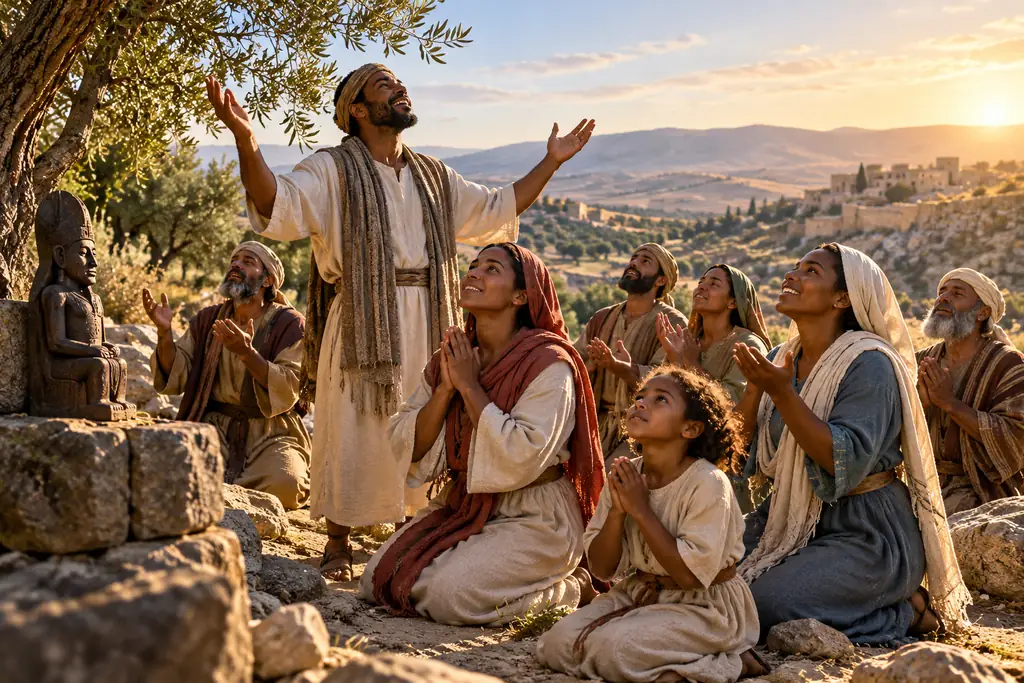
How can we tell whether our trust rests in the living God or things we have made?
01
Overview
When human-made gods fall silent, the LORD remains our help, our shield, and the source of blessing
Key text — Psalm 115:1, 9 (study rendering): Not to us, LORD, not to us, but to your name give glory, because of your steadfast love and faithfulness. Israel, put your trust in the LORD; he is their help and their shield.
What receives our deepest trust when life becomes uncertain? It might be a carved image or a religious object. It might be money, reputation, a public figure, a political movement, or our ability to control tomorrow. The forms differ, but the deeper question is the same: Can what we rely on actually hear us, help us, and sustain life?
Psalm 115 challenges the worship of things human hands have made. It sets their silence against the freedom of the living God. Yet the psalm is not merely a criticism of other people's religion. It turns toward the community of faith itself and asks whether Israel really trusts the LORD it confesses. The poem moves from God's honor to misplaced trust, from a call to reliance to a promise of blessing, and finally from death's silence to the urgency of praise here and now.
The opening prayer is its compass: “Not to us.” True worship is not a campaign to make our name impressive. It is an invitation to trust the God whose love and faithfulness are greater than anything we can construct.
02
1.0 Introduction
Psalm 115 belongs to the Egyptian Hallel, Psalms 113–118, a group traditionally associated with Jewish festival praise, including Passover. Psalm 113 celebrates the exalted God who raises the poor. Psalm 114 remembers the departure from Egypt and the Creator's power over sea, river, and mountains. Psalm 115 now asks a searching question: When Israel appears vulnerable and the nations mock its God, where should its confidence rest?
Its eighteen verses develop in five movements:
- Verses 1–3 — God's name and the taunt of the nations: The community asks that the LORD, rather than his people, receive glory, and confesses that he acts with sovereign freedom. - Verses 4–8 — The helplessness of idols: Objects formed by human hands have mouths and eyes, yet cannot speak or see; those who rely on them become like them. - Verses 9–11 — The invitation to trust: Israel, Aaron's priestly house, and all who fear the LORD are called to rely on their help and shield. - Verses 12–16 — The God who remembers and blesses: God's care embraces every group, the small and great, and the generations to come; the Creator gives the earth to humanity. - Verses 17–18 — Living praise: Against the silence of death, the worshiping community resolves to bless the LORD now and continually.
Goldingay classifies this as a psalm of trust, standing between praise and prayer, and notes how its shifts between “we,” “you,” and various groups sound like a communal liturgy with answering voices (Goldingay 2008, Psalm 115, “Interpretation”). Kidner similarly notices the force of its repeated responses and the way it exposes the inadequacy of objects that cannot act (Kidner 2014, 438–42).
Central message: The living God deserves glory because he alone is free, faithful, and able to act. People become shaped by what they trust; therefore worship must turn away from powerless substitutes toward the LORD, whose blessing calls for responsible life and living praise.
03
2.0 Historical and Literary Context
The psalm has no named author and no securely identifiable date. Its question in verse 2—why do the nations ask where Israel's God is?—may recall national vulnerability, possibly around the exile or restoration. But no particular crisis is named. Kidner considers a time when Israel was exposed to foreign ridicule; Goldingay allows a restoration-era setting without claiming certainty. Either way, the poem offers words for communities whose circumstances appear to challenge their confession of God's care.
Psalm 115's relation to Psalm 114 is especially interesting. In the Greek Septuagint and some other ancient textual traditions, what English readers know as Psalms 114 and 115 are joined together. Their messages belong well together: the Lord before whom the sea flees in Psalm 114 cannot be equated with an image unable to move in Psalm 115. Yet their styles differ. Psalm 114 is a compact poem of animated creation; Psalm 115 is a community's declaration, appeal, instruction, and blessing. We can respect both their literary connection and their distinction.
The poem may have been performed responsively. A leader could have called, “Israel, trust in the LORD,” with the congregation answering that the LORD is their help and shield. The Hebrew does not tell us exactly who spoke every line, and the structure should not be turned into an invented detailed ceremony. Still, repeated formulas and changing addressees make a worship setting plausible.
Its critique of idols belongs to a recognizable biblical tradition (Deut. 4:28; Isa. 44:9–20; 46:1–7; Ps. 135:15–18). In Israel's world, divine images might be made of precious materials and treated as mediators of a deity's presence. Psalm 115 deliberately looks at what such an image actually is: something made, without the capacities attributed to the living LORD. The purpose is to identify the true object of trust, not to authorize ridicule or mistreatment of people who follow different religions. Contemporary interfaith encounters require the same honesty about convictions joined to respect for persons.
Finally, the poem continues a major theme in the Psalter: the LORD's rule reaches heaven and earth, and the people who bear his name must respond with trust. Psalm 115 turns the celebration of divine kingship found throughout Book Four and the early Book Five into a question addressed to each worshiper's heart.
04
3.0 Walking Through the Text
3.1 Psalm 115:1 — Glory belongs to the LORD, not the worshiper
“Not to us” is repeated, making the opening emphatic. The request is not that the people cease to matter, nor that they reject every legitimate achievement. It is that God's name—his known character and public reputation—receive the honor. The ground for the request is his steadfast love (ḥesed) and faithfulness (ʾĕmet): the reliable commitment displayed throughout his covenant dealings (Exod. 34:6–7; Ps. 89:1–2).
This may be praise, but it may also be a prayer for God to act when circumstances appear humiliating. The next verse raises the nations' mockery, so the request likely includes a longing for God's character to be vindicated in the sight of others (compare Ezek. 36:22–23). Goldingay notes this tension: worship and petition are intertwined rather than separated into neatly labeled forms.
For leaders, the verse strikes at the temptation to turn ministry into a monument to one's name. A thriving congregation, a growing platform, a new building, or a celebrated initiative may be good. None should become the object of worship. Glory is not something we acquire by using God's name.
3.2 Psalm 115:2–3 — Where is your God? In heaven, free to act
The nations ask, “Where is their God?” In the ancient world, visible images gave many worshipers something to point toward. Israel's refusal to define its God through an idol could appear foolish to observers, especially in seasons when the nation seemed powerless.
The answer is neither an embarrassed excuse nor a list of visible objects: our God is in heaven; he does whatever he pleases. “In heaven” speaks of transcendent kingship, not of a God who has abandoned the earth (Ps. 103:19; Isa. 66:1). He cannot be captured in the place humans select for him. At the same time, this God is “our God”: transcendent without being indifferent to covenant relationship.
Divine freedom requires care in interpretation. The sentence is a confession of God's real capacity to accomplish his purposes, not a license to call every tragedy a direct expression of God's pleasure. Elsewhere the Psalms protest injustice, ask why God delays, and refuse easy accounts of human suffering (Pss. 13; 44; 88). The confession is that Israel's God is neither trapped nor helpless.
3.3 Psalm 115:4–7 — The crafted image that cannot act
The poem turns the question back toward the nations. Their idols are fashioned from silver and gold, precious but inanimate material. The poet lists features of a living body—mouth, eyes, ears, nose, hands, feet, throat—and then points out their uselessness. They do not speak, see, hear, smell, feel, walk, or make a sound.
This is more than a joke about statues. It is a contrast between human manufacture and divine action. The LORD acts; the image is acted upon. The Lord hears prayer; the object has no hearing. The God who led Israel speaks through his word; the artifact cannot answer when questioned. Isaiah 44:9–20 and Jeremiah 10:3–10 develop similar arguments.
Goldingay observes that the issue is not simply “God is spiritual whereas images are material.” Israel's own Scriptures use bodily images of God hearing, seeing, speaking, touching, and walking with his people. The psalm's point is that the living God truly acts, while the crafted object cannot perform what its form suggests. We must therefore avoid turning biblical resistance to idolatry into contempt for the goodness of created bodies or material creation itself.
The form of this critique also demands humility. Contemporary Christians may rightly distinguish religious art from treating an object as a deity; traditions differ over appropriate images in worship. Psalm 115's deeper test remains whether an image, institution, possession, or human work has been asked to bear the weight of ultimate trust.
3.4 Psalm 115:8 — We become like what we trust
The psalm declares that makers of idols—and those who rely on them—become like them. The Hebrew wording can be read as a prediction or as a wish of judgment; Kidner notes the grammatical possibility of either (Kidner 2014, 440). The central insight is sobering: when we entrust our lives to something that cannot truly hear, see, or sustain us, our own responsiveness can be diminished.
A person devoted to wealth as an ultimate good may learn not to see suffering. A leader dependent on applause may lose the ability to hear truthful correction. A community that prizes an institution over people's wellbeing can become unable to feel the harm it causes. These examples are contemporary applications, not claims that the psalm is directly describing modern finance, politics, or technology.
The opposite possibility also runs through Scripture: people who behold and honor the living God's character are called to grow in mercy, justice, and faithfulness (Ps. 111–112; 2 Cor. 3:18). Worship is never merely a private preference. It shapes the kind of people we become.
3.5 Psalm 115:9–11 — Three calls to trust, one help and shield
Now the poem addresses the community directly: Israel, the house of Aaron, and those who fear the LORD. Each is connected with the identical confession that the LORD is their help and their shield.
There is a genuine translation issue. The Masoretic vocalization supports an imperative: “Trust in the LORD!” Some ancient versions read the lines as declarations: “Israel trusts in the LORD.” The difference reflects alternative ways of vocalizing the Hebrew consonants. In context, the exhortation makes good sense after the description of misplaced trust; a statement of confidence also fits the responding refrain. Both readings keep the focus on the LORD, not on the worshipers' strength of will.
Why three groups? Israel names the covenant community; Aaron's house names its priestly servants; those who fear the LORD may describe all faithful worshipers or a broader group that includes people beyond ethnic Israel. We should not insist that the last phrase is already a fully developed technical designation for Gentile converts. Goldingay and Kidner both note the uncertainty.
The priestly house is not exempt from the command. Neither religious training nor inherited office makes anyone self-sufficient. All share the same need for help—God's active support—and shield—his protective care. The safeguard is not a promise that no believer will ever be hurt. It is an invitation to place ultimate confidence in the One who is faithful through danger.
3.6 Psalm 115:12–13 — God remembers the small and the great
“The LORD has remembered us” or “has been mindful of us” announces a decisive turn. The community confesses that it has not disappeared from God's concern. The verb remember in biblical narrative often means more than recalling information: it introduces faithful action on behalf of people (Exod. 2:24; Gen. 8:1).
The word bless now returns insistently. The blessing belongs to the entire house of Israel, the house of Aaron, and those who fear the LORD, small and great together. Here “small and great” can refer to differences in standing, influence, or resources. God's care is not reserved for highly visible persons.
The repetitions push back against religious hierarchies built on celebrity or status. The elderly widow, a child, the little-known volunteer, and a church official do not occupy identical roles, but none is invisible to God. For communities that easily confuse influence with divine favor, this is an invitation to reform how they honor people.
3.7 Psalm 115:14–15 — Blessing for present and future generations
The speaker prays that the LORD will increase the people and their children, then pronounces blessing from the Maker of heaven and earth. In the ancient covenant setting, increase could include growth in numbers and flourishing after insecurity or national weakness. Goldingay notes that a small restoration community could particularly welcome that promise.
Such language should not become a formula: If you believe enough, you will certainly have children, wealth, or an uninterrupted life. Scripture itself includes faithful people who remain childless, poor, persecuted, or awaiting justice (Pss. 22; 88; Heb. 11:35–40). The blessing points to the Creator's power to preserve and sustain his people; it does not assign personal blame to those whose circumstances remain painful.
The emphasis on descendants also directs the worshiping community beyond the current generation. Blessing is not simply what we receive; it is what we are called to hand forward through truthful teaching, shared resources, protection of children, and care for the common good.
3.8 Psalm 115:16 — The earth entrusted to humanity
The heavens belong to the LORD, while the earth has been given to human beings. This is a statement about God's generosity, not his withdrawal. It echoes Genesis 1:26–28 and Psalm 8:4–8, where human beings receive a vocation in a world that remains God's creation.
The gift carries responsibility. We have not manufactured the rivers, soils, forests, animals, or the lives of our neighbors. Human dominion cannot mean unlimited permission to destroy. Biblical stewardship is answerable to the Giver and ordered toward life (Gen. 2:15; Lev. 25:23; Ps. 24:1).
Kidner emphasizes that humanity is trustee rather than owner, while Goldingay reads this verse as an affirmation of the human calling under the Creator's sovereignty. These insights matter in everyday settings, from a farming household caring for water and land to a city deciding how development affects low-income residents. Reverence for God should make us more responsible for the world he has entrusted to us, not less.
3.9 Psalm 115:17–18 — Against death's silence, choose living praise
The poem ends with a stark contrast: the dead do not praise the LORD; those who go down to silence cannot join the public song. But we will bless the LORD from now on and continually. “Hallelujah”—praise the LORD—concludes the psalm.
This language expresses the Old Testament worshiper's urgency to honor God while alive. Death is depicted as silence, the interruption of the voices and acts of worship belonging to earthly community (Pss. 6:5; 30:9; 88:10–12). We should not force one poetic statement to resolve every later biblical question about the intermediate state or resurrection. Kidner considers whether verse 18 may point beyond an individual lifespan, while Goldingay allows the sense of a community whose praise continues through successive generations. The immediate emphasis is clear: do not postpone faithful worship until some imagined better season.
Christian readers may also hear the final promise alongside later biblical hope in resurrection (Isa. 26:19; 1 Cor. 15:20–28). That is a canonical development, not evidence that Psalm 115 by itself spells out the entire New Testament teaching about death. This is especially important where beliefs about death and the human person are debated among Christians.
The psalm began by asking God to receive glory. It ends with a people ready to give that glory. The movement is complete: God has not abandoned his name, and worshipers will not abandon their praise.
05
4.0 Theological Reflection
4.1 Idolatry is a problem of misplaced trust
The most penetrating question in Psalm 115 is not simply, Do you own an idol? It is, What do you expect to save you? Religious images are the poem's direct concern; contemporary applications reach any created thing that receives the allegiance appropriate to the Creator. Money can provide food, but cannot purchase eternal security. A leader can serve people, but cannot replace God's authority. A church building can shelter worshipers, but cannot become God. We should cherish what is useful without demanding divine power from it.
4.2 Divine freedom is not divine indifference
The God enthroned in heaven does what he wills (v. 3). Yet the psalm's first and last movements speak of his steadfast love, faithfulness, mindfulness, blessing, and praise. Sovereignty is not portrayed as arbitrary power divorced from character. The God who is free to act has revealed himself in covenant commitments. Worship trusts both his authority and his goodness, even when answers are not visible.
4.3 Faith changes not only what we believe but who we become
Verse 8 suggests that devotion shapes human perception and behavior. A community is gradually formed by what it praises, excuses, fears, and protects. When people trust the living God, they are called to become more alive to truth and neighborly need, not less. Psalm 112's portrait of generosity and justice gives a useful neighboring example of faith taking bodily, social form.
4.4 Blessing cannot be reduced to prosperity
The promise of increase and care belongs to an ancient community with a real need for survival. It is not a universal guarantee of fertility, wealth, or immediate victory. The God who is mindful of the small and the great also attends to those whose prayers remain unanswered in the way they hoped. Faithful biblical interpretation leaves room for lament alongside blessing.
4.5 The world is entrusted, not abandoned
The earth given to humanity is still God's earth. We are responsible for the neighbors and ecosystems affected by our choices. The psalm's Creator theology therefore invites both praise and practical stewardship—honest work, restraint, justice, and care for those who will inhabit the world after us.
06
5.0 Canonical and Christological Horizon
Psalm 115 grows out of the biblical argument against substituting created things for the Creator. The prophets challenge images that must be carried, repaired, or defended by human hands (Isa. 44:9–20; 46:1–7; Jer. 10:1–10). Paul makes a related distinction in Athens: the God who made the world does not dwell in shrines built by humans or depend on their service for life (Acts 17:24–29). These connections reinforce the psalm's first confession: glory belongs to God rather than to what humanity has built.
For Christians, the New Testament makes a surprising addition. Jesus is called the image of the invisible God (Col. 1:15) and the one in whom God's character is disclosed (John 1:18; Heb. 1:1–3). This is not a claim that Jesus is another crafted idol, nor is it permission to erase ancient Israel's concern about images. Christian confession identifies Jesus as the living, acting, suffering, risen Messiah through whom God reveals himself—not an object made by human hands and expected to perform divine acts.
Jesus' ministry also clarifies the contrast between lifeless substitutes and the God who hears, sees, and acts. He listens to neglected people, restores sight, speaks forgiveness, and calls disciples to follow him in costly love (Mark 10:46–52; Luke 7:11–17; John 13:12–17). Christians recognize these deeds as the presence of Israel's living God at work in and through the Messiah.
Paul describes turning from idols to serve the living and true God and to await the risen Jesus (1 Thess. 1:9–10). Meanwhile, 2 Corinthians 3:18 portrays worshipers being transformed as they behold the Lord's glory. Read together with Psalm 115:8, that is a powerful spiritual contrast: what we trust shapes what we become. In Christ, transformation should produce humility, truthfulness, and love rather than spiritual pride.
Finally, the psalm's language about the earth and the silence of death points toward the Bible's larger hope. In 1 Corinthians 15, God defeats death through the resurrection of Christ and the future resurrection of his people. Revelation 21–22 depicts renewed creation and God's dwelling with humanity. These later texts do not mean Psalm 115 directly predicted every element of Christian eschatology. They allow Christians to read its urgent earthly praise in the light of God's promised renewal of life.
07
6.0 Life Application
- Ask what you trust when no one is watching. Where does your mind turn first during fear—to prayer and wise action, or to a possession, influence, platform, or practice you secretly expect to guarantee safety? Recognizing a false ultimate trust is the first step toward freedom (vv. 3–8).
- Practice the prayer “Not to us.” In public ministry, academic work, business, or family achievements, give appropriate credit to people without turning the success into self-worship. Thank God, acknowledge collaborators, and resist the temptation to build a personal monument (v. 1).
- Make leadership accountable. Priests are told to trust alongside everyone else (vv. 9–11). Spiritual office is no exemption from transparency, correction, or responsible management. A leader who refuses accountability may be trusting status more than God.
- Honor the small and the great. Give pastoral attention not only to visible donors and influential members but also to children, widows, people with disabilities, workers, and quiet volunteers. The LORD's blessing is not distributed according to public importance (vv. 12–13).
- Receive blessings as responsibilities. Resources, opportunities, and the care of future generations are gifts to steward. Be honest in economic decisions and protect the land and water on which communities depend (vv. 14–16).
- Give thanks while you have breath. Do not wait for a perfect season before bearing witness to God's goodness. Praise may be spoken through tears, sung with others, or lived through an act of compassion. The present is a real opportunity for worship (vv. 17–18).
08
7.0 Reflection Questions
- Why does the psalm begin with “Not to us” before it speaks about idols and misplaced trust?
- What is the difference between honoring a useful human creation and treating it as the source of ultimate hope?
- What does the statement that idol makers “become like them” reveal about the ways our loyalties shape our character?
- Why are Israel, Aaron's house, and those who fear the LORD each reminded of the same need for God's help and protection?
- How can churches celebrate divine blessing without blaming people who experience poverty, infertility, illness, or hardship?
- What responsibilities follow from the declaration that God entrusted the earth to humanity?
- How do the closing verses encourage present-day praise without answering every question about death and resurrection?
09
8.0 Response Prayer
LORD, not to us, but to your name be glory. You have loved with a faithfulness we did not create, and you remain the living God when the things we trust fall silent.
Forgive us for turning useful gifts into masters, for seeking applause more than truth, and for trusting our own strength as if we were self-made. Teach us to recognize the idols of our time— those we can touch and those we hide inside our ambitions.
Be the help and shield of your people. Give courage to the overlooked, wisdom to leaders, and care to every generation. Where blessing comes, make us generous. Where waiting continues, keep us from blaming the wounded.
You made the heavens and entrusted us with the earth. Teach us to treat your world and its people with reverence. While we have breath, let our words and work proclaim your goodness. Through Jesus Christ, the living Lord, amen.
10
9.0 Window into What Comes Next
Psalm 115 begins with a community asking God to receive glory and ends with that community pledging to praise him. It answers the question of misplaced trust by declaring that the LORD is living, active, and faithful. But a congregation can make such a confession while still waiting for a particular prayer to be answered.
Psalm 116 gives us the voice of an individual who has passed through profound distress and can now say that the LORD heard his cry. The speaker remembers death's nearness, describes relief, and asks how to respond to the Lord's goodness. Where Psalm 115 urges the people to trust their help and shield, Psalm 116 tells the personal story of someone who called on that help and responded with thanksgiving.
The two psalms belong together: trust prepares us to pray, and remembered deliverance teaches us how to give thanks. Whether we are still waiting or looking back on rescue, the living God—not the work of our hands—deserves the glory.
11
10.0 Bibliography
- Scripture: Psalm 115; Psalms 6; 8; 13; 17; 22; 24; 30; 44; 73; 88–89; 103; 111–118; 135:15–18; Genesis 1:26–28; 2:15; 8:1; Exodus 2:24; 34:6–7; Leviticus 25:23; Deuteronomy 4:28; Isaiah 26:19; 44:9–20; 46:1–7; 66:1; Jeremiah 10:1–10; Ezekiel 36:22–23; Mark 10:46–52; Luke 7:11–17; John 1:18; 13:12–17; Acts 17:24–29; 1 Thessalonians 1:9–10; 1 Corinthians 15:20–28; 2 Corinthians 3:18; Colossians 1:15; Hebrews 1:1–3; Revelation 21–22. The key text above is a study rendering, not an exact quotation attributed to a named Bible translation.
- BibleProject. n.d. The Book of Psalms: Study Notes. Resource on the five-book structure of the Psalter, lament and praise, the Messiah, and the kingdom of God.
- Goldingay, John. 2008. Psalms, Volume 3: Psalms 90–150. Baker Commentary on the Old Testament Wisdom and Psalms. Grand Rapids, MI: Baker Academic. Commentary on Psalm 115, “God and Other Objects of Trust.”
- Kidner, Derek. 2014. Psalms 73–150. Kidner Classic Commentaries. Downers Grove, IL: InterVarsity Press. Originally published 1975. Commentary on Psalm 115, “Not unto us!,” pp. 438–42.
Be the first to leave a comment.