
When the sea steps aside and the rock gives water, what do we learn about deliverance?
01
Overview
The God of the Exodus, before whom creation trembles and the wilderness becomes a place of life
Key text — Psalm 114:7–8 (study rendering): Tremble, earth, before the Lord, before the God of Jacob, who turns hard rock into a pool of water and the flint-like stone into a flowing spring.
Imagine a people leaving a country in which they have lived under another people's power. Ahead of them is water they cannot cross. Behind them is a history of bondage they cannot undo. They have neither the military strength to secure their freedom nor the resources to sustain themselves through a wilderness.
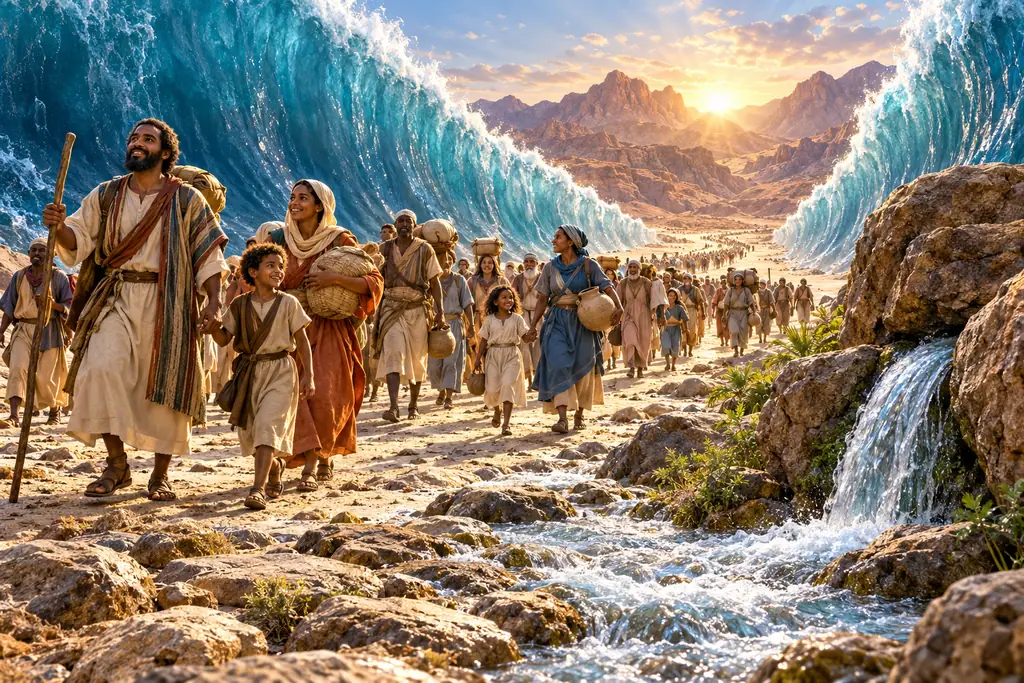
Then the sea retreats. A river stops. Mountains shake. A rock gives water.
Psalm 114 tells Israel's deliverance in language so vivid that creation itself becomes a participant in the story. The poem is only eight verses long, yet it insists that the Exodus was more than a change of political circumstances. The God who brought Israel out of Egypt is the Lord before whom the created world gives way—and the same Lord who provides water where life seems impossible.
The song asks us not merely to remember an extraordinary event but to recognize the One who acted in it.
02
1.0 Introduction
Psalm 114 belongs to the collection traditionally called the Egyptian Hallel (Pss. 113–118), a group of praise songs associated in later Jewish worship with the great festivals, including Passover. Psalm 113 asked who is like the exalted God who lifts the poor and overlooked. Psalm 114 gives a historical answer: he is the God who brought a powerless people out of bondage and made a way through obstacles no human leader could remove.
Its poetic movement may be followed in four pairs of verses:
- Verses 1–2 — The people are brought out: Israel leaves Egypt, and Judah/Israel becomes a place of holiness and royal belonging. - Verses 3–4 — Creation responds: The sea flees, the Jordan turns back, and the mountains and hills move like animals. - Verses 5–6 — Creation is questioned: The poet playfully challenges the waters and mountains to explain their astonishing response. - Verses 7–8 — The answer is revealed: Earth is called to tremble before the Lord, the God of Jacob, who also makes hard rock yield life-giving water.
This is not a neutral list of miracles. The psalm withholds God's name until verse 7. The reader first encounters the strange behavior of nature, asks why it happened, and only then hears the name of the One whose presence explains it all. Goldingay calls the poem an unusual, enigmatic praise song, combining remembrance with a demand that the congregation take the God of the Exodus seriously (Goldingay 2008, commentary on Psalm 114, “Interpretation”). Kidner describes its delight in the Exodus as both exuberant and earth-shaking (Kidner 2014, 437–38).
Central message: God's presence transforms the story of his people. The Lord who delivered Israel is sovereign over creation, yet he uses that sovereignty not simply to inspire awe but to give freedom, belonging, and provision. Remembering his works invites reverence, courageous trust, and care for those still longing for deliverance.
03
2.0 Historical and Literary Context
The Hebrew text gives Psalm 114 no named author or specific date. Its subject is clear: the Exodus from Egypt, the crossing of the sea (Exod. 14–15), the crossing of the Jordan (Josh. 3–4), the trembling associated with Sinai (Exod. 19:18), and God's provision of water from rock in the wilderness (Exod. 17:1–7; Num. 20:2–13). These events occurred at different points in Israel's narrated journey. The psalm deliberately draws them together into a short poetic vision, rather than arranging every detail in historical order.
The phrase “a people of strange language” (v. 1) evokes Israel's existence among speakers whose speech was unfamiliar. It may also remind later audiences of their own experiences of foreign domination and displacement (Deut. 28:49; Isa. 28:11). The wording describes estrangement from the perspective of a displaced community; it does not teach contempt for other peoples or languages.
Scholars do not agree on when the poem was written. Goldingay suggests its closing image of water in a barren landscape may resonate with later promises of restoration after exile (Isa. 41:18), but this is an interpretive possibility, not proof of a postexilic composition. Neither the setting of the first performance nor the author's identity can be confidently established.
In later Jewish liturgical life, Psalms 113–118 became associated with the festivals and especially the Passover. Psalm 114 naturally suits that setting because it celebrates the departure from Egypt. This later association should be distinguished from the psalm's unknown original occasion. Some ancient Greek and other textual traditions also join Psalms 114 and 115 into one poem; in the Hebrew Psalter they are distinct, with different poetic emphases (Goldingay 2008, “Interpretation”; Kidner 2014, 438–39).
Its placement between the two neighboring psalms matters. Psalm 113 praises a God whose greatness is expressed in lifting the lowly; Psalm 114 remembers this God delivering the community of Israel; Psalm 115 will demand that glory be given to the Lord rather than to human beings or lifeless idols. The sequence moves from God's compassionate character, through his saving work, to the confession that he alone deserves trust.
The literary artistry of Psalm 114 is exceptionally concentrated. Water sees and flees; mountains leap; the poet addresses them as if they could answer. Such personification is characteristic of Hebrew poetry (compare Pss. 77:16–20; 98:7–8). These lines do not require us to imagine that rivers possess human consciousness. They proclaim poetically that creation is neither divine nor independent: it belongs to its Maker.
04
3.0 Walking Through the Text
3.1 Psalm 114:1 — Leaving Egypt and the voice of an unfamiliar people
The poem opens without an introductory command to praise. It begins with an event: “When Israel went out of Egypt.” Everything that follows depends on these words. Israel's identity is rooted not first in its achievement, territory, or military success but in a deliverance it could not accomplish alone.
The parallel phrase calls the departing community “the house of Jacob.” This recalls a family story stretching back to Jacob and the ancestors who settled in Egypt (Gen. 46:26–27). A household became a people, and that people found itself subject to a foreign power (Exod. 1:8–14). The God of the family now acts publicly on behalf of the nation.
The description of the Egyptians as a people speaking an unfamiliar tongue does not mean Egyptian speech was defective. The Hebrew expression is unusual and can carry the impression of unintelligible speech. From Israel's perspective, the language of the surrounding society marks its alienation. Goldingay observes that such language can also resonate with later peoples living under foreign domination (Goldingay 2008, on vv. 1–2).
There is a pastoral depth here. Enslavement involves more than harsh labor. It may include the loss of agency, cultural displacement, humiliation, and the experience of being unheard. The Exodus announces God's concern for people trapped within a system that gives them little power to shape their future (Exod. 3:7–10).
The first verb—went out—is therefore a statement about freedom. Liberation begins with the initiative of the Lord who has heard the oppressed.
3.2 Psalm 114:2 — Judah and Israel: a holy people and a realm
The next verse announces a dramatic change of identity: Judah became a sanctuary, Israel a dominion or realm. Many translations supply “his,” understanding both to belong to God: Judah becomes his sanctuary and Israel his domain. This reading aligns naturally with God's call for Israel to be a priestly kingdom and holy nation (Exod. 19:5–6). The enslaved community is brought into a covenant relationship marked by God's presence and rule.
Yet the Hebrew does not explicitly name God in this verse. Goldingay raises a serious grammatical alternative: the pronouns may point back to the house of Jacob from verse 1, so that Judah/Israel became its sacred place and realm—an expression of the land becoming the people's home and inheritance (Goldingay 2008, on vv. 1–2). On this reading, sanctuary and realm speak of Israel's transformed place in the land rather than directly describing Judah as God's dwelling.
Both readings underscore the same dramatic movement: a vulnerable household leaves the land of bondage and receives a new place and vocation. They differ in precisely how the holiness and dominion are attributed, and the ambiguity deserves to be acknowledged rather than hidden.
Judah and Israel may describe the southern and northern territories or serve as overlapping names for the covenant people and land. There is not enough evidence to date the poem by choosing one of these possibilities.
Kidner remarks that the change between verses 1 and 2 is a change of status: people who had been outsiders now possess the dignity of belonging to a holy community and kingdom (Kidner 2014, 438). This is not a claim that Israel instantly became morally perfect. The Exodus narrative makes clear that the people still needed teaching, discipline, and transformation. Grace confers a vocation that the recipients must learn to live out.
3.3 Psalm 114:3 — The sea flees, the Jordan turns back
Now creation enters the poem. The sea saw and fled; the Jordan turned backward. The first image alludes to the sea crossing after the departure from Egypt (Exod. 14:21–31). The second recalls Israel's crossing into the promised land when the Jordan's waters ceased their normal flow (Josh. 3:14–17; 4:21–24).
The two waters frame the wilderness journey: leaving bondage and entering the land. The poet compresses years of movement, uncertainty, and provision into one astonishing pair of statements. At both thresholds, the way forward had to be opened by God.
Notice that the waters are portrayed as responding before the poem openly names God. The sea “sees” something and flees. What does it recognize? The answer is delayed until verse 7. This literary delay keeps the hearer attentive: who has such authority that even water gives way?
The sea and Jordan are not rival gods engaged in a struggle of equal powers. They are parts of creation that submit to their Creator. The poetry thereby resists the fear that Israel's future depends on forces beyond God's control (compare Ps. 77:16–20).
But the imagery should not become a mechanical promise that every barrier disappears for believers. The same Israel endured years in the wilderness. God's deliverance was real, yet the journey still required endurance and trust.
3.4 Psalm 114:4 — Mountains jumping like rams
The poem becomes even more animated: mountains skip like rams and hills like young sheep. A huge mountain, normally the image of stability, becomes as responsive as a creature in motion. The contrast is part of the poetry's delight.
This may call to mind the trembling of Sinai when God appeared to Israel (Exod. 19:16–19), as well as the broader biblical portrayal of mountains shaking before the Lord (Judg. 5:4–5; Ps. 68:7–8; Hab. 3:6). Goldingay allows the imagery to evoke the mountainous landscape of Israel's approach to its land as well; Kidner stresses the excitement produced by the Creator's arrival (Goldingay 2008, on vv. 3–4; Kidner 2014, 438).
Are the mountains dancing with joy or leaping in alarm? The verb can suggest movement that is joyful, but in this context trembling before a majestic presence is also prominent. The comparison works through its vigorous movement more than by requiring one human emotion from a mountain. It is safest to recognize the poetic drama rather than force a single psychological explanation.
Mountains do not need to be understood as literally growing legs. The imagery expresses the overwhelming significance of the Lord's presence: what seems immovable becomes responsive before him.
3.5 Psalm 114:5–6 — The poet questions creation
The singer turns to the sea and Jordan, then to the mountains and hills, asking what happened to make you flee, retreat, or leap? The questions are not requests for hydrological or geological data. They are rhetorical: the answer is so significant that the poem makes the audience wait for it.
There is also something almost playful in the address. The sea that terrified the escaping people is now spoken to as though it had suddenly run away. The intimidating mountains are pictured as animals startled into motion. Kidner hears in these questions a joyful confidence that the Lord is greater than every apparent obstacle; Goldingay notes the teasing tone that may accompany the questions (Kidner 2014, 438; Goldingay 2008, on vv. 5–6).
By speaking to creation, the psalm indirectly challenges human listeners. If the sea recognized the significance of God's saving action, will Israel recognize it? If mountains respond, what about communities that have received the story but grown indifferent?
The questions prepare us for the final turn. The poem has described the response of sea, river, mountain, and hill. Now it addresses not just these features but the whole earth.
3.6 Psalm 114:7 — Tremble, earth, before the God of Jacob
At last the hidden answer is spoken: the Lord, the God of Jacob. The command to the earth is usually rendered “tremble” before him. The Hebrew verb can have a range of associations, including quivering or writhing, and some translations emphasize a more lively movement. In this context, the weight of the divine presence favors a sense of reverent shaking, while the playful energy of verses 3–6 remains in the background.
“God of Jacob” takes us back to the “house of Jacob” in verse 1, forming a poetic frame. The identity of the delivered people is bound to the identity of the God who delivered them. The Lord of the entire earth has acted in the history of one family and its descendants.
Notice also the expansion: it is not only the Red Sea or Jordan that should tremble, but the earth. The particular story reveals a universal truth. Creation itself is accountable to its Maker. Human rulers and nations, therefore, cannot treat themselves as ultimate authorities (Pss. 96:9; 97:4–6).
But the call to tremble is not simply a threat. It is spoken within a remembrance of liberation. The Lord whose presence shakes the world is the Lord who heard the cries of slaves. Divine majesty and saving compassion belong together.
3.7 Psalm 114:8 — Rock transformed into water
The psalm ends in an unexpected place. After the sea retreats and mountains tremble, the Lord is described as turning rock into water and hard stone into a spring. The primary memories are God's provision at the rock in the wilderness (Exod. 17:1–7; Num. 20:2–13). Deuteronomy 8:15 similarly remembers water coming out of hard rock.
The image changes the role of water. Earlier it was an obstacle that had to retreat. Now it is a gift without which the travelers could not live. God can make water give way and can also make water appear. Both actions serve the needs of his people.
Strictly speaking, the Exodus accounts describe water coming from rock, not a geological conversion of an entire rock into liquid. Psalm 114 intensifies the event through poetic hyperbole: what was hard, dry, and apparently fruitless becomes a pool and a flowing spring. Goldingay connects the imagery with Isaiah 41:18, where a dry landscape becomes well watered in the promise of restoration. The echo suggests how the remembered Exodus could nourish later hope, though the psalm's date cannot be proven from it (Goldingay 2008, on vv. 7–8).
This closing verse guards us from treating divine power merely as spectacle. The God who can unsettle mountains also notices thirst. His sovereignty is not displayed simply to impress observers; it sustains fragile lives.
It is fitting that Psalm 114 ends not with an enemy being destroyed but with a spring. The Creator's presence opens paths of freedom and makes life possible in the wilderness.
05
4.0 Theological Reflection
4.1 The Exodus is more than a memory of the past
Israel's worship turned remembered deliverance into present confession: the God who acted then is still the God of Jacob. Goldingay stresses that liturgy can keep the memory of liberation alive for later generations living under very different and perhaps painful conditions. The psalm does not assert that their circumstances have already been transformed. It gives them a trustworthy account of God's identity from which to hope (Goldingay 2008, “Theological Implications”).
This distinction matters. A community must never deny present suffering by repeating stories of past victories. It may, however, allow those stories to resist despair and inspire truthful prayer and responsible action.
4.2 Creation is powerful but not divine
To ancient hearers, seas and mountains could signify forces beyond human control. Psalm 114 dramatizes their submission to the Lord. Water is not a god; mountains are not ultimate powers; the Creator is sovereign over both. The poem is not a scientific explanation of plate tectonics or hydrology. It is a theological confession communicated through intensely imaginative poetry.
This also opposes superstition and panic. Christians need not treat every frightening natural event as a particular divine warning against specific individuals. The poem celebrates God's sovereignty through Israel's saving history; it does not give us permission to assign blame for every disaster.
4.3 Freedom leads to belonging and responsibility
The movement from Egypt to sanctuary and realm (vv. 1–2) suggests that deliverance has a purpose. God does not merely release a people from coercion; he brings them toward a life ordered by covenant, worship, justice, and mutual care (Exod. 19:4–6; Deut. 10:12–19).
This is a challenge to communities that celebrate freedom while overlooking exploitation. The people who remember rescue from slavery should not reproduce slavery-like patterns in their leadership, labor practices, households, or institutions.
4.4 The sovereign God also supplies what life requires
The final rock-and-water image puts divine strength at the service of life. God's care reaches people not only at the dramatic moment of escape but during the long days after liberation. The wilderness still contains hunger, uncertainty, and thirst.
Theologically, this protects faith from expecting only sudden miracles. Ordinary daily provision, shared resources, and faithful care among neighbors may also become occasions for recognizing the Giver (Exod. 16–17; Matt. 6:25–34).
4.5 Reverent awe should produce hope, not religious intimidation
The command to tremble is addressed to the earth before its Creator. It must not become a preacher's excuse to threaten or dominate vulnerable people. The Lord who inspires awe is the same Lord who acts on behalf of the oppressed and provides for the thirsty.
True reverence makes human pride smaller while making compassion larger. The Exodus reveals a God who confronts unjust power without becoming a model for the abuse of power.
06
5.0 Canonical and Christological Horizon
The Exodus begins a pattern of salvation in Israel's Scriptures. Through Moses, God heard Israel's cry, confronted Pharaoh's oppression, opened a passage through the sea, and led the people into covenant life (Exod. 3:7–10; 14–15; 19:4–6). The Jordan crossing renewed that story for a new generation (Josh. 3–4). Later prophets imagined a fresh deliverance in language drawn from the first Exodus, speaking of paths through wilderness and water in desert places (Isa. 43:16–21; 48:20–21).
Psalm 114 belongs to that world of remembered deliverance and future expectation. Its final spring can be heard alongside Isaiah's language of restoration (Isa. 41:18). Neither text should be made into a guarantee that every shortage in the present age disappears immediately. They testify to God's commitment to the life and restoration of his people.
Christians hear these themes in the story of Jesus. Luke 9:31 uses the word exodus (often translated “departure”) when speaking of what Jesus would accomplish in Jerusalem. His death and resurrection become the decisive saving event through which the New Testament understands liberation from sin and death (Luke 9:30–31; Rom. 6:3–11). Paul also uses Israel's passage through the sea and the provision from the rock as typological instruction for Christians (1 Cor. 10:1–13). He calls Christ the spiritual Rock, not because the original writer of Psalm 114 explicitly named Jesus, but because Paul reads Israel's history through the risen Messiah.
The Gospels depict Jesus exercising authority even over turbulent waters (Mark 4:35–41), an event that echoes the wider biblical conviction that creation is answerable to the Lord (compare Ps. 107:23–30). It is appropriate to notice the resonance without claiming that Mark directly quotes Psalm 114.
The Hallel's later association with Passover also provides Christian readers a liturgical bridge. Mark 14:26 says Jesus and his disciples sang a hymn after the meal. The Hallel is a plausible background, but the text does not identify Psalm 114 as the hymn they sang. Responsible reading distinguishes historical possibility from explicit evidence.
Finally, the New Testament's vision of new creation looks beyond a single rescued community toward a world freed from death and the powers of evil (Rom. 8:19–25; Rev. 21:1–5; 22:1–5). Psalm 114's seas yielding and deserts receiving water offer poetic images that Christians may place within that broader hope, while retaining their first meaning as praise for Israel's deliverance.
The movement is not from Israel to a story that replaces Israel; it is from Israel's remembered salvation to the Christian confession that God's purposes reach the nations through the Messiah.
07
6.0 Life Application
- Remember your story without rewriting it. Recall moments of deliverance, unexpected help, or perseverance, while speaking truthfully about losses and unanswered prayers. Gratitude becomes more credible when it does not require a perfect ending.
- Notice people still living under oppression. The Exodus was deliverance from a real system of bondage. Let worship make you attentive to unfair wages, coercion, abuse, displacement, and those whose voices are ignored. Pray and act responsibly for justice (Exod. 3:7–10; Mic. 6:8).
- Distinguish an obstacle from a permanent verdict. Sea and Jordan represent barriers that people could not cross by their own resources. Do not assume that every barrier will disappear miraculously; seek wisdom, trustworthy assistance, and courage while placing your future before God.
- See God's greatness in daily provision. The spring from the rock may speak more directly to exhausted people than the trembling mountains. Give thanks for water, food, friendship, medical care, and the labor of those who serve your community. Share these gifts with those who lack them.
- Resist using fear as a tool of leadership. The earth is summoned to revere the Lord, not to obey a human leader without question. Let worship produce humility, transparency, accountability, and protection for the vulnerable.
- Tell the Exodus story across generations. Read Exodus 14–17 and Joshua 3–4 with children or a study group. Ask what each generation learns about God's saving character, human responsibility, and the need for trust when the future remains uncertain.
08
7.0 Reflection Questions
- Why does Psalm 114 begin with Israel leaving Egypt rather than with a direct call to praise?
- What do we gain by reading the sea, river, and mountains as poetic participants rather than treating every image as a literal description?
- How does verse 2 change our understanding of deliverance—from escape alone to belonging, worship, and responsibility?
- Why might the poet delay explicitly naming God until verse 7? What effect does that have when the psalm is read aloud?
- What is significant about the move from water as an obstacle (v. 3) to water as provision (v. 8)?
- How can we remember God's saving acts without promising that every contemporary crisis will end in the same way?
- How does the New Testament's interpretation of Exodus themes in Christ deepen Christian hope while preserving Psalm 114's first Israelite setting?
09
8.0 Response Prayer
Lord, God of Jacob, you heard the cry of people who could not free themselves. You made a way where the sea blocked their path, and you gave water where the wilderness held only rock.
Forgive us when we forget your mercy, or use stories of your power to silence those still suffering. Teach us to remember honestly, to hope without presumption, and to seek justice for the oppressed.
Where our communities are thirsty, make us willing to share what sustains life. Where fear rules our decisions, give us wisdom and courage. Where leadership has become proud, remind us that all the earth stands before you.
Through Jesus Christ, whom we confess as our liberating Lord, lead us into faithful service as we wait for the renewal of creation. Let our praise be joined to compassion, and our hope to truthful living. Amen.
10
9.0 Window into What Comes Next
Psalm 114 has asked the whole earth to tremble before the God of Jacob, who opened the sea and drew water from hard rock. Creation itself has testified that this Lord, not the forces that frighten humanity, holds ultimate authority.
Psalm 115 now asks where glory should go. It begins by insisting that honor belongs to the LORD rather than to human beings, because of his steadfast love and faithfulness. It then contrasts the living God with human-made idols—objects with mouths that cannot speak and eyes that cannot see—and calls Israel to trust the LORD as its help and shield.
The two psalms belong together. Psalm 114 shows what the living God has done; Psalm 115 asks why anyone would entrust their life to what human hands have made. The memory of rescue becomes a challenge to misplaced trust and a fresh invitation to praise.
11
10.0 Bibliography
- Scripture: Psalm 114; Psalms 23; 77:11–20; 96:9; 97:4–6; 107:23–30; 113; 115; Genesis 46:26–27; Exodus 1:8–14; 3:7–10; 14–17; 19:4–6, 16–19; Numbers 20:2–13; Deuteronomy 8:15; 10:12–19; 28:49; Joshua 3–4; Judges 5:4–5; Isaiah 28:11; 41:18; 43:16–21; 48:20–21; Micah 6:8; Habakkuk 3:6; Matthew 6:25–34; Mark 4:35–41; 14:26; Luke 9:30–31; Romans 6:3–11; 8:19–25; 1 Corinthians 10:1–13; Revelation 21:1–5; 22:1–5. The key text above is an original study rendering, not a verbatim quotation from a named modern Bible translation.
- BibleProject. n.d. The Book of Psalms: Study Notes. Resource on the design of the Psalter, Israel's history, the Exodus, and the biblical hope of God's kingdom.
- Goldingay, John. 2008. Psalms, Volume 3: Psalms 90–150. Baker Commentary on the Old Testament Wisdom and Psalms. Grand Rapids, MI: Baker Academic. Commentary on Psalm 114, “Still the God of the Exodus.”
- Kidner, Derek. 2014. Psalms 73–150. Kidner Classic Commentaries. Downers Grove, IL: InterVarsity Press. Originally published 1975. Commentary on Psalm 114, “The earth-shaking exodus,” pp. 437–38.
Be the first to leave a comment.