


Why does the God exalted above the heavens lift people the world has overlooked?
01
Overview
Why the Lord who is exalted above the heavens draws near to people the world has overlooked
Key text — Psalm 113:5–8 (study rendering): Who is like the LORD our God, who sits enthroned on high and bends down to look upon heaven and earth? He lifts the poor from the dust and raises the needy from the ash heap, giving them a place among the leaders of his people.
We usually recognize greatness by distance. Important people sit behind guarded doors. They receive visitors by appointment. Their names appear in public while the lives of the overlooked remain largely invisible.
Psalm 113 overturns our assumptions. It begins higher than the heavens and ends in a household where a woman who has known the grief and social stigma of childlessness is given a place of joy. Between those two scenes, a poor person is lifted from the dust and seated among the respected members of the community.
The astonishing claim is not merely that God possesses power. The God whom no human ruler can rival uses his power to notice, restore, and honor those whom human systems have pushed aside. That is why the psalm begins and ends with Hallelujah.
02
1.0 Introduction
Psalm 113 opens the sequence traditionally known as the Egyptian Hallel (Pss. 113–118): songs of praise associated, in later Jewish worship, with the great festivals and especially Passover. This opening song prepares worshipers to remember the God who liberated Israel from slavery by first asking a deeply personal question: What sort of God hears the voice of the lowly?
The psalm has a compact and beautifully arranged movement:
- Verses 1–3 — A call to praise: The servants of the LORD are summoned to bless his name across every time and place. - Verses 4–6 — A confession of divine greatness: The LORD is exalted above the nations and heavens, yet looks toward the world below. - Verses 7–9 — The character of his rule: God raises the poor and needy and brings joy and dignity to a woman living with childlessness. The song ends where it began: Praise the LORD.
The opening and closing “Praise Yah” (hallelu-yah) form an inclusio, a poetic frame. Inside it, heaven and earth, political status and domestic sorrow, transcendence and tenderness are held together.
Goldingay aptly titles his treatment “Yhwh Sits on High, Looks Down Low.” He observes that, unlike some neighboring psalms that focus on creation or Israel's public history, this one celebrates God's dealings with people in their ordinary and often painful circumstances (Goldingay 2008, Psalm 113, “Interpretation”). Kidner calls attention to its memorable pairing of God's incomparable majesty and his concern for those considered insignificant (Kidner 2014, 435–37).
Central message: God's exalted greatness does not make him indifferent to human need. His majesty is revealed in compassionate attention to the poor, the humiliated, and those bearing private grief. True praise should teach God's people to recognize the dignity of those whom he sees.
03
2.0 Historical and Literary Context
The Hebrew text of Psalm 113 has no named author and no dated historical heading. Neither the temple setting nor the precise occasion of composition can be established with certainty. The confident references to the LORD's universal greatness and to his lifting the lowly fit multiple periods of Israel's story.
In the Psalter's final arrangement, the placement of Psalm 113 is significant. Psalm 111 praised God's character and works. Psalm 112 portrayed a person whose reverence for God becomes visible in generosity and justice. Psalm 113 now calls the congregation to praise the God who himself raises the needy. The connection keeps two convictions together: God's people must care for their neighbors, and God's saving action cannot be reduced to human initiative alone.
Psalms 113–118 came to be known as the Egyptian Hallel because of their association with the deliverance from Egypt and the Passover liturgy. In later Jewish Passover practice, Psalms 113–114 were sung before the meal and Psalms 115–118 afterward. That later practice gives illuminating context, but it does not prove that Psalm 113 was originally composed for Passover. Mark 14:26 tells us that Jesus and his disciples sang a hymn after their final meal; the Hallel is a plausible historical context, but Mark does not name an individual psalm.
Two earlier songs especially illuminate Psalm 113. In Exodus 15:11, the people ask who is like the LORD after their rescue from Egypt. In 1 Samuel 2:1–10, Hannah praises the God who reverses the fortunes of the powerless. Psalm 113:7–8 closely echoes the wording and imagery of Hannah's song (1 Sam. 2:8); its final reference to the childless woman (v. 9) draws us still nearer to Hannah's own experience (1 Sam. 1:1–20). Sarah's story provides another earlier witness to unexpected joy after long barrenness (Gen. 18:9–15; 21:1–7).
The social setting matters. Poverty could bring more than hunger; it could strip a person of public standing. Childlessness, particularly for women in ancient patriarchal households, could lead to shame, vulnerability, and exclusion. The psalm identifies both forms of distress and imagines a change not simply in material condition but in honor and belonging.
The song is not a biography of one individual. It uses recognizable scenes from Israel's life to portray the LORD's characteristic concern. Its poetry asks worshipers to see the overlooked as God sees them.
04
3.0 Walking Through the Text
3.1 Psalm 113:1 — Praise begins with those who serve
The first word is “Hallelujah”—literally an invitation, “Praise Yah.” It is addressed to others before it becomes their shared response. The repetition that follows is purposeful: praise the LORD, servants of the LORD; praise the LORD's name.
“Servants of the LORD” may denote worshipers generally or those leading public worship. In either case, the address is relational. These people do not gather as customers evaluating a performance. They acknowledge that their lives belong in service to the God they praise.
To praise God's name is to respond to his revealed identity and character, not merely to repeat a sacred sound. Exodus 34:5–7 connects God's name to his mercy, faithfulness, and righteousness. Psalm 113 will soon describe that character by telling us what God does for vulnerable people.
There is also a searching implication. If worshipers call themselves the LORD's servants, their treatment of other people cannot be separated from their praise. A congregation that honors God's name while degrading the poor has not yet listened to the content of its own song.
3.2 Psalm 113:2–3 — Praise without borders
The psalm expands praise along two horizons. The LORD's name is to be blessed “from now and forever” (v. 2), and “from the rising of the sun to its setting” (v. 3).
The first phrase crosses time: worship is not a momentary enthusiasm or a duty reserved for an annual festival. The second crosses space, expressing the spread of praise from east to west; it can also evoke praise throughout the day. These paired expressions describe an ever-widening response to God's worthiness.
Israel's local congregation thus imagines worship larger than its own borders. Malachi 1:11 voices a comparable horizon in which the LORD's name is honored among the nations. This is not an invitation for a community to erase its particular history, but to recognize that the God known through that history is worthy of acknowledgment everywhere.
Our own worship may be offered in Kiswahili, English, another language, or through silent prayer. No one congregation owns the melody of God's praise. The scope of the invitation is as large as the world, and its duration exceeds the lifespan of any singer.
3.3 Psalm 113:4 — Exalted above the nations and the heavens
The reason for such praise begins with a majestic claim: the LORD is exalted above all nations, and his glory is above the heavens.
An earthly king may dominate a country. The LORD is not one powerful ruler competing for a larger territory. His majesty exceeds the structures of human government and the visible creation itself. No political power, religious institution, or heavenly body can define the limits of his reign.
This confession has practical consequences. National strength does not turn a government's decisions into God's decisions. Religious success does not give leaders the right to assume that every choice they make carries heaven's approval. The LORD stands above all these human claims and can judge them.
Yet the psalm has not reached its most surprising statement. It first takes us as high as thought can travel so that we may notice the direction in which this great King next turns: toward those below.
3.4 Psalm 113:5–6 — Who is like the Lord who looks down?
The rhetorical question—“Who is like the LORD our God?”—has an obvious answer: no one. Israel had asked a similar question after the crossing of the sea (Exod. 15:11). Here the question centers on a startling contrast: the LORD sits enthroned on high and looks down upon heaven and earth.
Translations differ in how they construe verse 6. Some describe God as stooping down to see what is in heaven and on earth; others emphasize that the God who sits high also looks low, or take “in heaven and on earth” as part of the question of who is comparable to him. Goldingay discusses the Hebrew arrangement, noting that the two lines work together poetically to contrast elevation and lowering (Goldingay 2008, on vv. 5–6). Readers should not build an elaborate theory of God's physical location from a metaphor describing his greatness and attention.
The point is more beautiful than a geographical statement. God is not too great to notice what appears small to the world. In human institutions, those with the highest positions are often insulated from ordinary suffering. Psalm 113 portrays the LORD's elevation as the very setting for an astonishing act of attention.
And his attention is not passive. The next verses show what that divine regard accomplishes.
3.5 Psalm 113:7–8 — From the dust to a place at the table
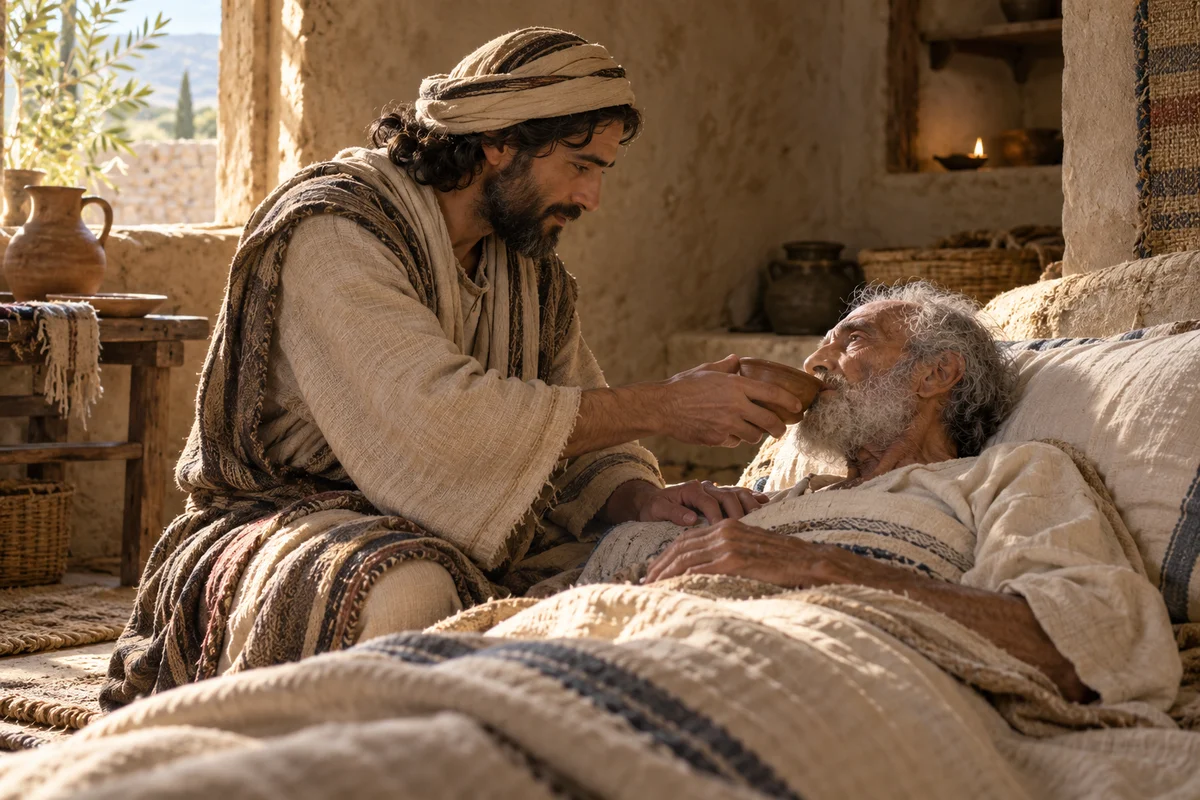
God raises the poor from the dust and lifts the needy from the ash heap, placing them among the leaders of his people. The words describe both a change of circumstances and a reversal of social standing.
The Hebrew terms suggest people who lack property or the resources necessary for life. The dust and heap of refuse may be figurative images for degradation, yet they recall real environments where people survive at the edges of communities. For a person reduced to such a position, help must mean more than a temporary handout. It may mean food, security, protection from exploitation, a respected voice, and a place in community.
The change is striking: the person once treated as disposable is seated with the honored. This echoes Hannah's praise that God raises the poor and gives them a place among princes (1 Sam. 2:8). It also recalls God's concern for the destitute in Psalms 107:41 and 109:31.
Goldingay notes that biblical texts often call people to aid the poor, while Psalm 113 speaks directly of what God does. These must not be set against each other. God's provision may come through the faithful work of neighbors, communities, and institutions. The psalm nevertheless insists that the deepest source of restoration is the LORD and that the poor are never outside his concern.
This image exposes the cruelty of measuring a person's value by income, clothing, education, or social connections. God can transform the social position of someone whom a powerful society has learned not to see.
3.6 Psalm 113:9 — A woman receives joy and belonging
The song moves from a public scene of poverty and honor to a private household. God gives a childless woman a place in the home as a joyful mother of children. This unexpected ending follows naturally from Hannah's song, but it also forces us to notice forms of sorrow that a society may conceal behind its doors.
In ancient Israel, childlessness could bring serious emotional suffering and social vulnerability, especially to women whose worth was unfairly measured by their ability to bear children. Hannah knew this distress personally (1 Sam. 1:6–11). When her prayer was answered, she praised a God who reverses humiliation rather than celebrating her own achievement (1 Sam. 2:1–10).
The verse celebrates God's care for a particular kind of socially wounded person. It does not teach that a woman's dignity depends on motherhood. Nor does it promise that every woman who prays for children will eventually conceive. Scripture itself knows prolonged unanswered longing, and pastoral care should never transform another person's reproductive pain into a test of faith or a judgment on their worth.
Kidner observes that the last verse may seem less grand than the preceding images of God above the heavens and the poor seated among leaders. That is exactly the point: the LORD's glory is revealed not only in the ordering of the world but also in the relief of an individual's grief (Kidner 2014, 436–37).
The psalm closes, as it began, with “Hallelujah.” The praise of the Most High has led us to the bedside of sorrow and back to the worshiping assembly. Divine greatness and personal compassion belong in the same song.
05
4.0 Theological Reflection
4.1 God's transcendence is not indifference
We sometimes assume that the greater a person becomes, the less accessible that person must be. Psalm 113 challenges that assumption at its deepest point. God's exaltation above nations and heavens is followed immediately by his regard for the humiliated. Holiness does not make God unapproachable in the way that human arrogance often makes leaders unapproachable.
This does not mean God is merely another sympathetic observer. The psalm describes a Lord who has power to restore standing and life. His compassion is effective; his greatness makes a difference for the lowly.
4.2 Worship and social dignity belong together
Psalm 112 praised human generosity; Psalm 113 praises the God who lifts the poor. Together they refuse two shortcuts. We cannot claim to honor God while ignoring injustice; nor can we imagine that the world depends entirely on our efforts, as though God were unnecessary.
A congregation may testify to divine mercy and also establish transparent assistance for families facing hunger, debt, disability, or exclusion. The testimony must not replace the action; the action need not replace prayer. Both can grow from the conviction that the poor have immeasurable worth before God (Deut. 15:7–11; Isa. 58:6–10; Jas. 2:1–9).
4.3 A place among the honored means restoration of relationships
The lifting of the needy to sit among leaders (v. 8) is more than a change in economic statistics. It describes restored dignity and participation. A person is not truly welcomed if they receive help but remain without a voice. Compassion that keeps recipients permanently inferior has not understood the direction of the psalm.
The test of a worshiping community is not merely how much it gives away, but whether those once marginalized can be heard, trusted, protected, and treated as neighbors rather than projects.
4.4 Personal suffering is never too small for God
The move from poverty to childlessness reminds us that pain is not always public. Some people suffer behind respectable clothing, quiet smiles, and successful careers. Their loss may concern fertility, family estrangement, widowhood, loneliness, or dreams that did not materialize.
The psalm does not promise identical outcomes to every sufferer. It teaches that God sees what other people overlook. Pastoral care must take that vision seriously: listening without forcing explanations, protecting dignity, and accompanying people even where there is no quick solution.
06
5.0 Canonical and Christological Horizon
Hannah's prayer is the nearest biblical companion. In 1 Samuel 1–2, a woman facing childlessness cries out to God; her song declares that the LORD overturns the fortunes of the powerful and powerless. Psalm 113:7–9 reuses those motifs so that Hannah's personal testimony becomes language for the entire congregation. Sarah's laughter after Isaac's birth (Gen. 21:6–7) further demonstrates that God can act in circumstances where human hope seems exhausted.
The larger exodus story provides another horizon. God heard the cry of an enslaved people and acted to deliver them (Exod. 2:23–25; 3:7–10). It is therefore fitting that Psalm 113 should open a collection later used in Passover worship. Divine greatness is known through liberation, not simply through demonstrations of overwhelming force.
Mary's song in Luke 1:46–55 makes a powerful connection. Like Hannah, she praises the God who brings down the proud and lifts the lowly, who fills the hungry and remembers mercy. Mary's song should not be treated as a direct quotation of Psalm 113 in every line. It belongs to the broader network of Israel's songs and hopes that Psalm 113 also expresses.
The Gospels portray Jesus sharing the Father's concern for those denied honor. He announces good news to the poor, embraces people cast aside, and redefines greatness in terms of humble service (Luke 4:16–21; Mark 10:42–45). His table fellowship challenges social hierarchies (Luke 14:12–14). For Christians, his death and resurrection further disclose the pattern of God bringing life where human judgment saw only shame and defeat (Phil. 2:5–11; Eph. 2:4–7).
The New Testament therefore extends the psalm's vision without cancelling its first setting. Psalm 113 is first Israel's praise to the LORD who attends to the poor and humiliated. Christian readers see the same divine character embodied and revealed in Jesus, and are called to reflect it in their treatment of others.
This also prevents a dangerous misreading. The God who lifts the lowly is not a guarantee that every believer will move into wealth, political office, or parenthood. The hope of the gospel is larger than worldly promotion. It includes dignity, reconciliation, resurrection, and the renewal of creation (Rev. 21:1–5).
07
6.0 Life Application
- Notice those easily overlooked. In church meetings, neighborhoods, workplaces, and schools, pay attention to the person whose poverty, disability, migration status, or social history makes them invisible. Learn their name and listen before assuming what they need.
- Make praise concrete. When you say that God is great, remember the ways he has shown compassion. Invite testimonies of restored dignity as well as accounts of material provision. Avoid exaggerating outcomes or measuring faith by visible success.
- Practice generosity that restores agency. Help in ways that protect confidentiality, dignity, and participation. Where possible, address unfair systems as well as immediate needs; do not make people dependent on a leader's approval.
- Care wisely for those living with infertility or family grief. Offer companionship without questions that shame, unsolicited remedies, or promises God has not made. Value people as whole persons, whether or not they become parents.
- Resist status-based leadership. A pastor, elder, employer, or parent who praises the God who stoops to lift the weak should be approachable, open to correction, and willing to share honor with others.
- Carry worship beyond one generation and one place. Psalm 113:2–3 stretches praise across time and geography. Teach children both God's greatness and his compassion, and make room for the worship and testimony of people from other cultures.
08
7.0 Reflection Questions
- What is surprising about a psalm that begins above the heavens and ends inside one woman's household?
- How do verses 5–6 correct our assumptions about greatness, authority, and accessibility?
- What is the difference between giving aid to a poor person and restoring that person's dignity and place in a community?
- How does Psalm 113 complement Psalm 112's emphasis on generosity and righteous conduct?
- How can we honor the hope in verse 9 while caring sensitively for people whose longing for children remains unanswered?
- What changes in Christian worship and leadership when we see Jesus as revealing the God who lifts the lowly?
09
8.0 Response Prayer
LORD our God, none is like you. Your glory is higher than the heavens, yet you do not turn away from those whose voices are seldom heard. Forgive us when we admire greatness and ignore goodness, when we honor status and overlook suffering. Open our eyes to the poor, the excluded, and those who carry grief in silence. Give us hearts that listen and hands that help without humiliation. Make our worship a truthful witness to your compassion. Where we cannot make suffering disappear, teach us to remain present and faithful. Through Jesus Christ, who came among us in humility and calls us to serve, let your praise be heard in our words and seen in our lives. Amen.
10
9.0 Window into What Comes Next
Psalm 113 asks, “Who is like the LORD our God?” Its answer takes us from heaven's heights to the dust of the poor and the hidden grief of a household. God's greatness is revealed in the restoration of those without power.
Psalm 114 now widens the scene into Israel's national memory. The exodus from Egypt is described in vivid poetry: the sea flees, the Jordan turns back, the mountains leap, and the earth trembles before the LORD. In Psalm 113, God raises the lowly; in Psalm 114, the Creator's presence makes a way for an enslaved people.
Together they introduce the Hallel with a unified claim: the God who rules creation does not remain aloof from those who need deliverance. He is great enough to move the sea and attentive enough to see an individual in sorrow.
11
10.0 Bibliography
- Scripture: Psalm 113; Psalms 23; 95:7; 107:41; 109:31; 111–114; 118; Genesis 18:9–15; 21:1–7; Exodus 2:23–25; 3:7–10; 15:11; 34:5–7; Deuteronomy 15:7–11; 1 Samuel 1–2; Isaiah 54; 58:6–10; Malachi 1:11; Mark 10:42–45; 14:26; Luke 1:46–55; 4:16–21; 14:12–14; Ephesians 2:4–7; Philippians 2:5–11; James 2:1–9; Revelation 21:1–5. The key text above is a study rendering, not a verbatim quotation from a named modern Bible translation.
- BibleProject. n.d. The Book of Psalms: Study Notes. Project resource on the literary design of the Psalter and its themes of divine kingship, wisdom, and justice.
- Goldingay, John. 2008. Psalms, Volume 3: Psalms 90–150. Baker Commentary on the Old Testament Wisdom and Psalms. Grand Rapids, MI: Baker Academic. Commentary on Psalm 113, “Yhwh Sits on High, Looks Down Low.”
- Kidner, Derek. 2014. Psalms 73–150. Kidner Classic Commentaries. Downers Grove, IL: InterVarsity Press. Originally published 1975. Commentary on Psalm 113, “Nothing too great for him, no-one too small,” pp. 435–37.

Be the first to leave a comment.