

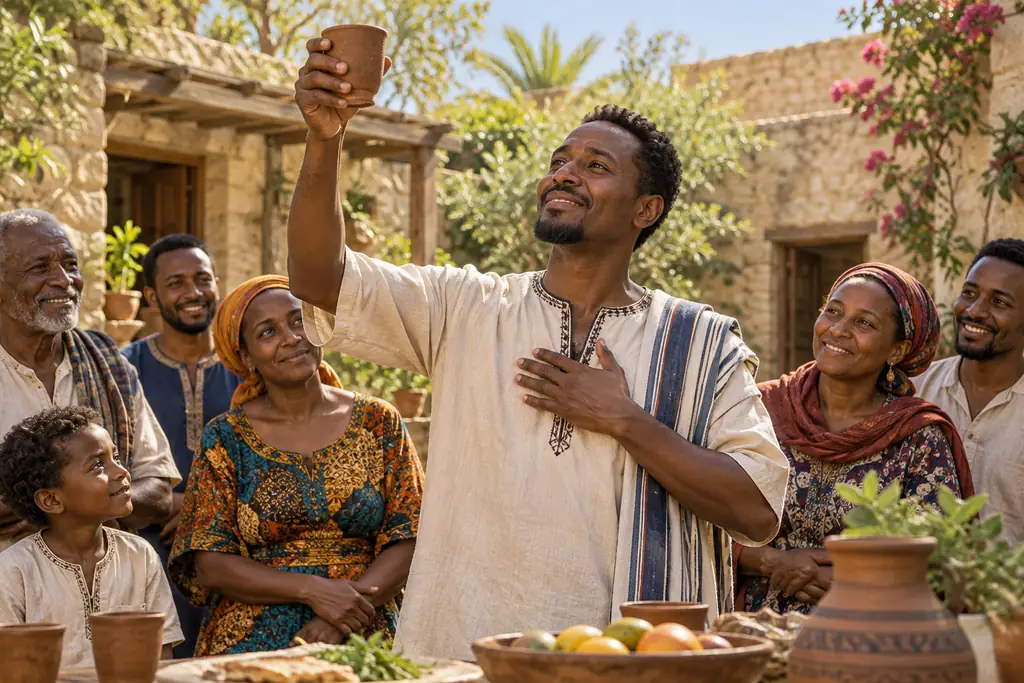
When God hears our cry, how does gratitude change the way we live?
01
Overview
From the grip of death to the courts of thanksgiving: a testimony of mercy, renewed trust, and public praise
Key text — Psalm 116:1–2, 12–13 (study rendering): I love the LORD, for he has heard my voice and my plea for mercy. Because he has turned his ear toward me, I will call on him as long as I live. What can I give back to the LORD for all the goodness he has shown me? I will take the cup of salvation and call on the LORD's name.
There are experiences after which it is difficult to speak. A frightening illness, an accident, betrayal, a season when death feels near: the body may survive while the heart takes longer to believe that danger has passed. Then, sometimes, words return. The first words may not be explanations. They may simply be: “God heard me.”
Psalm 116 is the testimony of someone who has walked close to death, cried out for rescue, and discovered that the LORD was listening. The singer does not turn suffering into a spectacle. Nor does the poem pretend that being rescued has made the person independent of God. Its movement is more searching: love grows from being heard; trust survives frightening honesty; gratitude takes the form of worship and a life newly dedicated to the LORD.
The psalm is intensely personal, yet it refuses to remain private. Its final destination is the gathered community in Jerusalem, where the survivor intends to tell others what God has done.
02
1.0 Introduction
Psalm 116 belongs to the Egyptian Hallel (Pss. 113–118), a collection of praise associated in Jewish tradition with festivals including Passover. Psalm 113 praised the God who raises the lowly; Psalm 114 remembered the Exodus; Psalm 115 called the people to trust the living God rather than powerless idols. Psalm 116 now brings that confession into the life of one worshiper: the living LORD has heard the prayer of a person who nearly died.
The poem follows five closely related movements:
- Verses 1–4 — Love and distress: The singer declares affection and dedication to the LORD because God heard a desperate plea amid deadly danger.
- Verses 5–9 — The character and rescue of God: Grace, righteousness, and compassion become visible in deliverance; the singer calls the soul back to rest.
- Verses 10–11 — Faith under pressure: Trust persists while the worshiper admits affliction, alarm, and profound disappointment in people.
- Verses 12–16 — The gift and the Giver: The rescued person asks what response is fitting, takes up the “cup of salvation,” commits to fulfilling vows, and speaks of a life precious to God.
- Verses 17–19 — Thanksgiving in public: A thank offering, repeated vows, and the courts of the LORD's house turn private deliverance into shared testimony.
John Goldingay calls Psalm 116 a personal thanksgiving or testimony and observes that verses 1–9 and 10–19 form two broadly parallel movements: the first emphasizes what the LORD did, while the second gives greater attention to the worshiper's response (Goldingay 2008, commentary on Psalm 116, “Interpretation”). Derek Kidner similarly traces the movement from danger, through remembered mercy, to fervent gratitude (Kidner, commentary on Psalm 116).
Central message: God's compassion does not make human vulnerability unreal. Instead, the God who hears becomes the ground of love and trust; and authentic gratitude expresses itself not merely in private relief but in truthful testimony, faithful service, and shared worship.
03
2.0 Historical and Literary Context
Psalm 116 does not name an author or identify the event from which the worshiper was delivered. We cannot say with certainty that the crisis was a particular illness, an assassination attempt, a journey, or persecution. Its images of death's cords, tears, stumbling, and the unreliability of people portray a severe threat without supplying a medical report or a political chronology. Kidner notes how the absence of details permits the psalm to speak to many kinds of distress without dissolving its genuine personal intensity.
The setting implied by the conclusion is public sanctuary worship. The worshiper promises to fulfill vows “in the presence of all his people” and “in the courts of the LORD's house” (vv. 14, 18–19). A thank offering is explicitly named (v. 17). Ancient Israel had practices for presenting offerings in thanksgiving, sometimes including a meal shared in the LORD's presence (Lev. 7:11–15; Deut. 12:17–18). The psalm may have been performed on such an occasion, but we should not invent the date, the assembled crowd, or a detailed ceremonial script.
A literary question requires attention. The Greek Septuagint tradition and Jerome's Latin numbering divide the material corresponding to Hebrew Psalm 116 into two psalms, at verse 10. That division recognizes a genuine change of movement: the worshiper who has already spoken of rescue now returns to the experience of affliction. Yet in the Hebrew Psalter, both halves work together. The second does not simply repeat the first; it makes the public responsibilities of thanksgiving clearer (Goldingay 2008, “Interpretation”).
The psalm also echoes other prayers. The cords of death recall Psalm 18:4–6; the confidence of walking before God in the land of the living is related to Psalms 27:13 and 56:13; the call to the soul to rest resembles the practice of addressing oneself in Psalms 42–43 and 103. These links make Psalm 116 part of a continuing tradition of prayer: later worshipers take up the words of earlier ones as their own.
In the broader shape of the Psalter, the poem belongs to Book Five (Pss. 107–150), where songs of deliverance and renewed praise become prominent. Psalm 107 began by calling the redeemed to tell their story; Psalm 116 shows us what one such story sounds like when spoken in the first person.
04
3.0 Walking Through the Text
3.1 Psalm 116:1–2 — Love begins with being heard
The opening declaration is strikingly personal: “I love the LORD.” The reason immediately follows: the LORD heard the singer's voice and plea. The image of God inclining an ear is not a claim that God has a body like ours. It is poetic language for deliberate attention: the high God does not ignore the voice of someone overwhelmed by trouble.
Goldingay offers an illuminating nuance. The opening Hebrew expression can be understood as an act of dedication or commitment, not simply a report of warm feelings. This matters because the singer's love is going to become ongoing service. The phrase “throughout my days I will call” turns a remembered answer into a future pattern of dependence.
Notice that God hearing prayer is the testimony; the psalm does not explain exactly how the deliverance occurred. No single technique of prayer is promised to work automatically. Rather than offering a formula, the singer tells us what made the relationship with God precious: when I cried out, I was not ignored.
3.2 Psalm 116:3–4 — When death seems to tighten its grip
Death is pictured as a hunter or captor whose cords have closed around the worshiper, and Sheol—the realm of the dead in Israel's poetic imagination—as a force from which escape seems impossible. The language can also be translated with an emphasis on the pains or distresses of death. The underlying picture is the same: the speaker was in overwhelming danger (compare Ps. 18:4–6).
In that extremity, the prayer is wonderfully brief: “LORD, save my life!” There is no polished speech and no attempt to impress heaven. A person who has reached the limit of strength may have only a few words left. The psalm insists that such words can still be prayer.
This does not mean that every Christian rescued from illness has prayed better than someone who died, or that death demonstrates a failure of faith. The testimony describes a particular rescue, not an infallible formula for controlling every outcome. That distinction is essential when this passage is read beside hospital beds or graves.
3.3 Psalm 116:5–6 — The God who cares for the vulnerable
The singer moves from personal peril to a confession about the LORD's character: gracious, righteous, and compassionate. Those qualities recall the divine self-revelation in Exodus 34:6–7. God's response is not presented as an unpredictable mood; it is consistent with who he has made himself known to be.
Verse 6 says that the LORD protects the simple. The Hebrew expression can refer to those who are inexperienced, naïve, or without the resources that others possess. It should not be romanticized as though ignorance were a virtue. Kidner emphasizes the humility of the worshiper's identification with people who cannot boast of cleverness or strength; Goldingay sees the singer as someone who had become helpless and nevertheless found the LORD attentive.
“I was brought low, and he saved me.” Grace begins exactly where the illusion of total self-sufficiency breaks down. To recognize weakness is not to celebrate helplessness as an ideal; it is to confess that we cannot manufacture every rescue we need.
3.4 Psalm 116:7–9 — The soul learning to rest again
After the danger, the psalmist speaks to the self: “Return to your rest, my soul.” This resembles the inner conversations of Psalms 42–43, though the tone differs. Here the danger has passed, yet the soul needs time to settle. Goldingay observes that a person may be safe again before the emotions have caught up with the new reality.
Verse 8 names three dimensions of the rescue: life from death, eyes from tears, and feet from stumbling. The language joins survival, grief, and the ability to continue living. None of these should be reduced to a mechanical promise that believers will never suffer again.
The speaker resolves to walk before the LORD in the land of the living. In its first setting, this expresses the gift of continued earthly life in God's presence. It does not itself provide a complete doctrine of resurrection or the intermediate state. Yet it belongs in a biblical story that will later express resurrection hope more explicitly (Isa. 25:8; Dan. 12:2; 1 Cor. 15). For now, the great wonder is the opportunity to live faithfully today.
3.5 Psalm 116:10–11 — Faith that can admit fear and disappointment
The second movement begins with a difficult line translated in different ways. Many English versions read, “I believed, even when I said, ‘I am greatly afflicted.’” Goldingay emphasizes trust emerging through the speaker's admission of weakness; Kidner sees a faith that remained alive while the person felt crushed. The wording also stands behind the form Paul cites in 2 Corinthians 4:13: “I believed, and so I spoke.”
The next line recalls a moment of alarm when the singer declared, “All people are liars.” We should hear this as the language of a frightened and disappointed person, not as an exhaustive doctrine that no human relationship is trustworthy. Suffering can make the failure of those on whom we depended feel universal.
Here the psalm models an important kind of honesty: faith does not always speak in calm tones. Some believers ask difficult questions, admit despair, or confess how abandoned they feel. Such speech may reveal the struggle of faith, not its absence. Wise listeners should meet it with compassion rather than forcing the sufferer to pretend.
3.6 Psalm 116:12–14 — What shall I give back?
The central question of the thanksgiving is not “How can I make God owe me more?” but “What shall I return to the LORD for all his goodness to me?” The answer begins with the “cup of salvation” or “cup of deliverance.”
Its exact ritual referent is uncertain. Goldingay discusses the possibility of a drink offering and the possibility of a cup associated with a shared thanksgiving meal. Kidner stresses the paradox that the response to salvation begins by receiving or taking up a sign of God's gift, not paying God back as an equal partner. Both readings connect the cup to thanksgiving. The text itself does not say that the cup is directly the later Christian communion cup, though Christians may notice resonances when reading the passage alongside the Last Supper.
The singer also promises to call on the LORD's name and fulfill vows before the people. In verse 4, calling on the name meant pleading for rescue; here it means publicly acknowledging the One who rescued. A vow was a serious commitment, not a purchase price for divine favor (Deut. 23:21–23; Eccl. 5:4–5). The worshiper had asked for mercy, and now intends to keep the promises associated with that appeal.
Thanksgiving is therefore more than a feeling. It is remembered goodness given a voice and a fitting action.
3.7 Psalm 116:15–16 — A life too precious to treat lightly
Verse 15 is one of the most frequently quoted and misunderstood statements in the psalm: “Precious in the sight of the LORD is the death of his faithful ones.” Read alone, it can sound as though God takes pleasure in the deaths of good people. In context, however, the singer is praising God for rescue from death.
The adjective translated “precious” can suggest something costly, weighty, or greatly valued. Kidner argues that the sense costly fits the preceding deliverance better than an expression of delight in death; Goldingay takes the verse to affirm that the lives of those devoted to the LORD matter deeply to him. The verse should not be deployed to silence mourners or claim that God is pleased by preventable harm.
The next verse returns to the worshiper's identity: “I am your servant, the child of your servant; you have loosened my bonds.” Being God's servant is not pictured here as a new imprisonment. The LORD has freed the singer from the cords that bound him. Goldingay notes the paradox: belonging to this Lord means release from a crueler captivity.
Nor does the confession imply that faithful people can never die. The psalm celebrates one real rescue and reveals the worth of life before God. The broader scriptural hope must be sought in the Bible's unfolding witness, not forced into one line.
3.8 Psalm 116:17–19 — Private deliverance becomes public testimony
The poem closes by repeating its promise: a thanksgiving sacrifice, calling on the LORD's name, and fulfilling vows before all God's people. Repetition here is not empty. It shows the speaker's determination to make the grateful response visible.
The location is now named: the courts of the LORD's house, in the midst of Jerusalem. The psalm started with the words of an individual and ends with the community's worship. The singer's story becomes a shared memory: people who were not present in the crisis now hear why the LORD is being praised.
Public testimony requires truthfulness. A church should make room for stories of rescue without turning them into advertisements for a preacher, demands for money, or proofs that those still suffering lack faith. The redeemed person can tell the story and still leave room for another worshiper to say, “I am waiting.”
The final summons—“Praise the LORD!”—is an invitation for the whole congregation to join in acknowledging God's mercy.
05
4.0 Theological Reflection
4.1 Love responds to God's gracious attention
The psalm begins with love but grounds it in the LORD's hearing. Love is not here a method for extracting blessings; it grows from encountering the God who listens. This does not make prayer into a bargaining arrangement. God is gracious before any worshiper speaks, and God's compassion cannot be measured simply by how quickly circumstances improve.
A responsible theology of prayer must allow both Psalm 116 and the unanswered cries of Psalm 88 to remain in the Psalter. Testimony and lament belong together. The church needs both voices.
4.2 Vulnerability is not spiritual inferiority
The person who calls to God admits to being weak, frightened, and unable to rely confidently on human help. Yet the psalm calls such a person a fitting recipient of grace. We must not use the language of “the simple” to excuse manipulation or discourage learning. Instead, the psalm warns communities not to value only the influential, educated, healthy, or materially secure.
A congregation reflecting God's compassion will listen seriously to people whose distress makes them easy to overlook: the hospitalized, prisoners, elderly people who live alone, families carrying grief, and those burdened by financial hardship.
4.3 Salvation deserves a whole-life response
The question “What shall I return?” is not answered by pretending we can repay the infinite goodness of God. It produces a life of testimony, worship, fidelity, and responsible promise-keeping. Sacrificial gratitude cannot be reduced to an offering envelope or a moment of emotional excitement.
A saved life is meant to be lived before the LORD (v. 9): with integrity, service, and concern for the lives God values. Grace is freely received and actively embodied (Rom. 12:1; James 2:14–17).
4.4 Life is precious even when mortality remains
Psalm 116 affirms the worth of the faithful in God's sight while remaining situated in a world of death. It is neither a denial of human mortality nor a guarantee of uninterrupted prosperity. The singer is grateful for renewed time; others may not receive the same temporal outcome.
Christian care should therefore celebrate recoveries without making those who died seem less loved. It should seek appropriate medical treatment, offer practical support, and grieve honestly where rescue has not come.
4.5 Testimony is shared responsibility, not personal branding
The movement into Jerusalem's courts means that the individual's story belongs to the worship of the LORD, not to the cultivation of the speaker's reputation. The testifier is not the hero who mastered death. The LORD is the One to whom gratitude points.
An honest testimony identifies what happened, acknowledges what remains unknown, and invites others to praise without pressuring them to imitate a particular emotional response. In this way personal stories strengthen the whole community.
06
5.0 Canonical and Christological Horizon
Psalm 116 resonates with Exodus 34:6–7, where the LORD reveals himself as compassionate and gracious. It also belongs near Psalm 115, where Israel is called to trust the God who truly lives and acts. Its mention of thanksgiving sacrifice stands within Israel's covenant worship (Lev. 7:11–15). These connections should be heard before moving to Christian applications.
The “cup of salvation” invites a careful canonical comparison. Jesus shares a cup with his disciples at his final meal and speaks of his own impending suffering in Gethsemane (Luke 22:14–20, 39–44). The cup imagery in those texts cannot simply be equated with Psalm 116's uncertain ritual detail. Yet Christian readers may see a larger contrast and relationship: God's salvation is celebrated as a gift, while Jesus willingly bears suffering to bring that saving purpose to fulfillment. The Lord's Supper becomes an act of remembrance and thanksgiving centered on his death and the new covenant (1 Cor. 10:16; 11:23–26).
Verse 10 has a more explicit New Testament connection. Paul cites its Greek-scripture form in 2 Corinthians 4:13 as he explains that trust in God gives him courage to speak while carrying suffering and the prospect of death. The context immediately proceeds toward the hope that God, who raised Jesus, will also raise his people (2 Cor. 4:14). Paul does not deny affliction. He sees resurrection hope as a reason to persevere and testify through it.
The Gospel narratives likewise portray Jesus praying earnestly amid anguish, and the New Testament places his death and resurrection at the center of God's action against death (Mark 14:32–42; 1 Cor. 15:20–26). Christians can therefore read Psalm 116 with gratitude for rescue in the present and hope for final resurrection. The psalm's first speaker, however, is describing deliverance that allowed continued life in the land of the living; we should not pretend that every line originally described the later events of Jesus' passion.
Finally, the psalm's call to bring personal thanksgiving into public worship echoes the New Testament's vision of a community that bears one another's burdens, gives thanks together, and tells of God's works without concealing sorrow (Gal. 6:2; Heb. 10:23–25; 13:15–16). Christian testimony is most faithful when it produces compassion and courage as well as words.
07
6.0 Life Application
- Pray simply when you have no strength for polished words. The cry “LORD, save my life” reminds us that honesty is more important than impressive religious language. In emergencies, seek appropriate human help as well as spiritual support.
- Let recovery include time for the heart to rest. When a crisis passes, emotions may remain unsettled. Give yourself and others patience; appropriate counseling, medical follow-up, companionship, and prayer can all be part of recovery.
- Tell the truth about what happened. If you give a testimony, distinguish what you know from what you infer. Avoid exaggeration and never suggest that those who remain ill have prayed less faithfully.
- Keep the promises you make. The singer's vows were not a payment for grace. Nevertheless, gratitude calls for integrity. Examine commitments to family, community, and God, and fulfill what is responsible and possible.
- Make thanksgiving a form of service. Support someone recovering from sickness, visit a lonely person, offer help to a struggling household, or contribute to just and compassionate work. Gratitude becomes visible through love.
- Give space to testimony and lament in the same congregation. Celebrate answered prayers while standing beside people still facing uncertainty. A faithful church needs no competition between joy and tears.
- Remember whose life is precious. God does not treat vulnerable lives as disposable. Advocate for truthful care, patient dignity, and protection of those overlooked or endangered.
08
7.0 Reflection Questions
- Why does the singer begin with love for the LORD rather than with a detailed account of the crisis?
- How does the brief prayer of verse 4 challenge our ideas about what makes a prayer effective?
- What might it mean for a soul to “return to rest” after a crisis has apparently ended?
- How can a person continue to trust while feeling crushed or deeply disappointed in others (vv. 10–11)?
- What does the “cup of salvation” teach about receiving grace and responding with gratitude, even though the exact ritual remains uncertain?
- How does the psalm's context clarify what verse 15 means when it says death is “precious” in God's sight?
- What practices would help a church honor both people who testify to rescue and people who continue to wait?
09
8.0 Response Prayer
LORD, you are gracious, righteous, and full of compassion. When fear closes around us and words fail, teach us to call on you without pretending to be strong. Where you have brought us through danger, give us truthful gratitude and patient hearts. Where suffering continues, do not let us confuse delay with abandonment or another person's death with your lack of love. Restore rest to those whose bodies have survived but whose minds still tremble. Help us keep our promises, use our renewed days well, and honor the lives that are precious to you. Make our testimonies humble, our worship sincere, and our communities places where the rejoicing and the grieving can stand together. Through Jesus Christ, whose resurrection grounds our lasting hope, receive our thanksgiving and strengthen our trust. Amen.
10
9.0 Window into What Comes Next
Psalm 116 begins with one voice: “I love the LORD, because he heard me.” The singer remembers danger, gives thanks for deliverance, and ends in the public courts of worship. A private rescue has become a reason for the gathered community to praise.
Psalm 117 opens that gathering to the nations. It is the shortest psalm, yet its invitation is immense: all nations and all peoples are called to praise the LORD because his steadfast love and faithfulness endure. The movement from Psalm 116 to Psalm 117 is therefore from one rescued person's testimony to a worldwide summons.
When a community tells its story faithfully, it does more than celebrate its own survival. It helps others hear why the living God is worthy of trust.
11
10.0 Bibliography
- Scripture: Psalm 116; Psalms 18:4–6; 27:13; 30; 42–43; 56:13; 88; 103; 107; 113–118; Exodus 34:6–7; Leviticus 7:11–15; Numbers 15:1–10; Deuteronomy 12:17–18; 23:21–23; Ecclesiastes 5:4–5; Isaiah 25:8; Daniel 12:2; Mark 14:32–42; Luke 22:14–20, 39–44; Romans 12:1; 1 Corinthians 10:16; 11:23–26; 15:20–26; 2 Corinthians 4:13–14; Galatians 6:2; Hebrews 10:23–25; 13:15–16; James 2:14–17. The opening key text is a study rendering, not a verbatim quotation from a named modern Bible translation.
- BibleProject. n.d. The Book of Psalms: Study Notes. Overview of the Psalter's literary design and the movement from lament to praise.
- Goldingay, John. 2008. Psalms, Volume 3: Psalms 90–150. Baker Commentary on the Old Testament Wisdom and Psalms. Grand Rapids, MI: Baker Academic. Commentary on Psalm 116, “How to Give Your Testimony (II).”
- Kidner, Derek. Psalms 73–150. Kidner Classic Commentaries. Downers Grove, IL: InterVarsity Press. Originally published 1975; reissued in classic-commentary format. Commentary on Psalm 116, printed pp. 442–446.


Be the first to leave a comment.