

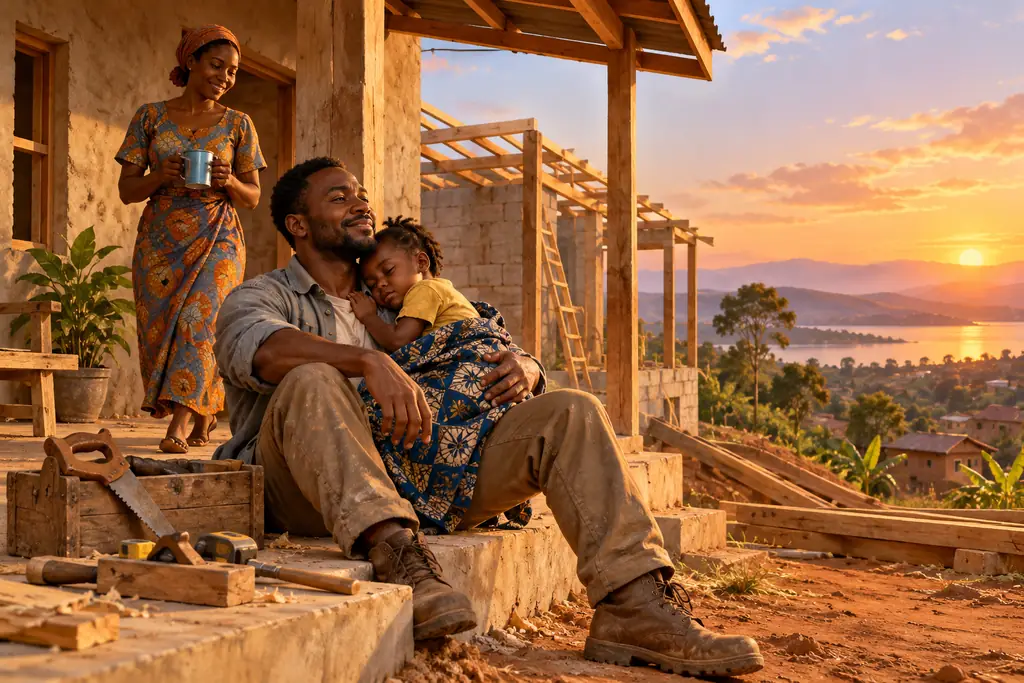
How can we work responsibly and rest without pretending we control everything?
01
Overview
The eighth Song of Ascents: learning to build responsibly without pretending to control the future
Key text — Psalm 127:1–2 (study rendering): “Unless the LORD builds the house, its builders labor for nothing. Unless the LORD watches over the city, the watchman stays awake for nothing. It is futile to rise so early and sit down so late, eating bread gained through anxious toil; for he gives sleep to those he loves.”
Some people lie awake thinking about the house they must build, the school fees they must pay, the work they cannot afford to lose, or the people whose safety depends on them. Others lead churches or organizations and secretly fear that everything will fall apart if they rest for a single day. Their labor is often sincere. Their responsibility is real. Yet somewhere along the way, responsibility can harden into the conviction that everything depends on them.
Psalm 127 speaks directly into that exhaustion. It does not despise builders, watchmen, parents, or workers. Instead, it asks a more unsettling question: Who finally makes their efforts fruitful? A well-made plan is not the same as control over life. An alert guard cannot foresee everything. A loving parent cannot manufacture a child's future. God is not an optional ornament placed on work after the important decisions have been made. His generous involvement is what makes human life possible in the first place.
The surprise is that the psalm turns from construction and sleeplessness to children. At first these may seem like unrelated subjects. But both halves ask what it means to receive the future rather than seize it: a house is not secured by frantic effort alone, and a household is not produced as a personal achievement. We build and protect what we can. We receive and care for what we cannot make by ourselves.
02
1.0 Introduction
Psalm 127 is the eighth of the fifteen Songs of Ascents (Psalms 120–134). Its heading associates it with Solomon, the king remembered for building the temple, constructing royal projects, and speaking wisdom (1 Kings 6–9; Proverbs 1:1). Its five verses are compact, yet they touch three matters that can dominate an entire life: building, security, and family.
Two movements shape the psalm:
- The limits of human control (vv. 1–2). A house needs builders, a city needs guards, and people need to work. Yet effort cannot guarantee the desired result. God, who continues to act while his creatures sleep, is the ground of security.
- The gift of the next generation (vv. 3–5). Children are described as a gift from the LORD, and grown sons are pictured as arrows supporting a family when public conflict arises at the city gate. The picture reflects an ancient social world and must be interpreted carefully rather than copied without qualification into every modern family.
Both sections offer wisdom for people who shoulder responsibility. The psalm neither recommends carelessness nor promises that faith makes plans succeed. It challenges self-sufficiency and encourages faithful participation in the gifts of God.
Its position after Psalm 126 is particularly meaningful. Psalm 126 remembers restoration and pictures people sowing seed through tears. Psalm 127 asks what makes sowing, building, guarding, and raising a family bear fruit. The answer is not that our work is useless, but that our work is never enough to become its own foundation. Psalm 128 will then depict the blessing of an ordered family life and a community sharing peace.
03
2.0 Historical and Literary Context
A Song of Ascents associated with Solomon
The superscription reads, in effect, “A Song of Ascents. Of Solomon.” The Hebrew designation may indicate authorship, association, dedication, or use within a Solomonic wisdom tradition. We should not claim to know precisely when Solomon—or a later worshiper shaped by his legacy—first composed or used the song. Goldingay notes that its subject concerns settled life in a house and city rather than a traveler's immediate experience. Its inclusion among the Songs of Ascents does, however, give pilgrims a lesson to carry home: worship must change the way everyday responsibilities are held.
The connection to Solomon is striking. He built the LORD's temple and an extensive royal complex (1 Kings 6–7); he fortified cities and organized labor (1 Kings 9). He also received the name Jedidiah, meaning “beloved of the LORD” (2 Samuel 12:24–25), making “his beloved” in Psalm 127:2 especially suggestive. Kidner observes that the wisdom of this psalm can be read as a warning even against Solomon's later excesses. Ambitious construction and political strength did not protect his kingdom from the consequences of divided loyalty (1 Kings 11). This is a powerful canonical irony, not proof that verse 2 is an intentional coded signature.
Two wisdom poems held together
At first glance, the poem appears to change subjects abruptly after verse 2. Goldingay describes its two movements as short teachings that could sit comfortably within Proverbs. Some interpreters have therefore wondered whether they began independently. Yet their placement creates a persuasive unity.
The first part speaks of builders, Hebrew bonim, and the second of sons, banim. Their similar sounds draw together a physical house and the people who make a household. The poem moves from the house to the guarded city in verse 1, then returns to the city gate in verse 5. Both halves begin with the LORD's involvement. What looks like a change from architecture to parenthood is a movement from a structure that people construct to relationships and a future they must receive.
The threefold expression “in vain” in verses 1–2 is deliberate. It strips away the assumption that increasing effort always increases security. Yet the psalm does not use precisely the same Hebrew word as the familiar “vanity” (hebel) of Ecclesiastes. Goldingay emphasizes the risk that carefully planned work can fail despite sincere effort; Kidner also asks whether outwardly successful achievements are worth having if they were built apart from God. The emphases differ, and together they illuminate the text's challenge.
House, city, sleep, and children in ancient Israel
A house might be a dwelling, a family, or a continuing household. Elsewhere God promises to build David a “house,” meaning an enduring royal line (2 Samuel 7:11–16). In Psalm 127 the term remains usefully open: what God builds may include both a place and the relationships that give that place its meaning.
Ancient cities needed guards who stayed awake at night to watch for danger. Families also depended on shared labor and the support of adult children. Public business—including disputes, judgments, and transactions—could be conducted at city gates (Ruth 4:1–12; Proverbs 31:23). Such details help explain why sons are compared to arrows and imagined speaking with adversaries there. The psalm describes a particular patriarchal social arrangement; it does not settle the value of daughters, dictate family size, or imply that people without children stand outside God's blessing.
Four translation and interpretation questions
First, verse 1 does not explain which house is intended. Temple, dwelling, household, and city-building associations all resonate, but no one should be imposed as the only meaning.
Second, the last clause of verse 2 can be translated “he gives sleep to his beloved” or “he gives to his beloved in sleep.” The Hebrew grammar permits discussion. The first emphasizes rest as God's gift; the second stresses God's continuing provision beyond human effort. Goldingay considers both; Kidner argues that “sleep” is probably part of the actual contrast despite linguistic difficulty. Neither reading praises laziness.
Third, the word translated “heritage” in verse 3, Hebrew nahalah, describes a valued gift or allotment. It should not be pressed into a claim that a parent owns children as property. Children possess dignity and responsibilities of their own.
Fourth, verse 5 likely describes a public or legal confrontation at the city gate, with family members standing together rather than a literal battle. Goldingay discusses a less likely verbal reading connected with overcoming adversaries, but favors ordinary “speaking” in a dispute. The picture is about social support and protection, not permission for intimidation.
04
3.0 Walking Through the Text
3.1 Psalm 127:1a — “Unless the LORD builds the house, the builders labor in vain”
The first sentence begins by naming real human workers: builders. The psalm does not say they should put down their tools. Walls require planning, materials, skill, time, and cooperation. A leaking roof does not repair itself through prayer. The builders' work matters enough for the poem to mention it.
But its lasting significance depends on more than the people who perform it. “Unless the LORD builds” directs attention to the difference between working as stewards and acting as ultimate owners of the future. The sentence confronts anyone who imagines that financial resources, technical expertise, influence, or religious enthusiasm can guarantee an outcome.
In ancient Israel, a house was not merely private real estate. It represented shelter, kinship, livelihood, memory, and continuity. Building a house could mean establishing a community able to welcome and sustain life. The LORD's involvement therefore concerns the quality and purpose of the household, not simply a project completed ahead of schedule. A splendid structure can still shelter manipulation, cruelty, or loneliness. A modest home can become a place of prayer, hospitality, safety, and faithful love.
Goldingay warns against tying “house” to one specific institution. The principle can address the Jerusalem temple, a family dwelling, a royal dynasty, or the rebuilding of a wounded community. Its openness is deliberate. At every level, human ability is necessary but limited.
The same verse is sometimes misused to say that a failed project proves God refused to bless it. The psalm does not authorize such certainty. Poverty, conflict, exploitation, illness, and sudden disasters can defeat good work. It is the illusion of complete human control that is challenged here, not the worth of those whose efforts have been disappointed.
For a church, the question becomes more searching than “Did we finish the building?” We must also ask: Does what we have built serve the people God loves? Is it honest? Is it safe? Does it enable worship, justice, education, and care? A religious structure is not made holy by its appearance alone (compare Jeremiah 7:1–11).
3.2 Psalm 127:1b — “Unless the LORD watches over the city, the watchman stays awake in vain”
The image now moves beyond the house to the wider community. Someone stands guard while others sleep. The watchman is alert precisely because danger exists. A city's well-being depends on care for its shared spaces and protection of its inhabitants.
The irony is sharp. The watchman may remain perfectly awake and still fail to prevent what comes. Human vigilance cannot see every threat. It cannot change every heart or control every event. The biblical writers knew well that walls could fall and rulers could betray their people. Jerusalem's fall made that painfully clear (2 Kings 25).
Yet nothing in the verse instructs the guard to abandon the watch. Goldingay explicitly observes that God's guarding does not replace the watchman's responsibility. Psalm 121 has already confessed that Israel's Keeper never slumbers, but it does not forbid travelers from preparing wisely. Divine care and human duty belong together without being interchangeable.
The same principle applies to public health, safeguarding children, financial accountability, hospital care, road safety, and church leadership. Trust in God is not a reason to leave dangerous wiring unrepaired, ignore a credible accusation, or neglect professional help. Prayer should make our vigilance humble and responsible, not less attentive.
At the same time, fear can become a ruler of the city. Leaders may promise absolute security if everyone gives them unlimited authority. The psalm quietly exposes that promise as false. Only the LORD can claim the final sovereignty that anxious human beings attempt to imitate.
3.3 Psalm 127:2a — “In vain you rise early and sit down late”
The first two sayings were framed as general observations. Now the poem addresses its listeners: “you.” It names the rhythm of a life squeezed between a too-early beginning and a too-late ending. A person's schedule can become a confession of faith—or a confession of fear.
There are times when unusual hours are unavoidable. A nurse on night duty, a farmer during planting, or a parent caring for a sick child is not condemned by this verse. Neither should people trapped in exploitative labor be blamed for the hours they must work to survive. The psalm challenges the anxious attempt to secure life by unending personal effort, not every instance of exhausting labor.
Goldingay gives the warning unusual force: we may be so convinced that our work is indispensable that we neglect the gift of rest. Even people engaged in ministry can begin acting as though God must rely on their sleeplessness. That temptation is especially powerful because work that serves others is genuinely important.
The psalm asks us to distinguish faithful diligence from compulsive self-reliance. Diligence says, “There is good work entrusted to me.” Self-reliance says, “Unless I do everything, nothing can survive.” The second claim makes the worker responsible for what only God can govern.
3.4 Psalm 127:2b — “Eating the bread of anxious toil”
The result of these endless hours is not necessarily riches. It is bread—food needed for ordinary life—eaten with exhaustion. Work has ceased to be a meaningful contribution and has become a consuming anxiety. The meal that should refresh the household carries the taste of pressure.
The imagery echoes the troubled condition of labor in Genesis 3:17–19. Food now comes with toil, sweat, and vulnerability. But Psalm 127 is not telling people to escape the created world or abandon productive activity. The same Scriptures celebrate skill, cultivation, commerce, and service (Genesis 2:15; Proverbs 31:13–27). The problem is work severed from trust and the possibility of rest.
For families facing economic hardship, this verse must not become an accusation: “You work too hard because you lack faith.” Some work relentlessly because wages are inadequate, debts are predatory, or access to opportunity is unequal. A community that takes the psalm seriously will confront those conditions, not merely urge the exhausted to relax.
A church can pray over livelihoods and also support fair treatment, practical skills, honest employment, and mutual aid. Dependence on God should increase attention to the people whose labor is keeping a community alive at great personal cost.
3.5 Psalm 127:2c — “He gives sleep to his beloved”
After three emphatic declarations of futility, the poem offers an unexpectedly gentle word: sleep. In contrast to anxious striving, God gives rest to those he loves. We cannot keep ourselves awake forever; our limits are part of being creatures, not evidence of failure.
The Hebrew also permits the sense “he gives to his beloved while they sleep.” On that reading, God's work continues when human hands are folded and minds are no longer calculating. The interpretations emphasize different aspects of the same truth: the LORD is free to give what effort alone cannot produce.
Psalm 121:4 says that Israel's Keeper does not slumber or sleep. Psalm 127 invites God's people to do what their Keeper does not need to do: rest. We are not God. The trust implied in closing one's eyes can itself become an act of worship.
But this verse is not a medical guarantee that every faithful person will sleep easily. Insomnia, grief, trauma, physical pain, irregular shifts, and illness are real. Those who cannot sleep should receive care, prayer, and appropriate treatment—not suspicion of spiritual weakness. The promise is about God's loving rule and our creaturely dependence, not a test that separates good believers from bad sleepers.
The Solomonic heading adds a possible echo. Solomon was called Jedidiah, “beloved of the LORD” (2 Samuel 12:25). Kidner notes the verbal connection, while Goldingay sees it as fitting the psalm's attribution. Yet the promise extends beyond a king. The message is addressed to ordinary people whose lives seem to depend on one more hour of labor.
3.6 Psalm 127:3 — “Children are a heritage from the LORD, the fruit of the womb a reward”
The poem appears to change direction. Suddenly it speaks about children. Yet the word “house” now takes on its relational meaning. People may construct a dwelling, but the future of a household is more than a finished building. It involves lives entrusted to other lives.
In the ancient setting, “sons” were particularly important for a household's continuity, livelihood, and public defense. The Hebrew line celebrates descendants as a valuable gift—a nahalah, or inheritance/allotment—from God. This is the opposite of presenting children as products that parents can manufacture through their own willpower.
“Reward” does not mean wages paid because the parents have earned divine approval. Goldingay cautions against pressing the commercial connotation too far. Scripture contains beloved people who suffer infertility or family loss: Hannah before Samuel's birth (1 Samuel 1), Elizabeth before John (Luke 1:5–25), and many others whose stories are not neatly resolved. Some parents lose children; others remain childless. Psalm 127 is wisdom celebrating a particular blessing, not a ranking of people by fertility.
Nor does the text authorize treating children as property or valuing sons above daughters. Although the imagery reflects a setting in which sons had special public roles, Scripture also recognizes the agency and worth of daughters (Numbers 27:1–11), mothers, widows, and those without descendants. Jesus welcomes children as persons worthy of care, not as trophies for adults (Mark 10:13–16).
A gift generates a responsibility. To call a child “from the LORD” is to refuse neglect, exploitation, and violence. Education, food, affection, protection, patient correction, and an opportunity to grow into responsible adulthood are all ways of honoring that gift. The verse does not count children in order to assign parents spiritual status; it points us toward grateful stewardship.
3.7 Psalm 127:4 — “Like arrows in the hand of a warrior are the sons of one's youth”
The comparison is vivid. An arrow extends a warrior's reach beyond his immediate position. In the psalm's world, sons born while a father was young would grow strong as he became older and faced public responsibilities. Their support could strengthen his position when challenged.
The imagery is a simile, not a parenting manual or a command to prepare children for violence. Goldingay notes that the poem's attention is on sons' usefulness in the society being described; it does not offer a complete account of the lives of children, daughters, or mothers. Modern readers should acknowledge that limitation rather than disguise it.
It would also be mistaken to treat children as weapons for a parent's ambitions. The desire to produce successful heirs can crush young people under expectations they did not choose. An arrow in the poem represents potential support; a son or daughter in real life is a human being called to love God and neighbor, and is not an extension of a parent's ego.
The strongest application, therefore, is not “train your children to fight your enemies,” but raise and support the next generation so they can contribute courageously to a just and compassionate community. Such formation includes teaching truthfulness, responsibility, mercy, discernment, and the wisdom to resist violence.
3.8 Psalm 127:5a — “Blessed is the man whose quiver is full of them”
A full quiver evokes abundance and preparedness. In the ancient household described by the psalm, multiple adult sons offered additional support. The word “blessed” recognizes a good gift without requiring everyone to possess it.
We must resist converting the picture into a divine demand for large families. The psalm does not instruct couples how many children to have. It does not say that childless people are cursed, that adoption is inferior, or that the safety and health of parents should be disregarded. Wisdom poetry describes a benefit in a particular social context; it is not a universal fertility policy.
There is also a community dimension that extends beyond biological parenthood. A family may include children raised by relatives, guardians, adoptive parents, or a whole fellowship of caring adults. Scripture's larger vision of God's people creates belonging that transcends ancestry (Isaiah 56:3–5; Mark 3:31–35; Ephesians 2:19). This does not erase the psalm's original interest in descendants, but it prevents that interest from becoming a reason to shame those whose households look different.
Real abundance is not just a number. A home filled with people but without justice or tenderness is not the flourishing envisioned by God's wisdom. A smaller household marked by love, safety, and shared responsibility may reveal profound gifts from the LORD.
3.9 Psalm 127:5b — “They will not be ashamed when they speak with enemies in the gate”
The final line moves us back to the city. The gate was not merely an entrance. It could be a place for negotiations, public hearings, trade, and legal decisions (Ruth 4:1–12). There a person might face accusations, conflict, pressure, or attempts to exploit a vulnerable household.
Goldingay argues that the verb most naturally means “speak”—perhaps in a legal or quasi-legal confrontation—rather than attack physically. The family members stand together and defend their interests publicly. The earlier image of arrows supplies the language of strength, but the actual scene may be one of words, testimony, and public accountability.
This detail takes us back to the first verse. There the LORD must guard the city; here a household contributes to its own defense within that city. The psalm neither worships human power nor abolishes responsibility. The community's future depends upon God's gift expressed through faithful human solidarity.
The ancient social arrangement requires ethical discernment. Justice cannot be allowed to depend on whether a person has several strong adult sons. What of a widow, an orphan, a newcomer, a person with disabilities, or someone living alone? Israel's law calls the community to protect those without powerful defenders (Deuteronomy 10:18–19; 24:17–22). A faithful reading of Psalm 127 should move us toward justice at the gate for everyone, not favoritism toward well-connected families.
For Christians, the final image can become an examination of community character. Do our families and congregations stand with the falsely accused and the vulnerable? Or do we use our numbers, status, and connections to overwhelm the weak? A household that knows its strength comes from God has reason to use that strength for justice.
05
4.0 Theological Reflection
4.1 God's provision is foundational, not an excuse for passivity
Psalm 127 does not place God on one side and human beings on the other, as though only one could act. Builders still build, guards still watch, and parents still care. But these activities are dependent acts. Psalm 126 has already shown people sowing while asking God for restoration. Proverbs 16:3 and 16:9 likewise pair human plans with the LORD's directing care.
Theological dependence does not eliminate budgets, engineering, safety procedures, medical advice, schooling, or wise planning. It locates those activities within gratitude, accountability, and limits. We work neither as gods nor as spectators. We work as creatures whose abilities are themselves received.
4.2 Security is a good responsibility but a poor savior
The watchman's vocation is honorable. Parents and leaders should take practical steps against harm. Yet fear can make safety into an idol. When absolute security becomes the highest goal, people can justify cruelty, secrecy, and unchecked power in its name.
Psalm 127 reminds us that no surveillance system, savings account, political alliance, or religious institution can guarantee the future. The LORD is not a substitute for responsible protection; he is the one who exposes the limits of every human protection. This truth should humble powerful people and console those who cannot purchase their own safety.
4.3 Rest is a confession that we are loved before we finish
The most radical phrase may be “his beloved.” God does not first demand an impossible amount of productivity before allowing a person to be loved. The gift of sleep challenges the fear that our worth depends on constant output.
The Sabbath command similarly sets a boundary around work and includes servants, foreigners, and animals in its scope (Exodus 20:8–11; Deuteronomy 5:12–15). Rest is thus social as well as personal. Leaders who celebrate their own rest while denying fair working conditions to others have not understood the biblical pattern.
4.4 A household is received, nurtured, and shared
Children are gifts; they are not guarantees, wages, or possessions. The psalm's ancient emphasis on sons and fathers should be read within the wider biblical insistence that vulnerable lives matter to God. Biological family can be a place of deep blessing, but it can also fail. The faith community is called to embody adoption-like welcome, practical solidarity, and protection for those who lack family support.
The question is not only how many members a household contains. It is also what kind of life people experience within it. A home built with God's help must never use religious language to cover domination or abuse. Blessing calls for greater responsibility toward the vulnerable, not stronger claims of ownership over them.
4.5 The Bible's wisdom is not a prosperity formula
A builder who prays may still lose a project. A guard who acts wisely may still suffer violence. A couple who loves God may remain childless. The psalm does not give us the authority to reverse these tragedies into accusations of insufficient faith.
Wisdom poetry states truths about living under God's care; it does not supply a mechanical equation linking righteousness to visible success. Ecclesiastes and Job challenge simplistic assumptions, while the Psalms themselves contain many prayers from faithful people who suffer. God's love cannot be measured by construction completed, nights slept, or children born.
4.6 Our private ambitions affect the whole community
The poem begins with a house and city and ends at the city gate. Personal aspirations are never wholly private. Building can create shelter or exclude the poor; security measures can protect neighbors or intimidate them; children can be nurtured as future servants of the common good or taught to defend privilege at any cost.
A biblical account of flourishing asks what a family or institution gives to the community, not merely what it acquires. The city gate becomes a moral test: will the strength received from God protect justice or distort it?
06
5.0 Canonical and Christological Horizon
Solomon's house and the promise to David
The Solomonic heading places Psalm 127 beside biblical stories of building a temple and establishing a royal household. In 2 Samuel 7:5–16, David proposes to build God a “house,” but God responds by promising to establish David's house—a royal line. The reversal is close to Psalm 127's logic: God's gift precedes and exceeds royal initiative.
The historical Solomon also illustrates the warning. The temple's splendor did not make disobedience harmless, and a powerful political structure could not preserve the kingdom from internal collapse (1 Kings 11–12). Psalm 127 should therefore not be turned into a slogan that any impressive religious building automatically enjoys God's approval. God cares about covenant loyalty and the people for whom buildings exist.
Jesus, the trustworthy builder and the gift of rest
Jesus' teaching about anxiety (Matthew 6:25–34) echoes the psalm's distinction between responsibility and self-consuming worry. He does not tell disciples to abandon life's needs. He teaches them to seek God's kingdom and justice rather than allowing fear to become their master.
In Mark 4:35–41, Jesus sleeps during a storm while his disciples panic. The scene has its own purpose—revealing his authority and challenging their fear—and should not be presented as a direct quotation of Psalm 127. Yet it offers a striking narrative conversation partner: trust can rest amid genuine danger. Jesus also invites the weary to come to him for rest (Matthew 11:28–30).
The New Testament later describes believers as God's building (1 Corinthians 3:9–11) and as a household in which Christ is the cornerstone (Ephesians 2:19–22). Paul can plant and another can water, yet it is God who gives the growth (1 Corinthians 3:6–7). These texts do not mean Psalm 127 originally predicted church construction. They develop the same theological pattern: meaningful human labor depends on God's life-giving action.
From biological households to a new community
Jesus welcomes children and warns against placing obstacles before them (Mark 10:13–16). Yet he also creates a family shaped by doing God's will (Mark 3:31–35), and the apostolic community learns to understand belonging in Christ beyond bloodline and social rank (Galatians 3:26–29; Ephesians 2:19). The early church therefore must not define spiritual worth by fertility or a traditional household arrangement.
In the gospel, people who have lost families, experienced infertility, been widowed, or lived without marriage can belong fully within God's people. This broader vision should shape how Christians hear the ancient celebration of sons: honor the gift where it is present without making its absence a verdict on someone's life.
The final house and the future God gives
The New Testament hope is not merely that each believer's earthly projects will succeed. It looks toward a renewed creation where God dwells with humanity (Revelation 21:1–5). The image of God's dwelling brings the Psalter's concern for a secure home and a just community to its largest horizon.
Until then, Christian service is neither frantic self-salvation nor inactivity. It is participation in a future that we cannot manufacture but that God has promised. We plan, teach, repair, defend the weak, raise children where entrusted to us, welcome the lonely, and rest—all under the lordship of the risen Jesus.
07
6.0 Life Application
- Ask what you are really building. Think of your home, work, studies, business, or ministry. Beyond visible results, what habits of honesty, welcome, justice, and love will remain?
- Plan carefully without pretending to control the outcome. Make a budget, seek advice, verify risks, and invite accountability. Prayer is not a replacement for wise preparation; it is the proper posture within it.
- Notice when diligence has become anxious striving. Review the hours spent working and the fears that make it difficult to stop. What do you imagine will collapse if you are unavailable?
- Treat rest as part of faithfulness. Where possible, establish regular sleep, Sabbath rhythms, shared responsibilities, and time for human relationships. Seek appropriate health care when exhaustion or sleeplessness becomes persistent.
- Do not spiritualize exploitative working conditions. If people cannot rest because of unjust wages or unsafe employment, support fair treatment and practical relief rather than blaming them for overwork.
- Protect others responsibly. The LORD's watchfulness should inspire stronger safeguarding, accurate records, professional competence, and prompt responses to credible reports of abuse or danger—not negligence.
- Receive children as people, not achievements. Provide love, protection, education, patient guidance, and opportunities for their own responsible choices. Reject favoritism based on gender, ability, or accomplishment.
- Honor households that look different from yours. Make meaningful room in the church for those who are single, widowed, childless, adoptive parents, guardians, separated from family, or living with loss. Do not treat their lives as incomplete testimonies.
- Stand for justice at the gate. Use your family ties, professional skills, and public influence to protect the vulnerable in disputes. Never confuse having many supporters with being right.
- Build for the common good. Ask whether your organization or family uses its resources only to strengthen itself or also to make the neighborhood safer, fairer, and more hopeful.
- Release the burden of being indispensable. Share tasks, mentor others, and leave room for their gifts. A ministry dependent on one exhausted person has learned the wrong lesson about God's provision.
- Close the day with a short prayer of trust. Name one task completed, one task unfinished, and one person you cannot fully protect. Give thanks for what was possible and entrust the rest to the LORD.
08
7.0 Reflection Questions
- Why does Psalm 127 say the builders and guards still work, even though their success depends on the LORD?
- In what ways can a house be impressive yet fail to become a healthy household?
- How does the connection between Hebrew bonim (“builders”) and banim (“sons”) help unite the poem's two halves?
- What might change in my choices if I accepted that God continues to work while I sleep?
- How can we distinguish necessary hard work from anxiety-driven overwork without shaming people who live under economic pressure?
- How should the two possible readings of verse 2—God giving sleep or giving during sleep—shape our understanding of grace?
- What does it mean to receive children as a gift without treating them as property or making fertility a test of spiritual worth?
- Why does the image of the city gate matter for understanding the sons compared to arrows?
- How can a church support widows, single people, childless couples, and children without stable families as full members of God's household?
- What might Solomon's later life teach us about the limits of magnificent construction and political security?
- How do Jesus' teaching about anxiety and Paul's image of God giving growth deepen Psalm 127 without erasing its original setting?
- What one concrete responsibility can I undertake faithfully—and what one burden of absolute control must I release?
09
8.0 Response Prayer
LORD, Maker of heaven and earth, you see the work of our hands and the worries we carry into the night. Forgive us when we act as though everything depends on us. Teach us to build with integrity, to guard with wisdom, and to use our strength for the good of others. Give rest to the weary and justice to those whose labor is exploited. Bless children and all who care for them; protect those whose homes are unsafe, and draw near to those who grieve the families they wished for or have lost. Let our households and churches become places of belonging, truth, and mercy. Give us courage to do today's work and humility to entrust tomorrow to you. Through Jesus Christ, our Lord. Amen.
10
9.0 Window into What Comes Next
Psalm 126 pictured people sowing through tears and asking God to restore their future. Psalm 127 has now asked who can make our building, guarding, and family life last. Human effort is meaningful, but it is not sovereign. God gives what our plans cannot guarantee, including the ability to rest in his care.
Psalm 128 continues with a picture of ordinary blessing: work whose fruit can be enjoyed, a home filled with life, and peace extending from the household to Jerusalem. It begins, “Blessed is everyone who fears the LORD, who walks in his ways.” The focus moves from dependence to the shape of a life lived within that dependence.
The two psalms belong together without becoming a formula of automatic success. Psalm 127 checks our frantic desire to manufacture blessing; Psalm 128 celebrates the goodness of blessings received and shared. We do not build life alone, and we are not meant to enjoy God's gifts alone.
11
10.0 Bibliography
- Scripture: Psalm 127; Psalms 121; 125–128; 131; 144:12; Genesis 2:15; 3:16–19; 11:1–9; Exodus 20:8–11; Deuteronomy 5:12–15; 10:18–19; 24:17–22; Numbers 27:1–11; Ruth 4:1–12; 1 Samuel 1; 2 Samuel 7:5–16; 12:24–25; 1 Kings 6–9; 11–12; Proverbs 10:22; 16:3, 9; 31:13–27; Ecclesiastes 2:18–26; Isaiah 56:3–5; Jeremiah 7:1–11; Matthew 6:25–34; 11:28–30; Mark 3:31–35; 4:35–41; 10:13–16; Luke 1:5–25; 1 Corinthians 3:6–11; Galatians 3:26–29; Ephesians 2:19–22; Revelation 21:1–5.
- Goldingay, John. Psalms, Volume 3: Psalms 90–150. Baker Commentary on the Old Testament Wisdom and Psalms. Grand Rapids: Baker Academic, 2008. Commentary on Psalm 127, “Yhwh Gives, Yhwh Fills”: two wisdom sayings; “builders/sons” soundplay; the divine and human roles in labor and security; the gift of sleep; the focus on sons within an ancient household; and public confrontation at the city gate.
- Kidner, Derek. Psalms 73–150. Tyndale Old Testament Commentaries. Downers Grove, IL: InterVarsity Press, 1975; later editions. Commentary on Psalm 127, “In vain?”: building, security, and family; the connection with Solomon's name Jedidiah; “house” and “household”; the problem of anxious toil; and the textual alternatives for verse 2.
- BibleProject. Book of Psalms overview and resources concerning biblical poetry, wisdom, and the arrangement of the Psalter. Used for broad literary and canonical orientation rather than for a specific ruling on Psalm 127's disputed Hebrew.
- Project resources: The Book of Psalms — Study Notes and Book of Psalms: Guide with Key Information and Resources. General orientation to the Songs of Ascents and the Psalter; their broad themes supplement the detailed commentary on Psalm 127. Translation note: Verses labeled “study rendering” are interpretive paraphrases for this article, not quotations from a named modern Bible edition. The poem's ancient household structure is explained historically; later ethical and Christological applications are distinguished from what Psalm 127 explicitly states.


Be the first to leave a comment.