

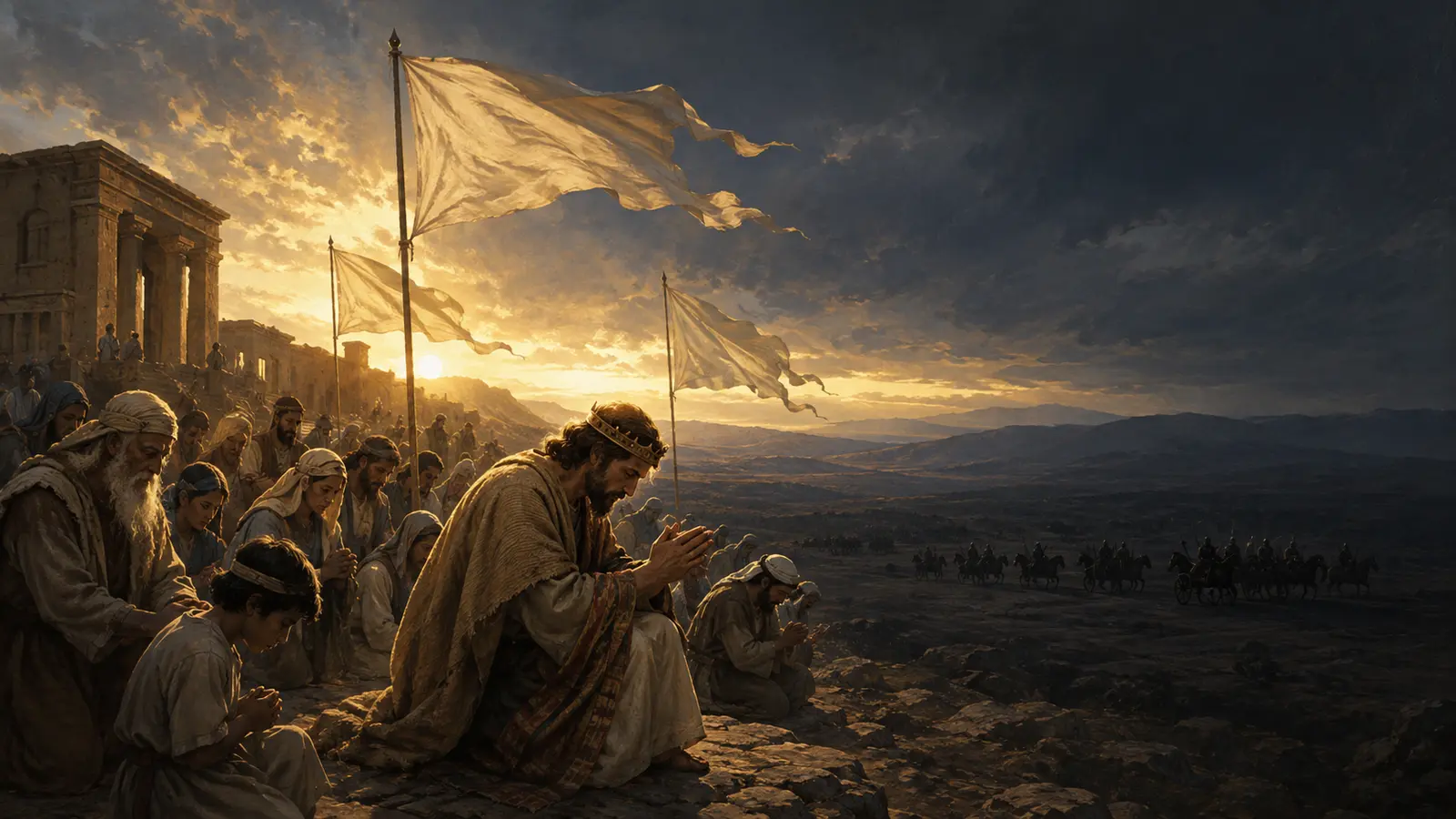
Faith That Remembers, Protests, and Still Appeals to Covenant Love
01
1.0 Introduction: What Do You Do When the Old Testimonies Do Not Match the Present?
The elders told stories of victories won by God’s hand. The present generation stands in shame and defeat. Between memory and mystery, Psalm 44 teaches a wounded community to bring its unanswered questions into the presence of God.
Some of the hardest spiritual moments come when the stories we inherited seem to collide with the life we are living.
We have heard how God delivered before. We know the testimonies. We can repeat the language of faith. Yet the present looks like defeat.
Psalm 44 begins with inherited memory: “We have heard with our ears, O God; our ancestors have told us what you did in their days” (44:1). But by verse 9 the tone changes sharply: “But now you have rejected and humbled us.”
The community is not struggling because it has forgotten God’s mighty acts. It is struggling because it remembers them.
That makes this psalm more unsettling than a simple confession of national sin. The people insist that they have not abandoned the covenant (44:17–18), yet disaster has come. They refuse to solve the tension by pretending that every suffering must be the direct result of some hidden wrongdoing.
The heart-question is: How do faithful people pray when their present experience seems to contradict the story they have been taught about God?
Psalm 44 is about remembered faith becoming courageous lament, because covenant trust is strong enough to bring defeat, confusion, and protest honestly before the God whose steadfast love remains the community’s final appeal.
02
2.0 Historical and Literary Context: From Personal Longing to Communal Defeat
Psalm 44 belongs to the Korahite collection and follows Psalms 42–43. The voice now changes. The singular worshiper longing for God’s presence gives way to a community speaking as “we.”
BibleProject groups Psalms 42–44 with the opening Korahite movement of Book Two: longing for God’s presence, communal lament, and hope rooted in covenant faithfulness. The sequence matters. Psalms 42–43 ask, “When will I return?” Psalm 44 asks a darker communal question: “Why has the God who acted for our ancestors not acted for us?”
Goldingay aptly summarizes Psalm 44 as “coping with defeat.” The psalm moves through four major movements:
- remembered deliverance (vv. 1–8), - present humiliation (vv. 9–16), - protest of covenant faithfulness (vv. 17–22), - urgent appeal for God to wake, rise, and redeem (vv. 23–26).
The psalm does not identify a specific historical battle, and the sources do not require us to force one. Its power lies in its portability: any generation of God’s people that knows the old stories yet stands in unexplained defeat can find words here.
03
3.0 Walking Through the Text
04
3.1 Psalm 44:1–3 — When Memory Refuses to Credit the Sword
“We have heard with our ears, O God; our ancestors have told us.”
The psalm begins with testimony passed from one generation to another. Israel’s memory is communal. Faith has been taught around homes, gatherings, and worship: God acted in the days of old.
Verses 2–3 emphasize that the land was not gained by Israel’s sword or by the strength of its own arm. The victory came through God’s “right hand,” his “arm,” and “the light of your face.”
The point is theological before it is military: Israel’s existence rests on grace, not self-congratulation.
The same community that later laments defeat begins by rejecting triumphalism. Their ancestors were not saved because they were stronger. They were sustained because God favored them.
This makes the present crisis sharper. If victory was never finally about human strength, then defeat cannot be explained merely by saying, “We were not strong enough.”
05
3.2 Psalm 44:4–8 — When Yesterday’s God Is Confessed as Today’s King
“You are my King and my God; decree victories for Jacob” (44:4).
The psalm moves from what God did to who God is. The King of the ancestors is still addressed as King now.
The people again reject misplaced confidence: “I put no trust in my bow; my sword does not bring me victory” (44:6). They know weapons are not saviors.
Their confidence has a clear center: “You give us victory over our enemies” (44:7).
Then verse 8 says, “In God we make our boast all day long.” The community has not abandoned praise. The disaster described next therefore lands with even more force.
Their theology is not shallow. They know grace, kingship, dependence, and praise.
And still they lose.
06
3.3 Psalm 44:9–16 — When the Word “But” Breaks the Song
“But now you have rejected and humbled us” (44:9).
This is the fracture line of the psalm.
The people do not merely say, “Our enemies defeated us.” They interpret the defeat theologically: “You no longer go out with our armies.”
The language intensifies. They retreat. Enemies plunder them. They become like sheep for food. They are scattered among the nations. They are mocked by neighbors and turned into a byword.
Shame becomes public.
Goldingay observes that the language stacks image upon image—defeat, loss, massacre, scattering, disgrace. The community is not simply wounded; it feels abandoned by the God whose past deeds it has just celebrated.
This is one of the Psalter’s important gifts: Scripture does not require suffering people to speak politely about catastrophe. It gives them words strong enough to match the wound.
07
3.4 Psalm 44:17–21 — When the Community Says, “We Have Not Forgotten You”
“All this came upon us, though we had not forgotten you; we had not been false to your covenant” (44:17).
This is the theological shock at the center of the psalm.
Many biblical texts connect calamity with covenant unfaithfulness. Psalm 44 knows that framework—and insists it does not explain this situation.
“Our hearts had not turned back; our feet had not strayed from your path” (44:18).
The claim reaches inward and outward: heart and steps, loyalty and conduct.
Then the community submits its claim to divine examination. If it had forgotten God’s name or raised its hands to another god, would not God discover it (44:20–21)?
The people are not claiming sinless perfection in the abstract. They are arguing that this particular catastrophe cannot simply be explained as punishment for apostasy.
That distinction matters. Not every wound is evidence that God is punishing a hidden sin.
08
3.5 Psalm 44:22 — When the Sheep Image Becomes Even Darker
“For your sake we face death all day long; we are considered as sheep to be slaughtered.”
The sheep image from verse 11 returns, now sharpened.
Goldingay cautions against reading the verse too quickly as though the psalm itself were celebrating suffering as redemptive. In its own setting, the people are emphasizing the terrible mystery of their condition: they are suffering in relation to God, yet they cannot identify covenant betrayal as the cause.
Paul later quotes this line in Romans 8:36. There, he places it inside a different argument: suffering, persecution, and even death cannot separate believers from the love of God in Christ (Rom. 8:35–39).
Paul does not erase the protest of Psalm 44. He places that protest inside resurrection-shaped assurance.
09
3.6 Psalm 44:23–26 — When Prayer Dares to Say, “Wake Up”
“Awake, Lord! Why do you sleep? Rouse yourself! Do not reject us forever” (44:23).
These are among the boldest words in the Psalter.
The psalmist knows God does not sleep in the ordinary sense (cf. Ps. 121:4). The metaphor names experience: God’s apparent inactivity feels like sleep.
“Why do you hide your face and forget our misery and oppression?” (44:24).
Earlier the people remembered God. Now they accuse God of forgetting them.
The psalm ends with bodies in the dust: “We are brought down to the dust; our bodies cling to the ground” (44:25).
Then comes the final appeal:
“Rise up and help us; redeem us because of your steadfast love” (44:26).
Not because they have explained the mystery.
Not because they have discovered a hidden sin.
Not because they have earned rescue.
The final ground is hesed—God’s steadfast covenant love.
The psalm ends unresolved, but not empty. Lament has carried the community to the deepest foundation it knows: God’s own faithful love.
10
4.0 Theological Reflection
11
4.1 Remembered Deliverance Can Make Present Suffering Harder
Testimony is usually comforting, but Psalm 44 shows that memory can also sharpen grief. If God acted then, why not now?
The Bible does not treat that question as faithless. It gives the question a place in worship.
12
4.2 Not All Suffering Can Be Reduced to Personal Failure
Psalm 44 resists simplistic moral arithmetic. The people examine covenant loyalty and still conclude that their defeat cannot be explained by apostasy.
This does not remove the Bible’s call to repentance. It removes the assumption that every disaster is a divine verdict on the victim.
13
4.3 Faith Can Protest Without Leaving the Relationship
The strongest accusations in the psalm are addressed to God, not spoken behind his back.
Lament remains relational. The people can say “Why do you sleep?” precisely because they still believe God is the One who must act.
14
4.4 Covenant Love Is Deeper Than Our Explanations
The final request rests on God’s hesed. The community does not end with a theory of suffering. It ends with an appeal to character.
There are times when faith has no complete explanation to offer, only a name to call.
15
5.0 Canonical and Christological Horizon
Psalm 44 stands within a wider biblical tradition that refuses to equate suffering automatically with guilt.
Job suffers despite being introduced as upright (Job 1:1, 8). Jeremiah protests injustice while remaining God’s prophet. The servant in Isaiah suffers in ways that cannot be reduced to personal wrongdoing (Isa. 52:13–53:12).
In the New Testament, Jesus rejects the assumption that particular suffering necessarily proves particular guilt (John 9:1–3; Luke 13:1–5). His own cross becomes the decisive biblical witness that innocence and suffering can occupy the same story.
Paul quotes Psalm 44:22 in Romans 8:36. He does not say suffering is unreal, nor that faithful people will always escape it. Instead, he surrounds the verse with the claim that neither trouble, persecution, famine, nakedness, danger, sword, death, nor life can separate God’s people from the love of God in Christ (Rom. 8:35–39).
Psalm 44 asks, “Has God abandoned us?”
Romans 8 answers not by denying the slaughtered-sheep experience, but by pointing to the crucified and risen Messiah: suffering cannot have the final interpretive word over God’s covenant love.
The church therefore does not need to choose between lament and hope. At the cross, both are heard. In resurrection, hope receives the last horizon.
16
6.0 Life Application
1. Remember honestly. Tell the old stories of God’s faithfulness, but do not use them to silence present grief.
2. Reject simplistic explanations of suffering. Do not assume every defeat, illness, loss, or setback is punishment for a hidden sin.
3. Examine yourself without accusing yourself falsely. Repent where repentance is needed; refuse invented guilt where Scripture gives no warrant for it.
4. Bring communal pain into communal prayer. Psalm 44 is a “we” psalm. Churches and families need language for shared grief, not only private devotion.
5. Do not confuse means with saviors. Bows and swords have their place, but the psalm refuses to trust them as ultimate sources of deliverance.
6. Pray boldly when God seems inactive. “Awake” is not irreverence when spoken inside covenant relationship; it is the language of desperate dependence.
7. End where the psalm ends: with God’s steadfast love. When explanations fail, let hesed become the ground beneath the prayer.
17
7.0 Reflection Questions
1. Which stories of God’s past faithfulness are hardest for me to hear in my present season?
2. Have I ever assumed that suffering automatically means God is punishing someone?
3. Where do I need to distinguish honest self-examination from false guilt?
4. What would it look like for my community to lament together rather than hide collective pain?
5. Can I pray boldly enough to tell God where his absence seems unbearable?
6. When I have no explanation, is God’s steadfast love still enough ground on which to keep praying?
18
8.0 Response Prayer
God of our ancestors and God of this hour, we have heard what you did in days of old. You were their help, their King, and the light of their faces. Yet there are seasons when our present does not look like the stories we inherited. When defeat confuses us, keep us from false explanations and false guilt. Search us where we need searching; correct us where we need correction; but do not let suffering persuade us that your covenant love has disappeared. Wake to our cry. See those brought low to the dust. Rise and help your people—not because we have solved the mystery, but because your steadfast love is still your name. Through Jesus, the crucified and risen Lord, hold us when we cannot understand. Amen.
19
9.0 Window into What Comes Next
Psalm 44 ends with a community on the ground, asking God to rise. Psalm 45 answers with a radically different sound: a royal wedding song celebrating a king, beauty, justice, and an enduring throne. After the darkness of defeat, the Psalter places before us a vision of righteous kingship. The question shifts from “Why have you rejected us?” to “What kind of king can carry God’s purposes forward?”
20
10.0 Bibliography
BibleProject. The Book of Psalms: Study Notes.
Goldingay, John. Psalms, Volume 2: Psalms 42–89. Baker Commentary on the Old Testament Wisdom and Psalms. Grand Rapids: Baker Academic, 2007.
Kidner, Derek. Psalms 1–72. Kidner Classic Commentaries. Downers Grove, IL: IVP Academic, 2008.
Be the first to leave a comment.