
Zion, God’s Steadfast Love, and the Story Told to the Next Generation
01
1.0 Introduction: What Makes a Place Worth Remembering?
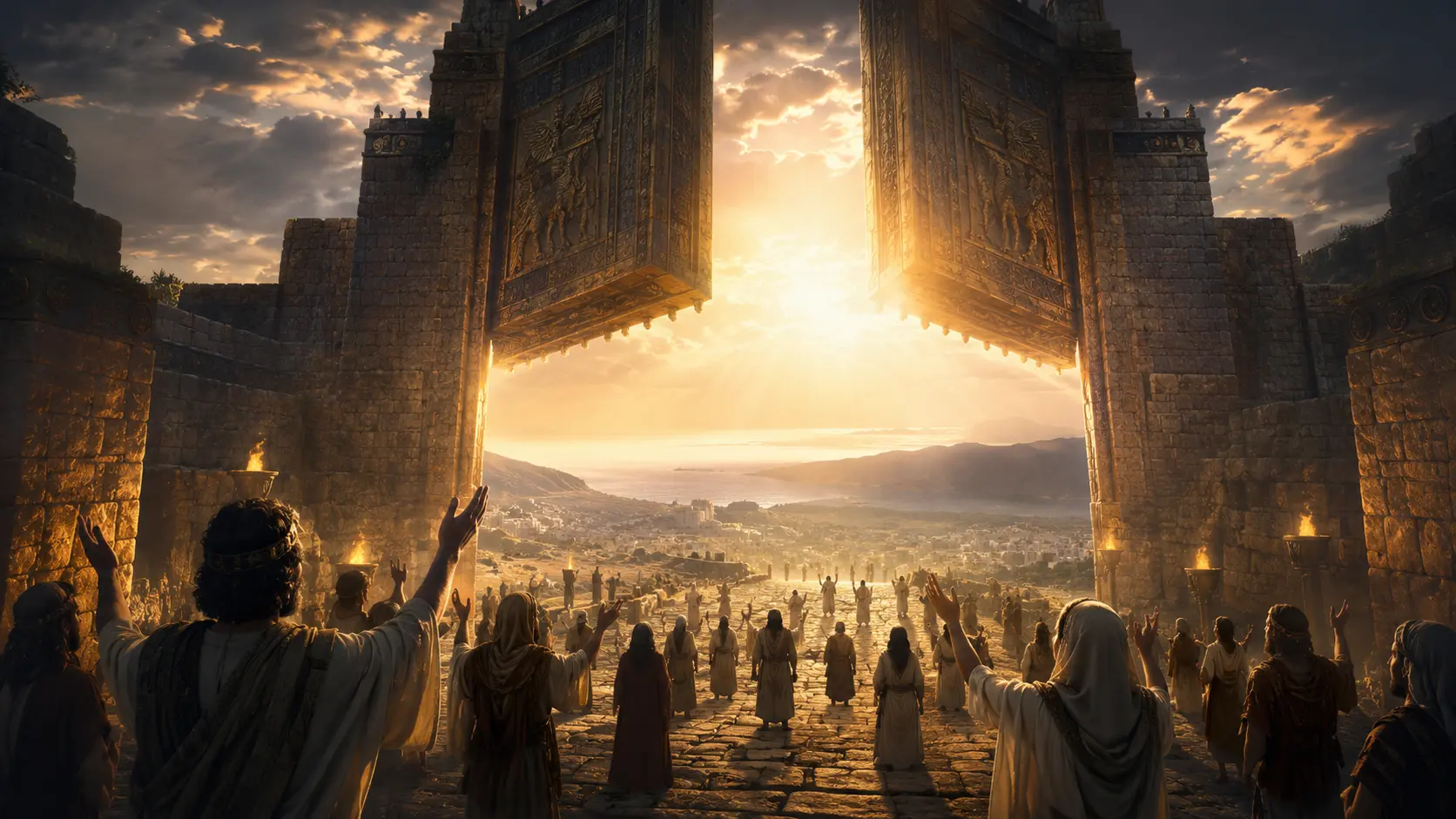
The kings arrive and panic. The city remains. Worshipers walk the walls, count the towers, and turn architecture into testimony: “This is God—our God forever and ever.”
Some places matter because of what happened there.
A house can become precious because a family learned to pray there. A church building can carry memory because generations worshiped, wept, married, buried, and hoped there. Yet the place itself is never the deepest thing.
Psalm 48 celebrates Zion, “the city of our God,” with unusually strong language. It is beautiful, joyful, secure, and feared by hostile kings. But the psalm does not finally tell the next generation merely to admire towers.
It tells them to recognize God.
The worshipers are instructed to walk around Zion, count its towers, inspect its ramparts, and pass through its citadels “so that you may tell the next generation that this is God, our God forever and ever” (48:12–14).
The city becomes a visible memory of divine faithfulness.
The heart-question is: How does a community turn remembered deliverance into faith for the next generation without mistaking the gift for the Giver?
Psalm 48 is about place becoming testimony, because Zion matters not as an invincible object in itself but as the place where God has made his presence, protection, steadfast love, and faithfulness known.
02
2.0 Historical and Literary Context: The Climax of the Zion Sequence
Psalm 48 is a song of the sons of Korah and stands at the end of the Psalms 45–48 cluster.
BibleProject describes Psalms 45–48 as celebrations of God’s royal power in Zion. The sequence develops naturally:
- Psalm 45 celebrates the royal figure, - Psalm 46 celebrates God as refuge in the city, - Psalm 47 proclaims God as King over all the earth, - Psalm 48 celebrates Zion as the city where that kingship has been experienced and remembered.
Goldingay notes that Psalm 48 links strongly with both Psalms 46 and 47. Like Psalm 47, it is broadly a praise psalm. Like Psalm 46, it stresses confidence in Yahweh. It also reuses Israel’s deliverance imagery, especially patterns associated with the Red Sea and the defeat of hostile powers.
The psalm moves from praise of Zion (vv. 1–3), to the panic of hostile kings (vv. 4–7), to the community’s confession that what it had heard it has now seen (v. 8), and finally to meditation, praise, inspection, and intergenerational testimony (vv. 9–14).
03
3.0 Walking Through the Text
04
3.1 Psalm 48:1–3 — When the City Is Beautiful Because God Is There
“Great is Yahweh and most worthy of praise in the city of our God.”
The psalm begins with Yahweh, not with Zion.
That order is important.
The mountain is called holy, beautiful, and “the joy of all the earth.” Goldingay cautions that Zion is not physically the highest or most spectacular mountain in the region. The language is theological.
Zion is beautiful because God can be met there.
Its joy comes from presence.
The city belongs to “the great King,” echoing the universal kingship celebrated in Psalm 47.
Verse 3 says that in the city’s citadels God has made himself known as a refuge.
The defensive structures are visible, but God is the real haven.
The walls do not explain God.
God explains the walls’ significance.
05
3.2 Psalm 48:4–7 — When the Kings Arrive and Lose Their Confidence
“When the kings joined forces, when they advanced together, they saw her and were astounded; they fled in terror.”
The attacking rulers arrive with confidence.
Then sight reverses the scene.
They see, they are stunned, they panic, and they flee.
The imagery intensifies: trembling seizes them “like a woman in labor.”
Then comes the east wind breaking the ships of Tarshish.
Goldingay reads these scenes against the wider biblical memory of God defeating powers that appear overwhelming. The imagery recalls a pattern familiar from Israel’s story: imperial confidence meets a force it cannot master.
The ships of Tarshish symbolize impressive reach and wealth. Yet one east wind is enough to shatter them.
Human power can look massive right up to the moment it proves fragile.
06
3.3 Psalm 48:8 — When Inherited Testimony Becomes Personal Experience
“As we have heard, so we have seen in the city of Yahweh of Armies, in the city of our God.”
This is one of the key lines of the psalm.
Earlier generations told the story.
Now this generation says, “We have seen.”
Faith has moved from testimony received to testimony experienced.
The line does not reject inherited faith. It fulfills it.
The community discovers that the God their ancestors spoke about is not only a God of old stories.
He has acted again.
This is the bridge every generation needs: from “they told us” to “we have seen.”
Yet even here, faith cannot demand that God repeat every event in exactly the same way. The psalm celebrates a particular deliverance; it does not establish a formula that sacred cities can never fall.
The later biblical story will make that painfully clear.
07
3.4 Psalm 48:9–11 — When Worship Reflects on Steadfast Love
“Within your temple, O God, we meditate on your steadfast love” (48:9).
The movement slows.
After panic and battle imagery, worshipers sit and think.
The Hebrew word often rendered “steadfast love” points to God’s covenant commitment—his loyal, faithful love.
This is what the city is really about.
Not stone.
Not military superiority.
Not prestige.
Covenant love.
Verse 10 declares that God’s praise reaches to the ends of the earth, and his right hand is full of righteousness or faithfulness.
The vision expands beyond Zion again.
The city does not trap God.
It witnesses to a name that reaches the earth’s ends.
Then Zion and the towns of Judah rejoice because of God’s judgments.
Joy is rooted in God setting things right.
08
3.5 Psalm 48:12–13 — When Walking the Walls Becomes a Spiritual Practice
“Walk about Zion, go around her, count her towers, consider well her ramparts, view her citadels.”
This is almost a guided tour.
Look carefully.
Count.
Pay attention.
Remember.
But the goal is not architectural pride.
The next line tells us why:
“that you may tell of them to the next generation.”
The city becomes a teaching tool.
Every tower says, “God preserved.”
Every rampart says, “God was our refuge.”
Every surviving wall becomes memory made visible.
The worshiper is being trained not merely to see a structure, but to narrate grace.
09
3.6 Psalm 48:14 — When the Final Lesson Is Not “This Is Zion” but “This Is God”
“For this God is our God forever and ever.”
The climax is remarkable.
After all the attention to the city, the psalm does not conclude:
“This is our city.”
It concludes:
“This is our God.”
The place points beyond itself.
The final Hebrew phrase is textually difficult. The Masoretic Text can be understood along the lines of God guiding “against death” or “unto death,” while the Greek tradition reflects a reading such as “forever.” Goldingay notes the uncertainty.
The central confession is nevertheless clear:
God remains “our God forever and ever.”
The deepest inheritance passed to the next generation is not a monument.
It is God.
10
4.0 Theological Reflection
11
4.1 Sacred Places Matter Because God Has Met People There
Psalm 48 honors place without worshiping place.
Zion matters because God has made himself known there.
This distinction protects faith from both extremes: treating places as meaningless, or treating them as magical.
12
4.2 Memory Must Become Testimony
“As we have heard, so we have seen.”
Healthy faith receives testimony and eventually learns to speak its own.
The goal is not novelty. It is lived confirmation that the God of the ancestors is still worthy of trust.
13
4.3 Security Must Never Be Detached from God
The towers are counted, but God is the refuge.
When people transfer trust from God to structures, institutions, buildings, or traditions, the sign has replaced the One it was meant to signify.
14
4.4 Faith Must Be Told Forward
Psalm 48 ends with the next generation.
Deliverance that is not narrated can become forgotten.
The community must learn not only to survive God’s faithfulness, but to interpret and tell it.
15
5.0 Canonical and Christological Horizon
Psalm 48’s celebration of Zion sits inside a larger biblical story in which Jerusalem is both deeply significant and repeatedly corrected.
The prophets can celebrate Zion as the place of God’s presence, yet they also warn that temple and city are not magical guarantees of safety when covenant faithfulness is abandoned (Jer. 7:1–15; Mic. 3:9–12).
That tension is essential.
Psalm 48 teaches confidence in God, not superstition about architecture.
The New Testament deepens this movement. Jesus identifies himself as the true meeting place of God and humanity (John 2:19–21), and the early church understands God’s people themselves as a dwelling place for God’s Spirit (Eph. 2:19–22; 1 Pet. 2:4–5).
The final biblical vision returns to city imagery, but in transformed form. Revelation 21 presents the New Jerusalem coming down from heaven, and the striking feature is that no temple building is needed because “the Lord God Almighty and the Lamb are its temple” (Rev. 21:22).
Psalm 48 says, “Walk around Zion and tell the next generation.”
Revelation answers with a city whose deepest glory is the immediate presence of God and the Lamb.
For Christians, Jesus does not make place meaningless. He relocates the center of sacred presence around himself and the renewed people of God, while the final hope expands toward a renewed creation where God dwells openly with humanity.
16
6.0 Life Application
1. Remember what God has done in real places. Homes, churches, hospital rooms, prisons, classrooms, and gravesides can become landmarks of grace.
2. Do not confuse the landmark with God. Buildings and institutions can carry memory without becoming objects of ultimate trust.
3. Turn testimony into teaching. Ask what stories of God’s faithfulness the next generation needs to hear from you.
4. Inspect your “towers.” Notice the people, practices, and gifts through which God has sustained your community.
5. Meditate on steadfast love, not merely survival. The deepest meaning of deliverance is the character of the Deliverer.
6. Let inherited faith become experienced faith. Receive the stories of others, but also learn to name where you have seen God’s faithfulness.
7. End with God, not the gift. The final confession is not “this is our city” but “this is our God.”
17
7.0 Reflection Questions
1. Which places in my life carry strong memories of God’s faithfulness?
2. Have I ever confused a church, tradition, leader, or institution with God himself?
3. What have I “heard” from earlier generations that I have also begun to “see” for myself?
4. Which stories of grace am I responsible to pass to the next generation?
5. What would it mean for my community to “count the towers” without becoming proud of the towers?
6. Can I say, beneath every gift, “This is our God”?
18
8.0 Response Prayer
God of Zion and God of every generation, teach us to remember without turning memories into idols. Thank you for the places where you have met us, protected us, corrected us, and carried us. Give us eyes to see the signs of your faithfulness and wisdom to tell their meaning well. Keep us from trusting walls more than your presence, institutions more than your steadfast love, or inherited stories more than you yourself. Let what we have heard become what we have seen, and let what we have seen become testimony for those who come after us. Through Jesus, the true meeting place of God and humanity, teach us to end every story with the confession: this God is our God forever and ever. Amen.
19
9.0 Window into What Comes Next
Psalms 45–48 have celebrated king, refuge, universal reign, and Zion. Psalm 49 now changes the atmosphere. The attention shifts from city walls and royal power to a problem no fortress can solve: death. Rich and poor alike must face mortality, and wealth cannot ransom a life from the grave. The question moves from “What makes the city secure?” to “What can save a human being when money and status finally fail?”
20
10.0 Bibliography
BibleProject. The Book of Psalms: Study Notes.
Goldingay, John. Psalms, Volume 2: Psalms 42–89. Baker Commentary on the Old Testament Wisdom and Psalms. Grand Rapids: Baker Academic, 2007.
Kidner, Derek. Psalms 1–72. Kidner Classic Commentaries. Downers Grove, IL: IVP Academic, 2008.
Be the first to leave a comment.