

The King of All the Earth and the Joy of His Reign
01
1.0 Introduction: What Happens When Worship Outgrows the Borders of One People?
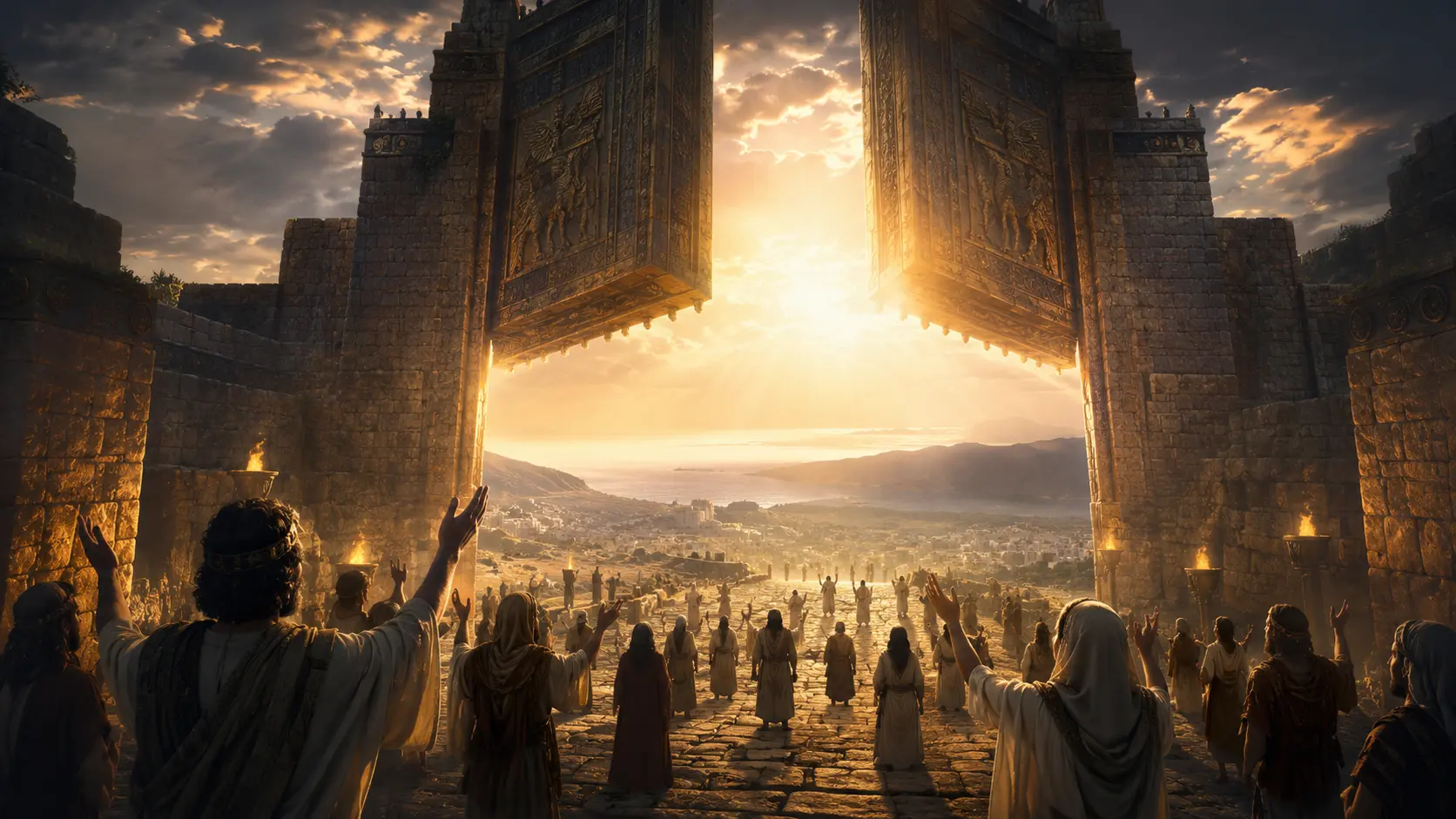
Hands clap. Voices rise. A horn sounds. The God of Jacob is acclaimed not as a tribal deity, but as the great King over all the earth.
Psalm 46 ended with the confession, “Yahweh of Armies is with us,” and with the nations being told to stop and acknowledge God.
Psalm 47 begins by inviting those same peoples to clap.
“All you peoples, clap your hands; shout to God with cries of joy” (47:1).
The movement is striking. The nations are not merely subdued; they are summoned into praise.
The God who protected Zion is now named “the great King over all the earth” (47:2). The song refuses to let Israel think of Yahweh as a local deity whose concerns stop at the border.
The heart-question is: What does it mean for Israel’s God to be King not only for Israel, but for all peoples?
Psalm 47 is about local deliverance opening into universal kingship, because the God who acts for Jacob is also the King of the whole earth, and his reign ultimately summons the nations not merely to fear him, but to acknowledge and celebrate him.
02
2.0 Historical and Literary Context: The Korahite Vision Widens to the Nations
Psalm 47 belongs to the sons of Korah and continues the movement of Psalms 45–48.
BibleProject sees Psalms 45–48 as a cluster celebrating God’s royal power in Zion. Psalm 45 presented a royal figure; Psalm 46 celebrated God as refuge in the city; Psalm 47 now widens the horizon and repeatedly names God as King over the nations.
Goldingay titles the psalm “God Has Begun to Reign” and notes that it follows the classic shape of a praise psalm twice over:
- a call to praise (v. 1), - a reason for praise: Yahweh is King (vv. 2–5), - a renewed call to praise (v. 6), - another reason for praise: God reigns over the nations (vv. 7–9).
The psalm makes no reference to a human king. Its central royal figure is God himself. Goldingay also connects the shout and horn of verse 5 with Israel’s memories of conquest and the bringing of the ark to Jerusalem (Josh. 6; 2 Sam. 6:15), while warning against building a speculative annual enthronement festival from this verse alone.
03
3.0 Walking Through the Text
04
3.1 Psalm 47:1–2 — When All Peoples Are Summoned to Applaud the King
“All you peoples, clap your hands; shout to God with cries of joy.”
The psalm begins with the body.
Hands clap. Voices shout.
Goldingay notes that clapping and shouting belong to public celebration and can also accompany coronation scenes (1 Sam. 10:24; 2 Kings 11:12–13). Worship here is not muted admiration. It is public acclaim.
But the addressees are significant: “all you peoples.”
The reason follows:
“For Yahweh Most High is awesome, the great King over all the earth” (47:2).
The title “great King” would have sounded politically charged in the ancient Near East, where emperors claimed universal authority. Psalm 47 makes a theological counterclaim: no empire finally owns the world.
Yahweh does.
The claim is not merely that Israel’s God is stronger than other gods. It is that the earth itself belongs under his reign.
05
3.2 Psalm 47:3–4 — When Election and Victory Become Part of a Larger Story
“He subdued peoples under us, nations under our feet. He chose our inheritance for us, the pride of Jacob, whom he loved.”
These verses are among the most difficult for modern readers because they speak the language of victory and subjugation.
Within the psalm, the lines recall Israel’s possession of the land. Goldingay understands verses 3–5 as looking back to that story. The “inheritance” is the land chosen for Jacob.
Yet the psalm does not stop with Israel standing over the nations. By verse 9, nobles from the peoples are gathered with—or as—the people of the God of Abraham.
That movement matters.
The story begins with election, but election is not the end of the story.
Israel was chosen within the Abrahamic promise, and that promise always contained a horizon for the nations (Gen. 12:1–3).
So the tension in verses 3–4 should not be erased, but neither should it be isolated from verse 9.
Biblically, election is meant to serve blessing beyond itself.
06
3.3 Psalm 47:5 — When God “Goes Up” with a Shout
“God has gone up with a shout, Yahweh with the sound of a trumpet.”
The imagery sounds like a coronation procession.
Goldingay connects the shout and horn with Israel’s memories of entering the land and, especially, with David bringing the covenant chest up to Jerusalem (2 Sam. 6:12–15). The ark represented Yahweh’s enthroned presence among his people.
The line therefore evokes the public celebration of kingship.
God “goes up” not because he has been absent from heaven, but because his reign is being acknowledged in Israel’s story and worship.
The trumpet does not make him King.
It announces that he is.
07
3.4 Psalm 47:6–7 — When Praise Becomes Both Passionate and Thoughtful
“Sing praises to God, sing praises; sing praises to our King, sing praises.”
The repetition is deliberate.
Four times the command comes.
Then verse 7 gives the reason:
“For God is the King of all the earth; sing praises with understanding.”
Goldingay notes that the final phrase stresses intelligent praise. Worship is not less emotional because it has content, and not less thoughtful because it is joyful.
The psalm wants both.
Clapping and understanding.
Shouting and theology.
Joy and truth.
The King deserves worship from the whole person.
08
3.5 Psalm 47:8 — When God Sits on the Holy Throne
“God reigns over the nations; God is seated on his holy throne.”
The scope is now explicit.
Not merely Israel.
The nations.
Goldingay notes that the Hebrew verbal form can suggest the beginning or public establishment of a reign, similar to the way Scripture speaks of a human king beginning to reign. In his reading, the bringing of the ark to Jerusalem functions as a visible earthly sign of Yahweh’s kingship.
But the theological point reaches beyond one historical moment.
God’s throne is holy because his rule is not simply powerful.
It is morally distinct.
He reigns as God.
09
3.6 Psalm 47:9 — When the Nations Gather with the God of Abraham’s People
“The nobles of the nations assemble as the people of the God of Abraham.”
The Hebrew is difficult enough that interpreters debate whether the nobles gather “with” God’s people or are gathered “as” part of them.
Goldingay observes that the practical difference may be small. Either way, representatives of the nations are pictured acknowledging Yahweh alongside Israel.
And then comes the crucial name:
“the God of Abraham.”
That phrase widens the horizon back to Genesis 12.
Abraham was chosen so that all the families of the earth might be blessed through him (Gen. 12:1–3; 18:18).
Psalm 47 therefore reaches beyond conquest toward inclusion.
The peoples who were once outside the covenant story are now pictured gathering around the God of Abraham.
The psalm ends not with Israel alone on the stage, but with the nations present before the King.
10
4.0 Theological Reflection
11
4.1 God’s Kingship Is Universal
Psalm 47 repeatedly refuses a small vision of Yahweh.
He is “King over all the earth.”
Israel knows him by covenant, but Israel does not own him.
12
4.2 Election Is for Mission, Not Possession
Israel’s chosen inheritance matters, but the final horizon includes the nations gathering around the God of Abraham.
Biblical election reaches outward.
13
4.3 Worship Is Both Embodied and Intelligent
The psalm is noisy and thoughtful.
Hands clap, voices shout, instruments sound, and praise is offered “with understanding.”
Biblical worship does not require us to choose between heart and mind.
14
4.4 God’s Reign Reframes Human Power
If God is King over all the earth, every human claim to ultimate authority is relativized.
No ruler, nation, or empire can carry the title “ultimate.”
15
5.0 Canonical and Christological Horizon
Psalm 47 belongs to the wider biblical hope that the God of Israel will be acknowledged among all nations.
The promise begins early. God tells Abraham that all families of the earth will be blessed through him (Gen. 12:3). The prophets later imagine the nations streaming toward Zion to learn God’s ways (Isa. 2:2–4; Mic. 4:1–3) and joining in worship of Israel’s God (Isa. 56:6–8).
The New Testament draws deeply on this trajectory.
After Jesus’ resurrection, the mission of his followers extends to “all nations” (Matt. 28:18–20). Acts portrays the risen Jesus’ lordship expanding across ethnic and geographic boundaries (Acts 1:8).
The language of Psalm 47:5—God going up with a shout—has also been read by Christians in relation to Jesus’ ascension. The New Testament does not directly quote Psalm 47:5 as an ascension proof text, so care is needed. Yet canonically the image resonates with the proclamation that the risen Christ has been exalted and enthroned (Acts 2:32–36; Eph. 1:20–23).
The deepest New Testament development of Psalm 47’s kingship is not nationalism but the gathering of the nations under one Lord.
Revelation ends with people from every nation gathered in worship before God and the Lamb (Rev. 7:9–10), and with the kingdoms of the world belonging to God and his Messiah (Rev. 11:15).
Psalm 47’s noisy coronation song thus opens toward a renewed creation in which the peoples of the earth are no longer rivals around competing thrones, but worshipers before the one true King.
16
6.0 Life Application
1. Let your vision of God grow larger than your community. God is not the private possession of one church, ethnicity, or nation.
2. Worship with your whole self. Use body, voice, mind, and understanding.
3. Hold election and mission together. Any privilege received from God becomes a calling to bless others.
4. Refuse to absolutize human power. Every leader and institution is secondary beneath the King of all the earth.
5. Make room for the nations in your theology. The biblical story is always moving toward a multiethnic people gathered around God.
6. Let praise be intelligent. Know why you sing.
7. Celebrate God’s reign as good news. His kingship is not merely dominance; it is the hope that the whole earth can finally be ordered under the rightful King.
17
7.0 Reflection Questions
1. Has my picture of God become smaller than the biblical vision of “King over all the earth”?
2. In what ways does my worship engage both emotion and understanding?
3. Do I treat God’s blessings as possessions to protect or gifts to share?
4. What human power am I tempted to treat as ultimate?
5. How does the mention of “the God of Abraham” reshape the way I hear the end of this psalm?
6. What would it look like for my community to embody the joy of a kingdom open to all peoples?
18
8.0 Response Prayer
Great King over all the earth, enlarge our vision of your reign. Keep us from making you small enough to fit inside our tribe, our language, our church, or our nation. Teach us to praise you with hands, voices, minds, and lives. Where you have blessed us, make us a blessing. Where we have treated power as ultimate, remind us that every throne stands beneath yours. Gather the nations around your mercy, fulfill the promise given to Abraham, and form us into a people whose joy makes room for others. Through Jesus, the risen and exalted Lord, teach us to sing with understanding until the whole earth knows that you are King. Amen.
19
9.0 Window into What Comes Next
Psalm 47 announces the King over all the earth. Psalm 48 brings the camera back to Zion, “the city of our God,” and asks the worshiper to walk around its walls, count its towers, and tell the next generation what God has done. The movement shifts from “Who is King over all nations?” to “What does the city shaped by that King’s presence look like, and how is its story passed on?”
20
10.0 Bibliography
BibleProject. The Book of Psalms: Study Notes.
Goldingay, John. Psalms, Volume 2: Psalms 42–89. Baker Commentary on the Old Testament Wisdom and Psalms. Grand Rapids: Baker Academic, 2007.
Kidner, Derek. Psalms 1–72. Kidner Classic Commentaries. Downers Grove, IL: IVP Academic, 2008.
Be the first to leave a comment.