

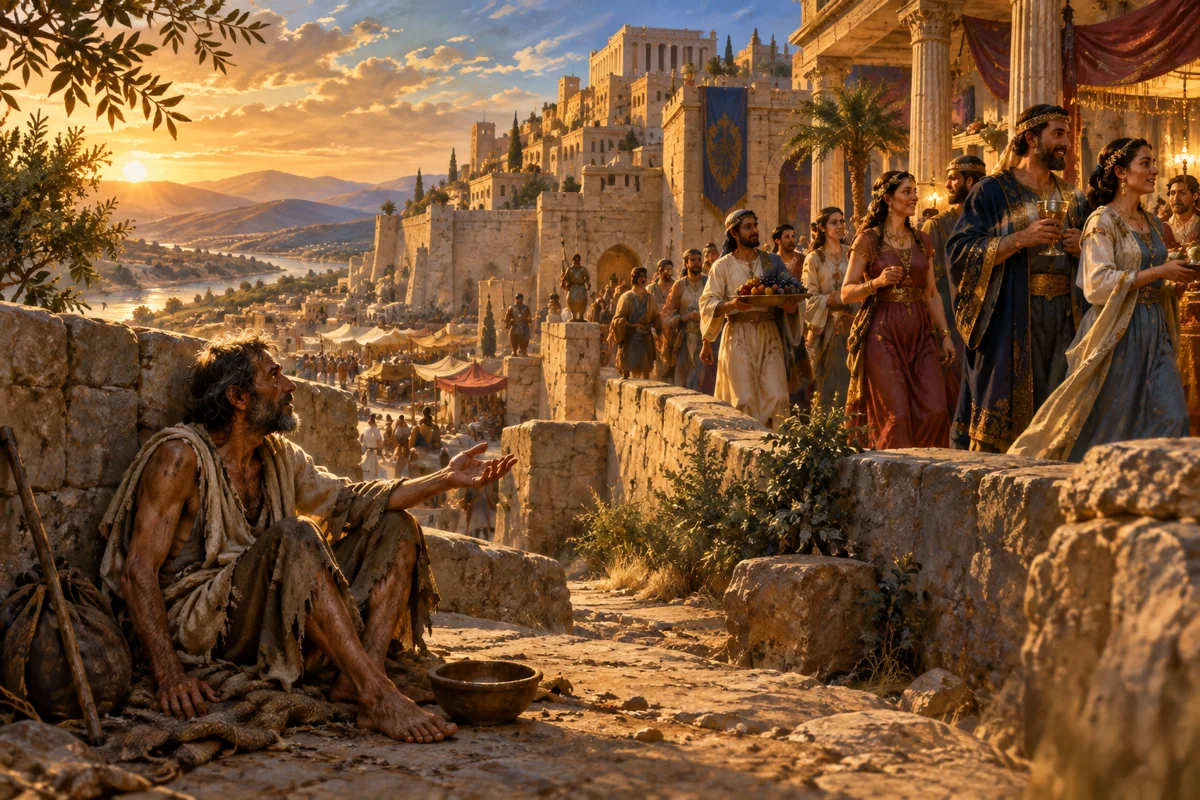
Folly, corruption, and the hope of salvation from Zion
01
1.0 Introduction: “God Is Not Here”
A society does not need to erase the word “God” before it begins to live without him. Psalm 53 watches what happens when God is pushed out of the moral horizon.
Psalm 53 opens with one of the Bible’s most famous lines:
“The fool says in his heart, ‘There is no God.’”
It is easy to read that sentence as though the psalm were entering a classroom debate about philosophical atheism. But the poem is aiming somewhere more concrete.
The “fool” is not merely someone who has reached the wrong intellectual conclusion. In biblical wisdom, folly is moral as well as mental. It describes a way of living that resists truth, rejects accountability, and acts as though God will not call anyone to account.
John Goldingay translates the thought vividly: “God is not here.”
That catches the atmosphere of the psalm. The fool lives as though heaven is empty, as though no one is watching, as though exploitation can continue without answer.
But the next verse overturns that illusion:
“God looks down from heaven.”
The One whom people have removed from the picture is already looking at the whole scene.
Psalm 53 is about the foolishness of living as though God is absent, the corruption that grows from that illusion, and the hope that God will still bring salvation to his people.
02
2.0 Historical and Literary Context
Psalm 53 is closely related to Psalm 14. The two poems are almost duplicates, though there are important differences in wording. Psalm 53 uses “God” more consistently where Psalm 14 often uses the covenant name, Yahweh, and verse 5 differs more substantially.
Its placement in Book Two matters.
Psalm 52 confronted a powerful person who used deceit, wealth, and destructive words as though God’s steadfast love did not matter. Psalm 53 broadens the problem. The issue is no longer one dangerous person. The psalm looks across humanity and asks whether anyone truly seeks God and does good.
Goldingay notes the contrast between the two psalms. Psalm 52 denounces those who dedicate themselves to evil rather than good. Psalm 53 laments that there is no one doing good.
The lens has moved from one corrupt actor to a corrupt human field.
The psalm also moves in a clear sequence. Verses 1–3 describe humanity from God’s vantage point. Verse 4 focuses on those who consume God’s people. Verse 5 announces divine reversal. Verse 6 ends with longing: “Oh, that salvation for Israel would come out of Zion!”
The poem begins in corruption but refuses to end there.
03
3.0 Walking Through the Text
04
3.1 The Fool’s Heart — Living Without Moral Accountability (v. 1)
“The fool says in his heart, ‘There is no God.’”
The “heart” in biblical language is not only the seat of emotion. It includes thought, intention, desire, and decision.
The statement therefore describes an inner posture that becomes a way of life.
The fool may never say publicly, “I reject God.” He may still use religious language. The deeper issue is practical: he lives as though God is irrelevant.
The result appears immediately:
“They are corrupt, doing abominable iniquity; there is none who does good.”
The psalm joins belief and behavior. When God is pushed out of the moral horizon, people eventually begin to redefine good and evil around appetite, power, fear, or convenience.
That is why biblical folly is dangerous. It does not stay in the mind. It enters the street.
05
3.2 God Looks Down — Heaven Is Not Empty (vv. 2–3)
“God looks down from heaven on the children of man to see if there are any who understand, who seek after God.”
The fool says, “God is not here.”
The psalm answers: God is looking.
This is not the gaze of a distant spectator. The language recalls biblical scenes in which God sees oppression and acts: the blood of Abel crying from the ground, the misery of Israel in Egypt, the cries of the afflicted throughout the Psalms.
God looks for “one who understands” and “one who seeks God.”
The search exposes the depth of the problem:
“They have all fallen away; together they have become corrupt.”
The word “all” is uncomfortable. Psalm 53 will not let the worshipper stand comfortably outside the diagnosis.
The corruption of the world is not merely “their” problem.
It is ours.
06
3.3 “They Eat Up My People as They Eat Bread” — When Evil Becomes Ordinary (v. 4)
“Have those who work evil no knowledge, who eat up my people as they eat bread, and do not call upon God?”
This is one of the psalm’s strongest images.
Oppression has become as ordinary as eating a meal.
The wicked consume people without trembling. They have repeated injustice so often that it has become routine.
That is how evil deepens. What once shocked the conscience becomes a habit. What once required justification becomes simply “how things are done.”
The verse also returns to prayer: “They do not call upon God.”
Their violence and their prayerlessness belong together.
To call upon God is to acknowledge dependence, accountability, and need. The oppressor lives as though he needs none of these.
07
3.4 Terror Where There Was No Terror — God Reverses the Scene (v. 5)
“There they are, in great terror, where there is no terror!”
The line is startling.
Those who produced fear are now overtaken by fear.
The psalm then speaks of God scattering the bones of the besieger and rejecting them. The picture is military and severe. The aggressor who appeared secure finds that the battlefield has changed because God has entered the scene.
The verse is not a celebration of cruelty. It is a declaration that violent power is not self-securing.
Oppressors may organize, surround, threaten, and appear permanent.
But they are not beyond judgment.
The fool’s deepest mistake was never only bad behavior.
It was bad theology.
He thought God was absent.
08
3.5 “Oh, That Salvation Would Come from Zion” — Hope at the Edge of Ruin (v. 6)
The final verse changes the sound of the psalm:
“Oh, that salvation for Israel would come out of Zion!”
After the sweeping diagnosis of corruption, the psalm does not end with despair. It ends with longing.
“When God restores the fortunes of his people, let Jacob rejoice, let Israel be glad.”
The hope is communal. The people who have been “eaten” need restoration. The society damaged by corruption needs more than private comfort.
The answer must be large enough for a people.
Zion becomes the place from which salvation is expected because Zion is associated with God’s dwelling, kingship, and promised rule.
The psalm has moved from “God is not here” to “salvation will come from where God has chosen to dwell.”
That is a remarkable journey in six verses.
09
4.0 Theological Reflection
10
Biblical Folly Is a Way of Life
Psalm 53 does not reduce folly to low intelligence.
The fool may be clever, strategic, and socially powerful.
The folly is deeper: living as though reality has no moral center beyond the self.
A person can be brilliant and still be a fool in the biblical sense.
11
God Sees What Becomes Normal to Us
Human beings can normalize corruption.
We learn to live beside injustice. We find polite names for exploitation. We accept systems that “eat people like bread.”
Psalm 53 refuses that numbness.
God looks down.
What becomes invisible to society is not invisible to heaven.
12
Sin Is Both Personal and Social
The psalm speaks about hearts, but it also speaks about groups, oppression, and a people being consumed.
Biblical sin is never only private.
Disordered hearts create disordered households, institutions, markets, courts, churches, and nations.
That is why salvation must also be more than private relief.
13
Hope Comes from God’s Presence
The psalm begins with the claim that God is absent.
It ends by looking to Zion.
That movement reveals the answer to practical atheism: not merely winning an argument about God, but recovering life before God.
The cure for “God is not here” is a people learning again to seek, call upon, and wait for him.
14
5.0 Canonical and Christological Horizon
The apostle Paul draws heavily from Psalm 14 and the language shared with Psalm 53 in Romans 3:10–18. His point is sweeping: both Jews and Gentiles stand under the power of sin.
“There is none righteous, no, not one.”
Paul uses the psalm to close the door on moral superiority.
The problem is not simply that some violent people somewhere have become corrupt. Humanity itself needs rescue.
That makes the final cry of Psalm 53 even more important: “Oh, that salvation for Israel would come out of Zion!”
The New Testament tells the story of that hope taking flesh in Jesus.
Jesus comes to Zion as Israel’s Messiah, confronts corrupted power, bears human sin, and through resurrection opens a new future. The salvation expected from Zion becomes good news that moves outward to the nations (Luke 24:46–47; Acts 1:8).
Yet Jesus also deepens the diagnosis.
He teaches that evil does not arise only from bad systems outside us. It comes from the human heart (Mark 7:20–23).
So the gospel answers Psalm 53 at both levels: it exposes the corrupted heart and begins forming a renewed people.
15
6.0 Life Application
1. Ask where you are living as though God were absent. The issue may not be what you say you believe, but which parts of life you manage without prayer, accountability, or reference to God.
2. Do not confuse intelligence with wisdom. Skill, education, and influence cannot protect a person from moral folly.
3. Notice what injustice has become ordinary around you. Who is being “eaten like bread” through exploitation, humiliation, manipulation, neglect, or abuse?
4. Refuse the comfort of saying, “At least I am not like them.” Psalm 53 uses “all.” Romans 3 keeps that universality. The text calls us to humility before it calls us to critique.
5. Call upon God. Prayer is one of the simplest acts of resistance against practical atheism. It says: God is here, I am accountable, and I am not self-sufficient.
6. Expect salvation large enough for communities. Ask God not only to change individuals, but to restore homes, churches, institutions, and societies damaged by corruption.
7. Let hope have the last sentence. Psalm 53 sees corruption clearly, but it ends waiting for restoration.
16
7.0 Reflection Questions
1. In what area of my life do my habits suggest, “God is not here”?
2. What wrong has become so normal around me that I barely notice it anymore?
3. Where am I tempted to diagnose corruption in others without admitting my own need for grace?
4. What would it mean for me to “seek God” in practical terms this week?
5. What community or institution should I be praying for God to restore?
17
8.0 Response Prayer
God who sees from heaven, save me from the foolishness of living as though you were absent.
Search my heart. Show me where I have learned to excuse what you call wrong.
Do not let me become comfortable with people being used, silenced, consumed, or forgotten.
Teach me to seek you. Teach me to call upon your name. Give me wisdom that begins with reverence.
And where corruption has wounded a family, a church, a community, or a nation, bring restoration.
Let salvation come from your presence. Let Jacob rejoice. Let your people be glad.
Amen.
18
9.0 Window into What Comes Next
Psalm 53 looks across humanity and sees corruption everywhere.
Psalm 54 brings the camera close again.
Now David is surrounded by particular enemies, and the prayer becomes personal: “Save me, O God, by your name.”
After asking whether anyone truly seeks God, the Psalter gives us a threatened man doing exactly that.
He calls.
19
10.0 Bibliography
Goldingay, John. Psalms, Volume 2: Psalms 42–89. Baker Commentary on the Old Testament Wisdom and Psalms. Grand Rapids: Baker Academic, 2007.
Kidner, Derek. Psalms 1–72. Kidner Classic Commentaries. Downers Grove, IL: IVP Academic, 2008.
BibleProject. The Book of Psalms: Study Notes.
BibleProject. “The Book of Psalms.” Old Testament Overview Guide.

Be the first to leave a comment.