

When God rises to judge the powerful, what hope is there for the oppressed?
01
Overview
From the defense of Zion to the Judge who rescues the afflicted of the earth
“when God arose to judgment, to save all the afflicted ones of the earth.” Psalm 76:9, World English Bible
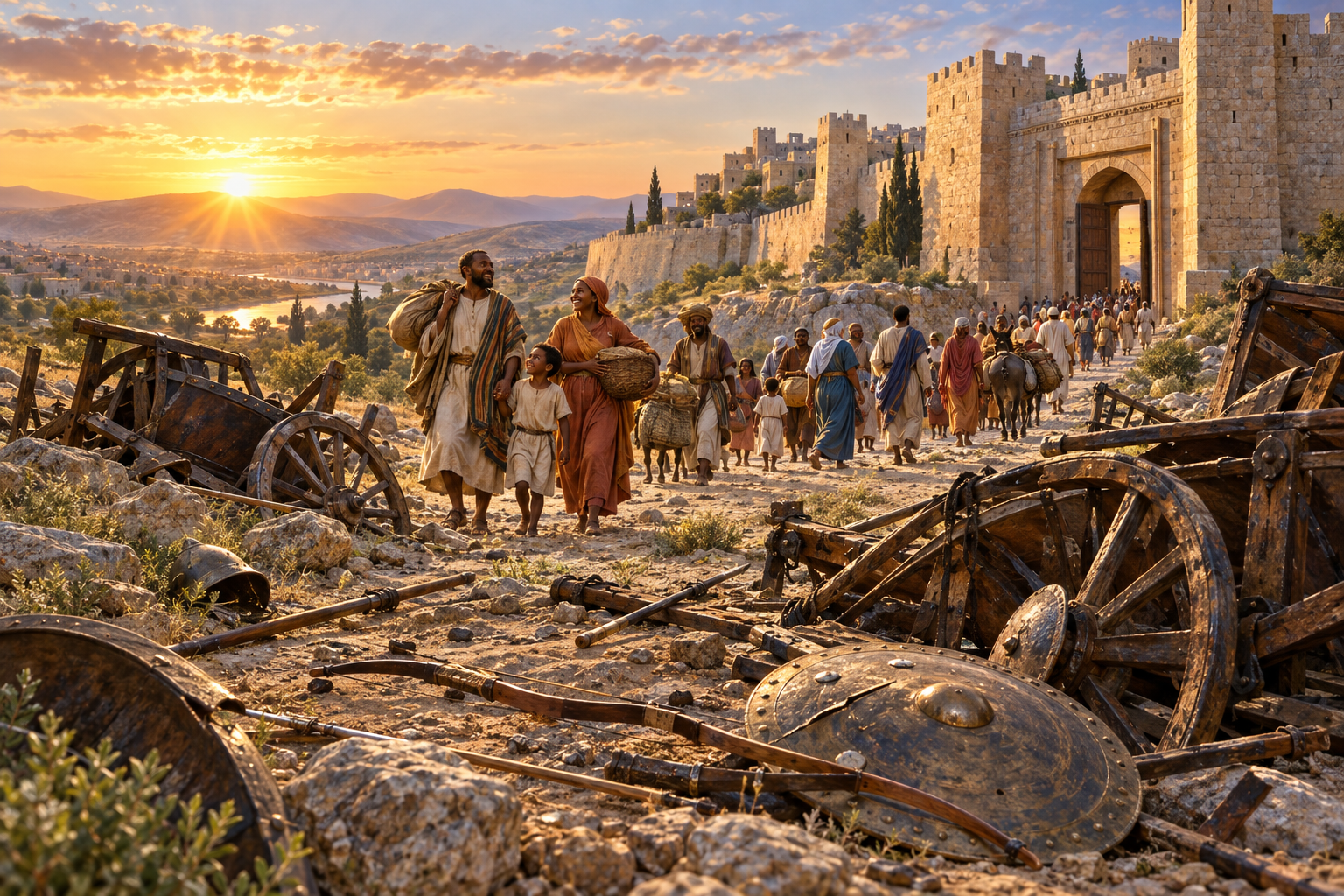
A city hears the approach of an army. Its defenders count weapons, watch the horizon, and wonder whether their walls will hold. Then the poet describes a startling reversal: bows are broken, the courageous cannot lift a hand, and horses and chariots fall silent. The decisive power does not belong to those who arrived with the greatest force. It belongs to the God who rises to judge—and to rescue.
02
1.0 Introduction
Power is often measured by how much a person can command: armies, money, influence, institutions, or public attention. Those who possess these resources may behave as if they hold the final word. Those who lack them can feel that justice is forever out of reach.
Psalm 76 challenges both assumptions. It celebrates Yahweh as the God known in Judah and present in Zion. He has shattered the weapons of aggressors and rendered their strength useless. But the song refuses to stop with the safety of one city. It stretches from Zion to heaven, and from one people's deliverance to God's concern for all the afflicted of the earth.
The movement matters. In Psalm 74, worshipers asked God to rise amid the ruins of his sanctuary. In Psalm 75, God announced that he would judge with fairness at the appointed time. Psalm 76 depicts the effect of that divine action: instruments of violence fall silent, the earth itself becomes still, and the lowly find deliverance.
The central claim of Psalm 76 is that God's power is not another version of human domination. His righteous judgment restrains violent pride, protects the vulnerable, and invites both his people and the rulers of the world to acknowledge him with reverence.
03
2.0 Historical and Literary Context
The heading associates the poem with Asaph and directs it to the musical leader, with stringed instruments. It belongs to the Asaph psalms in Book Three (Psalms 73–83), where questions of injustice, defeat, covenant, and divine kingship repeatedly meet. Unlike Psalm 74's community lament, Psalm 76 is principally a song of praise for God's decisive authority (BibleProject, n.d., 14–15).
The poem names Judah, Israel, Salem, and Zion (vv. 1–2). Salem is a poetic name for Jerusalem; Zion identifies the place associated with God's dwelling and rule. The images of the shattered bow, disabled warriors, and stunned horses suggest deliverance from a military threat.
Derek Kidner considers the defeat of Sennacherib's Assyrian army, recalled in Isaiah 37:33–36, a particularly compelling background (Kidner 2014, 302–4). The ancient Greek heading also connects the psalm with the Assyrians. John Goldingay is more cautious. He observes that the poem draws on several scenes in Israel's memory—including the exodus, David's victories, and deliverance from Assyria—and does not require us to identify a single historical battle as its occasion (Goldingay 2007, 449–50). The Assyrian connection is plausible, but not certain.
The poem can be heard in four movements: God's reputation and the disarming of war in verses 1–3; the collapse of aggressive power in verses 4–6; the Judge's saving verdict in verses 7–9; and humanity's fitting response in verses 10–12. Goldingay emphasizes the recurring language of being known, being splendid, and being revered, while Kidner stresses the widening horizon from Zion's deliverance to God's judgment for the whole earth (Goldingay 2007, 449; Kidner 2014, 302–3).
This wider horizon is important. The psalm begins in a particular place because Israel's story is particular. It does not end there because the God of Israel claims the whole world.
04
3.0 Walking Through the Text
3.1 God's name is known where his people have encountered his action
Psalm 76:1–3
The first line joins Judah and Israel. God's name is great among the people who know him, not because a human army has successfully defended his reputation, but because God has made himself known.
Verse 2 locates God's dwelling in Salem and Zion. The Hebrew description of his shelter is vivid and relatively modest: he has chosen to make himself present among a people in a definite place. God's presence, rather than the prestige of the city, gives Zion its significance.
Then comes the surprising evidence of God's greatness: he breaks the bow, shield, sword, and instruments of war. The weapons by which invaders expect to secure victory become useless (Psalm 46:9). In the psalm's imagery, the place associated with divine presence becomes the place where violent power loses its claim to rule.
Yet this is not a promise that Jerusalem or any worshiping community can never suffer defeat. Psalm 74 has already mourned the destruction of the sanctuary. Read together, the two poems will not allow either despair or false invincibility. A former deliverance is reason for praise and renewed trust, not a guarantee that our buildings or institutions can never fall (Goldingay 2007, 451–52).
3.2 The strongest warriors cannot secure the final outcome
Psalm 76:4–6
Now the poem turns directly to God. He shines with splendor and is more majestic than the mountains described in verse 4. The Hebrew phrase translated “mountains of prey” is difficult; ancient and modern versions sometimes understand it as “everlasting mountains.” The exact comparison is debated, but God's superiority to formidable earthly power is not (Kidner 2014, 303–4; Goldingay 2007, 452–53).
The next picture is full of deliberate irony. The stouthearted warriors came expecting to take the spoils of war. Instead, they themselves are plundered. Their hands, so useful in battle, can no longer wield their weapons. At God's rebuke even horses and chariots—symbols of military mobility and strength—fall into helpless stillness.
The reference recalls both Pharaoh's chariots at the sea (Exodus 14:23–28; 15:1–4) and the later confidence of powerful empires. Israel's faith insists that no weapon system, however overwhelming it appears, makes a ruler morally right or invulnerable.
The psalm gives neither a strategy for military conquest nor permission to invoke God in support of our own aggression. Its praise is directed toward the God who stops arrogant attackers.
3.3 To the violent, God is terrifying; to the afflicted, he is refuge
Psalm 76:7
The poet repeats his address with force: God alone is to be feared or revered. The question follows: who can stand before him when his anger is stirred?
We should not flatten biblical fear into either panic or a harmless feeling of admiration. The word can carry dread before judgment and reverent awe before majesty. Which response fits depends, in part, on how one stands toward God's justice.
For an aggressor who treats human lives as expendable, divine judgment is dreadful news. For a community threatened by such aggression, that same power can inspire gratitude and trust. Goldingay highlights precisely this contrast: a superpower may find Yahweh fearsome because his rule threatens its supremacy, while a vulnerable people revere the God who puts such supremacy in question (Goldingay 2007, 454, 457).
Reverence therefore does not make God the ally of whatever cause we happen to prefer. It requires us to submit our own conduct, power, and desires to his justice.
3.4 Judgment is heard from heaven so the afflicted may be saved
Psalm 76:8–9
The voice of judgment comes from heaven, and the earth falls silent. The silence is not the emptiness that troubled the worshipers in Psalm 74. It is the stillness of a world confronted by an authority greater than its competing claims and noisy threats.
Then the psalm explains why God rises to judge: to save the afflicted or humble of the earth.
This purpose is crucial. Divine judgment is not presented simply as the display of a superior warrior or a desire to punish. It is an act that makes room for those whom unchecked power has crushed. The language can refer to the afflicted, the lowly, or those who humbly depend on God; the emphasis is on people without the power to secure justice for themselves (Kidner 2014, 304–5).
The scope is equally striking. The psalm began in Judah and Zion, but verse 9 speaks of the earth. Goldingay notes that restraining an abusive superpower benefits more than Israel alone: other weak peoples also gain when dominating power is curbed (Goldingay 2007, 454–55).
God's judgment and God's salvation belong together. The Judge does not merely announce what is right; he acts against what destroys the vulnerable.
3.5 Even human fury is not beyond God's sovereignty
Psalm 76:10
Verse 10 is among the most difficult lines in the psalm. A familiar reading says that human wrath will result in praise to God, while the remaining wrath is restrained or taken up for God's purposes. But the Hebrew is compressed, and the verbs and pronouns have led to quite different renderings.
Kidner argues that the image may involve God girding himself with the remaining wrath, rather than simply restraining it. Goldingay understands human fury as ultimately compelled to acknowledge God, while discussing difficult alternatives concerning what happens to the “remainder” (Kidner 2014, 305; Goldingay 2007, 455–56).
The ambiguity should be acknowledged rather than hidden. The firm point from the surrounding verses is that human rage does not possess ultimate sovereignty. Its boastful opposition cannot overturn God's purposes.
That conviction is not an excuse for violence, as though everything violent must therefore be good. The psalm has just named the salvation of afflicted people as the aim of judgment. Human fury remains something to be confronted, not celebrated.
3.6 Those who know God must honor him—and rulers must answer to him
Psalm 76:11–12
The poem ends with an appeal: make vows to the Lord and fulfill them. Those around him are called to bring tribute, and the spirit of rulers is brought low before the One whom kings must fear.
Worship is not only speech. A vow fulfilled is worship with integrity. It means that gratitude becomes faithfulness after danger has passed, rather than disappearing as soon as life becomes comfortable.
The concluding verse also broadens the summons beyond Judah. Those who exercised great power are not exempt from reverence. Goldingay allows a hopeful reading: even defeated powers may learn to acknowledge Yahweh rather than continue as enemies; Kidner emphasizes the severe choice between willing homage and submission under judgment (Goldingay 2007, 456–57; Kidner 2014, 305–6).
No ruler may finally define justice by personal appetite. The earth's kings, like its ordinary citizens, stand before a greater King.
05
4.0 Theological Reflection
4.1 God's glory is revealed in the defeat of violent pride
Human societies can confuse being impressive with being righteous. Psalm 76 does not. Chariots may glitter, armies may intimidate, and rulers may dominate public speech, yet their power is provisional. God's greatness is displayed in his ability to stop what human beings cannot stop.
4.2 Biblical judgment serves the rescue of those harmed by injustice
Verse 9 stands at the theological heart of the poem. It prevents us from treating judgment as divine entertainment or celebrating another person's suffering. The purpose is the deliverance of the vulnerable. A community that praises this God must therefore be concerned with those facing violence, exploitation, and neglect.
4.3 Reverence calls the powerful and the powerless to different forms of repentance
For someone who abuses authority, reverence means surrendering arrogance and giving up the right to treat others as disposable. For someone living under threat, reverence may mean refusing to believe that the oppressor possesses the last word. For both, worship requires humility before God's authority.
4.4 God's past rescue provides hope, not a formula for instant escape
Psalm 76 celebrates an astonishing deliverance; Psalm 74 remembers an equally real catastrophe. Both belong in Scripture. Faith can ask boldly for rescue without guaranteeing when or how the next rescue will come. The God who has acted remains worthy of trust, even when his people are still waiting.
06
5.0 Canonical and Christological Horizon
Psalm 76 recalls Exodus 15, where the Lord defeats Pharaoh's chariots and Israel sings that Yahweh will reign forever. Its vision of disarmed warfare also resonates with Psalm 46:8–11 and Isaiah 2:2–4, where the nations are summoned toward a future in which weapons give way to peace.
It belongs beside Psalm 75 as well: the Judge who determines the time of justice is the God who now rises to save the afflicted. These poems should not be made into a simple promise that God will always vindicate the group calling itself his people. Together with the ruined sanctuary of Psalm 74, they preserve the tension between remembered deliverance and present suffering.
For Christians, Jesus reveals the nature of divine kingship through a surprising path. He enters Jerusalem not in a conquering chariot but on a donkey (Matthew 21:1–11). He refuses to defend his reign by the kind of violence that sustains earthly domination (John 18:36). At the cross, human rulers appear to have won. Yet the resurrection announces that the powers of sin and death are not ultimate (Acts 2:23–24; Colossians 2:13–15; 1 Corinthians 15:20–26).
This does not mean Psalm 76 directly predicts Jesus' crucifixion. Rather, the New Testament reveals how the God who judges oppression brings his promised victory through the Messiah who gives himself for others. The Lion's victory is inseparable from the Lamb who was slain (Revelation 5:5–10).
The end of this story is not the endless repetition of stronger armies defeating weaker armies. It is the reconciliation of divided peoples through Christ (Ephesians 2:14–18) and the healing of the nations in God's renewed creation, where death and tears finally cease (Revelation 21:1–5; 22:1–5). Psalm 76 invites us to hope for that peace while practicing its justice now.
07
6.0 Life Application
1. Question the authority of impressive power. When a leader, institution, or movement appears irresistible, ask what it does to the vulnerable. Do not confuse strength with moral legitimacy. 2. Pray for disarmed violence, not merely the defeat of rivals. Name a setting where intimidation has silenced others. Ask God for protection, accountability, and the restoration of peace. 3. Let reverence correct your own use of power. Examine one responsibility you carry—in family, church, workplace, or community. Where could you listen better, give up control, or make room for the weak? 4. Keep the promises you made in difficult times. Psalm 76:11 joins vows to their fulfillment. Choose one act of gratitude, reconciliation, or service that will make your worship trustworthy. 5. Make God's concern for the afflicted practical. Offer safe, appropriate support to someone exposed to injustice. Seek trustworthy help where protection, reporting, or material assistance is needed.
08
7.0 Reflection Questions
1. What kinds of human power most easily impress or intimidate me, and why? 2. How does the purpose of God's judgment in verse 9 change the way I understand divine wrath? 3. When might fear of God be good news for a vulnerable person but a warning to an oppressor? 4. Which promise of faithfulness have I allowed to fade after a crisis passed? 5. How can our community demonstrate that God's concern extends beyond our own group to all who suffer injustice?
09
8.0 Response Prayer
God of Jacob, King whose name is great, you see the weapons raised in anger and hear the cries buried beneath the noise.
Break the pride that feeds on fear. Silence the threats that leave your children trembling. Rise to defend the afflicted and the lowly.
Teach us to revere you with truthful lives. Where we have misused strength, lead us to repent. Where we have been afraid, hold us in your peace.
Let our promises become acts of faithfulness, our worship become mercy, and our communities become places where the vulnerable are safe.
Through Jesus, the crucified and risen King, keep us in the hope of your coming justice, until the nations learn peace and your renewed creation rejoices before you.
Amen.
10
9.0 Window into What Comes Next
Psalm 76 sings of a God whose judgment makes the earth still. Psalm 77 returns to the other side of faith: a worshiper cannot sleep, cannot find comfort, and wonders whether God's love has ceased. That shift is no contradiction. The biblical prayer book places public songs of deliverance beside private nights of unanswered questions.
Psalm 77 will teach us to do what Psalm 76 already practices: remember the mighty acts of God. Yet it will show that memory is not always easy. Sometimes the stories that once strengthened faith first sharpen the question, Why does God seem distant now? The journey from confidence into renewed lament invites us to bring even that question into God's presence.
11
10.0 Bibliography
Scripture: World English Bible. Psalm 76 and other biblical passages cited above. Psalm 76.
BibleProject. n.d. The Book of Psalms: Study Notes. Especially pp. 14–15. Project study notes.
Goldingay, John. 2007. Psalms. Volume 2: Psalms 42–89. Baker Commentary on the Old Testament Wisdom and Psalms. Grand Rapids, MI: Baker Academic. Commentary on Psalm 76, pp. 448–57.
Kidner, Derek. 2014. Psalms 73–150. Kidner Classic Commentaries. Downers Grove, IL: InterVarsity Press. Originally published 1975. Commentary on Psalm 76, pp. 302–6.
Be the first to leave a comment.