


How does God’s holiness give us joy while exposing the false powers on which we rely?
01
Overview
God's holiness unsettles false powers, while his righteousness gives the earth reason to rejoice
Key text — Psalm 97:2 (study rendering): Clouds and deep darkness surround him; righteousness and justice are the foundation of his throne.
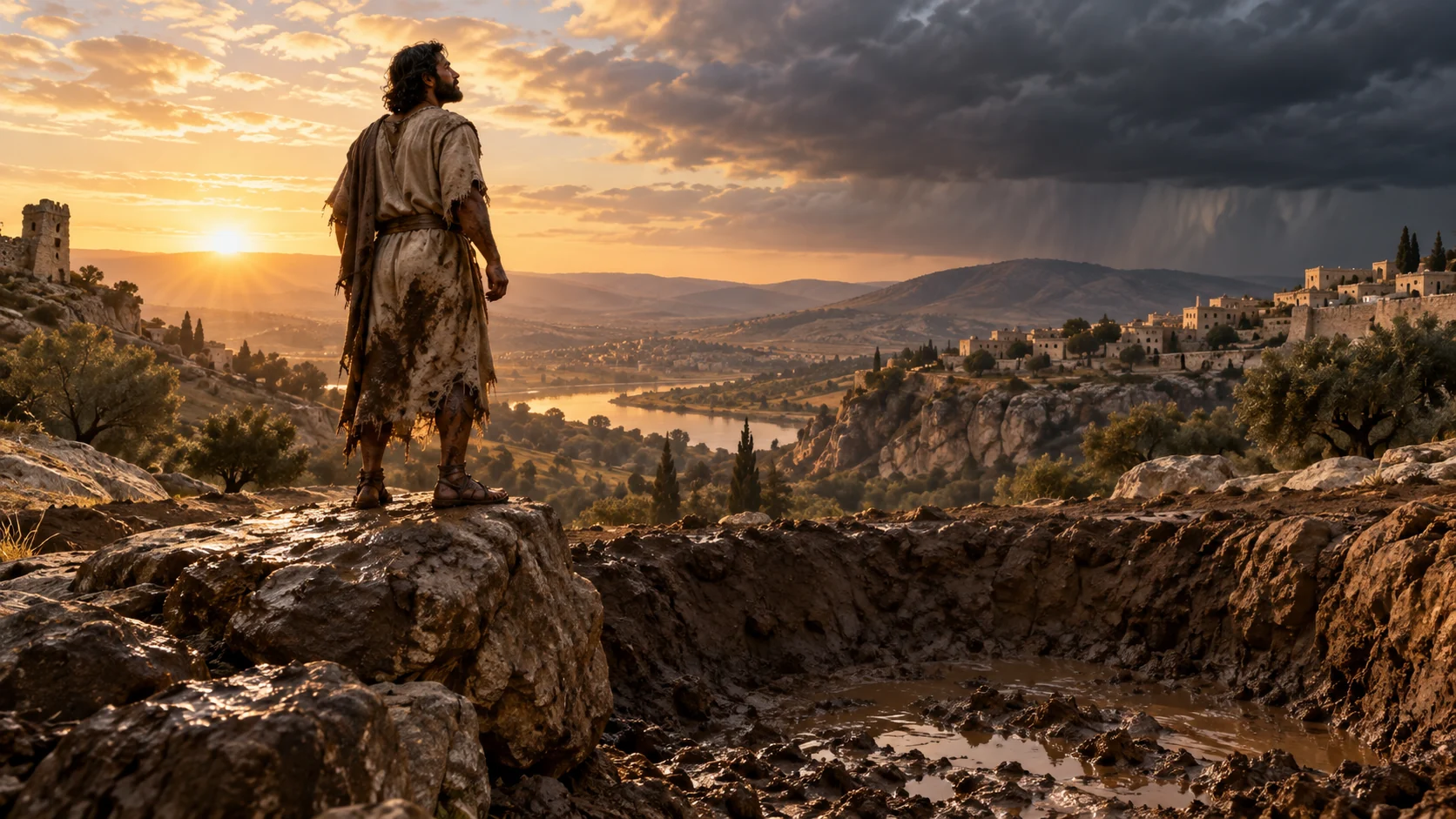
When a storm gathers over the hills, the landscape changes. Clouds cover familiar landmarks. Lightning reveals what darkness seemed to conceal. Everything suddenly appears smaller beneath a sky no one can command.
Psalm 97 announces the arrival of a King with imagery like that. Yet it begins with an unexpected instruction: Let the earth rejoice. The thunder is not the announcement of an unpredictable tyrant. Behind the clouds stands the God whose throne rests on righteousness and justice. His presence threatens what is false and oppressive precisely because his rule is good.
The psalm asks a searching question: Can we welcome God's reign not only when it comforts us, but also when it confronts what we have trusted and what we have become?
02
1.0 Introduction
Psalm 96 ends by celebrating the Creator's coming to judge the world with righteousness and faithfulness. Psalm 97 begins with the same royal proclamation—the LORD reigns—but shows another dimension of that good news. The approaching King is surrounded by clouds, fire, lightning, and trembling mountains. False gods are humiliated. Zion rejoices. Those who love the LORD are called to reject evil and to rejoice in his holy name.
The apparent tension is intentional. How can the earth celebrate an appearance so fearsome? Verse 2 supplies the answer: God's authority is not arbitrary. Righteousness and justice are the foundation of his throne. The frightening imagery portrays the seriousness of his holiness; the moral language tells us what kind of sovereign this holy God is.
The psalm unfolds in three broad movements:
- Verses 1–6: The world is summoned to rejoice as the LORD manifests his righteous kingship. - Verses 7–9: Idolatry is exposed while Zion celebrates the supremacy of the LORD. - Verses 10–12: Those who love him are summoned to reject evil and live in the hope of his protection and light.
Central message: Because the LORD reigns in righteousness and justice, the collapse of false powers is good news. Loving this King means refusing evil, trusting his faithful care, and learning to rejoice in his holiness.
03
2.0 Historical and Literary Context
Psalm 97 belongs to Book Four of the Psalter (Psalms 90–106). Book Three ended with a disturbing question: what has happened to God's covenant with David when the royal crown lies in the dust (Ps. 89:38–51)? Book Four repeatedly answers, not by denying that crisis, but by directing Israel's attention to the kingship that no political disaster can abolish: the LORD himself reigns (Pss. 93; 95–100).
The Hebrew text provides no authorial heading or specific historical setting for Psalm 97. The Greek Psalter includes a Davidic notice linked with the establishment of his land, but it does not establish a reliable date of composition. Scholars have proposed connections with ancient worship festivals, Israel's great deliverances, or the return from exile. None can be proved from the psalm's wording alone. Goldingay cautions against assigning a definite date or liturgical reconstruction where the available evidence is insufficient (Goldingay 2008, Psalm 97, “Interpretation” and “Heading”).
What is unmistakable is the poem's biblical memory. Clouds, darkness, fire, lightning, and mountains evoke God's appearance at Sinai (Exod. 19:16–20; 20:18–21), the storm imagery of Psalm 18, and poetic depictions of divine intervention (Judg. 5:4–5; Hab. 3:3–15). Here that theophanic language—a description of God's appearing—shows the universal significance of his reign.
Psalm 97 also has close verbal and thematic connections with its neighbors. Psalm 96 calls distant nations and creation itself to rejoice; Psalm 97 invites even far-off coastlands into the celebration (v. 1). Psalm 98 will return to a broad invitation to sing because God has made his salvation known. Kidner sees Psalm 97 as the more formidable member of this group: where Psalms 96 and 98 emphasize joy, Psalm 97 insists that the arrival of the King also exposes rebellion (Kidner 2014, 382–84).
An important literary feature is the shift in audience. The opening addresses the earth and distant coastlands (v. 1); the middle contrasts idol-worshipers and Zion (vv. 7–9); the conclusion turns directly to those who love the LORD (vv. 10–12). The poem moves from the King's cosmic majesty to the ethical choices of ordinary worshipers.
04
3.0 Walking Through the Text
3.1 Psalm 97:1–2 — Rejoicing before a King who cannot be controlled
The opening declaration is brief: the LORD reigns. This is not a description of a vacant throne suddenly being occupied. Israel confesses that the Creator is sovereign, and the psalm celebrates the recognition or decisive manifestation of that sovereignty. Goldingay favors hearing the proclamation as God's kingship asserted through action; Kidner gives special attention to its great horizon of divine coming. Both emphases alert readers to something more than a static idea about God (Goldingay 2008, Psalm 97:1; Kidner 2014, 382).
The proper response is joy extending as far as the many coastlands. The Hebrew image does not need to mean islands alone. It can evoke distant shores and peoples beyond Israel's immediate horizon (compare Isa. 42:10–12). No people can claim to own the King of all the earth.
But verse 2 interrupts any expectation of an easy or comfortable royal procession. Clouds and thick darkness surround him. At Sinai, the cloud both announced God's presence and placed a boundary around a holiness that people could not simply manipulate or approach on their own terms (Exod. 19:9, 16; 20:21). The darkness speaks of mystery and divine otherness, not of evil within God.
Then comes the essential moral clarification: righteousness and justice uphold his throne. A terrifying human ruler may keep subjects obedient through fear while governing according to whim. The LORD is different. His authority is bound to what is right. The Hebrew words traditionally rendered righteousness and justice speak of right relationships, faithful judgment, and the ordering of life in accordance with God's character. Goldingay draws out their implications in terms of divine faithfulness and authoritative judgment (Goldingay 2008, Psalm 97:2).
The clouds prevent us from reducing God to something manageable. The foundation of his throne prevents us from imagining him as morally unpredictable. He is beyond our control, but not beyond our trust.
3.2 Psalm 97:3–5 — Fire, lightning, and mountains that melt
Fire goes before the LORD and consumes his adversaries. Lightning illumines the world. The earth trembles, and mountains melt like wax before the Lord of the whole earth.
These images belong to the Bible's language of theophany. Their purpose is not to provide a meteorological report or to predict the exact physical sequence of the end of history. They make a theological claim in images the human body can feel: no seemingly immovable power can stand before the Creator's just authority. The mountain, one of the most stable things in the ancient landscape, dissolves like something fragile.
The pattern recalls God's appearance at Sinai and the praise of his intervention in Psalm 18 (compare Ps. 18:7–15; Mic. 1:3–4; Nah. 1:3–6). Yet the setting in Psalm 97 gives the imagery a public and universal meaning. The LORD is Lord of all the earth, not merely the private protector of one nation.
What, then, does the consuming fire mean for the psalm's opening joy? We should not romanticize destruction or treat human suffering as a spectacle. In this poem God's enemies stand opposed to the justice that supports his throne. Removing oppression and unmasking false authority can be good news for those who have lived under their weight. Even so, the poetry does not identify a list of contemporary individuals whom believers may declare destined for destruction. God's judgment is his prerogative, not a mandate for human cruelty.
The imagery also examines worshipers. When we pray for God's rule to be visible, do we imagine only our opponents trembling? The holiness that unmasks oppressive systems also searches our own loyalties and conduct.
3.3 Psalm 97:6–7 — The heavens announce justice; the idols lose their claim
Verse 6 turns from the storm's power to its meaning: the heavens proclaim God's righteousness, and the peoples see his glory. This echoes the language of Psalm 19:1 and Psalm 50:6, but the emphasis here is not merely the grandeur of creation. What the world comes to recognize is the justice of the God who rules.
Immediately the poet names those shamed by this revelation: people who trust carved images and boast in idols. The irony is deliberate. What they took to be glorious proves unable to compete with the living Lord. The term used for worthless gods in these neighboring psalms underscores the emptiness of entrusting ultimate allegiance to what cannot save (compare Ps. 96:5; Isa. 44:9–20).
The final line of verse 7 is difficult: all the gods are called to bow before the LORD, or are portrayed as already bowing. Some readers take these to be the supposed deities worshiped by the nations; others understand the Hebrew term as referring to heavenly beings. The ancient Greek rendering uses language of angelic beings, a wording relevant to the discussion of Hebrews 1:6. Even there, scholars debate whether Hebrews is directly drawing on Psalm 97:7, Deuteronomy 32:43 in the Greek tradition, or a related liturgical formulation. These distinctions should not be flattened into a claim of certain direct quotation (Kidner 2014, 383).
What both readings affirm is clear: no spiritual power or object of devotion can rival the LORD's supremacy.
For Christians, that conviction must never be used to humiliate neighbors who hold another faith. The biblical criticism of idolatry challenges misplaced worship and loyalty; it does not erase the dignity of people created in God's image. Nor does the challenge end at the boundary of religious images. A congregation can condemn idols while placing ultimate trust in wealth, political influence, celebrity leaders, or its own institutional reputation.
3.4 Psalm 97:8–9 — Zion hears the news and rejoices
The next scene is quieter but no less important. Zion hears and rejoices; the towns of Judah are glad, because of the LORD's judgments. The language recalls Psalm 48:11, where God's righteous action gives his people reason to celebrate.
Here the people do not boast that their local ruler has become the strongest of all. They rejoice because the LORD is Most High over all the earth. The smaller community's experience becomes witness to a much larger truth. His reign does not terminate at Jerusalem's walls.
Verse 9 also repeats the theme of superiority over all supposed gods. The point is not simply a numerical contest in strength. If the LORD's throne is grounded in justice, then the nations need something better than an endless competition among powerful patrons. They need the rule of the One who will judge with integrity.
This passage belongs with Psalm 96's invitation to every nation. Zion's gladness should expand its horizon rather than breed contempt for outsiders. Those who have heard good news are entrusted to bear witness to it.
3.5 Psalm 97:10 — Love for the LORD requires resistance to evil
The psalm now addresses its worshipers directly: You who love the LORD, hate evil. This is a startling movement from mountains melting to everyday moral responsibility. The God who judges evil calls his people to refuse cooperation with it.
The Hebrew wording is quite direct. Attempts to smooth it into a statement that God's lovers simply happen to hate evil weaken its force. Kidner emphasizes the imperative, while Goldingay notes its particular force against the temptation to serve rival gods; the principle also speaks naturally to injustice and wrongdoing in society (Kidner 2014, 383–84; Goldingay 2008, Psalm 97:10).
The command is to hate evil, not to nurture hatred against human beings. It requires refusing what destroys lives: dishonesty, abuse, exploitation, idolatry, and the use of sacred language to protect wrongdoing. In family, church, and public life, love for God cannot be separated from truthful moral choices.
The second half of the verse promises that God guards the lives of those faithful to him and rescues them from the wicked. The language is personal and encompassing: God cares for the whole life of his people. But guarding is not a guarantee of an uninterrupted life without injury, death, or loss. Kidner explicitly distinguishes divine watchfulness from a promise that believers will never become casualties (Kidner 2014, 384; compare Dan. 3:16–18; Ps. 44).
God's guardianship gives courage to do right even when right action is costly. It does not license a believer to accuse a suffering person of deficient faith.
3.6 Psalm 97:11–12 — Light is planted, and joy is invited
The final image changes everything we see. After clouds, darkness, fire, and lightning, verse 11 speaks of light for the righteous and joy for the upright in heart.
The Hebrew textual tradition gives rise to an illuminating difference. The Masoretic reading is commonly rendered “light is sown” for the righteous, suggesting a seed placed in the ground before its fruit can be seen. Some ancient witnesses support a reading such as “light dawns”, which Kidner prefers. Goldingay follows the image of light being sown. Both readings communicate hope, but with different emphasis: one pictures hidden beginnings and eventual harvest; the other, the breaking of morning after night (Goldingay 2008, Psalm 97:11; Kidner 2014, 384).
The distinction matters pastorally. Light sown is not necessarily light already visible. A believer may be doing the right thing while waiting through a prolonged night. To say that light will dawn is not to deny that the darkness currently feels real.
Finally the psalm commands: Rejoice in the LORD, you righteous, and give thanks to his holy name (v. 12, study paraphrase). It began with an invitation to the entire earth; it ends by inviting God's own people to respond. The proper object of their joy is not the humiliation of others. It is the holy and righteous King whose rule makes ultimate hope possible.
05
4.0 Theological Reflection
4.1 God's sovereignty is morally defined
Psalm 97 does not celebrate authority for its own sake. In a world where power can be bought, inherited, exploited, or displayed, it offers a different measure of kingship. The LORD's throne is established on righteousness and justice (v. 2; compare Ps. 89:14). Any religious message that glorifies raw force while neglecting justice misrepresents the King it claims to honor.
4.2 Divine mystery and divine reliability belong together
Clouds conceal God even while his presence is revealed. This guards against the arrogance of claiming to explain every event of suffering or every decision of providence. But hiddenness is not caprice: the throne beneath the cloud is righteous. We may not understand every divine action; we are nevertheless invited to trust God's character. Such trust should be humble, not a demand that suffering people stop asking difficult questions (Pss. 88–89).
4.3 The exposure of idols is an act of liberation
Idolatry diminishes human life by giving ultimate claims to something created, manufactured, or politically useful. The psalm exposes those claims. Its critique is not satisfied with ridiculing statues. It asks whether anything other than God has acquired the right to dictate our conscience, consume our resources, and determine whose suffering matters (Isa. 44:9–20; 1 John 5:21).
4.4 A love that tolerates evil is incomplete
The command to hate evil follows the assurance that the LORD reigns. Worship is therefore both joyful and morally demanding. The church cannot convincingly proclaim God's just kingship while concealing abuse, excusing corruption, or exploiting the weak. To hate evil is to resist wrongdoing through truthful, proportionate, and just means—not to become cruel in the name of righteousness (Amos 5:15, 24; Rom. 12:9–21).
4.5 Light and joy may arrive through faithful waiting
The psalm promises neither instant relief nor continuous emotional excitement. Light can be pictured as sown before the harvest, or as morning after a long night. Believers may lament honestly while refusing despair as the final truth about creation. Hope has room for patience and for the care of those who are still waiting (Ps. 30:5; Rom. 8:18–25).
06
5.0 Canonical and Christological Horizon
Psalm 97 participates in a scriptural pattern that begins long before the psalmist: God appears at Sinai in cloud, fire, and trembling (Exod. 19:16–20); the mountains respond to his approach in the Song of Deborah (Judg. 5:4–5); prophets use storm and fire to portray his decisive involvement in human affairs (Hab. 3:3–15; Nah. 1:3–6). Such imagery consistently refuses to domesticate the holy Creator.
The royal songs of Book Four also answer the broken-human-kingship question of Psalm 89. They insist that God's government has not ceased merely because Israel's political fortunes have collapsed. The LORD's reign precedes every earthly monarchy and stands above it (Pss. 93; 96–99).
Christian readers see that royal claim brought into fresh focus through Jesus Christ. Jesus announces the kingdom of God (Mark 1:14–15), exposes false religious security (Mark 11:15–17), and refuses the kind of power that secures loyalty by coercion (Mark 10:42–45). In the cross, the world's supposed powers appear to triumph; in his resurrection, God vindicates the crucified Messiah (Acts 2:23–24, 32–36).
The language of heavenly worship in Psalm 97:7 has an important textual resonance with Hebrews 1:6, where heavenly beings are summoned to worship God's Son. The precise source of Hebrews' wording is discussed among interpreters because the Greek textual tradition of Deuteronomy 32:43 provides a close parallel. It is better to acknowledge the question than to present one cross-reference as indisputable. The larger argument of Hebrews is nevertheless clear: the Son has a dignity no created heavenly being can claim (Heb. 1:1–14).
The New Testament also anticipates a public unveiling of Christ's authority. Images of divine appearing, judgment, and the world's response can be heard in Matthew 24:30; 2 Thessalonians 1:6–10; Revelation 1:7; 19:11–16. Yet Psalm 97 is not itself a detailed end-times chart. Goldingay emphasizes its celebration of divine kingship manifested in history; a Christian eschatological reading adds a future horizon without erasing that original emphasis.
Finally, Christian hope does not end with the defeat of adversaries. Revelation 21:1–5; 22:1–5 describes a world in which God's presence brings justice, healing, and light. The King who comes through the clouds is the One who intends creation to be free from the darkness that ruins it.
07
6.0 Life Application
- Measure authority by justice. When evaluating a leader in church, government, or family, ask not only whether the person appears strong but whether they act truthfully and protect those with less power. God's throne is founded on justice, not spectacle.
- Name the loyalties competing with God. Consider whether money, public approval, party identity, professional status, or religious reputation has become too important to question. Identify one practice that restores proper perspective.
- Resist evil without dehumanizing people. Refuse bribery, exploitation, abusive speech, and concealment of wrongdoing. Pursue fair accountability rather than personal vengeance; seek to protect people rather than indulge hostility.
- Make room for those waiting for light. Visit, listen to, or practically help someone enduring grief, illness, unemployment, or prolonged disappointment. Do not insist that their circumstances must immediately change if they believe enough.
- Let worship strengthen ethical courage. Bring the words “the LORD reigns” into a difficult decision. Ask what a truthful, compassionate, courageous response would look like even if it costs you.
- Practice hope as disciplined gratitude. At the end of a troubling day, identify one sign of God's goodness without pretending the troubling realities have disappeared. The psalm invites joy grounded in God's character, not denial of pain.
08
7.0 Reflection Questions
- Why does Psalm 97 begin with rejoicing when its description of God's appearance is so overwhelming?
- What difference does it make that righteousness and justice, rather than sheer power, are the foundation of God's throne?
- Which false sources of security are most attractive in our families, churches, and public life?
- How can believers obey the command to hate evil without turning it into permission to hate other people?
- What does the image of sown light or dawning light say to someone still waiting for deliverance?
- How does Jesus' crucified-and-risen kingship reshape our expectations about the way God overcomes evil?
09
8.0 Response Prayer
Holy LORD, King over all the earth, we confess that your reign is greater than the powers we fear and more righteous than the powers we admire.
When clouds hide what we wish to understand, keep us from claiming certainty we do not possess. Teach us to trust the justice of your throne without silencing the questions of those who suffer.
Expose the idols we have learned to serve. Where we have excused dishonesty, awaken truth. Where we have protected the powerful at the expense of the weak, teach us repentance and courageous repair. Where we have confused hatred of evil with hatred of people, form in us the mercy of Jesus Christ.
Guard those who live under violence and fear. Stay near to those whose night seems long. Let the light you have planted grow toward morning, and make us faithful companions while they wait.
Through Jesus our crucified and risen Lord, teach us to rejoice in your holiness and to serve your coming kingdom with justice and love.
Amen.
10
9.0 Window into What Comes Next
Psalm 97 announces that the LORD reigns, surrounds his coming with the fierce imagery of holiness, exposes false gods, and summons God's people to reject evil. Its last word is joy: rejoice in the LORD and give thanks to his holy name.
Psalm 98 begins with another invitation to sing a new song, but the atmosphere changes. The overwhelming King of Psalm 97 is now celebrated for making his salvation known and revealing his righteousness before the nations. The sea, rivers, and mountains join the praise as the earth welcomes its Judge.
The two psalms belong together. Psalm 97 asks whether we will welcome the holy King who unmasks evil; Psalm 98 invites us to sing because the same King's righteous action brings salvation and hope to the world.
11
10.0 Bibliography
- Scripture: Psalm 97; Psalms 18, 19, 30, 44, 48, 50, 89, 93–99; Exodus 19–20; Deuteronomy 32:43 (including the ancient Greek textual tradition); Judges 5:4–5; Daniel 3:16–18; Isaiah 42:10–17; 44:9–20; Amos 5:15, 24; Micah 1:3–4; Nahum 1:3–6; Habakkuk 3:3–19; Mark 1:14–15; 10:42–45; 11:15–17; Matthew 24:30; Acts 2:23–36; Romans 8:18–25; 12:9–21; Hebrews 1:1–14; 12:29; 2 Thessalonians 1:6–10; 1 John 5:21; Revelation 1:7; 19:11–16; 21:1–5; 22:1–5. The key text is a study rendering, not a verbatim quotation from a named modern translation.
- BibleProject. n.d. The Book of Psalms: Study Notes. Project resource on the Psalter's five-book arrangement and Book Four.
- Goldingay, John. 2008. Psalms, Volume 3: Psalms 90–150. Baker Commentary on the Old Testament Wisdom and Psalms. Grand Rapids, MI: Baker Academic. Commentary on Psalm 97, “Yhwh Began to Reign: Earth Is to Rejoice.”
- Kidner, Derek. 2014. Psalms 73–150. Kidner Classic Commentaries. Downers Grove, IL: InterVarsity Press. Originally published 1975. Commentary on Psalm 97, “Formidable Majesty,” pp. 382–84.
Be the first to leave a comment.