


Can We Trust Promises Spoken Thousands of Years Ago?
01
Introduction
Part III — Scripture, Gospel, and the Trustworthiness of God’s Story
Faith Built on Truth — Through Christ, Through Scripture, for Life
What value does an ancient promise have when today’s sky is dark and tomorrow remains hidden? Can words spoken to Abraham, exiles, prophets, and persecuted churches still carry hope into our homes, hospital rooms, and unanswered prayers?
Promises are easy to make when the road is level.
Their weight is tested when the road enters the wilderness.
The Bible is filled with promises, but they are not offered as religious slogans floating above ordinary pain. They are spoken to a childless couple staring at old age, to slaves making bricks under empire, to a nation watching its city burn, to prophets surrounded by unbelief, to disciples frightened by a cross, and to churches trying to remain faithful under pressure.
Biblical promises are born in places where human strength runs out.
That is also why they are easily misunderstood. A promise in Scripture is not a blank cheque for whatever we desire. Not every sentence spoken to one person becomes a private guarantee for every believer. God’s promise to Abraham must be read as God’s promise to Abraham; his promise to David belongs within the covenant story of Israel; prophetic promises must be heard within judgment, exile, restoration, Messiah, and new creation.
The question, then, is not simply, “Can I find a verse that sounds encouraging?”
The deeper question is: Has the God who speaks in Scripture shown himself faithful across the long road of the biblical story?
Here are ten reasons to believe he has.
02
1. God’s Promises Are Trustworthy Because They Rest on His Character
Human promises often fail for familiar reasons. We change our minds. We forget. We lack power. We discover hidden costs. Sometimes we never meant what we said.
Biblical hope begins somewhere else—with the character of the One who speaks.
When God reveals his name to Moses, he describes himself as compassionate and gracious, slow to anger, and overflowing in steadfast covenant love and faithfulness [Exodus 34:6–7]. Deuteronomy calls him the faithful God who keeps covenant love through generations [Deuteronomy 7:9]. The Psalms return again and again to the conviction that his faithfulness endures [Psalm 100:5; 117:2].
This matters because many people who receive God’s promises are unimpressive. Abraham hesitates. Jacob manipulates. Israel rebels. David fails. The disciples flee.
The Bible does not finally invite us to trust the strength of the recipients. It invites us to trust the faithfulness of the Promiser.
That does not make human response irrelevant. Covenant calls for faith, loyalty, repentance, and obedience. But our hope is not that trembling hands will never tremble. It is that God remains faithful even when his people discover how weak their grip can be.
Takeaway: When your faith feels small, look first at the character of the One you trust, not the size of the faith you possess.
03
2. God’s Promise to Noah Shows That He Has Not Abandoned Creation
After the flood, the world remains wounded. Human violence has not disappeared, and Genesis itself says the human heart is still bent toward evil [Genesis 8:21].
Yet God makes a covenant with Noah, his descendants, and “every living creature” [Genesis 9:8–17].
That detail matters.
God’s promise is not only about religious people. It embraces the earth itself. Seedtime and harvest, cold and heat, summer and winter, day and night will continue [Genesis 8:22]. The rainbow becomes a sign stretched across a world still capable of suffering, yet still held within divine mercy.
Every sunrise is not proof that nothing is wrong. It is evidence that God has not thrown the world away.
The prophets later draw on Noah’s covenant to speak about God’s enduring mercy [Isaiah 54:9–10], while the New Testament looks toward the reconciliation of “all things” in Christ [Colossians 1:15–20].
The Creator’s answer to a damaged world is not disposal but patient preservation on the way to renewal.
Takeaway: Another dawn, another season, another seed breaking soil can remind us that God has not surrendered the work of his hands.
04
3. God’s Promise to Abraham Shows That Delay Is Not the Same as Forgetfulness
God calls Abraham and Sarah when the future appears closed.
They have no child. They possess no settled homeland. Yet God promises Abraham a family, a land, and a vocation: through him, all the families of the earth will be blessed [Genesis 12:1–3; 15:1–6; 17:1–8].
The promise is almost painfully slow.
Years pass. Abraham and Sarah age. Their attempts to force the promise create more pain. Even after Isaac is born, the larger promise remains far from complete.
But the biblical story keeps carrying it forward.
Isaac comes. Jacob becomes Israel. Israel survives slavery, wilderness, kingdom, division, exile, and return. Then the New Testament identifies Jesus as Abraham’s descendant and sees the promised blessing flowing outward to the nations through him [Matthew 1:1; Galatians 3:6–9, 14–16].
From Abraham’s tent to a multiethnic family in Christ lies a long road.
The road itself becomes part of the lesson.
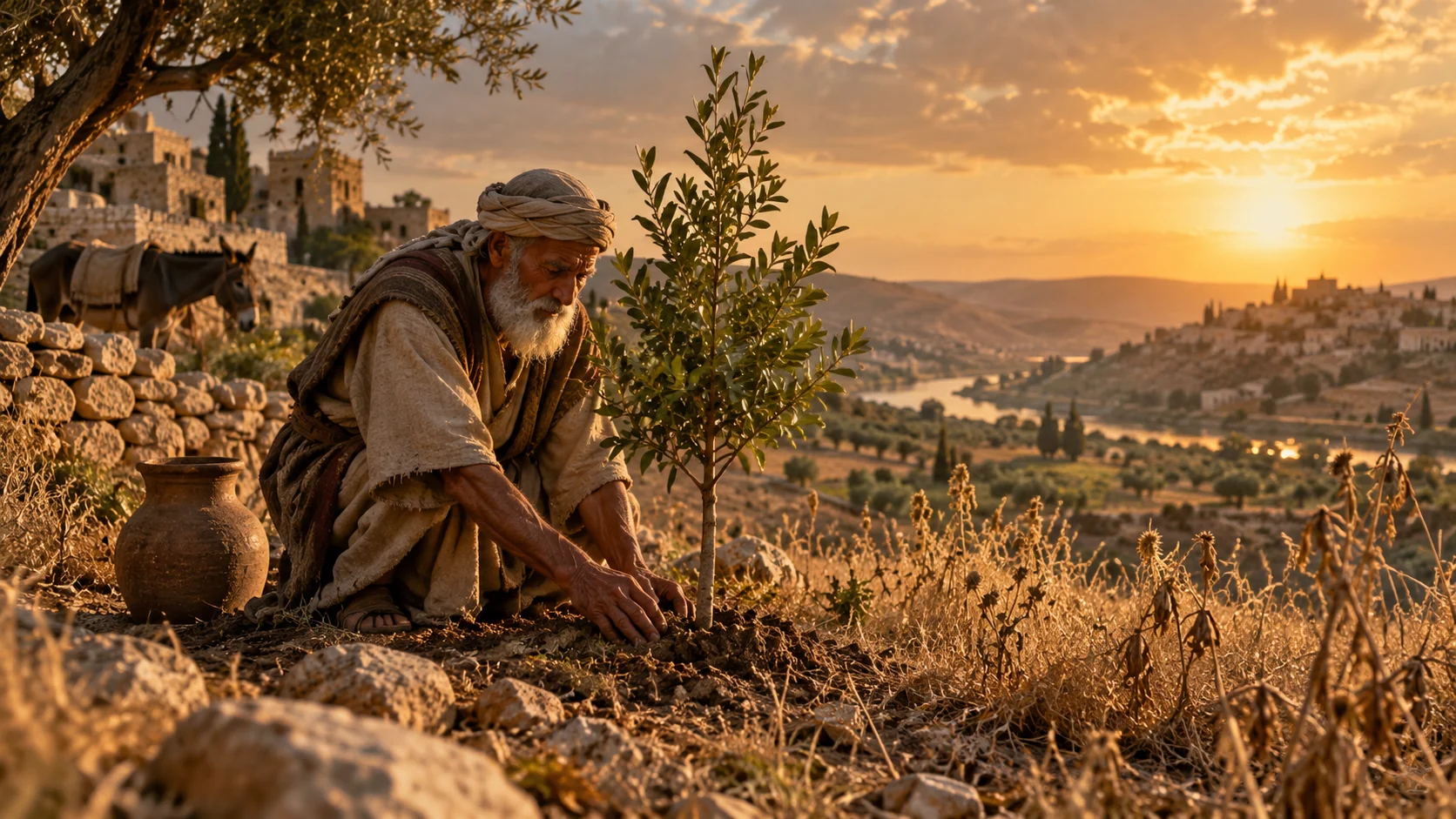
God’s delay is not necessarily God’s absence. A seed can be alive underground long before a green shoot breaks the surface.
Takeaway: When fulfilment is slow, resist the assumption that God has forgotten; some promises grow through seasons we cannot yet interpret.
05
4. The Exodus Shows That God Remembers His Promises in the Cry of the Oppressed
God told Abraham that his descendants would pass through oppression and later be brought out [Genesis 15:13–16].
Generations later, Israel groans under Pharaoh.
Exodus says God hears their cry, remembers his covenant, sees their suffering, and knows [Exodus 2:23–25]. “Remembered” does not mean God had misplaced the promise. It means covenant faithfulness is now moving into action.
Pharaoh sees labor units. God sees his people.
The empire sees bricks. God hears groaning.
The Exodus becomes Israel’s great memory of divine faithfulness. The Psalms sing it. The prophets use its language when they promise a new rescue from exile [Isaiah 40:1–5; 43:16–21]. The New Testament places Jesus’ death and resurrection within Passover and exodus imagery [Luke 22:14–20; 1 Corinthians 5:7].
The pattern becomes larger than Egypt: God hears, confronts bondage, makes a way, and forms a liberated people.
Takeaway: God’s timing may remain mysterious, but oppression does not fall outside his hearing, and no Pharaoh receives the final word.
06
5. God’s Promise to David Survives the Ruins of Failed Kingship
God promises David that his royal house will have a lasting future [2 Samuel 7:12–16].
For a while, the promise seems visible in stone, palace, dynasty, and temple.
Then everything unravels.
The kingdom divides. Kings become corrupt. Jerusalem falls. The temple burns. David’s heirs lose the throne. Psalm 89 itself dares to ask what has happened to the covenant God swore to David [Psalm 89:38–52].
If divine faithfulness meant preserving every institution exactly as it stood, the promise would appear dead.
Instead, the prophets look beyond failed kings toward a righteous ruler still to come. Isaiah sees a Davidic king whose reign brings justice and peace [Isaiah 9:6–7; 11:1–10]. Jeremiah speaks of a righteous Branch [Jeremiah 23:5–6]. Ezekiel imagines one shepherd over God’s restored people [Ezekiel 34:23–24].
The Gospels then present Jesus as Son of David [Matthew 1:1; Luke 1:31–33].
But his throne looks unlike normal thrones. He rules through service, wears a crown of thorns, dies under the sign “King of the Jews,” and is vindicated in resurrection [Mark 10:42–45; 15:16–39; Acts 2:29–36].
God keeps the promise not by preserving every broken form, but by bringing the true King through the ruins.
Takeaway: When familiar structures collapse, God’s faithfulness may be deeper than maintaining the form you expected him to preserve.
07
6. The Prophets Show That Judgment Does Not Cancel God’s Promise of Restoration
Biblical promises are not soft words designed to protect us from accountability.
The prophets warn Israel that idolatry, exploitation, violence, and covenant betrayal will bring judgment. Jeremiah stands near the temple and tells people that sacred buildings cannot protect injustice [Jeremiah 7:1–15]. Micah announces that Zion itself can be ploughed like a field if leaders use religion to cover corruption [Micah 3:9–12].
Then judgment comes.
Jerusalem falls. Exile begins.
Yet the prophets do not end there.
Isaiah announces a new exodus [Isaiah 43:16–21]. Jeremiah promises a new covenant in which God’s instruction is written on the heart and sin is forgiven [Jeremiah 31:31–34]. Ezekiel promises cleansing, a new heart, a new spirit, and a valley of dry bones coming to life [Ezekiel 36:24–28; 37:1–14].
This reveals something important about faithfulness.
God’s faithfulness is not indulgence. He does not call darkness light in order to preserve appearances. But neither is his judgment abandonment. His “no” to what destroys serves his deeper “yes” to healing, holiness, and restoration.
Takeaway: God’s correction does not mean his redemptive purpose has failed; sometimes judgment clears the ground for a deeper renewal.
08
7. God’s Promises Find Their Living “Yes” in Jesus
Jesus does not simply tick boxes beside a few ancient predictions.
He gathers the covenant story into himself.
He is introduced as son of Abraham and son of David [Matthew 1:1]. He announces God’s kingdom. He acts with authority over sin and sickness. He speaks of himself in temple language [John 2:19–21]. He celebrates Passover and interprets his death as the new covenant in his blood [Luke 22:14–20].
Paul therefore says that however many promises God has made, their “Yes” is found in Christ [2 Corinthians 1:20].
Yet the “Yes” comes in a surprising form.
The promised King wears thorns. Victory passes through apparent defeat. The Messiah is crucified. Then God raises him.
That resurrection changes the meaning of every earlier promise. It says that covenant faithfulness has gone through death and come out the other side. The promise is no longer only ink on parchment; it has a human face and a risen body.
Takeaway: Measure God’s faithfulness by the crucified and risen Jesus, not only by whether your present circumstances match your expectations.
09
8. The Gift of the Spirit Shows That God Has Already Begun Fulfilling the Promise of Renewal
The prophets look forward to a day when God will do more than repair outward structures.
He will change hearts.
Jeremiah promises God’s instruction written within [Jeremiah 31:31–34]. Ezekiel promises a new heart and a new spirit [Ezekiel 36:25–27]. Joel speaks of the Spirit poured out across age, gender, and social status [Joel 2:28–32].
At Pentecost, Peter says this promise is beginning to unfold [Acts 2:1–21].
The Spirit is not presented as the whole future already completed. Paul calls the Spirit “firstfruits,” a seal, and a down payment of the inheritance still to come [Romans 8:22–27; Ephesians 1:13–14].
A deposit is not the whole house.
But it is not nothing.
Where the Spirit forms love, patience, courage, holiness, reconciliation, prayer, and faithful witness, tomorrow’s world has begun to send roots into today.
God has placed the breath of the future inside fragile people in the present.
Takeaway: Every Spirit-shaped act of love, truth, courage, and holiness is a small sign that God has not forgotten the future he promised.
10
9. Biblical Promises Sustain People Through Suffering Rather Than Promising Escape from It
A promise can become dangerous when we turn it into a charm against pain.
Scripture never does that.
Joseph suffers before deliverance. Israel leaves Egypt only to enter wilderness. David receives a royal promise yet spends years running for his life. The exiles wait. Jesus carries a cross. Paul prays for suffering to be removed and sometimes receives sustaining grace instead [2 Corinthians 12:7–10].
Biblical hope therefore differs from easy optimism.
Psalm 23 does not say there is no valley; it says God is present in it [Psalm 23:4]. Isaiah does not say there will be no waters or fire; it says God will be with his people through them [Isaiah 43:1–3]. Romans 8 does not say believers avoid tribulation; it says nothing in all creation can separate them from the love of God in Christ [Romans 8:31–39].
An anchor does not stop the storm.
It prevents the storm from owning the ship.
Takeaway: Hold God’s promise in suffering not as denial of the storm, but as confidence that the storm will not write the final chapter.
11
10. The Resurrection Guarantees That God’s Greatest Promises Still Have a Future
The Bible’s promises finally stretch beyond one family, one land, one kingdom, or one generation.
They reach toward creation itself.
Isaiah sees death swallowed up, deserts blooming, nations reconciled, and a new heavens and new earth [Isaiah 25:6–9; 35:1–10; 65:17–25]. Revelation gathers those hopes into the vision of God dwelling with humanity, wiping away tears, defeating death, and making all things new [Revelation 21:1–5; 22:1–5].
The resurrection of Jesus is the pledge that this future is not merely poetic longing.
Paul calls Christ the “firstfruits” of those who have died [1 Corinthians 15:20–23]. Firstfruits are the beginning of harvest. The first sheaf matters because more is coming.
Christian hope therefore does not end with souls escaping creation. The Creator who raised Jesus intends to redeem bodies, communities, and the world he made.
The empty tomb is God’s signature beneath the promise of new creation.
Takeaway: Because Jesus is risen, death is not the final measure of reality, and faithful labor offered to God is never finally wasted.
12
Truth and Your Decision: If God Is Faithful to His Promises
The Bible’s promises travel across centuries because they are carried by one faithful God.
His covenant preserves creation. His promise calls Abraham. His compassion hears Israel under Pharaoh. His faithfulness carries David’s hope through the collapse of monarchy. His prophets speak restoration beyond judgment. His promises find their living “Yes” in Jesus. His Spirit brings the future into the present. His presence sustains people through suffering. His resurrection promise opens toward the renewal of all things.
This is not a string of inspirational sentences.
It is a story.
And that story also teaches us how to handle promises carefully.
Not every desire is a promise. Not every verse is addressed to every person in the same way. Not every delay is denial. Not every hardship means God has forgotten. Biblical promise must be read inside covenant, context, Christ, and the larger story of Scripture.
Perhaps you are carrying a promise today while standing in a place that looks nothing like fulfilment.
A hospital room.
A grave.
A family conflict that has lasted too long.
A prayer repeated until the words feel worn.
Scripture does not ask you to call darkness light. It asks you to look through the darkness toward the crucified and risen Jesus.
Will you measure God only by the unfinished chapter in front of you, or trust the Author whose faithfulness has carried the story through flood, slavery, wilderness, exile, cross, and grave—and who promises to carry it into new creation?
13
Closing Prayer
Faithful God, you have carried your promises through wilderness, exile, cross, and grave.
Teach me to distinguish your true promises from my private wishes. Keep me from using Scripture carelessly, and keep me from despair when fulfilment seems slow.
Fix my eyes on Jesus, in whom your promises find their “Yes.” When I walk through waiting, give me patience. When I walk through suffering, give me courage. When life is easy, keep me humble.
Fill me with your Spirit and make my life a small sign of the world you have promised to renew.
Amen.
14
Join the Conversation
Which biblical promise has carried you through a difficult season? Which promise do you still find hardest to trust?
Share your reflection, question, or testimony as we continue the Reasons to Believe series—Faith Built on Truth, Through Christ, Through Scripture, for Life.
Previous lesson: The Bible Tells One Unified Story: Ten Reasons to Believe
Next lesson: The Bible Is Historically Trustworthy: Ten Reasons to Believe

Be the first to leave a comment.