

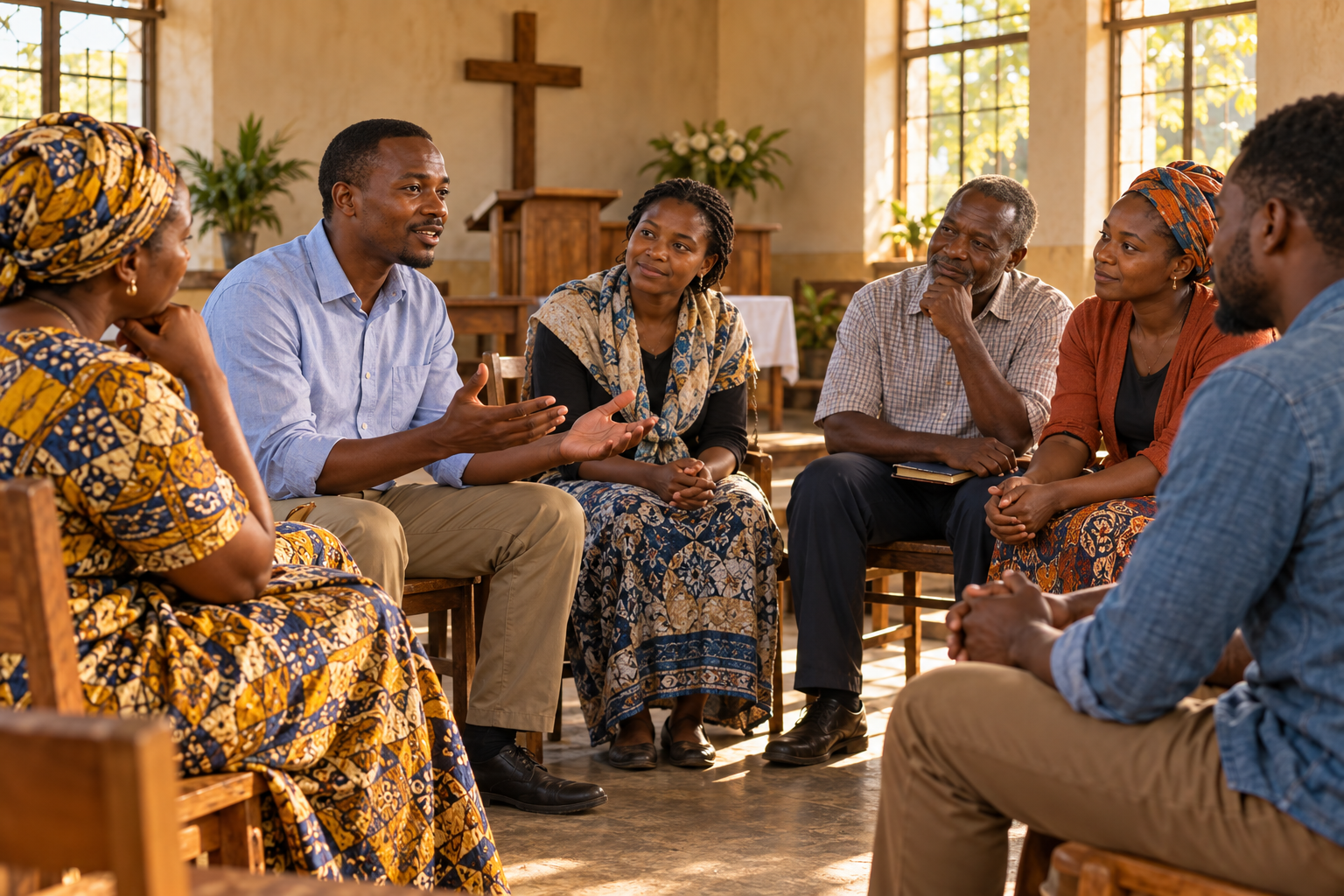
Why remain connected to a community that has sometimes wounded people?
01
Introduction
Faith Built on Truth — For Christ, Through Scripture, For Life
What do you say to someone who came to church looking for shelter and was harmed by the very people who welcomed them?
Can the church still matter when its failures have made belonging feel dangerous?
Some wounds come from strangers. Others come from a preacher whose words we trusted, a leader who used authority to silence a question, or friends who looked away when help was needed.
We cannot defend the importance of the church by stepping around those wounds.
Wrongdoing must be named. Those who caused harm must be held accountable. A person may need to leave a congregation, seek help, and stay away from an unsafe place.
No one should be pressured to return in order to prove their faith.
And yet the failures of churches raise a deeper question: Did Jesus call people into a shared life that is still worth seeking, even when particular communities betray that calling?
Scripture gives us reasons to say yes. It also gives us standards by which churches can be questioned, corrected, and reformed.
These ten reasons make a case for Christian community shaped by truth, safety, and accountability. They do not require loyalty to an institution at the expense of a person.
02
1. Jesus intended to gather a people around himself
Jesus did not call people to follow him only as isolated individuals. He called disciples, lived with them, ate with them, taught them to forgive one another, and sent them out to serve.
He said he would build his church (Matthew 16:18). After his resurrection, he sent his followers into the world as witnesses, and their testimony gathered communities devoted to teaching, fellowship, shared meals, and prayer (Matthew 28:18–20; Acts 2:41–42).
The church therefore begins with Jesus’ call, even when a particular congregation loses sight of his way.
But that origin is not permission to defend everything a church does.
A group cannot simply say, “We belong to Jesus,” and place all its decisions beyond question.
Jesus welcomed children and confronted leaders who cared more about religious appearance than justice, mercy, and faithfulness (Mark 10:13–16; Matthew 23:23).
When leaders act against that way, the wounded person is not responsible for protecting them.
The church itself must ask: Are we still following our Lord, or have we begun protecting our own name instead?
Takeaway: Measure a church by the way it follows Jesus, especially in how it treats people with little power.
03
2. The gospel brings people into God’s household
Paul tells those who were once strangers that they are now members of God’s household (Ephesians 2:19–22).
In Christ, the old divisions that once determined who belonged lose their final authority (Galatians 3:26–28).
This is more than joining an organization.
It is learning to call people brothers and sisters across differences that would normally keep us apart.
But the word family can also be misused.
Households can wound the people within them.
A church should never use the language of “we are family” to demand secrecy, hide wrongdoing, or pressure someone to remain close to a person who harmed them.
In a healthy family, wounded people are heard. Harm is not hidden. Safety matters more than reputation.
The church remains worth seeking because Christ’s welcome is real, not because every community that calls itself a family lives faithfully.
Takeaway: Belonging is a gift from Christ; it should never be used to trap someone in danger.
04
3. The New Testament does not hide the early church’s failures
The first churches were not flawless communities.
Greek-speaking widows were overlooked in the daily distribution of food (Acts 6:1–6).
At Corinth, wealthier believers humiliated poorer ones during the shared meal (1 Corinthians 11:17–22).
Paul even confronted Peter when his conduct separated people at the table along ethnic lines (Galatians 2:11–14).
These failures were preserved in Scripture.
They were not erased to protect the reputation of the early church.
Nor did the New Testament writers say, “Everyone makes mistakes, so we should simply accept this.”
They named the problem and called for change.
The neglected widows received attention. The divided table was rebuked. Conduct that damaged fellowship was brought into the light.
When a church today says, “Every community has problems,” Scripture answers: then deal honestly with yours.
Exposure is not always the end of a church.
Sometimes it is the beginning of reform.
Takeaway: The early church’s failures do not excuse ours; they teach us to bring failure into the open and address it truthfully.
05
4. Jesus’ concern for the vulnerable judges the church’s conduct
Israel’s prophets condemned shepherds who fed themselves while neglecting the weak (Ezekiel 34:2–4).
Jesus warned sternly against causing vulnerable people to stumble and confronted religious leaders who placed heavy burdens on others without helping them carry those burdens (Matthew 18:6; 23:4).
The church cannot hide behind Jesus’ name while harming the very people he called it to protect.
Imagine someone reporting abuse and being asked first:
“What will people say about our church?”
That question already reveals whose safety is being protected.
A faithful response begins by taking the report seriously, helping the person access support that is independent of those accused, and—when appropriate—involving qualified professionals or relevant authorities.
A person’s safety should never be sacrificed to protect an institution’s reputation.
A church that refuses scrutiny needs correction, not the silence of the wounded.
Takeaway: Protecting vulnerable people is part of the church’s faithfulness to Jesus.
06
5. Leaving an unsafe congregation can be a faithful decision
The Psalms know the pain of betrayal by someone with whom one once worshiped (Psalm 55:12–14).
The Bible does not ask a wounded person to call betrayal love.
It gives them words with which to bring their distress before God.
At the same time, the prophets remind spiritual leaders that God will hold them accountable for the people they have harmed (Ezekiel 34:10).
A person may therefore need to step away from a congregation for a time.
They may need to move to another church, speak with someone trustworthy outside the leadership involved, or seek professional support.
Those choices do not cancel Christ’s welcome.
They can create the space needed to breathe, heal, and decide whether, when, and where communal worship may become safe again.
The people who caused the wound do not get to set the timetable for someone else’s recovery.
Nor can they insist that a quick return proves forgiveness or faith.
Takeaway: You can seek safety and still be seeking God.
07
6. The body of Christ needs the gifts of every member
Paul compares the church to a body.
The eye cannot say to the hand, “I do not need you,” and members who seem weaker are to receive particular honor (1 Corinthians 12:21–26).
Teachers need people who listen carefully.
Leaders need people who can tell them the truth.
Those who serve quietly should not disappear behind the platform as though their contribution does not matter.
Gifts bring life when they are used for service rather than domination (Romans 12:4–8).
In a healthy congregation, a young person’s question may expose something adults have missed.
An older member may sit patiently with someone who is grieving.
A gifted person can also learn to receive help rather than only provide it.
No one should have to carry every burden alone.
The body image also exposes an unhealthy church.
If one voice cannot be questioned, or if some people can be discarded as though they do not matter, the community is acting against the very image it uses to describe itself.
Takeaway: Seek a community where people can give, receive, question, and be cared for with dignity.
08
7. Shared worship keeps the story of Jesus before us
When believers sing, teach, and give thanks together, they allow the word of Christ to shape the memory and life of the community (Colossians 3:16).
At the Lord’s table, they remember Jesus giving his body for others—not power using others for itself (1 Corinthians 11:23–26).
Someone too weary to find words for prayer may sometimes be carried by the prayers, songs, and hope of others.
That is part of the beauty of worshiping together.
But worship can also be misused.
A moving song can be used to cover a wound.
Someone may be told, “Just move on,” before wrongdoing has even been faced.
That is why Paul confronted the Corinthians in the very setting of their shared meal (1 Corinthians 11:20–22).
Worship that truly remembers Jesus must also make room for confession, repair, and the restoration of dignity to those who have been pushed aside.
Takeaway: Look for worship that remembers Jesus not only in its words, but also in the way people are treated.
09
8. Community makes care for neighbors more durable
The early believers shared resources so that practical needs could be met (Acts 4:34–35).
When widows were overlooked in the distribution of support, the church changed the way that care was organized (Acts 6:1–6).
James asks what good warm words are to someone who lacks food or clothing if no one helps meet the need (James 2:14–17).
A congregation can become a place where compassion lasts longer than a single moment.
It can provide meals for a grieving family, visit a prisoner, support a student, or keep caring for someone who is ill after the first wave of visitors has gone.
But good intentions alone are not enough.
The widows in Acts were overlooked inside a community already committed to generosity.
That detail matters.
Shared care requires listening to those who have fallen through the cracks and changing systems when those systems keep leaving people behind.
When the church learns to do that, its common life can become visible good news even to people outside its walls.
Takeaway: Ask whether a church notices who is being overlooked and what it changes when those people speak.
10
9. Confession and accountability make genuine repair possible
The New Testament does not present the church as a place where sin must be hidden.
Believers are called to tell the truth about wrongdoing, confess, and pray for one another (1 John 1:8–9; James 5:16).
Jesus also teaches that the person who has harmed another should take initiative toward repair (Matthew 5:23–24).
The burden of beginning that work should not be shifted onto the person who was injured.
But repair is more than saying, “I am sorry,” from a pulpit.
At times it may require removing someone from authority, conducting an independent investigation, making restitution where possible, cooperating with relevant authorities, or changing long-standing practices that allowed harm to continue.
The injured person cannot be ordered to forgive on someone else’s timetable.
And the person who broke trust cannot simply announce that trust has now been restored.
Trust is rebuilt through truth, accountability, and changed conduct over time.
A church that accepts those limits is beginning to understand repentance.
Takeaway: Trust grows slowly where truth is told, harm is addressed, and responsibility produces visible change.
11
10. Christ’s future gives the church a reason to begin again
The risen Jesus met disciples who had scattered and failed to stand with him, then sent them out as witnesses (John 20:19–23).
That did not make their failure unimportant.
Peter still had to face the truth of his denial (John 21:15–19).
But their story did not end on the night they failed.
Christian hope looks toward the God who makes all things new, wipes away tears, and brings the reign of death to an end (Revelation 21:1–5).
No church today has already reached that fullness.
But a congregation can offer small signs of it.
A stranger can be welcomed at the table.
A wounded person can be heard and protected.
A leader can accept correction.
A neighbor can be helped when no camera is present.
These actions do not erase every loss.
But they show that a community can learn to live more truthfully under Christ.
The church’s hope does not rest in being flawless.
It rests in the risen Christ, who calls his people to repent, repair, and grow.
Takeaway: The church’s hope rests in the risen Christ; for that reason, the church has a responsibility to change now.
12
Conclusion and Invitation
The church still matters because Jesus gathers people, teaches them to share life, and sends them to love their neighbors.
But Scripture does not allow us to bless the church’s failures as though they were part of God’s plan.
It tells of neglected widows, humiliated poor people, rebuked discrimination, and shepherds held accountable.
So if a church has wounded you, you do not owe it your silence.
You do not have to forgive on someone else’s timetable.
And you do not have to return to a place that puts you in danger.
Your safety and the truth matter.
Perhaps your next step is to tell one trustworthy person what happened.
Perhaps it is to rest and seek support.
Perhaps, in time, you may visit another community where questions are welcomed, leaders are accountable, and safeguards are visible in practice.
And if you already belong to a church, ask:
Whose voice is missing from the table?
Who has stopped speaking because they do not believe they will be heard?
What happens when someone says they have been harmed?
Christ has not abandoned the hope of a people learning to live by his love.
But that hope becomes more credible when the church chooses truth over reputation, safety over appearance, and repentance over self-protection.
13
Final Prayer
Lord Jesus, you know the wounds carried even where your name has been used.
Protect those who are vulnerable.
Give courage to those who need to speak the truth.
Give humility to those who must answer for harm.
Build us into communities where your love can be seen in honest words, protection for the vulnerable, and faithful action.
Lead us in the way of repentance, repair, and hope.
Amen.
Continue the conversation: What would help a wounded person feel heard and safe in a church? You may share a question, a careful response, or your own testimony if you wish. Please do not share another person’s private story without permission.


Be the first to leave a comment.