

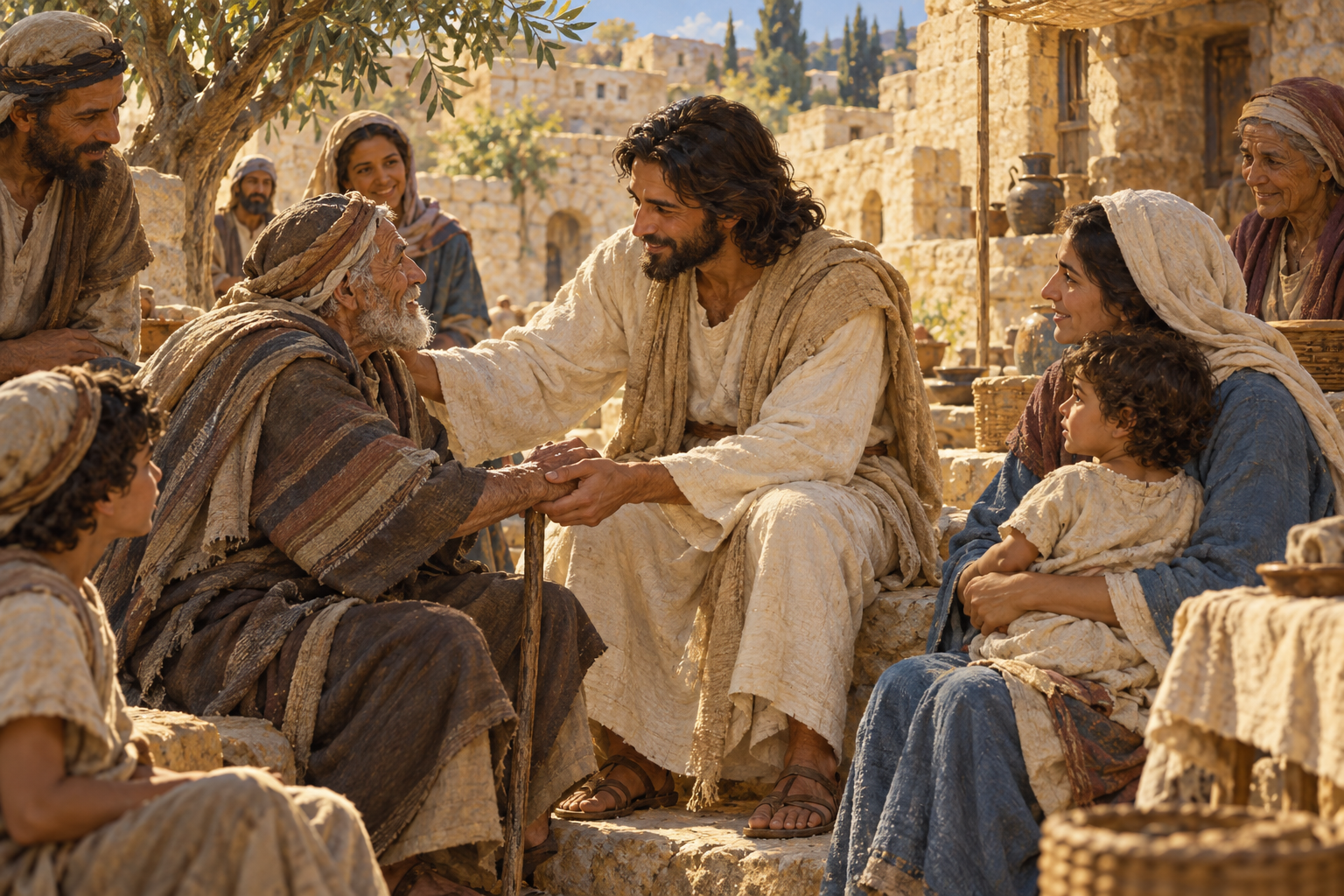
Is it only a future dream, or a present reality already breaking into history?
01
Introduction
Faith Built on Truth — For Christ, Through Scripture, For Life
If God is King, why does cruelty still seem to rule so much of the world?
When Jesus said the kingdom of God had come near, what could his listeners actually see?
A mother waits outside a hospital room. Across town, a worker goes home without the wages he earned.
To tell either of them that God reigns may sound like a beautiful sentence spoken far from the place where they actually stand.
Jesus’ claim deserves a closer and more demanding hearing.
He announced the kingdom of God in a world already familiar with sickness, hunger, oppression, and rulers who used power to protect themselves.
So what did he mean?
In Scripture, kingdom refers first to God’s reign—his rule and his purpose to put a damaged world right.
It is not a country on a map.
It is not an escape into private spiritual feelings.
Nor is it permission for a church to control society in God’s name.
Jesus announced that God’s reign was arriving through his own ministry. Yet he also taught his followers to pray, “Your kingdom come.”
That tension matters.
The kingdom has truly begun, but it has not yet arrived in its fullness.
These ten reasons explore that biblical hope. They point to a real beginning in Jesus and a promised future still ahead, without pretending that the world has already been healed.
02
1. Israel hoped for God to set the world right
Long before Jesus began preaching, Isaiah pictured a messenger announcing peace with the words, “Your God reigns” (Isaiah 52:7).
Daniel saw violent, beast-like empires losing their claim to rule while dominion was given to one like a son of man and, with him, to the holy people of the Most High (Daniel 7:13–14, 18).
These visions arose in a world where conquest and oppression were painfully visible.
Yet they dared to say that violent empires would not have the final word.
Israel’s hope was not simply for a new flag to fly over the same injustice.
Psalm 72 describes a righteous king by what happens to the poor and vulnerable under his rule: he defends the needy, rescues the oppressed, and treats their lives as precious (Psalm 72:1–4, 12–14).
So when Jesus announced the kingdom of God, he entered a long biblical story about who truly rules—and what God’s good rule means for people with little power.
Takeaway: The kingdom is God’s promise to bring justice and peace to a world that cannot make itself whole.
03
2. Jesus announced a kingdom people could begin responding to now
Mark summarizes Jesus’ public message with striking words: the time has been fulfilled, the kingdom of God has drawn near, and people are called to repent and believe the good news (Mark 1:14–15).
At Nazareth, Jesus read Isaiah’s promise of good news for the poor and freedom for the oppressed, then declared that the Scripture was being fulfilled as his listeners heard it (Luke 4:16–21).
He was not asking them merely to imagine a better world in some distant future.
Something was beginning in their midst.
And that announcement required a response.
To repent is to turn—to change direction, allegiance, and way of life. It is not a password by which we earn a place in God’s kingdom.
A merchant who had prospered by exploiting others would now have to ask what God’s reign meant for tomorrow’s business.
A person accustomed to ignoring a needy neighbor would have to reconsider what faithfulness looked like at the next doorway.
The kingdom comes near enough to reach the market, the household, and the decisions we make when no one is watching.
Takeaway: Jesus invites us to begin living under God’s reign now, starting with the choices already within our reach.
04
3. Jesus’ healings showed what God’s reign is like
When John the Baptist’s messengers asked whether Jesus was truly the one to come, Jesus pointed to what was happening around him: people receiving sight and mobility, the sick being healed, and good news reaching the poor (Luke 7:18–23).
He also said that if he drove out demons by the Spirit of God, then the kingdom of God had come upon his hearers (Matthew 12:28).
These works were signs.
They showed what happens when God’s reign confronts forces that deform, oppress, and destroy human life.
But a sign is not the whole landscape.
People continued to become sick after Jesus left a village.
And a testimony of healing today does not guarantee that another person will recover on the same timetable.
Still, the direction of Jesus’ ministry is clear.
He moved toward suffering people rather than away from them.
A kingdom that appears beside the sickbed cannot be indifferent to bodies, treatment, patient care, or the dignity of those who remain ill.
Takeaway: Jesus’ works give us a glimpse of the healing God intends, while calling us to care faithfully for those who still suffer.
05
4. Jesus’ table made room for people pushed to the margins
Jesus ate with tax collectors and others whom respectable religious people regarded as unworthy company.
When questioned, he replied that the sick need a physician and that he had come to call sinners (Mark 2:15–17).
In his stories of the lost sheep and the lost coin, finding what was lost becomes an occasion for joy (Luke 15:1–10).
God’s reign can be recognized in this movement toward people others are quick to dismiss.
But welcome does not mean pretending wrongdoing never happened.
Nor does it mean forcing a wounded person to share a table with someone who harmed them.
Jesus’ welcome called people toward repentance.
At the same time, it confronted the pride of those who assumed that only other people needed to change.
His meals still ask uncomfortable questions of Christian communities:
Who would feel safe entering this room?
Who is always welcomed?
And whose absence have we learned not to notice?
Takeaway: Where God’s kingdom is welcomed, mercy crosses social boundaries without hiding the truth.
06
5. Jesus expected the kingdom to grow in ways easy to overlook
Jesus told of a farmer who scatters seed, sleeps, rises, and discovers that growth has been taking place beyond his control (Mark 4:26–29).
He also compared the kingdom to a mustard seed—a beginning small enough to overlook, yet capable of growing far beyond its first appearance (Mark 4:30–32).
These images challenge our assumption that only dramatic victories count as real change.
That does not mean every small religious project should automatically be called a success of the kingdom.
Seed is eventually known by what it produces.
But Jesus’ images teach us to notice quiet forms of faithfulness:
a debt honestly repaid,
a child defended,
a hungry neighbor fed,
or two enemies beginning a truthful conversation.
None of these actions ends war or erases grief.
But they remind us that the world’s loudest powers are not the only powers at work.
Takeaway: Do not despise a small act of faithfulness; ask what kind of fruit it is beginning to grow.
07
6. The kingdom reaches our loyalties, our money, and our daily bread
Jesus taught his disciples to pray, “Your kingdom come,” and in the same prayer to ask for daily bread, forgiveness, and deliverance from evil (Matthew 6:9–13).
God’s reign therefore belongs in the ordinary conditions of life.
Jesus also told his followers not to let anxiety about food and clothing become their master, but to seek first God’s kingdom and righteousness (Matthew 6:25–33).
That teaching should never be used to lecture a hungry person about having more faith.
Instead, it asks what rules our own hearts when fear, money, or abundance puts pressure on us.
A business owner deciding whether to pay workers fairly faces a kingdom question.
So does a neighbor deciding whether to share food.
So does a debtor deciding whether to tell the truth.
The kingdom is larger than private peace with God, but it reaches the heart from which public actions flow.
Takeaway: Praying for God’s kingdom has consequences for bread, money, forgiveness, and the way we treat our neighbors.
08
7. The cross revealed a King who refused the path of domination
Jesus told Pilate that his kingdom was not from this world: if it were, his followers would fight to prevent his arrest (John 18:36–37).
Earlier, he had rejected the pattern of rulers who dominate others and taught that greatness among his followers must take the form of service (Mark 10:42–45).
At the cross, Rome displayed the kind of power it knew well—the power to humiliate, wound, and kill a vulnerable body.
Jesus did not answer by turning his disciples into another army.
Calling the cross a victory does not mean calling its violence good.
The Gospels name betrayal, mockery, injustice, and execution for what they are.
Their claim is that Jesus faced evil without becoming its mirror.
His faithful love exposed the lie that salvation requires domination.
That means the language of God’s kingdom can never be used to excuse coercion, spiritual intimidation, or the abuse of power.
The crucified King gives the church a different pattern.
Takeaway: The crucified King gives us a measure for power: serve, protect, and give life rather than control.
09
8. The resurrection declares that death has not kept the throne
If Jesus’ story had ended in the tomb, his announcement of God’s kingdom could have been remembered as another brave promise crushed by violence.
But the apostles proclaimed that God raised him from the dead (Acts 2:22–24).
Paul called the risen Christ the firstfruits of those who have died—a beginning whose full harvest is still to come (1 Corinthians 15:20–26).
Christian faith therefore anchors the kingdom’s future in the resurrection of Jesus.
That does not mean believers no longer bury those they love.
Paul still calls death an enemy and looks forward to its final destruction.
But if Jesus is risen, then death no longer has the right to claim that every grave is the end of the story.
The resurrection gives Christians reason to see care for bodies, work for justice, and hope beyond death as parts of one great story of renewal.
God has begun what the whole creation still waits to see completed.
Takeaway: Christian hope rests on the risen Jesus and reaches beyond personal survival to the renewal of God’s creation.
10
9. The Spirit forms communities that can witness to the kingdom
After Pentecost, Jesus’ followers devoted themselves to teaching, fellowship, shared meals, prayer, and meeting practical needs (Acts 2:42–47).
Their common life gave the surrounding world a visible clue to what allegiance to the risen King could look like.
But even that community needed correction.
When some widows were overlooked in the distribution of food, the church changed its arrangements (Acts 6:1–6).
That detail matters.
The church’s witness included the willingness to admit failure and change.
No congregation is identical with the kingdom of God.
A church can contradict the kingdom, especially when it protects powerful people while neglecting the vulnerable.
That distinction does not make the church’s daily practices less important.
It makes them more important.
A community that listens to those who have been overlooked, shares what it has, welcomes correction, and protects the vulnerable can point beyond itself to the King it claims to serve.
Takeaway: The church witnesses to the kingdom when its life makes the justice and mercy of Jesus visible.
11
10. The unfinished world keeps us praying for the kingdom in its fullness
The New Testament never asks us to confuse the present with a completed victory.
Paul looks ahead to the destruction of the last enemy, death, and to the final handing over of the kingdom to the Father (1 Corinthians 15:24–28).
Revelation pictures God dwelling with humanity, wiping away tears, ending death and pain, and making all things new (Revelation 21:1–5).
Those promises reach far beyond anything a congregation, government, or social movement can accomplish on its own.
War, abuse, hunger, disease, and graves remain serious challenges to careless claims that God’s reign has already filled the earth.
Christians should not silence that objection.
They should listen to it.
The Christian answer is not that the work is finished.
It is that the kingdom has truly begun in Jesus and that its completion is still promised.
That is why a Christian can feed a hungry person today and still pray tomorrow, “Your kingdom come.”
Hope refuses two temptations at once:
to become indifferent to present suffering,
and to surrender to the belief that suffering will always have the final word.
Takeaway: The kingdom has begun in Christ, and its unfinished work gives us reason both to act and to pray.
12
Conclusion and Invitation
The kingdom of God is real because Jesus did more than offer a comforting religious idea.
He announced God’s reign.
He healed and welcomed people.
He taught a different way of using power.
He went to the cross without surrendering to the logic of domination.
And Christians proclaim that God raised him from the dead.
His followers were then called to let that good news take visible shape in their common life.
None of this makes the suffering of the present world imaginary.
Scripture itself teaches us to keep praying for a kingdom whose justice, healing, and peace have not yet arrived in their fullness.
You do not need to pretend that you can already see everything God has promised.
Begin where Jesus asked his first hearers to begin:
Listen to his announcement.
Consider what it would mean to trust him.
Then take one step that fits the kingdom he proclaimed.
Perhaps it means asking forgiveness.
Perhaps it means sharing a meal.
Perhaps it means defending someone whose voice has been ignored.
Perhaps it means questioning a form of power you were taught to admire.
Then keep praying for the day when no wound will need to be explained away because God has made all things new.
13
Final Prayer
Father, let your kingdom come and your will be done on earth.
Open my eyes to the work of Jesus, my hands to the needs of my neighbors, and my heart to your truth.
Give courage to those who seek justice.
Strengthen those who wait for healing.
Teach us to use power in the way of Christ—with humility, service, and love.
Keep us faithful as we wait for the day when you make all things new.
Amen.
Continue the conversation: Where do you see signs of God’s reign, and where do you still long to see it? You are welcome to share a question, reflection, or testimony.
Be the first to leave a comment.