

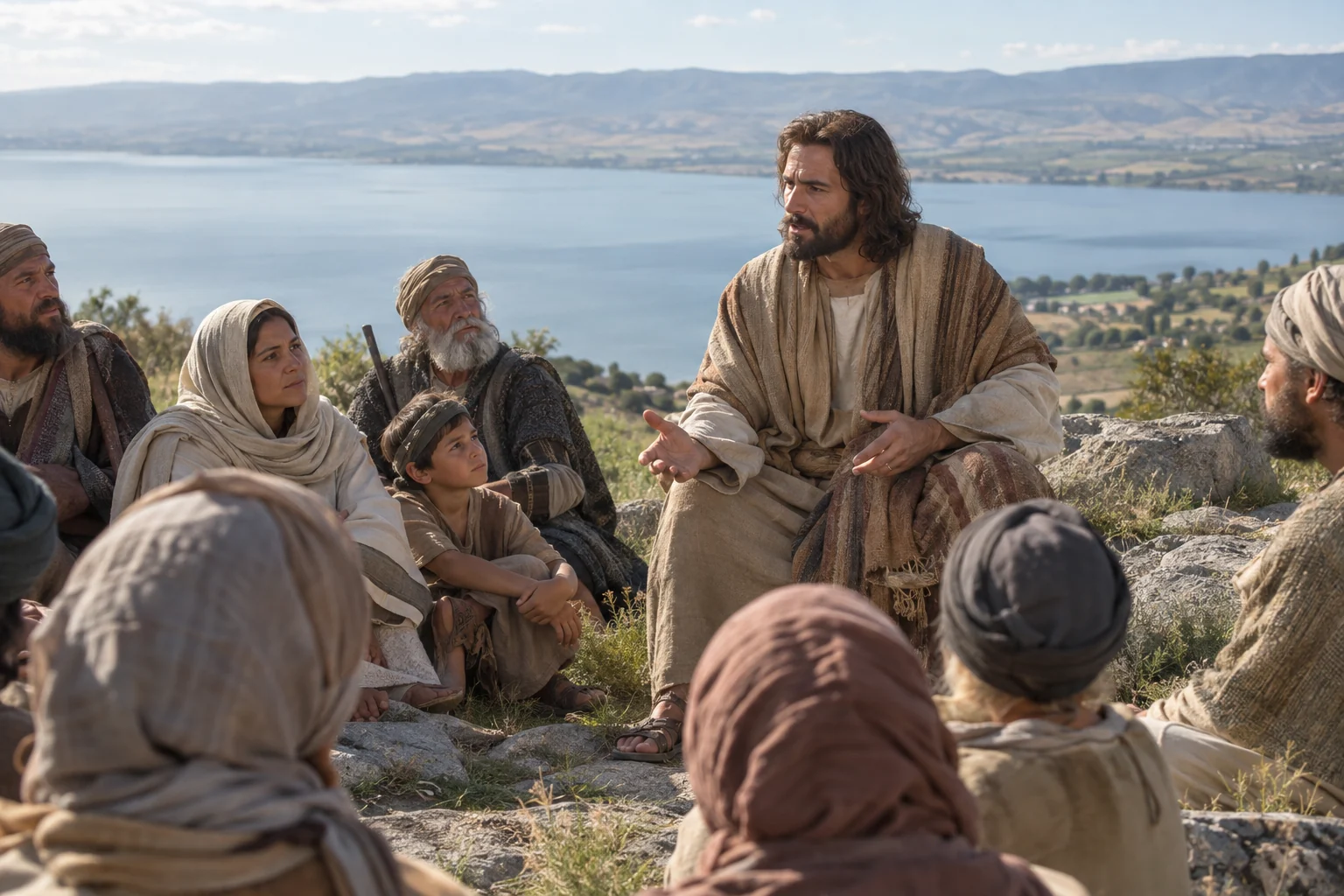
Were His Miracles Displays of Power, or Windows into a Restored World?
01
Introduction
Part III — Jesus Christ: The Centre of the Story
Faith Built on Truth — Through Christ, Through Scripture, for Life
Were Jesus’ miracles mainly demonstrations meant to prove that he possessed supernatural power? Or were they signs—small openings through which people could glimpse the world as God intends it to be?
Miracle stories can be misunderstood in two opposite ways.
One person dismisses them immediately because miracles do not fit a closed picture of reality.
Another person accepts them only as displays of raw power: Jesus does extraordinary things, therefore he must be powerful.
The Gospels invite us to look more carefully.
Jesus’ miracles are powerful, but power alone is not their meaning.
He heals the blind.
He restores damaged bodies.
He cleanses lepers.
He releases people from destructive spiritual oppression.
He feeds the hungry.
He calms storms.
He raises the dead.
And he does these things while announcing, “The kingdom of God has come near” [Mark 1:14–15].
That connection matters.
In Israel’s Scriptures, the coming reign of God was expected to bring justice, healing, liberation, forgiveness, peace, restored creation, and the defeat of death. Isaiah imagined deserts blooming, weak hands strengthened, blind eyes opened, deaf ears unstopped, and the lame leaping for joy [Isaiah 35:1–6]. He imagined good news for the poor and liberty for captives [Isaiah 61:1–2].
Jesus does not merely talk about that future.
He begins acting it out.
His miracles are not the whole kingdom. People he healed eventually died. Hunger returned. Storms rose again. The world was not yet fully renewed.
But the future had begun leaking into the present.
Here are ten reasons to believe the miracles of Jesus were signs of God’s kingdom.
02
1. Jesus Connects His Miracles Directly to the Arrival of God’s Kingdom
Jesus does not perform miracles in a theological vacuum.
His central announcement is that God’s kingdom has drawn near [Mark 1:14–15].
When accused of casting out demons by evil power, Jesus responds, “If it is by the Spirit of God that I cast out demons, then the kingdom of God has come upon you” [Matthew 12:28].
That is a remarkable explanation of his own actions.
The miracles are not side attractions beside the message.
They are part of the message.
Where destructive powers are driven back, God’s reign is arriving.
Where bodies are restored, God’s reign is arriving.
Where shame loses its grip, God’s reign is arriving.
The miracle is therefore not merely, “Look what Jesus can do.”
It is, “Look what happens when God becomes king.”
Takeaway: Jesus’ miracles matter because he interprets them as concrete signs that God’s saving reign is breaking into the present.
03
2. His Healings Echo Israel’s Prophetic Hope of Restoration
The prophets did not imagine salvation as disembodied escape.
They pictured bodies, communities, land, justice, and creation being restored.
Isaiah describes a future when blind eyes will open, deaf ears will hear, the lame will leap, and deserts will blossom [Isaiah 35:1–7].
When John the Baptist sends messengers asking whether Jesus is truly the coming one, Jesus does not answer with a slogan.
He points to what is happening:
the blind see,
the lame walk,
lepers are cleansed,
the deaf hear,
the dead are raised,
and good news is preached to the poor [Matthew 11:2–6].
Jesus’ answer echoes Isaiah.
In other words, the miracles are not random marvels.
They are prophetic signs.
Israel’s hoped-for restoration is beginning.
Takeaway: Jesus’ healings look like the future promised by Israel’s prophets arriving ahead of schedule.
04
3. Jesus Restores People to Community, Not Just to Physical Health
Illness in the ancient world could damage more than the body.
It could isolate.
It could produce shame.
It could separate a person from worship, family life, work, and ordinary social contact.
That is why some of Jesus’ miracles are acts of social restoration.
A leper is not merely given better skin. He can return to community [Mark 1:40–45].
A bleeding woman is not merely cured physically. Jesus calls her “Daughter” and sends her in peace [Mark 5:25–34].
A man living among tombs, isolated and tormented, is later seen clothed and in his right mind [Mark 5:1–20].
Jesus restores bodies.
But he also restores names, relationships, dignity, and belonging.
The kingdom does not treat people as medical problems to be repaired and then forgotten.
It brings them home.
Takeaway: Jesus’ miracles reveal a kingdom that heals whole persons—body, dignity, relationships, and belonging.
05
4. His Exorcisms Announce That Oppressive Powers Are Being Driven Back
The Gospels portray Jesus confronting spiritual forces that deform human life.
Whatever questions modern readers bring to these accounts, the narrative meaning is clear:
Jesus does not negotiate with destructive powers.
He expels them.
People who have been tormented become free [Mark 1:21–28; 5:1–20].
Jesus describes this in kingdom language.
The strong man’s house is being invaded [Mark 3:22–27].
The rule of God means rival powers are losing ground.
This is crucial.
The kingdom is not only about private religious comfort.
It is liberation.
Anything that enslaves, dehumanizes, silences, isolates, or destroys stands under challenge from the reign of God.
The exorcisms function as signs that evil does not possess permanent ownership of human beings.
Takeaway: Jesus’ deliverance ministry reveals that God’s kingdom confronts powers that enslave and restores people to freedom and wholeness.
06
5. Jesus’ Miracles Over Nature Reveal the Creator’s Authority at Work
Some of Jesus’ miracles concern human bodies.
Others concern the created world itself.
He calms a storm [Mark 4:35–41].
He walks upon the sea [Mark 6:45–52].
He provides abundance where resources appear insufficient [Mark 6:30–44].
These stories echo Israel’s Scriptures, where God rules the chaotic waters, provides bread in the wilderness, and sustains creation.
When Jesus stills the storm, the disciples ask, “Who then is this, that even the wind and the sea obey him?” [Mark 4:41].
That question is the point.
The miracles are not circus tricks.
They reveal the authority of the Creator operating through Jesus.
Creation is not being discarded.
It is being reclaimed.
Takeaway: Jesus’ authority over nature points toward the Creator restoring a world wounded by chaos rather than abandoning it.
07
6. The Feeding Miracles Show a Kingdom of Abundance, Hospitality, and Shared Bread
Jesus sees hungry crowds and feeds them [Mark 6:30–44; 8:1–10].
At one level, this is compassion.
Hungry people receive food.
But the scene carries deeper biblical echoes.
There is wilderness.
There is bread.
People are gathered in groups.
Jesus gives thanks, breaks bread, and provides more than enough.
The story recalls Israel’s manna in the wilderness and anticipates the messianic banquet—the biblical hope that God’s reign will look like a feast where hunger and exclusion no longer have the final word [Isaiah 25:6–9].
The miracle is therefore not merely multiplication.
It is a sign of the kind of kingdom Jesus announces.
No one is disposable.
Hungry bodies matter.
God’s abundance is meant to become shared provision.
And the disciples themselves are told, “You give them something to eat.”
Takeaway: The feeding miracles reveal a kingdom where God’s abundance becomes hospitality, shared bread, and care for real human need.
08
7. Jesus’ Miracles Reunite Forgiveness and Healing
In Mark 2, friends lower a paralyzed man through a roof.
Everyone expects a healing.
Jesus first says, “Your sins are forgiven” [Mark 2:1–12].
The religious leaders object because forgiveness belongs to God.
Then Jesus heals the man.
The story joins two realities Christians sometimes separate:
forgiveness and restoration.
Jesus does not teach that every illness is caused by a person’s individual sin.
Elsewhere he explicitly resists that assumption [John 9:1–3].
But he does show that God’s kingdom addresses the human problem at more than one level.
Bodies need healing.
Sin needs forgiveness.
Relationships need repair.
Shame needs release.
Human beings need restoration before God and within creation.
The miracle points toward a salvation bigger than either “spiritual forgiveness only” or “physical health only.”
Takeaway: Jesus’ miracles reveal a kingdom that deals with both sin and suffering without confusing them.
09
8. Jesus Often Refuses to Turn Miracles into Spectacle
If miracles were mainly publicity stunts, Jesus behaves strangely.
He sometimes tells healed people not to broadcast what happened [Mark 1:43–44].
He refuses demands for signs when those demands are rooted in unbelief or spectacle [Mark 8:11–13].
In the wilderness, he refuses to throw himself from the temple simply to force a dramatic demonstration of divine protection [Matthew 4:5–7].
This matters.
Jesus does not use power to entertain.
He does not perform miracles on command to protect his reputation.
He does not turn suffering people into props for religious branding.
His signs are acts of compassion and kingdom announcement.
They point beyond themselves.
That gives us a standard by which claims of miracle-working can be examined today.
A ministry obsessed with spectacle, money, status, manipulation, or the personality of the miracle worker is already moving away from the pattern of Jesus.
Takeaway: Jesus’ refusal of spectacle shows that kingdom power serves people and points to God; it does not exploit suffering to build a performer’s reputation.
10
9. The Raising of the Dead Points Toward the Defeat of Humanity’s Final Enemy
Healing is remarkable.
But death eventually returns.
That is why the stories in which Jesus raises the dead carry special weight.
Jairus’ daughter rises [Mark 5:35–43].
A widow receives her son back [Luke 7:11–17].
Lazarus walks out of a tomb [John 11:1–44].
These people were restored to ordinary mortal life; they would eventually die again.
So these are not yet the final resurrection.
They are signs.
Death—the enemy that appears to close every human story—does not hold unquestioned authority in the presence of Jesus.
The miracles point beyond themselves toward Easter and beyond Easter toward the promised resurrection of God’s people [1 Corinthians 15:20–26].
The kingdom is not complete while death still rules.
Jesus’ signs announce that death’s reign has been challenged.
Takeaway: Jesus’ raising of the dead acts as a preview of the kingdom’s ultimate promise: death itself will not have the final word.
11
10. The Resurrection of Jesus Turns All His Miracles into Signs of New Creation
If Jesus had healed others but remained dead himself, the miracle stories would be moving but incomplete.
The resurrection changes their meaning.
The healer is himself raised.
The one who gave life to others enters death and emerges into transformed life.
Paul calls the risen Christ the “firstfruits” of those who will rise [1 Corinthians 15:20].
That image matters.
Firstfruits are not the whole harvest.
They are the beginning of it.
The miracles of Jesus work the same way.
A blind person seeing again is a first glimpse.
A leper cleansed is a first glimpse.
A hungry crowd fed is a first glimpse.
A tormented person restored is a first glimpse.
A dead child rising is a first glimpse.
The resurrection declares what all those signs were pointing toward:
God is not rescuing souls away from creation.
He is beginning to make creation new.
Takeaway: The resurrection reveals the deepest meaning of Jesus’ miracles: they were previews of the new creation that began decisively in the risen Messiah.
12
Truth and Your Decision: If the Miracles of Jesus Were Signs of God’s Kingdom
Were Jesus’ miracles displays of power?
Yes—but not power for its own sake.
They were power with a direction.
Toward healing.
Toward freedom.
Toward forgiveness.
Toward restored community.
Toward shared bread.
Toward peace.
Toward life.
They were windows into the kingdom.
For a few moments, a body looked the way creation is meant to look.
A tormented mind became quiet.
A rejected person came home.
A hungry crowd ate.
A storm obeyed.
A grave opened.
Then ordinary brokenness continued.
That is why the miracles create both faith and longing.
They tell us the kingdom has begun.
They also remind us it is not yet complete.
Christians should therefore avoid two errors.
The first is to treat miracles as impossible simply because they do not fit a worldview closed to divine action.
The second is to act as though faith guarantees that every illness will be healed immediately if someone believes hard enough.
The Gospels promise neither.
Jesus’ miracles are signs.
Signs are real, but they point beyond themselves.
They point to the day when God will wipe away tears, death will be no more, and creation itself will be renewed [Revelation 21:1–5].
Until then, the church is called to live in the direction of the signs:
healing where possible,
feeding the hungry,
welcoming the excluded,
resisting evil,
praying for the sick,
telling the truth,
sharing resources,
and carrying resurrection hope into places that still smell like death.
The question, then, is not only:
“Do I believe Jesus performed miracles?”
It is:
“Do I see what kind of world those miracles say God intends to make?”
And if that world has already begun in Jesus, will I live now as one of its citizens?
13
Closing Prayer
God of life, open my eyes to see the miracles of Jesus not as religious entertainment, but as windows into your kingdom.
Where bodies are broken, teach me compassion.
Where people are excluded, teach me welcome.
Where hunger is ignored, open my hands.
Where destructive powers enslave, give courage for freedom.
Where sickness remains, teach me to pray without manipulation and to care without false promises.
Where death casts its shadow, anchor me in resurrection hope.
Thank you that in Jesus your future has already touched our present.
Make my life, my church, and my community small signs of the world you are making new.
Amen.
14
Join the Conversation
Which miracle of Jesus most clearly looks to you like a window into God’s restored world? How would our churches change if we treated Jesus’ miracles not merely as proofs of power, but as signs showing us what God’s kingdom is like?
Share your reflection, question, or testimony as we continue the Reasons to Believe series—Faith Built on Truth, Through Christ, Through Scripture, for Life.
Be the first to leave a comment.