


How does resurrection hope change what you plant and do today?
Key Scripture
How Jesus' Resurrection Gives Us Reason to Live Faithfully Even When Life Has Not Become What We Hoped
Colossians 3:1–17
Beyond the Horizon
There are seasons when life becomes covered in thick fog.
You look ahead, but you cannot see very far.
You see an unpaid debt. You see a body struggling with illness. You see children whose needs you cannot fully meet. You see a closed door to employment or a family that still struggles to trust you.
Perhaps you see the years you lost in prison.
Perhaps you see the empty chair at the table after someone you loved has died.
Or you see one serious mistake that people continue to remind you of, even after you have decided to change.
At times like these, our eyes can become so fixed upon the dust beneath our feet that the road itself seems to be our entire world.
We begin telling ourselves:
“This is how my life will always be.”
“I will never become different.”
“This pain is the end of my story.”
“If people do not trust me now, they never will.”
But imagine a long, rainy night when the sky is completely covered by clouds.
Someone traveling through that darkness may see nothing but night. They might even begin believing that the sun will never rise again.
Yet their darkness cannot prevent the sunrise.
The dawn may not yet be visible, but it has not been canceled.
This is how the gospel teaches us to look at the world.
It does not deny our suffering. It does not treat sin, violence, illness, or death as insignificant.
It announces that something has happened in history that has changed the ultimate direction of humanity's story.
Jesus Christ has risen from the dead.
The grave did not have the final word over him.
And because of that, the grave, sin, shame, and suffering do not have to possess the final word over his people.
In the previous article, we learned that lasting freedom requires community and accountability.
Now we face a larger question:
Where is our journey leading? Why should we continue doing good when its results remain unseen?
Colossians 3 teaches us to lift our eyes toward the risen Christ so that we can place our feet more faithfully upon the ground of everyday life.
“You Have Been Raised with Christ”: New Identity Before New Conduct
When Paul begins Colossians 3, he does not start by telling believers to think more positively.
He reminds them of what has happened through their relationship with Christ.
In Colossians 2:11–15, Paul describes believers as united with Christ in his death and resurrection. Their forgiveness rests upon Christ's saving work rather than their own ability to rescue themselves.
Then he explains that because they have been raised with Christ, they should seek the things above, where Christ is (Colossians 3:1).
This provides the foundation of an eternal perspective.
The Christian life does not begin merely with the hope of traveling to a better place someday.
It begins with our present relationship with the risen Jesus Christ.
Through faith, we belong to a people whose lives are joined to his.
We therefore do not have to wait until death before beginning to live under his reign.
We are called to begin now.
Someone once ruled by dishonesty can begin telling the truth.
Someone who measured their worth by money can begin working faithfully.
Someone dominated by revenge can begin seeking justice without nurturing hatred.
Someone who believed they were worthless can learn to see their life in the light of Christ's love.
This does not mean every transformation will happen immediately.
Paul describes a life that has already begun but is still awaiting its fullness.
In Christ, the life of God's coming world begins shaping us now, even before that world is revealed in its completeness.
Seeking the Things Above Does Not Mean Escaping the Earth
Colossians 3:1–2 can easily be misunderstood.
Someone may read Paul's command to seek the things above and conclude that earthly responsibilities no longer matter.
They may say:
“Why should I worry about my health? This world is only temporary.”
“Why should I challenge injustice? God will put everything right in the end.”
“Why should I learn a trade? The important thing is going to heaven.”
But if we continue reading the chapter, we discover a very different meaning.
Paul calls believers to abandon dishonesty, greed, destructive anger, abusive speech, and other behaviors that damage human life.
Then he calls them to put on compassion, kindness, humility, gentleness, patience, forgiveness, and love (Colossians 3:5–17).
All these qualities concern life here on earth.
They affect families, work, money, speech, bodies, and relationships.
Seeking the things above, therefore, does not mean closing our eyes to the needs of people below.
It means living here under Christ's reign.
Paul describes Christ as seated at God's right hand.
This is royal language. It announces the authority and victory of the risen Jesus.
A Christian should therefore ask:
“How does Christ reign over the way I use money?”
“How does Christ reign over the words I speak to my children?”
“How does Christ reign over the way I respond to someone who has hurt me?”
“How does Christ reign over my work, authority, and relationships?”
These are the questions of someone learning to seek the things above.
An eternal perspective does not make the earth meaningless. It teaches us to live on earth as though Jesus truly is its rightful King.
Already, but Not Yet: Living Between Resurrection and Fulfillment
Every Christian lives within a profound tension.
On the one hand, Jesus has risen and defeated the powers of sin and death.
On the other hand, we still encounter disease, war, violence, corruption, temptation, and graves.
How can both realities be true?
The New Testament teaches us to live within what theologians often describe as already, but not yet.
Already, Christ has risen as the firstfruits of the resurrection (1 Corinthians 15:20–23).
Already, those who belong to him have received forgiveness and have been called into new life (Romans 6:3–14).
Already, the Holy Spirit is at work among God's people (Romans 8:9–11).
Already, God's kingdom has entered history through Jesus (Mark 1:14–15).
But not yet have we overcome every struggle with sin.
Not yet have our bodies ceased to suffer, weaken, and die.
Not yet has creation been delivered from its bondage to decay (Romans 8:19–23).
Death continues as an enemy whose final destruction belongs to the completion of Christ's victory (1 Corinthians 15:25–26).
And we still await Christ's return, the resurrection of his people, and the renewal of creation.
This helps us avoid two errors.
The first is claiming that because Christ is victorious, genuine believers should never experience sickness, suffering, or difficulty.
The second is believing that because pain still exists, Christ's victory makes no difference to our present lives.
Scripture teaches neither of these extremes.
It calls us to hold firmly to the victory already inaugurated while awaiting its completion.
Someone may be healing emotionally while still needing medical care.
They may have received God's forgiveness while their family still needs time to rebuild trust.
They may believe in the resurrection while weeping beside a grave.
Faith does not pretend that the “not yet” has disappeared. It lives faithfully within the “not yet” because of what Christ has already accomplished.
Your Life Is Hidden with Christ
In Colossians 3:3–4, Paul describes believers' lives as hidden with Christ in God, awaiting the day when they will be revealed with him in glory.
This truth matters deeply to people whose lives have become defined by labels imposed by society.
“The former prisoner.”
“The addict.”
“The failed husband.”
“The poor person.”
“The sick person.”
“The abandoned woman.”
There may be real experiences behind these descriptions.
But none of them can fully define a human being.
Someone may have a criminal record and yet be learning to practice justice.
Someone may carry physical scars while developing perseverance.
Someone may perform humble, unnoticed work that has become an expression of faithfulness to Christ.
Paul does not say that our past has been erased or that the consequences of wrongdoing no longer matter.
He teaches that a person united with Christ possesses an identity deeper than the judgments of others.
Their ultimate future is bound to the risen Lord.
When he appears in glory, their identity in him will be fully revealed.
Until then, we do not need to spend our entire lives trying to prove our worth to everyone.
We need to live truthfully before God.
Your history may explain where you came from. But in Christ, your history does not own the ending of your story.
Treasure in Jars of Clay: Hope That Does Not Belittle Suffering
In 2 Corinthians 4:7–18, Paul describes believers as ordinary clay vessels carrying treasure.
Clay vessels can crack.
They are not especially valuable in themselves.
They can fall and break.
Yet within them is the treasure of the gospel—the knowledge of God's glory revealed in Jesus Christ.
Paul never imagined himself to be someone incapable of being wounded.
He spoke about being afflicted, perplexed, persecuted, and struck down.
He knew suffering.
That is why we must read his words about present affliction and eternal glory with care.
Paul was not saying that another person's pain is insignificant.
He was comparing the weight of present suffering with the immeasurable greatness of the glory God will reveal.
Imagine a mother grieving the death of her child.
It would be cruel to tell her, “Don't cry. Your suffering is only light and temporary.”
Nor should someone experiencing trauma be accused of lacking an eternal perspective because their pain remains intense.
Jesus himself wept at Lazarus's tomb (John 11:35).
When we walk alongside someone who is grieving, we should begin by being present, listening, and acknowledging what has happened.
We can speak of hope without silencing tears.
There is another encouraging truth in Paul's picture.
A clay vessel may be fragile, but its fragility does not remove the value of the treasure within it.
Someone may need medical treatment, counseling, time to mourn, and trustworthy people who will support them.
Such needs do not mean Christ has abandoned them.
Eternal hope does not mean we are incapable of breaking. It means that even in our fragility, God continues to hold us.
From Eden to New Creation: God Has Not Abandoned His World
The biblical story begins with God's good creation.
In Genesis 1–2, we encounter a living world and human beings called into relationship with God, one another, and the creation entrusted to their care.
But sin fractures these relationships.
Death, corruption, injustice, and suffering enter human experience.
Yet God does not abandon his creation.
He delivers Israel and establishes his dwelling among the people (Exodus 25:8; 40:34–38).
Later, the Word becomes flesh and dwells among humanity (John 1:14).
In Christ, God comes to seek and save what has been lost.
Through the Holy Spirit, God's people become a dwelling place for his presence (Ephesians 2:21–22).
Finally, we reach Revelation 21–22.
We encounter a new heaven and a new earth. The holy city descends from God. The central announcement is that God's dwelling will be with humanity.
This ending fulfills the direction established at the beginning of the story.
God did not create humanity merely to discard the created order and make physical existence meaningless.
The biblical hope concerns resurrection and new creation.
In 1 Corinthians 15, Paul teaches that the body will be raised and transformed, no longer subject to corruption and mortality.
This does not give us permission to neglect our bodies today.
It gives us reason to care for them.
We anticipate new creation, so we learn to care for the present creation.
We anticipate justice, so we practice justice now.
We anticipate a world without abuse, so we refuse to conceal abuse today.
We anticipate God's dwelling with humanity, so we make room for people society has pushed to the margins.
We cannot bring God's kingdom to completion through our own power.
But we can offer small signs of the kingdom that is coming.
Our hope is not to escape God's creation. It is that God will redeem his creation and dwell with his people.
God Will Wipe Away Tears, and Death Will Be No More
Revelation 21:4 offers one of Scripture's most comforting images.
God will wipe away tears, and death, mourning, crying, and pain will no longer remain.
The promise does not imply that our present tears are meaningless.
It reveals that the God who knows them will accomplish what no human being can fully achieve.
He will remove the ultimate causes of suffering in the new creation.
Think of the tears of an abandoned child.
The tears of a grieving parent.
The tears of someone imprisoned who has lost many years of life.
The tears of a patient who has prayed and still suffers.
The tears of someone who has repeatedly begun again but continues facing rejection.
The hope of Revelation is that God has not forgotten those tears.
And beyond that, death will no longer belong to life in the world God makes new.
Paul calls death the last enemy to be destroyed (1 Corinthians 15:26).
Christ's resurrection is the beginning of that victory.
When we experience bereavement, therefore, we can grieve deeply while continuing to hold onto hope.
We need not pretend that death is a friend or that separation from loved ones is painless.
We face this enemy through the hope of the risen Christ.
That hope gives us courage to continue living faithfully.
Today's tears are real. But they cannot write the final page of the story God has promised to make new.
Living Today as Citizens of the Coming World
If we believe that Christ is King and that a new world is coming, this belief should transform our choices today.
In a broken world, power may be used to intimidate others.
In Christ's kingdom, authority is meant to serve and protect (Mark 10:42–45).
In a broken world, money may become the master of life.
In Christ's kingdom, money becomes a resource to manage faithfully, provide for family, meet obligations, and help others.
In a broken world, someone who has done wrong may lie to protect their reputation.
In Christ's kingdom, people learn to tell the truth and accept responsibility.
In a broken world, those with power may exploit the vulnerable.
In Christ's kingdom, vulnerable people deserve dignity and protection.
In a broken world, people may damage their environment without considering future generations.
In Christ's kingdom, we care for water, land, trees, and other living creatures because they belong to God's creation.
This also applies to life in prison.
Someone who is incarcerated may believe their life cannot have purpose until release.
But even in prison, a person can reject violence, act honestly, learn, study Scripture, encourage another prisoner, and help someone in need.
Likewise, someone who has been released can live with an eternal perspective by choosing honest work, rebuilding trust, and rejecting harmful shortcuts.
A parent can demonstrate the kingdom by raising children without humiliation.
A teacher can demonstrate it through fairness toward students.
A healthcare worker can demonstrate it through compassionate care.
A pastor can demonstrate it through ministry that serves people rather than controlling them.
God's kingdom does not become visible only through our preaching. It also becomes visible through the way we use power, money, time, words, and the opportunities entrusted to us.
A Garden Behind the Wall: Planting Even When We May Never See the Harvest
Consider the illustration of Moses, a man serving a long prison sentence.
While learning about eternal hope, he asks a question:
“What is the point of planting something if I may never live to enjoy its fruit?”
He has been permitted to help care for a small garden within the prison grounds.
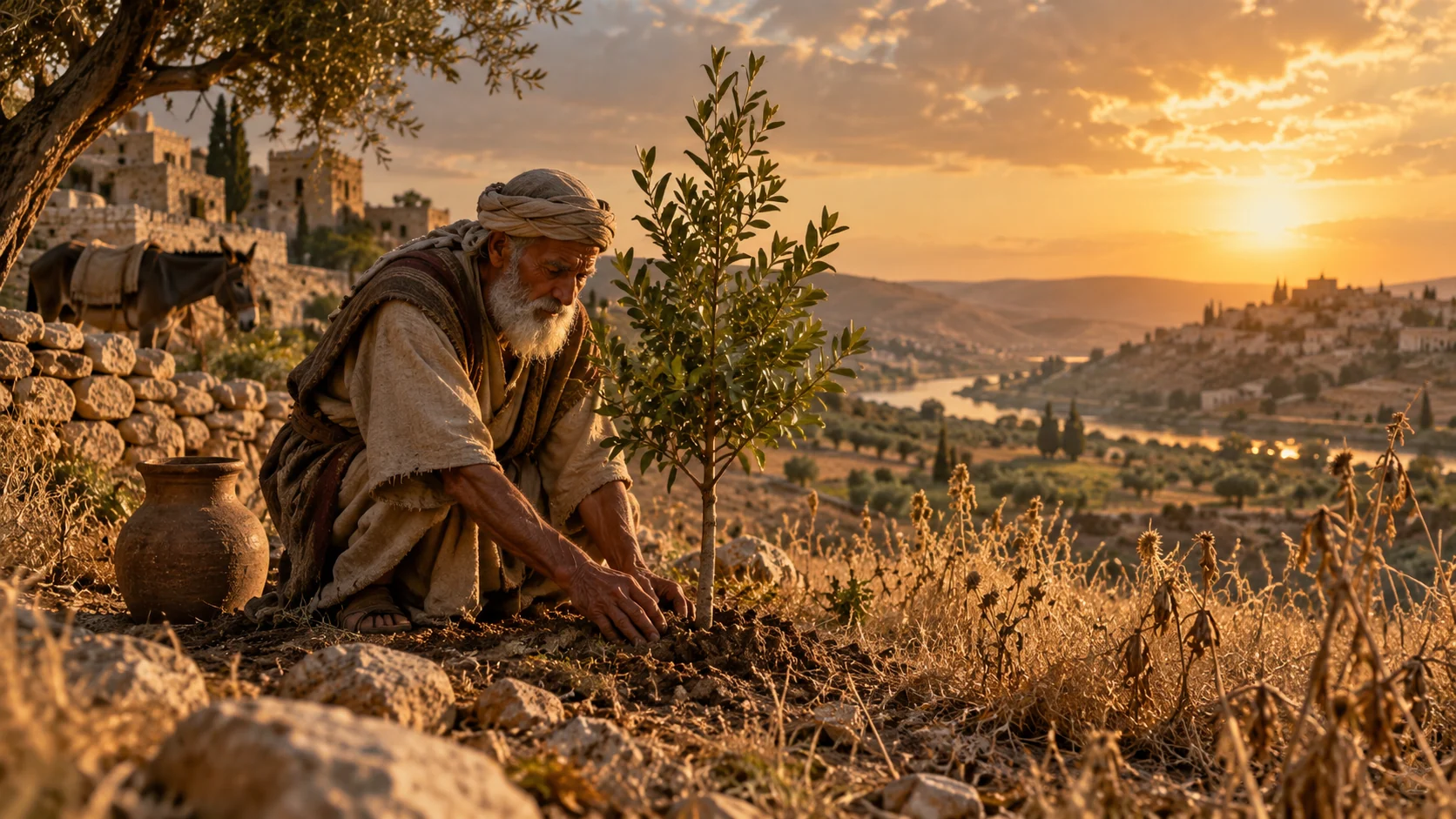
One day, he plants several young fruit trees.
Another prisoner laughs at him.
“These trees may begin producing fruit after you have left. Perhaps you will never eat any of it.”
Moses replies quietly:
“Then someone else will eat it.”
He continues watering and caring for the trees.
He teaches other prisoners how to plant. Some begin learning to care for the young trees and continue the work he has started.
Years pass, and one of the trees begins to bear fruit.
Moses does not keep the fruit to himself.
He shares it.
The garden does not remove the prison walls.
It does not cancel his sentence.
It does not return the years he has lost.
But it demonstrates that even in a place marked by confinement, a person can do something meaningful for the lives of others.
Moses has learned to live with a hope greater than his ability to see every result.
Here we discover an important principle.
Not every faithful action will bring public recognition.
You may never harvest every seed you plant.
Not everyone you help will return to thank you.
Yet work done in the Lord is not in vain (1 Corinthians 15:58).
Perhaps your contribution today is teaching a child to read.
Offering water to a patient.
Repaying money you borrowed.
Asking forgiveness.
Preventing anger from becoming violence.
Helping another prisoner learn a skill.
Or planting a tree whose fruit will be enjoyed by another generation.
An eternal perspective teaches us to plant faithfully even when we cannot be certain that we will enjoy every harvest.
Summary of the Biblical Journey: Dawn Is Approaching
Our journey has begun with God's good creation and the ways sin damaged human life and relationships.
We have seen God deliver Israel, dwell among his people, and promise through the prophets a greater restoration.
In Jesus Christ, God has accomplished the decisive foundation of that restoration through the life, death, and resurrection of his Son.
Colossians 3 calls believers to live now as people whose lives are united with the risen Christ.
Second Corinthians 4 teaches us that present weakness and suffering do not prove God has forgotten us.
First Corinthians 15 grounds our hope in the resurrection and the final defeat of death.
And Revelation 21–22 brings us to the destination of the biblical story: a new heaven and a new earth, justice, life, and God's dwelling with humanity.
An eternal perspective, therefore, does not mean waiting to leave the earth while neglecting our responsibilities.
It means living in the light of the world God has promised to renew.
That light enables us to practice justice, care for our bodies, love, forgive, build trust, and continue doing good even when the fruit takes time to appear.
Christ is risen. Therefore death is not the end, sin is not our master, tears have not been forgotten, and faithful labor in the Lord is not in vain.
Dawn is coming.
Keep walking.
Life Application: A Covenant for Continuing to Walk in Freedom
- As we reach the end of these fourteen articles, consider writing a personal commitment for the journey ahead.
- This commitment is not a way of purchasing God's grace. It is a response of faith to the grace already given.
- I will begin each day with Christ. Before allowing fear, news, or the opinions of others to dominate my thinking, I will remember that Jesus is risen and that I belong to him.
- I will live according to the truth of the kingdom. I will choose honesty over deception, justice over revenge, and service over controlling others.
- I will care for the life entrusted to me. I will respect my body, health, relationships, finances, work, and environment as responsibilities of stewardship before God.
- I will not walk alone. I will continue seeking healthy fellowship, receiving correction, addressing healthcare needs, and supporting others within my abilities.
- I will keep planting even when the harvest is delayed. I will not measure my life only by immediate success. I will seek to remain faithful in today's responsibilities.
- You may revisit this commitment each month and ask: What have I learned? Where do I need help? What new step should I take?
Questions for Reflection
- If God's new creation became the window through which I viewed my life today, what decision or habit would I begin to see differently?
- What suffering or judgment from others have I allowed to become the final word over my story?
- What seed of justice, love, service, or faithfulness can I plant this week, even if I will not immediately see its fruit?
A Prayer for the Journey
Eternal Father,
Today I lift my eyes from the dust of the road and view my life in the light of the risen Christ.
You know the doors that have closed, the years I have lost, the wounds I carry, and the tears no one else has seen.
Thank you that none of these things can cancel your faithfulness.
Lord Jesus, you entered death and emerged from the grave victorious. Teach me to live under your reign.
Help me seek the things above without running away from my responsibilities here on earth.
Rule over my words, thoughts, finances, relationships, work, and the way I exercise authority.
Teach me to practice justice, love mercy, and walk humbly with you.
When I suffer, do not let me pretend my pain is unreal. When I grieve, help me receive your comfort and the support of trustworthy people.
When I am tempted to despair, remind me that your resurrection is the beginning of new creation.
Holy Spirit, clothe me with the character of that coming world—compassion, kindness, gentleness, patience, forgiveness, love, and peace.
Give me the faithfulness to plant when I may not see the harvest, to serve when no one applauds, and to tell the truth when I am afraid.
Make me a blessing to prisoners, patients, the bereaved, the lonely, and everyone searching for a new beginning.
Father, I await the day when you will complete your work, remove death, and wipe away the tears of your people.
Until that day, help me keep walking.
In the name of Jesus Christ, the King who makes all things new. Amen.
A Window into the Series Conclusion
Final Conclusion: The Journey Continues — Walking in Freedom Day by Day
We have reached the end of fourteen articles, but not the end of the journey.
We began with the question of identity: “Who am I in Christ?”
We have explored repentance and forgiveness, healing emotional wounds, addressing anger and fear, facing anxiety, spiritual disciplines, overcoming temptation and addiction, building healthy relationships, finding purpose, moving beyond loneliness, preparing to reenter society, and developing community and accountability.
Now we have seen the destination toward which this journey is moving—resurrection, justice, and new creation.
In the concluding article, we will gather these lessons into one practical roadmap for continuing to walk in freedom, including daily practices, regular reflection, and a calling to become a blessing to others.
For the final question is not, “How many articles have I read?”
It is this:
“How will I live tomorrow in the light of the truth I have received today?”
Read the next article: The Journey Continues: Walking in Freedom Day by Day
Sources and References
- Mwakalindile, Enos. Kutembea Katika Uhuru: Safari ya Urejesho wa Maisha Katika Kristo [Walking in Freedom: A Journey of Restoration in Christ]. First edition, 2026. Chapter 14: An Eternal Perspective.
- The Holy Bible: Genesis 1–3; Exodus 25:8; 40:34–38; Psalm 13; Isaiah 65:17–25; Micah 6:8; Mark 1:14–15; 10:42–45; John 1:14; 11:35; Romans 6:3–14; 8:9–23; 1 Corinthians 15:20–28, 50–58; 2 Corinthians 4:7–18; Galatians 5:16–17; Ephesians 2:21–22; Colossians 2:11–23; 3:1–17; 1 Peter 2:9–10; 2 Peter 3:13; Revelation 21:1–5; 22:1–5.
Be the first to leave a comment.