

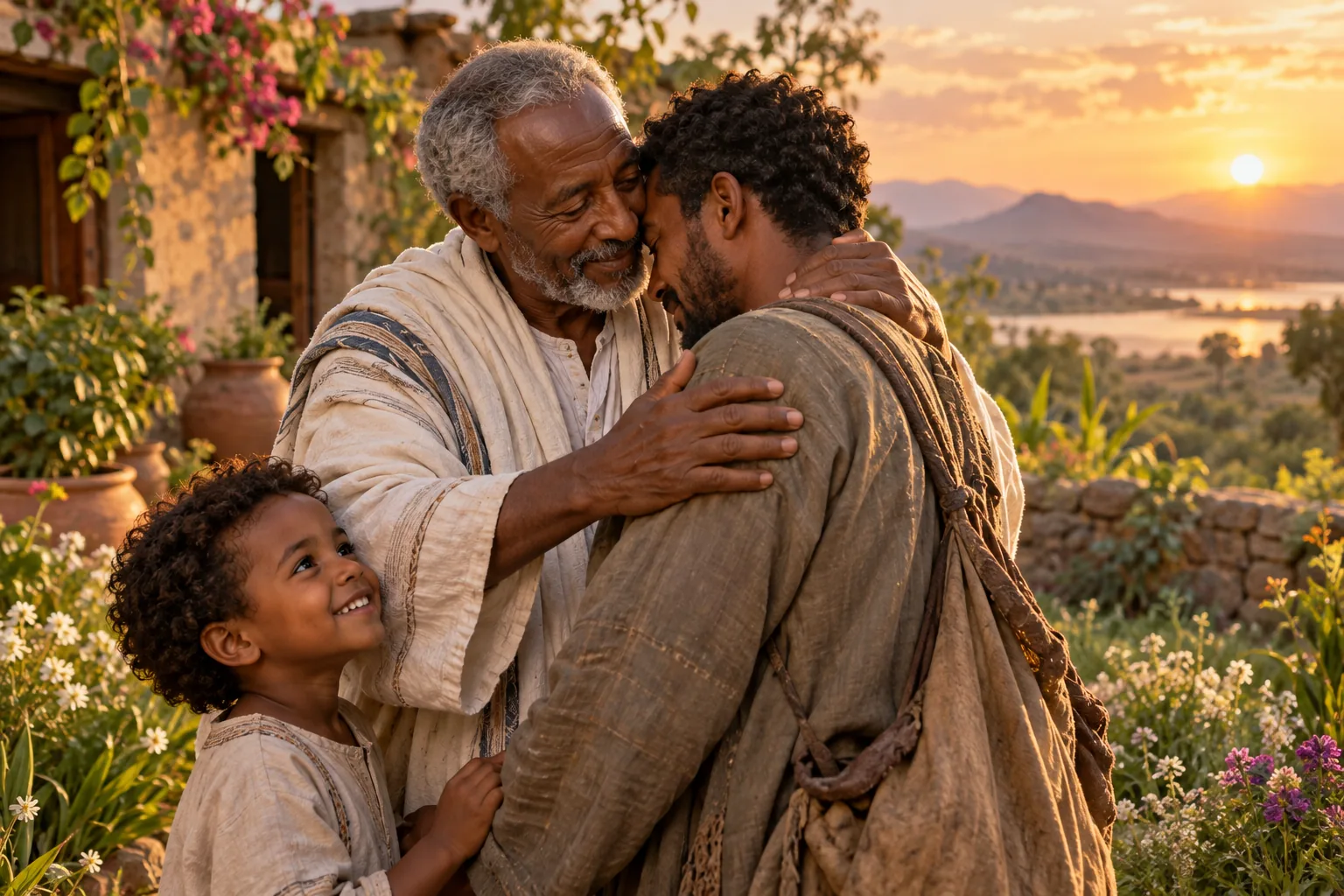
What does returning to the Father mean after hurting other people?
Key Scripture
From the Bondage of Sin and Shame into the Father's Grace
Luke 15:11–32
The Burden No One Can See
Some burdens can be put down when we reach home. A sack of maize, a bucket of water, or a bundle of firewood may be heavy, but eventually we can lay it aside and rest.
Guilt and shame are not so easily set down.
Someone may continue working, laughing with friends, and attending worship while carrying the memory of something they did many years ago.
Perhaps they lied, stole, broke a promise, or deeply hurt their family. Perhaps they made a decision whose consequences still follow them.
Guilt says, “I did something wrong.”
Shame goes further: “I am a bad person. I am worthless. I no longer deserve to be loved.”
Sometimes people carry shame that was never theirs to bear. Someone who has experienced abuse or humiliation may wrongly blame themselves for the wrong another person committed.
The gospel teaches us to distinguish between wrongdoing, its consequences, and a person's worth before God.
It does not teach us to conceal sin. It calls us to tell the truth. But neither does it leave us imprisoned by shame forever.
In the previous article, we discovered that our mistakes do not have the final authority to define who we are in Christ. Now we face another important question:
How can we acknowledge our wrongdoing, receive forgiveness, and begin a new life?
Jesus answers through the story of a lost son and a father who welcomes him home.
The Distant Country: Seeking Freedom Apart from the Father
In Luke 15:11–32, Jesus tells the story of a young man who asks his father for his share of the inheritance.
He wants his father's possessions, but no longer wishes to remain in his father's household.
He leaves for a distant country and wastes his wealth on reckless living. Eventually, he loses everything. When famine strikes, he finds himself feeding pigs and longing even for their food.
He left home in search of freedom, only to end up in humiliation and dependence.
This story echoes Israel's long journey.
God delivered Israel from Egypt, gave the people his covenant law and the land of Canaan, and later established the temple as a place of worship. These gifts were intended to help Israel know, love, and represent God in the world.
Yet Israel repeatedly sought to enjoy the inheritance while neglecting the One who had given it. The people placed their confidence in the land, the temple, and their religious identity even as they broke the covenant, worshiped other gods, and practiced injustice (Deuteronomy 8:11–18; Jeremiah 7:4–11).
Eventually, the kingdom of Judah fell. Jerusalem and the temple were destroyed, and many of the people were carried into exile in Babylon, under foreign rule (2 Kings 25:1–12).
Like the younger son in Jesus' parable, Israel had lost its freedom while pursuing life apart from faithful fellowship with the Father.
This is a theological parallel that helps us read the two stories together. Jesus does not explicitly mention Babylon in the parable, but the picture of a son far from home resonates with Israel's experience of exile and longing for restoration.
True freedom is not enjoying God's gifts without God himself. It is living in a relationship of love and faithfulness with the Father who has redeemed us.
Returning from Babylon: More Than Coming Back Home
But God had not finished his story with Israel.
Through the prophets, he promised to gather his people again, forgive their sins, and establish a new covenant with them.
Jeremiah spoke of a day when God would write his law upon the hearts of his people and forgive their wickedness (Jeremiah 31:31–34). Ezekiel proclaimed God's promise to give them a new heart and his Spirit, enabling them to walk in his ways (Ezekiel 36:24–27).
After the exile, some of the Jewish people returned to their homeland. Yet geographical restoration did not fully resolve the problem that had led them into exile: sin, covenant unfaithfulness, and hearts that still needed renewal.
They had returned to their land, but they still needed a deeper kind of redemption.
This is where Jesus' message becomes especially significant.
Jesus announced the arrival of God's kingdom and called people to repent and believe the good news (Mark 1:14–15). Through his life, death, and resurrection, he opened the way for deliverance from the dominion of sin and the restoration of fellowship with God.
In this sense, Jesus' ministry can be understood as inaugurating the fulfillment of God's promised new deliverance—a second Exodus, reaching beyond the physical return from Babylon.
And notice who begins responding to his invitation.
In Luke 15:1–2, tax collectors and others regarded as sinners gather around Jesus to hear him. The Pharisees and teachers of the law complain because he welcomes these people and eats with them.
It is in this setting that Jesus tells the stories of the lost sheep, the lost coin, and the two sons.
Those considered lost are beginning to return, while some who regard themselves as faithful struggle to rejoice over their homecoming.
Jesus also declares that tax collectors and prostitutes who believed John's call to repentance were entering God's kingdom ahead of religious leaders who refused that call (Matthew 21:31–32).
In Jesus' ministry, Israel's promised restoration begins to take shape as those once considered far away respond in faith and repentance and return to the Father.
Coming to His Senses: Repentance Means Turning and Returning
In Jesus' parable, the younger son's transformation begins when he finally faces his situation.
He remembers his father's household. He acknowledges his wrongdoing. Then he decides to get up and return home (Luke 15:17–20).
Here we see a beautiful picture of repentance.
Repentance is not self-hatred. It is awakening to the truth, changing direction, and returning to God.
There is an important difference between regret and repentance.
Regret may arise because someone has lost money, reputation, or opportunity. A person may be sorry about being caught without being troubled by the harm they caused.
Repentance goes deeper. It recognizes that we have sinned against God and harmed others. It leads us to confession, a change of direction, and a willingness to learn a different way of living.
That is why David, in Psalm 51, asked for more than the removal of guilt. He pleaded with God to create a clean heart within him.
Genuine repentance does not end with tears or expressions of sorrow. It welcomes God's transforming work in both heart and conduct.
The Father Who Runs: Grace That Welcomes Us Home
While the younger son is still far away, his father sees him.
He runs to meet him, embraces him, and welcomes him home.
Here Jesus reveals the heart of God.
The father does not deny his son's wrongdoing. The inheritance has been wasted, and the relationship has been damaged. But he refuses to allow that failure to become his son's permanent identity.
He restores his place in the household.
This reflects the heart of God's promise to Israel during the exile. God intended not merely to bring his people back to their land, but to bring them back to himself—to forgive their sins and renew their hearts (Jeremiah 31:18–20, 31–34).
In Jesus, we encounter that same Father welcoming those who have lost their way.
But we must not overlook the older brother.
He has remained at home and worked for his father. Yet when his younger brother returns, he becomes angry and refuses to share in his father's joy.
The father goes out to speak with him as well.
Both sons, therefore, need restoration to a genuine relationship with their father. One has been physically far away. The other has remained nearby, but his heart has grown distant from his father's mercy.
The parable invites us to examine ourselves. We may wander into openly destructive behavior, or we may remain busy with religious activities while trusting in our own achievements and looking down on others.
The Father's house is not a place where we prove ourselves better than others. It is where sinners are welcomed into truth, repentance, and grace.
Forgiveness That Opens the Door to a New Beginning
Some people believe that God can forgive others but struggle to believe that he can forgive them.
They say, “I know God forgives, but I cannot forgive myself.”
Receiving forgiveness does not mean convincing ourselves that we did nothing wrong. It means acknowledging our sin before God and trusting the grace he offers through Jesus Christ.
First John 1:9 invites us to confess our sins to the God who is faithful to forgive and cleanse us. Through Christ, God has opened the way to reconciliation and new life (2 Corinthians 5:18–21).
Forgiveness, therefore, does not erase our memories. It means those memories need no longer become a lifelong prison.
A confessed failure can teach us humility rather than keep us trapped in self-condemnation.
When the Holy Spirit convicts us of sin, he calls us into the light so that we may repent and be transformed. He does not imprison us in hopeless shame.
The Fruit of Repentance: Grace Does Not Remove Responsibility
God's forgiveness does not cancel our responsibility toward those we have harmed.
When Zacchaeus encountered Jesus, he demonstrated a changed direction by promising to help the poor and repay those he had defrauded (Luke 19:1–10).
Repentance may require us to confess a lie, return stolen property, repay a debt, abandon harmful behavior, or accept wise counsel.
But restoration does not happen all at once.
Someone who has repeatedly deceived their family may sincerely apologize today, yet cannot demand to be trusted tomorrow. Trust will need to be rebuilt through honesty and consistent actions over time.
Forgiveness may be offered today. Trust is rebuilt step by step.
It is also important to distinguish forgiveness from reconciliation.
Forgiveness may begin in the heart of someone who chooses to release personal revenge. Reconciliation requires the participation of those involved, along with truth, repentance, and safety. Trust develops through a pattern of dependable behavior.
A person may forgive someone who hurt them without returning to an abusive or violent relationship.
No one should be pressured to resume a relationship with an abuser in the name of Christian forgiveness. The God of grace is also the God of justice and protection.
Genuine repentance respects the boundaries of others and acknowledges that some wounds require time and professional support.
Summary of the Biblical Journey: Returning to the Father
The story of the lost son reveals something Scripture has been teaching throughout Israel's history: human beings can receive God's gifts yet turn away from God himself.
Israel was delivered from Egypt and received the inheritance of the covenant, but persistent unfaithfulness eventually led to exile in Babylon. God then promised another deliverance—not merely a return to the land, but forgiveness, a new heart, and a renewed relationship with him.
In Jesus Christ, that promised restoration begins to be fulfilled. Those who are lost are invited to return. Those who consider themselves righteous are invited to share in the Father's mercy. Both need grace.
We, too, are called to stop hiding, acknowledge our wrongdoing, receive forgiveness, and live in ways that bear the fruit of repentance.
Repentance is returning to the Father. Forgiveness is the grace that welcomes us. New life is learning to walk faithfully with him.
Life Application: Take a Step Toward Home
- Tell the truth. Identify the wrongdoing or pattern that requires repentance without beginning with excuses.
- Recognize the harm. Consider who has been hurt and which responsibilities have been neglected.
- Return to God. Read Psalm 51 and 1 John 1:9. Confess your sin and ask God for a renewed heart.
- Demonstrate the fruit of repentance. Make appropriate amends with wisdom, transparency, and integrity.
- Respect time and safety. Do not pressure others to forgive you, trust you, or resume contact with you.
- Where there is violence, intimidation, abuse, or danger to another person, seek appropriate professional and protective assistance.
Questions for Reflection
- Is there an area of my life where I want to enjoy God's gifts without living faithfully in relationship with him?
- What do I need to confess and turn away from as I begin the journey back to the Father?
- How can I demonstrate the fruit of repentance in my relationships and everyday decisions?
A Prayer for the Journey
Heavenly Father,
I come before you carrying my history, my mistakes, and the burdens of guilt I have carried for so long.
Give me the courage to tell the truth without excuses. Forgive my sins and create a clean heart within me.
Lord Jesus, thank you for opening the way back to the Father. Teach me to receive your grace without hiding in shame.
Holy Spirit, help me leave my old ways behind, repair what I can, and live faithfully.
When I stumble, do not let me run back to the distant country. Remind me that the way home remains open through Christ.
In the name of Jesus Christ. Amen.
A Window into the Next Article
Article 03: Where Is God When the Heart Is Broken?
Repentance and forgiveness help us confront the wrongs we have committed. But some wounds were never caused by our own wrongdoing.
What do we do when we have been betrayed, abused, rejected, or have lost someone we love?
In the next article, we will turn to Psalm 34 and explore how God draws near to the brokenhearted, even when healing takes time.
Read the next article: Where Is God When the Heart Is Broken?
Sources and References
- Mwakalindile, Enos. Kutembea Katika Uhuru: Safari ya Urejesho wa Maisha Katika Kristo [Walking in Freedom: A Journey of Restoration in Christ]. First edition, 2026. Chapter 2: Repentance and Forgiveness.
- The Holy Bible: Deuteronomy 8:11–18; 2 Kings 25:1–12; Psalm 51; Jeremiah 7:4–11; 31:18–20, 31–34; Ezekiel 36:24–27; Matthew 21:28–32; Mark 1:14–15; Luke 15:1–32; 19:1–10; 2 Corinthians 5:18–21; 1 John 1:9.


Be the first to leave a comment.