
Lesson 2 / 14 · Luka / Luke 15:11–32
Repentance and Forgiveness
Explain repentance as returning to the Father and choose one responsible response.
Your lesson plan · 45–60 minutes
Your steps through this lesson
Explain repentance as returning to the Father and choose one responsible response.
- Read the passage and core study
- Explore the passage’s imagery and message
- Choose one practice for this week
- Check your understanding and reflect if you wish
You can divide the lesson into shorter sessions. Readings, the gallery and worksheets are available without an account.
1 · Listen to Scripture
Begin with Scripture, then read the article
Read the whole passage in your Bible. Open the study in your current language. Readings open in a new tab so you can keep your lesson open.
Lesson worksheet
Download a two-page PDF for personal or classroom study. Print it and write your responses by hand.
Download worksheet (PDF) ↓Open PDF in a new tab ↗ · Download the complete workbook ↓
Preview the worksheet on this page
If your browser cannot display the PDF here, use the download button or open it in a new tab.
Open the interactive lesson gallery
Explore the lesson in four movements. No account is needed for this gallery; read the whole biblical passage alongside it.
1 / 4 · Observe
Repentance and Forgiveness
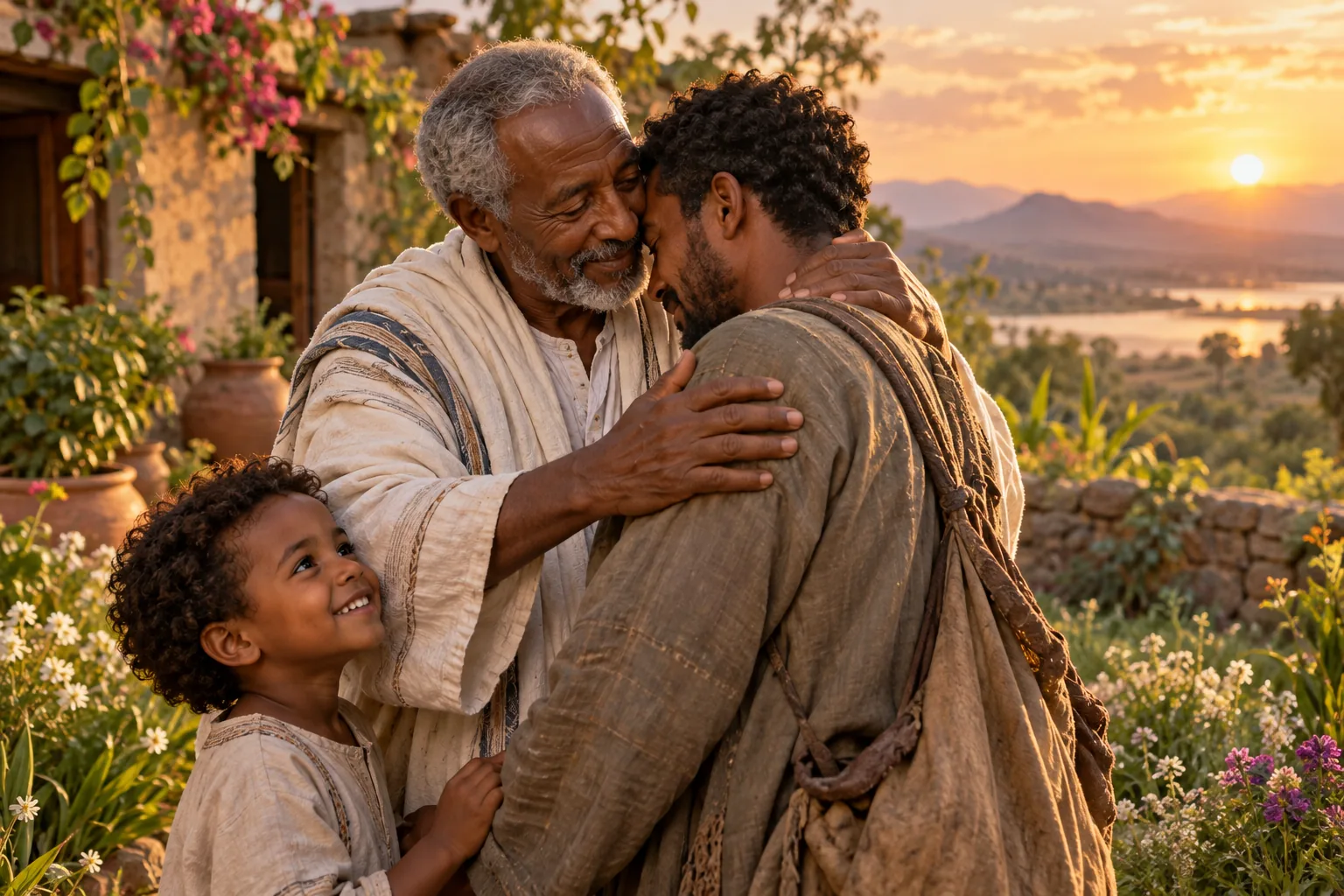
Read Luka / Luke 15:11–32. Notice God’s action, the human response, and the invitation to renewed life. The illustration invites reflection; the passage guides interpretation.
Read the passage in your Bible. Compare its words with the illustration: what does the picture show, and what does it leave out?
2 · Understand and discuss
Understanding the message
What changes when repentance becomes a return to the Father?
Mercy precedes repair; repentance bears fruit in truth and changed conduct.
Read Luke 15:1–2 alongside the two sons. Jesus responds to complaints about welcoming sinners. The younger son leaves, loses property, comes to a reckoning, and returns. The older son remains near the house yet distant from the Father’s joy.
The father runs to welcome the returning son before the proposed arrangement as a hired worker develops. Grace cannot be purchased through labor. The homecoming reveals God’s mercy calling both the lost and the self-righteous.
Repentance exceeds shame or a request for restored reputation. Repentance acknowledges and leaves wrongdoing, seeks safe repair, and respects consequences. Forgiveness, reconciliation, and trust are distinct; trust grows through time and conduct.
A barrier to examine
Self-justification conceals wrongdoing; hopeless self-condemnation obstructs return.
Read and discuss
- What important images, words or movements do you notice in the passage?
- How can mercy welcome a returning wrongdoer while upholding protection and justice?
- Which conduct needs to stop? Which harm requires acknowledgment without excuses?
3 · Carry the lesson into life
One practice for this week
On the second evening, write down wrongdoing, harm, and one safe step of repair. Read Psalm 51:1–12. Plan a step before the weekend with suitable counsel. Do not demand contact, forgiveness, or closeness from a person harmed.
A closing prayer
Merciful Father, let repentance bear fruit in truth, changed conduct, and wise repair. Amen.
In a group, anyone may choose to listen without answering a personal question. Respect privacy and do not pressure anyone to share their story.
4 · Pause and review
A gracious weekly check-in
At the weekend, record a truth learned, practice attempted, obstacle, question, and next step. A voluntary 10–15 minute conversation with a trusted companion may help.
Use a notebook, worksheet, or the private reflection section below. Course records track participation and understanding rather than the worth of faith.
Study freely. Sign in to save your journey.
Lessons and quizzes are open. Sign in with a ChatGPT account to enroll, keep progress and reflections across devices, and contact the teacher.
Sign in to save progressCheck your understanding
Short quiz
Answer every question. Explanations help you return to Scripture; no pass mark blocks your progress.
Your reflection and next step
Which conduct needs to stop? Which harm requires acknowledgment without excuses?
On the second evening, write down wrongdoing, harm, and one safe step of repair. Read Psalm 51:1–12. Plan a step before the weekend with suitable counsel. Do not demand contact, forgiveness, or closeness from a person harmed.
You can reflect in your own notebook. Saving notes online requires signing in and enrolling.
Ask the teacher
Questions and replies here are visible only to you and the teacher. This is not a public discussion. Replies are not immediate; return here to check them.
Sign in and enroll to submit a question.
Other ways to ask →