

How can leadership receive devoted service without treating workers’ lives as property?
Study overview
After Gilboa, Israel gathers around a new king. Jerusalem's walls rise, warriors gather, and a thirsty king receives water bought at great risk. Yet the most revealing act is not drinking, but pouring the water before the Lord.
Passage: 1 Chronicles 11:1–47
Controlling image: Water poured before the Lord
Heart-question: Can a leader receive courageous loyalty without treating the lives of loyal people as personal property?
Introduction: When Power Must Learn Reverence
Leadership attracts admiration for visible victories: captured cities, expanding institutions, gifted supporters. But power becomes dangerous when devoted people become resources to be spent. Behind success stand names, sacrifices, and wounds hidden from public celebration.
First Chronicles 11 begins where Saul's reign ended. Israel needs leadership after Gilboa (10:1–14). David is recognized at Hebron; Jerusalem becomes the royal center; warriors establish the kingdom. Then an unexpected scene: David refuses to drink water brought from Bethlehem at the risk of three warriors' lives (11:15–19).
This text is about royal power becoming covenant leadership when God's word orders the kingdom and human lives are honored before God. The water from Bethlehem asks what a crown is worth when compared with the lives of the people beneath the crown.
Historical and Literary Context: From Family Records to a Gathered Kingdom
First Chronicles 1–9 preserves Israel's identity after catastrophe. Chapter 10 explains Saul's fall through failure to seek the Lord (10:13–14). Chapter 11 shows all Israel gathering around David. Failed kingship must yield to leadership shaped by the Lord's word.
The parallels in 2 Samuel 5:1–10 and 23:8–39 narrate similar events. Chronicles foregrounds Israel's unity, divine promise, Jerusalem, and the warriors rather than David's contested ascent (Sailhamer 1983; Knoppers 2004).
For the postexilic community, Jerusalem's former establishment offered hope after destruction (2 Chr 36:17–21). Yet God's presence, not walls, measures covenant life. David will later prepare Jerusalem for the ark and the temple (1 Chr 15:1–3; 22:1–5).
Walking Through the Text
When All Israel Comes to the Shepherd (11:1–3)
At Hebron, representatives of all Israel declare kinship with David: Israel and David belong to one people. The delegates recall David's earlier leadership even during Saul's reign and the Lord's command that David shepherd Israel and govern God's people (11:1–2; cf. 1 Sam 16:1–13).
David then makes a covenant before the Lord with Israel's elders. The elders anoint David king according to the Lord's word through Samuel (11:3). The order matters: belonging, divine calling, covenant, anointing. Royal authority is not private property. The king receives responsibility for God's people.
The shepherd image resists domination: the king must protect rather than consume the flock (Ezek 34:2–4, 23–24). Israel's recovery requires responsibility as well as a crown.
When Jerusalem Becomes More Than a Fortress (11:4–9)
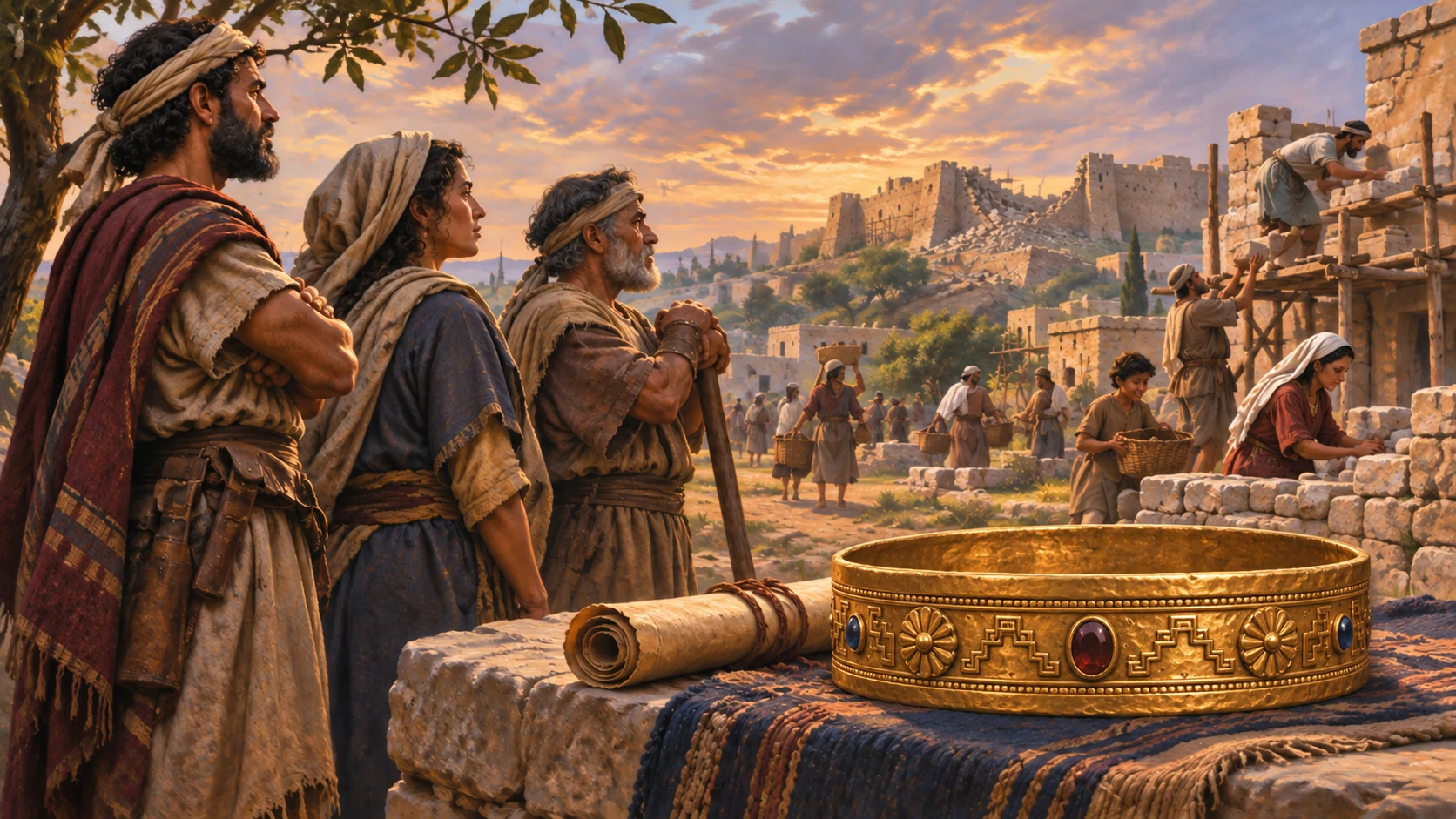
David and all Israel move against Jerusalem, then held by the Jebusites (11:4). Despite the defenders' resistance, the stronghold of Zion falls. Joab, son of Zeruiah, leads the assault and becomes commander; David occupies the stronghold, builds around the Millo, and Joab repairs the remaining city (11:5–8).
Military tactics receive little attention. Instead: David grows increasingly powerful because the Lord of hosts is with David (11:9). Human labor matters, but ultimate credit belongs elsewhere.
Jerusalem is not yet the completed temple center. The ark and temple preparations will follow (1 Chr 15–17; 22). Here kingship prepares for worship. A city can have strong walls while remaining spiritually hollow; divine presence, not architecture, gives covenant life its center (Ps 48:1–3; 2 Chr 6:6).
When a Barley Field Becomes a Place of Deliverance (11:10–14)
The catalogue begins by explaining the warriors' purpose: the leaders strengthened David's kingship with all Israel, in fulfillment of the Lord's word (11:10). Jashobeam is remembered for extraordinary prowess (11:11). Eleazar, son of Dodo, stands with David at Pas-dammim when Philistines threaten a barley field and other soldiers retreat (11:12–13).
Rather than surrender the field, the defenders hold the ground. The narrator's final statement gives the decisive interpretation: the Lord brings the great victory (11:14). The deliverance belongs to God.
This is ancient warfare, not a command for Christian communities to employ force for religious goals. The theological point is that God's purpose operates through courageous human service without becoming the possession of the human servant. The list celebrates loyalty, but the victory belongs to the Lord.
When Bethlehem's Water Cannot Be Swallowed (11:15–19)
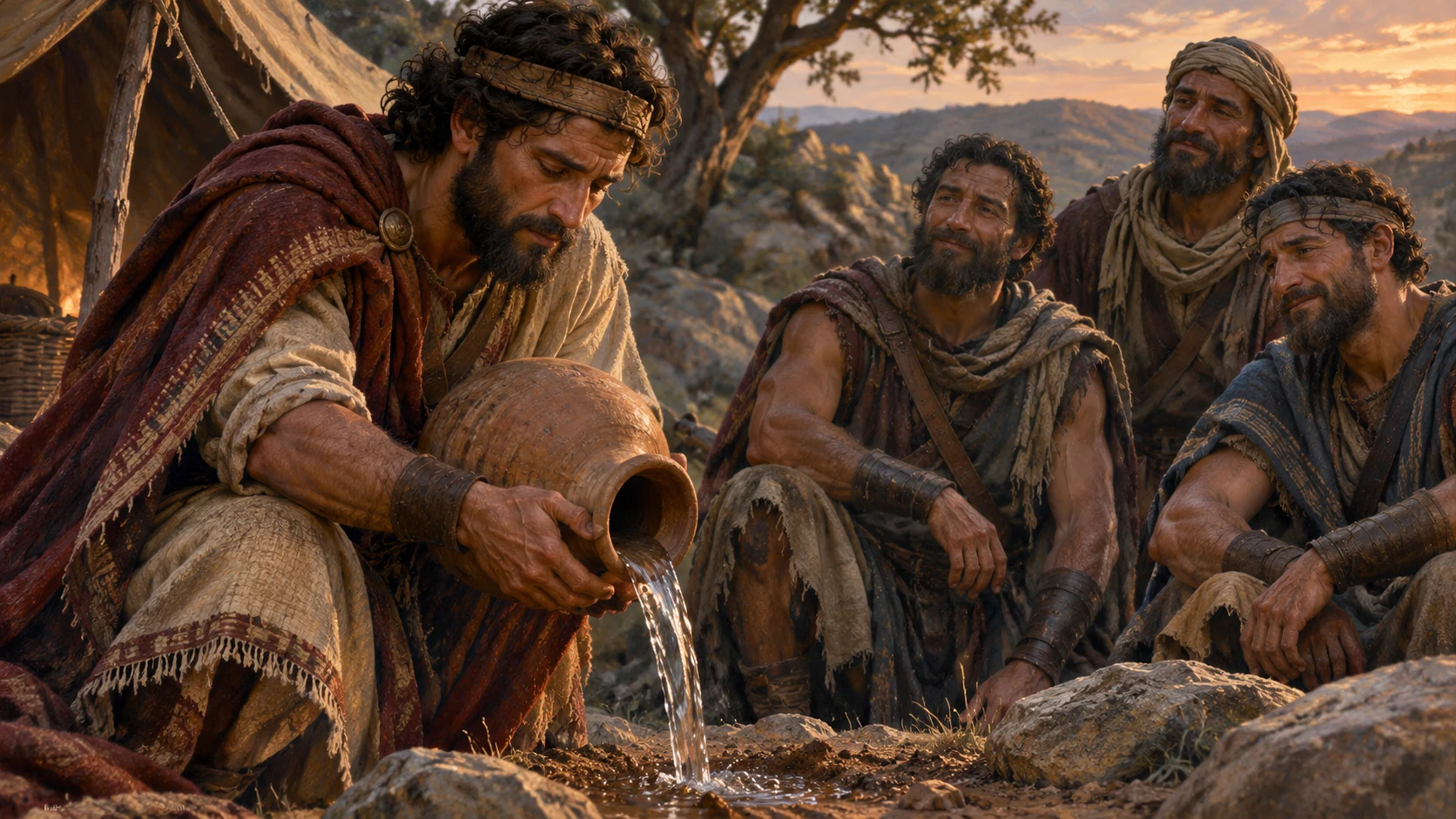
Three warriors reach David at the cave of Adullam while Philistines hold Bethlehem. David expresses a longing for water from the well by Bethlehem's gate (11:15–17). The warriors cross enemy lines and return with the water (11:18).
Royal privilege could have consumed the prize. Instead, David refuses to drink. The water represents lives endangered for David's sake. David pours the water before the Lord, treating the costly gift as an offering rather than a private indulgence (11:18–19).
The narrative neither condemns the warriors nor reports a formal order. Instead, loyalty carries a cost. The king refuses to consume another person's danger as royal luxury. Reverence for God places a limit on what a leader may demand or enjoy. Sailhamer (1983) rightly highlights David's awareness of the risks borne by the warriors.
When Renown Is Named but Not Worshiped (11:20–25)
Abishai, Joab's brother, is distinguished for great feats and command, yet the text marks limits to Abishai's standing among the leading warriors (11:20–21). Benaiah, son of Jehoiada, defeats formidable opponents, including a lion in a snowy pit and a heavily armed Egyptian (11:22–23). Benaiah receives responsibility over David's bodyguard (11:24–25).
Distinct ranks locate even remarkable people within the wider community. Gifts should be recognized without turning gifted people into objects of worship.
When the Kingdom Remembers Every Name (11:26–47)
The final catalogue names warriors from different places and backgrounds: Asahel, brother of Joab; men from Bethlehem, Tekoa, Benjamin, and other districts; Zelek the Ammonite; Ithmah the Moabite; and Uriah the Hittite (11:26–47). Few receive biographies; every name resists erasure.
Uriah the Hittite appears in verse 41. Readers of 2 Samuel 11 know that David later betrayed Uriah through the abuse of royal power. Chronicles does not recount that episode here, and the list alone should not be made to say more than the list says. Yet the canonical juxtaposition is sobering: a king capable of honoring endangered warriors at Bethlehem later failed to honor a faithful warrior in Jerusalem. Admiration must never replace moral accountability (2 Sam 11:14–17; 12:7–9).
Theological Reflection: What Makes a Kingdom Secure?
God's Word Establishes the Crown
The chapter twice frames David's rule by the Lord's word (11:3, 10). The same God who judged Saul's refusal to seek divine guidance establishes a different kind of kingship (10:13–14). David's rule is a vocation under authority, not authority without limits (Deut 17:18–20).
God's Presence Outweighs Visible Strength
Jerusalem is taken through brave action, yet David's growth is attributed to the Lord's presence (11:9). The barley field is defended, yet the victory belongs to the Lord (11:14). Covenant hope cannot be reduced to armies, institutions, budgets, or buildings. The temple story ahead will ask whether God's people can receive divine presence with reverence (1 Chr 13:7–12; 15:13–15).
Genuine Leadership Honors Costly Service
The poured water turns strength toward worship. David sees people where an insecure ruler might see only instruments. That same principle later appears in the king's prayer that all offerings come from God's hand (1 Chr 29:14). Leaders must honor volunteers, workers, and families before celebrating results.
The Son of David Must Be More Faithful Than David
The Chronicler celebrates David without presenting a flawless human ruler. The wider canon remembers both David's faithful moments and David's grievous sins. The promise of a lasting Davidic house (1 Chr 17:11–14) invites hope beyond every limited king. Christians identify Jesus as the promised Son of David, the shepherd-king who serves rather than exploits, and gives life rather than spending the lives of others (Mark 10:42–45; John 10:11; Luke 1:32–33).
Life Application: Pour the Water Before the Lord
- Make authority accountable. Establish shared decisions, documented responsibilities, and safe channels for correction in churches, organizations, and families.
- Recognize the people behind outcomes. Thank volunteers, caregivers, administrators, security workers, and overlooked members by name, not merely the visible leaders.
- Measure the true cost of requests. Before asking for extra service, consider workers' rest, family obligations, financial strain, and personal safety.
- Give victories back to God. Celebrate achievements with prayer, honesty, generosity, and acknowledgment of the whole community rather than personal branding.
- Join worship to justice. Refuse to offer lavish public praise while tolerating mistreatment of workers or silence around misconduct (Isa 1:11–17).
- Remember Uriah. Revisit past leadership decisions, listen to harmed people, confess abuses, and make restitution wherever possible (2 Sam 12:13; Luke 19:8).
Reflection Questions
- Does current leadership resemble a shepherd entrusted with people or an owner entitled to people's sacrifices?
- Which overlooked workers deserve public recognition and practical support?
- Where has a successful ministry begun to confuse visible strength with God's approval?
- What costly gift should be received with reverence rather than consumed as a privilege?
- Which unresolved wrong requires confession, protection of affected people, and repair?
Response Prayer
Lord of hosts, God of Israel, place every crown beneath divine authority. Give leaders a shepherd's heart, not a hunger to possess the flock. Teach congregations to remember the names behind every victory. Where workers are exhausted, bring rest; where loyalty has been exploited, bring truth and repair. Receive the water poured before the Lord—the confession that every life is sacred and every good gift belongs to God. Prepare the house for worship, the heart for humility, and the people for faithful service. Through Jesus Christ, the true Son of David. Amen.
Window into What Comes Next
The stronghold has become David's city, and a people have begun to gather around the promised king. But the story of unity is not finished. First Chronicles 12 will draw warriors from many tribes to David, including members of Saul's own Benjamin. The next question is not merely who sits on the throne, but how a divided people become one around God's purpose.
Annotated Bibliography
- Hill, Andrew E. 1 & 2 Chronicles. NIV Application Commentary. Grand Rapids: Zondervan, 2003. Connects the Chronicler's portrait of leadership and community to contemporary practice.
- Japhet, Sara. I & II Chronicles: A Commentary. Old Testament Library. Louisville: Westminster John Knox, 1993. Examines the Chronicler's literary selection, genealogical memory, and Davidic themes.
- Klein, Ralph W. 1 Chronicles: A Commentary. Hermeneia. Minneapolis: Fortress, 2006. Offers textual and historical analysis of Jerusalem, the warrior traditions, and parallels in Samuel.
- Knoppers, Gary N. I Chronicles 10–29: A New Translation with Introduction and Commentary. Anchor Bible 12A. New York: Doubleday, 2004. Provides detailed critical study of 1 Chronicles 11 and its shaping of Davidic kingship.
- Sailhamer, John. First and Second Chronicles. Everyman's Bible Commentary. Chicago: Moody Press, 1983. The supplied commentary highlights David's establishment, the warriors' support, and the king's concern for their lives.
- Williamson, H. G. M. 1 and 2 Chronicles. New Century Bible Commentary. Grand Rapids: Eerdmans, 1982. Situates the Chronicler's portrait of David within postexilic covenant identity and divine promise.
Be the first to leave a comment.