

How can truth, discernment, and hospitality build covenant unity?
Study overview
From the wilderness stronghold, footsteps approach. Some arrive with weapons, some with doubts, some from the household of an old rival. At Hebron, scattered roads lead to a common table—and the joy of Israel begins to sound like a people coming home.
Passage: 1 Chronicles 12:1–40
Controlling image: Roads converging at Hebron's shared table
Heart-question: Can wounded communities exchange divided loyalties for a shared purpose without surrendering discernment, truth, or care?
Introduction: When a People Must Choose a Direction
Families inherit old grievances, leaders demand allegiance, and belonging becomes a matter of whom a person opposes rather than whom a people serves.
First Chronicles 12 remembers a different movement. While Saul still threatens David, warriors cross dangerous boundaries to join the future king. After Saul's death, representatives from many tribes arrive at Hebron. The chapter ends not with another battle but with food, fellowship, and joy (12:38–40).
What loyalty can heal division without creating a new tribalism?
This text is about divided allegiance becoming wholehearted covenant solidarity under the word of the Lord. At Hebron, courage, discernment, generosity, and worship belong together.
Historical and Literary Context: The Kingdom Before the House
Chapters 1–9 recover Israel's identity through genealogical memory. Chapter 10 interprets Saul's fall as covenant unfaithfulness (10:13–14). Chapter 11 establishes David at Hebron and Jerusalem according to the Lord's word (11:1–9). Chapter 12 returns to David's fugitive years, then expands the scene of national support surrounding David's accession.
The sequence is thematic, not strictly chronological: Ziklag recalls David's flight (1 Sam 27:1–7), the Philistine dismissal recalls 1 Samuel 29, and Hebron recalls 2 Samuel 5:1–3. Chronicles foregrounds support from all Israel, including Saul's own Benjaminite kin (12:2, 16, 29).
For postexilic readers, these names proclaim that identity survives collapse. Yet unity cannot replace obedience: the ark narrative tests enthusiasm against God's instructions (1 Chr 13:7–12; 15:13–15). Sailhamer (1983) identifies the chapter's emphasis on national participation and God's promise to David.
Walking Through the Text
When Saul's Own Kin Cross the Divide (12:1–7)
The first arrivals come to David at Ziklag while Saul's hostility keeps David from secure public life (12:1). Remarkably, these archers belong to Benjamin, Saul's tribe. The warriors can use either hand with sling and bow (12:2), and the Chronicler patiently preserves individual names (12:3–7).
David is vulnerable; loyalty may be costly. Family background need not dictate every moral decision, though the text does not endorse casual betrayal. Allegiance turns toward God's chosen king (11:3; 12:23).
A wounded nation begins to heal when inherited hostilities no longer determine the future.
When Courage Crosses a Flooded River (12:8–15)
Gadite warriors join David at the wilderness stronghold. The Chronicler describes military skill with vivid comparisons: faces like lions, speed like gazelles (12:8). Eleven leaders are named and ranked (12:9–14).
The account reaches a striking image: these warriors cross the Jordan in the first month, when the river overflows its banks, and drive opponents from the valleys (12:15; cf. Josh 3:15). Commitment takes physical form along a dangerous road.
Ancient military courage is not a template for using force in contemporary religious disagreements. Faithfulness crosses costly boundaries without surrendering conscience.
When Loyalty Is Tested and Peace Is Spoken (12:16–18)
Other warriors from Benjamin and Judah approach David. David does not mistake enthusiasm for trustworthiness. David asks whether the visitors come in peace or intend betrayal, calling on the God of the ancestors as witness (12:16–17).
Then the Spirit comes upon—or, more literally, clothes—Amasai. Amasai answers with a declaration of belonging, repeated peace, and confidence that God helps David (12:18; cf. Judg 6:34). David welcomes the newcomers and gives responsibility to the leaders.
The order matters: honest questioning, Spirit-enabled speech, welcome, service. Peace faces suspicion honestly while opening room for reconciliation. Repeated peace (shalom) points to a shared future under God's help.
When Help Gathers Day After Day (12:19–22)
Some Manassites join David during the tense episode when Philistine rulers dismiss David from a campaign against Saul; David does not participate in that attack (12:19; 1 Sam 29:1–11). The Manassite leaders later assist against raiding bands (12:20–21).
Supporters arrive day after day until David's army resembles an army of God (12:22). Strength accumulates through many acts of commitment.
The phrase describes formidable strength; it does not make every military action automatically righteous. Chapter 11 has already credited the Lord with David's rise (11:9). The Chronicler's central concern remains God's fulfillment of the promised kingship, not the glorification of warfare.
When Every Tribe Has a Place in the Assembly (12:23–37)
Now the scene moves to Hebron. The stated purpose governs the catalogue: the assembled troops come to transfer the kingdom to David according to the word of the Lord (12:23). Judah and Simeon appear; Levites and Aaronic leaders, including Jehoiada and Zadok, appear; Benjamin appears despite earlier loyalty to Saul's house (12:24–29). Ephraim, Manasseh, Issachar, Zebulun, Naphtali, Dan, Asher, and the eastern tribes also contribute (12:30–37).
The large numbers raise questions about ancient counting conventions; no modern census method is supplied. The literary emphasis is broad national participation, not David's private faction.
Two descriptions deserve attention. Issachar's leaders understand the times and know what Israel should do (12:32): discernment joined to responsible action, not a claim to secret predictions. Zebulun's warriors stand ready with undivided purpose (12:33). A community needs both clear judgment and steadfast commitment. Zeal without discernment is dangerous; discernment without costly action remains incomplete.
When the Road Ends at a Shared Table (12:38–40)
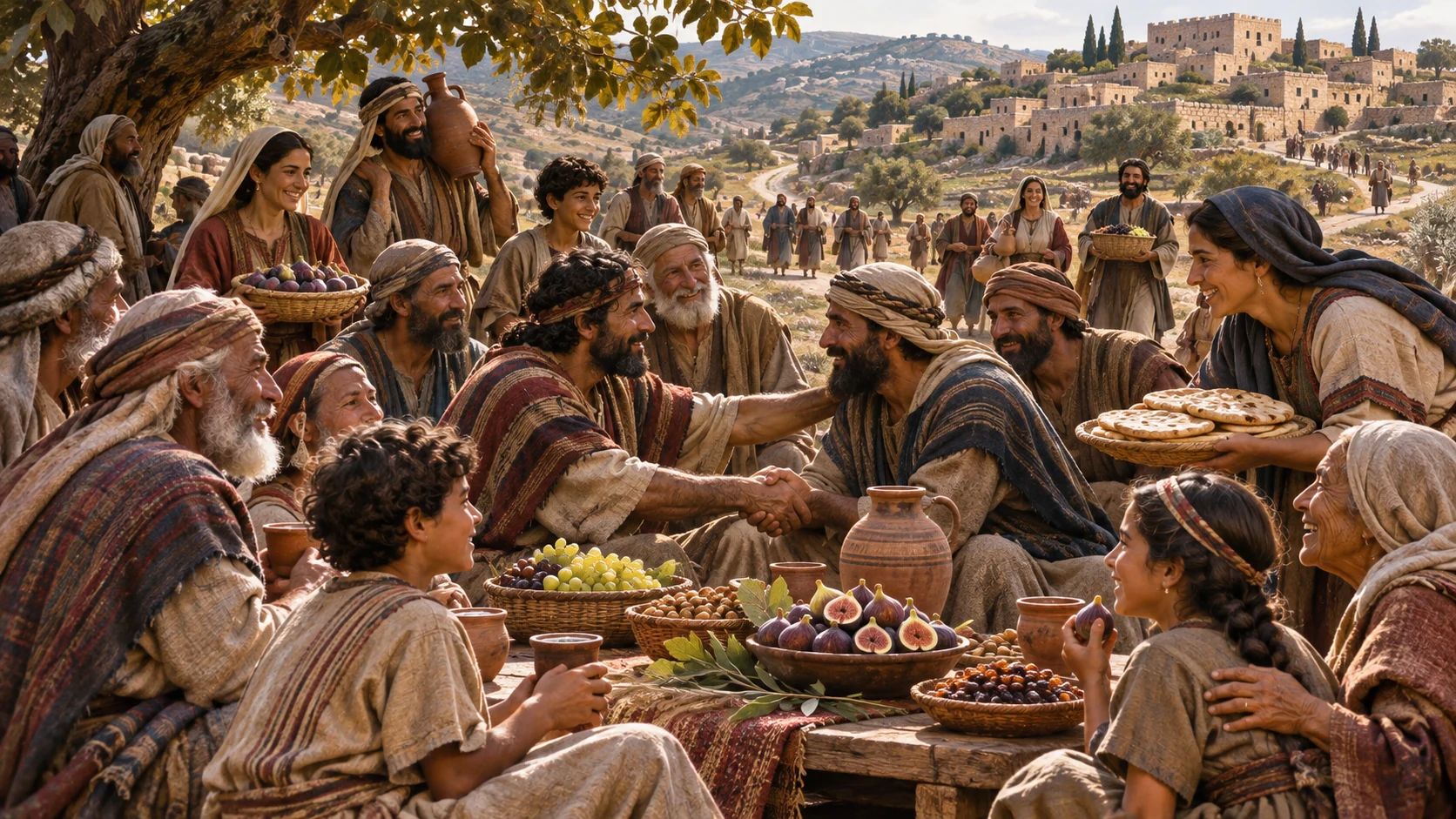
The final verses replace marching columns with households preparing food. The warriors come with a whole heart, and the rest of Israel is of one mind concerning David's kingship (12:38). The gathering continues for three days. Relatives and neighbors bring flour, fig cakes, raisins, wine, oil, livestock, and abundant provisions (12:39–40).
Kinship turns military assembly into communal hospitality. Even those outside the ranks sustain the gathering. There was joy in Israel (12:40).
Unity is not complete because everyone wears the same uniform. Unity becomes visible when the whole community shares responsibility, bread, and hope. Yet joy must mature into obedient worship; chapter 13 will show how quickly celebration can outrun holiness.
Theological Reflection: What Makes One Heart Possible?
God's Word, Not Popularity, Gives Direction
The gathering is interpreted by God's word (12:23; cf. 11:3). David's broad support matters, but popularity alone cannot authorize a king. The Lord's covenant purpose judges public enthusiasm. Numbers and applause cannot replace Scripture and accountability (Deut 17:18–20).
The Spirit Creates Courage for Truthful Peace
Amasai's declaration follows divine empowerment, not a public-relations campaign (12:18). The Spirit's work here encourages a truthful commitment to God's purpose. Modern leaders cannot demand unconditional loyalty or claim divine approval for every decision. The New Testament tests spiritual claims by allegiance to Christ and love expressed in truth (1 John 4:1; Eph 4:15).
Covenant Unity Needs Many Gifts and Many Tables
The Chronicler names archers, experienced fighters, discerning leaders, priests, relatives, and food-bearers. Israel's strength is not uniformity. In the church, no member is unnecessary (1 Cor 12:12–27). Provision and hospitality are not secondary to visible leadership (Rom 12:6–13).
The Greater Son of David Gathers Beyond Old Hostilities
The Davidic promise reaches beyond one generation (1 Chr 17:11–14). Christians see fulfillment in Jesus, the Son of David (Luke 1:32–33), whose kingdom grows through self-giving love and resurrection (Mark 10:42–45; John 18:36). In Christ, hostility gives way to a new humanity (Eph 2:14–18). Hebron's feast anticipates, without equaling, the deeper reconciliation around the Lord's table (1 Cor 10:16–17).
Life Application: Make Room at the Table
- Name the old divisions. Identify family, ethnic, denominational, or leadership rivalries that still shape congregational decisions. Invite honest conversations without pressuring injured people into premature reconciliation.
- Test loyalty by truth. Build transparent procedures for evaluating leaders, protecting dissent, and addressing wrongdoing. Peace should never require silence about abuse.
- Practice Issachar's discernment. Read Scripture, listen to the community, assess actual circumstances, and make timely decisions without pretending to know the future.
- Cross one costly boundary. Initiate a respectful conversation with a mistrusted group, repair a broken partnership, or cooperate in a concrete act of service.
- Honor unseen contributors. Budget for meals, transport, caregiving, and hospitality. A gathering is sustained by more than those speaking at the front.
- Turn agreement into shared service. Give former rivals meaningful responsibilities, with appropriate safeguards and accountability.
- Let joy lead to holy obedience. After celebrations, ask what habits of prayer, teaching, justice, and reverent worship must now be established (1 Chr 13:3; 15:13).
Reflection Questions
- Which inherited rivalry has become stronger than commitment to God's word?
- Where is a congregation confusing popularity with divine approval?
- What difficult truth must be spoken before trust can be rebuilt?
- Whose wisdom, labor, or hospitality has been missing from the community's table?
- What visible action would turn shared enthusiasm into accountable, faithful service?
Response Prayer
Lord God of Israel, gather divided hearts beneath the truth of the covenant. Give courage to cross the flooded rivers of fear, wisdom to recognize the right path, and humility to receive a former rival as a neighbor. Let God's Spirit clothe the church with truthful speech and lasting peace. Remember the hands preparing bread, the weary travelers, and the names seldom spoken. Keep the joy of gathering from becoming empty spectacle. Lead every road toward faithful worship and every shared table toward the peace of Jesus Christ, the Son of David. Amen.
Window into What Comes Next
The people are together, the tables are full, and rejoicing fills Israel. But one question remains: Will a united nation also approach the holy God in the right way? In 1 Chronicles 13, David seeks to bring the ark toward Jerusalem. The procession begins with music and celebration, but a neglected command turns joy into trembling. Unity is a gift; reverent obedience must shape the gift.
Annotated Bibliography
- Hill, Andrew E. 1 & 2 Chronicles. NIV Application Commentary. Grand Rapids: Zondervan, 2003. Explores leadership, community, and the practical implications of the Chronicler's portrayal of David.
- Japhet, Sara. I & II Chronicles: A Commentary. Old Testament Library. Louisville: Westminster John Knox, 1993. Examines the Chronicler's literary shaping of tribal participation and covenant identity.
- Klein, Ralph W. 1 Chronicles: A Commentary. Hermeneia. Minneapolis: Fortress, 2006. Provides textual and historical discussion of David's supporters, military lists, and chronology.
- Knoppers, Gary N. I Chronicles 10–29: A New Translation with Introduction and Commentary. Anchor Bible 12A. New York: Doubleday, 2004. Offers detailed critical analysis of the tribal muster and the Chronicler's vision of united Israel.
- Sailhamer, John. First and Second Chronicles. Everyman's Bible Commentary. Chicago: Moody Press, 1983. The supplied source emphasizes support from all Israel, Benjamin's participation, Amasai's peace declaration, and fulfillment of God's promise.
- Williamson, H. G. M. 1 and 2 Chronicles. New Century Bible Commentary. Grand Rapids: Eerdmans, 1982. Situates Davidic legitimacy and national solidarity within the postexilic concerns of Chronicles.
Be the first to leave a comment.