

How can courage before a king give way to deception beside a welcoming table?
Study overview
The Word Above the Throne, the Lie beside the Table, and the Call to Finish Faithfully
Key passage: 1 Kings 13:32–33 — The judgment announced against Bethel will certainly stand, yet Jeroboam continues along the path of disobedience. (Summary, not a direct quotation.)
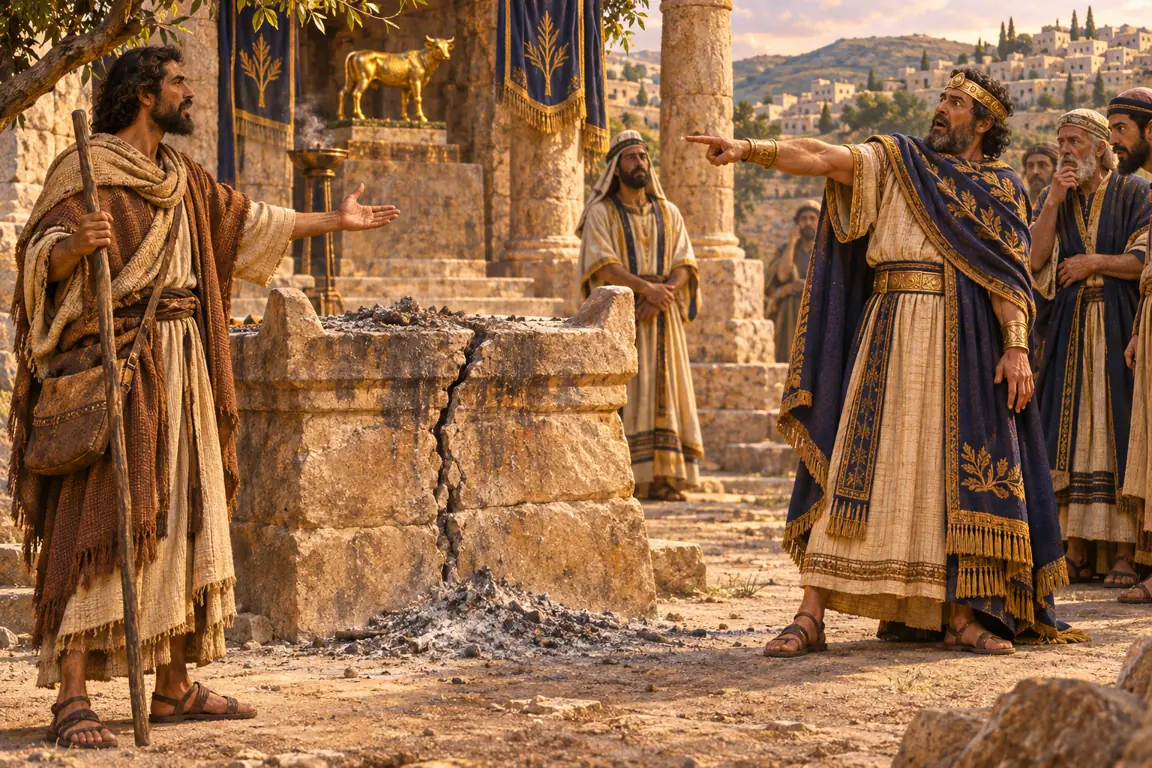
Ashes spill from a royal altar. A commanding hand hangs powerless in the air. Beside a welcoming table, a false word changes a road. Beyond a messenger’s grave, the word of God still stands.
Introduction — The Dangerous Voice Can Sound Familiar
A traveler may resist an obvious threat and still be misled by a friendly voice offering directions. Danger does not always arrive shouting. Sometimes danger offers a chair, warm food, and the reassuring language of shared faith.
First Kings 13 begins with public courage. A man of God enters Bethel and confronts an altar established under royal authority. The king commands arrest, the altar cracks, and the royal hand becomes powerless. God’s word proves stronger than the machinery of the throne.
The messenger also refuses royal hospitality and reward. Yet a later invitation comes from a different direction: an old prophet claiming an angel’s instruction. The claim appears to carry sacred authority. The invitation leads away from an already clear command.
How can courage before a king become surrender before a religious claim? First Kings 13 exposes borrowed spiritual authority becoming deception, while showing God’s word enduring beyond the failure of God’s messenger.
The story is unsettling. A deceiver survives, while a messenger dies after accepting the deception. The chapter provides no comfortable explanation of every moral difficulty. Faithful reading must hear the warning without pretending the grief has become simple. The broken altar and the lonely road direct attention toward a question larger than reputation: can service remain obedient after the first courageous moment?
Historical and Literary Context — Bethel beneath the Covenant Word
Chapter 12 ended with Jeroboam establishing alternative worship at Bethel and Dan. Fear of losing northern loyalty to Jerusalem drove the religious arrangements (12:26–33). Chapter 13 opens at the Bethel altar, bringing a prophetic interruption into the middle of the king’s project.
Bethel carried respected memories from Israel’s past. Jacob encountered God’s promise at Bethel and called the place God’s house (Gen 28:10–22). An honored history, however, cannot give permanent approval to later practice. The present altar remains accountable to the God associated with the place.
The wider book evaluates kings through covenant faithfulness. Solomon’s kingdom has divided, but the word of God continues crossing political boundaries. A messenger from Judah speaks in the northern kingdom. The prophetic word also reaches beyond the immediate reign by naming Josiah, a future king from David’s house. Second Kings 23:15–20 will deliberately return to the announcement.
Two unnamed prophetic figures carry much of the story. Rank and reputation cannot settle the question of truth. The narrator repeatedly emphasizes the word of the LORD, the road, and returning. Provan notes the painful movement from a messenger returning against a command to Jeroboam refusing to turn from evil (Provan 2012, commentary on 1 Kgs 13:1–34).
The chapter must therefore remain joined to the royal narrative. The messenger’s death does not distract from Bethel’s judgment. The death intensifies the warning: the word confronts the messenger as well as the king. Brueggemann emphasizes the continuing force of the announced judgment despite the disturbing turns in the story (Brueggemann 2000, 167–73).
Walking Through the Text
A Voice Interrupts the Royal Altar — 13:1–3
A man of God arrives from Judah by the word of the LORD. Jeroboam stands at the altar to make an offering. The messenger addresses the altar and announces the birth of Josiah in David’s house. Priests of the high places will face judgment there, and human bones will be burned on the altar.
The announcement reverses the altar’s purpose. A structure presented as a center of sacred security will become a place of defilement. Royal construction cannot guarantee divine acceptance.
The messenger also announces an immediate sign: the altar will split and the ashes will spill. The sign links a present event with a future judgment. God’s word does not depend on a king’s permission or the appearance of a successful festival. Leithart observes the literary connection between the tearing of Ahijah’s garment and the tearing of Jeroboam’s altar: the same imagery unsettles royal confidence (Leithart 2006, commentary on 1 Kgs 13).
The Arresting Hand Needs Mercy — 13:4–10
Jeroboam stretches out a hand and orders the messenger’s arrest. The hand withers or becomes rigid, preventing withdrawal. The altar also splits, fulfilling the announced sign. The ruler cannot control the prophet, the altar, or even the movement of the royal hand.
Jeroboam then asks the man of God to pray for healing. The messenger intercedes, and God restores the hand. Mercy enters the confrontation before the king has demonstrated a change of allegiance. The healing creates an opportunity to respond differently.
The king offers hospitality and a reward. The messenger refuses, explaining the command against eating bread, drinking water, or returning by the original route. The narrator does not explicitly explain every purpose behind the restrictions. Provan suggests protection from compromising obligations as a possible background, rather than a stated fact (Provan 2012, commentary on 1 Kgs 13:7–30). The messenger leaves by another road. Public courage and practical obedience remain joined at the end of the scene.
A Religious Claim Reopens a Closed Door — 13:11–19
An old prophet in Bethel hears the report from the prophet’s sons, follows the departing messenger, and finds the man of God resting under a tree. The old prophet offers food at home. The messenger again states the prohibition.
Then the invitation acquires a claim of revelation. The old prophet identifies a shared prophetic calling and claims an angel delivered a new instruction from God permitting the meal. The narrator immediately identifies the claim as a lie. No genuine angelic appearance is narrated.
The man of God returns and eats. A command resisted before royal power has now been abandoned before a colleague’s religious assurance. The crucial issue is the contradiction between the already received command and the later claim. The chapter gives no reason for treating prophetic status as authority to cancel God’s instruction.
The old prophet’s motive remains unstated. Jealousy, hospitality, concern for Bethel, and other explanations remain proposals. Certainty about the lie does not require certainty about the hidden motive. The reader knows enough to recognize the moral danger without inventing a private history.
A True Word Arrives at a Troubled Table — 13:20–23
During the meal, the word of the LORD comes to the old prophet. The distinction matters: the earlier claim was a lie; the present announcement receives the narrator’s explicit identification as God’s word.
The message condemns the man of God’s disobedience and announces burial away from the ancestral tomb. The forbidden meal has become the setting for judgment. The messenger had known the command and had repeated the command clearly before accepting the contradictory claim.
The scene remains painful. The deceiver delivers the judgment against the deceived messenger. The chapter does not explain the absence of an immediate penalty for the lie, and the silence cannot become moral approval of deception. Neither does a later true message make the earlier lie trustworthy. A genuine spiritual experience cannot provide a blanket endorsement of a religious leader’s conduct. The authority belongs to God’s word, and both prophetic figures remain accountable before God.
A Lion Stands beside the Unfinished Journey — 13:24–28
After departure, a lion meets the man of God and kills the messenger. The body lies on the road, while the donkey and lion remain nearby. Travelers report the sight to the city.
The old prophet identifies the death as the fulfillment of the announced judgment. On reaching the road, the prophet finds the body uneaten and the donkey unharmed. The unusual restraint distinguishes the event from an ordinary attack driven by hunger. The narrative presents a sign of judgment, not simply a traveler’s misfortune.
The road now embodies the chapter’s warning. The messenger brought back alive through deception must be brought back dead for burial. The warning about returning has become visible in the journey (Provan 2012, additional note on 1 Kgs 13:33).
The text supplies an explicit interpretation for the messenger’s death. The account does not authorize assigning hidden divine judgments to present-day accidents or deaths. The emphasis remains the seriousness of the command in the narrated mission.
A Grave Bears Witness, but the King Continues — 13:29–34
The old prophet carries the body to Bethel, places the messenger in the prophet’s tomb, and mourns the loss as the death of a brother. The prophet then asks for eventual burial beside the man of God. The reason given concerns the certainty of the word against Bethel and the northern shrines.
The old prophet’s grief does not erase responsibility for the lie. The scene allows sorrow, guilt, and recognition to remain together without explaining every inward movement. The burial also prepares a later moment: Josiah will leave the shared tomb undisturbed during the judgment against Bethel (2 Kgs 23:17–18).
The final verses return to Jeroboam. Despite the signs and warnings, the king continues appointing priests and maintaining the high-place system. The house established through a divine promise now faces destruction through persistent disobedience. A restored hand has not become a repentant heart. The messenger’s failure cannot release the king from the truth of the message.
Theological Reflection
The Word Judges the Platform and the Messenger
The king cannot silence God’s word by commanding arrest, and the prophet cannot stand above God’s word by delivering a courageous sermon. Public calling creates responsibility rather than exemption. The narrative resists a dangerous division between a leader’s message and a leader’s obedience. The final authority belongs to God; gifts, titles, and past achievements remain beneath divine instruction. The chapter therefore searches both institutional power and the spiritual confidence of a successful minister.
Spiritual Claims Require Discernment
The old prophet’s claim combines familiar identity, supernatural language, and an attractive invitation. The lie works through apparent credibility. Deuteronomy 13:1–5 had already warned Israel against religious claims leading away from covenant loyalty. The test concerns faithfulness to God, beyond the impressiveness of the claim. Applied to Christian communities, discernment requires Scripture, careful attention to context, and honest communal examination. A leader’s claimed revelation cannot make deception, exploitation, or disobedience holy.
Mercy Invites a Changed Direction
The healing of Jeroboam’s hand shows divine mercy within a scene of judgment. The king receives relief but persists in the religious system under judgment. A received blessing does not certify every existing practice. Gratitude must become a changed direction. The chapter’s repeated language of returning deepens the point: the messenger returns against the command, while the king refuses the necessary return from evil. The right response involves more than relief from pain; the right response includes renewed allegiance.
Serious Judgment Leaves Serious Questions
The messenger’s death and the deceiver’s survival do not form an easy moral picture. The text identifies disobedience and confirms the word, while leaving questions about the deceiver’s immediate fate unanswered. Reverence does not require inventing explanations. The severity should produce humility rather than pleasure in another person’s fall. The narrative also gives no verdict on the messenger’s final resurrection destiny. Faithful teaching can warn clearly, grieve honestly, and entrust unspoken judgments to God.
Canonical and Christological Horizon — The Faithful Road of Jesus
The promise concerning Josiah gives the chapter an explicit future horizon. Second Kings 23:15–20 records judgment against Bethel and recalls the man of God’s announcement. The word survives the messenger’s death and reaches fulfillment across generations.
The wider biblical story also prepares attention for faithful obedience under temptation. In Matthew 4:1–11, Jesus faces suggestions involving bread, spectacular religious proof, and royal power. Jesus answers through Scripture and remains faithful to the Father. Galatians 1:8 similarly places even an angelic claim beneath the gospel already received. Supernatural language cannot reverse divine truth.
Jesus carries obedience through suffering and death (Phil 2:8). Christian hope rests in the faithful King’s saving work and resurrection, rather than a minister’s flawless record. Hebrews 4:15–16 brings tested believers toward the compassion and timely help of Jesus. First Corinthians 15:20–23 places death beneath the promise of resurrection. The road beyond Bethel finally opens toward a living Savior, giving grace for renewed obedience and hope beyond the grave.
Life Application
- Place a persuasive claim beside Scripture. Before acting on a claimed revelation, read the relevant passage in context with a trusted Bible student. Ask whether the proposed action agrees with the gospel and God’s revealed character.
- Keep an obedient boundary after public success. Following a demanding ministry assignment, review commitments before accepting a new invitation. A successful sermon does not remove the need for continued faithfulness.
- Refuse hospitality carrying a demand for compromise. A leader offered money, access, or comfort in exchange for silence should state the condition openly and decline the arrangement. Transparent accountability protects both message and community.
- Correct a false spiritual claim plainly. A teacher discovering an inaccurate claim should name the error, apologize to affected listeners, and repair the harm. Another successful message cannot substitute for truthfulness.
- Let received mercy change a practice. After answered prayer or relief from a crisis, identify one continuing area of disobedience. Take a concrete step of repentance instead of treating relief as approval of the existing path.
- Receive grace for a faithful next step. Read Hebrews 4:14–16 with a ministry partner. Bring a known failure before God, seek appropriate help, and rebuild obedience without using shame as the foundation of discipleship.
Reflection Questions
- Which familiar voice has begun carrying greater authority than Scripture read carefully in context?
- Where has public courage concealed a private willingness to compromise?
- Which invitation offers comfort or influence at the cost of a clear responsibility before God?
- What received mercy still awaits a concrete response of repentance?
- How can a congregation cultivate discernment, truthful correction, and compassion without making a leader’s reputation the standard of truth?
Response Prayer
God of truth, the altar can crack while a heart remains unchanged. Give churches the humility to receive warning and the courage to change direction. Rescue leaders from confidence resting on titles, gifts, and yesterday’s obedience. Make Scripture clear within careful study, and make obedience steady beyond the public moment.
Lord Jesus, faithful King, expose the comforting lie before a welcoming table becomes a place of compromise. Give tired servants strength to resist pressure, wise companions for discernment, and honesty to acknowledge error. Let mercy bear the fruit of repentance rather than a renewed defense of sin.
Where the road carries grief and unanswered questions, sustain trust in God’s justice and compassion. Heal wounds caused by religious deception. Through the cross and resurrection, restore hope and give courage for the next faithful step. Let the word of God remain greater than the reputation of every messenger. Amen.
Window into What Comes Next — A Disguise before a Prophet
Jeroboam’s hand has been restored, but the king has not turned from the path under judgment. Chapter 14 brings the royal household into a more intimate crisis: a child becomes ill, and Jeroboam seeks an answer through Ahijah, the prophet associated with the original promise of a kingdom.
The visit will involve a disguise. Watch the difference between managing appearances and standing truthfully before God. The next chapter also turns toward Judah, preventing the southern kingdom from becoming a comfortable spectator of northern failure. What can royal strategy accomplish when God’s word reaches past appearances into the condition of a household and a nation?
Bibliography
- Bible. 1769. The Holy Bible: King James Version. 1 Kings 13. BibleGateway. https://www.biblegateway.com/passage/?search=1%20Kings%2013&version=KJV. Scripture wording in the study is paraphrased unless otherwise indicated.
- Brueggemann, Walter. 2000. 1 & 2 Kings. Smyth & Helwys Bible Commentary. Macon, GA: Smyth & Helwys. See “Ominous Prophetic Inscrutability,” 167–73.
- Leithart, Peter J. 2006. 1 & 2 Kings. Brazos Theological Commentary on the Bible. Grand Rapids: Brazos Press. See commentary on 1 Kings 13.
- Provan, Iain W. 2012. 1 & 2 Kings. Understanding the Bible Commentary Series. Grand Rapids: Baker Books. See “The Man of God from Judah (1 Kgs. 13:1–34)” and additional notes.

Be the first to leave a comment.