

Why do bronze shields and a mother’s journey belong together in a chapter about kingship and hope?
Study overview
God Sees beneath Appearances, Grief Enters the Palace, and Royal Splendor Cannot Preserve a Kingdom
Key passage: 1 Kings 14:13 — God recognizes a good disposition toward the LORD in Abijah, and the child receives burial and national mourning amid the judgment against Jeroboam’s house. (Summary, not a direct quotation.)
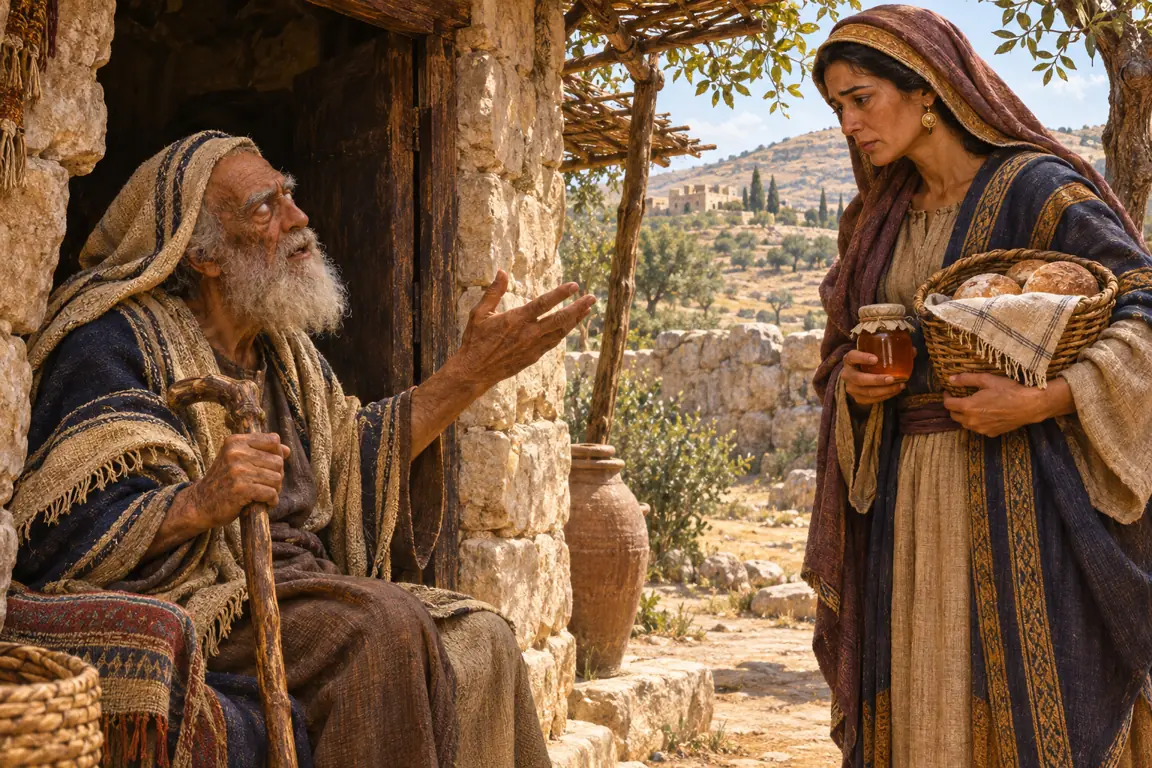
A mother walks toward a prophet’s door. A disguise cannot hide a household from God. In Jerusalem, bronze shields follow the old procession. Behind the ceremony, the gold has gone.
Introduction — Keeping the Appearance after Losing the Substance
A familiar ceremony can continue after the conditions beneath the ceremony have changed. The chairs remain arranged, the procession follows the usual route, and the public words retain the old confidence. Yet a household or institution may already be carrying a loss requiring honest attention.
First Kings 14 opens inside a royal family facing illness. Jeroboam’s son Abijah becomes sick. The king sends a disguised wife to Ahijah, the prophet associated with the original promise of kingship. A personal crisis brings the household back toward a prophetic voice neglected in public policy.
The chapter later moves south. Egypt takes the treasures of Jerusalem, including Solomon’s golden shields. Rehoboam replaces the shields with bronze, and the ceremonial routine continues. The replacement is practical, but the contrast carries the memory of diminished glory.
What hope remains when a kingdom protects appearances while refusing truthful accountability? First Kings 14 portrays concealed disobedience becoming exposed loss, while revealing God’s attention to an individual within a failing royal house.
The grief demands tenderness. Abijah cannot become merely an illustration for a sermon about leadership. The child’s death is a tragedy, the mother’s journey is heavy, and God’s recognition of goodness deserves careful hearing. Truth and compassion must remain together beside the doorway.
Historical and Literary Context — Two Kingdoms beneath One Judgment
Jeroboam received a conditional promise of an enduring house through obedience (11:38). Fear subsequently shaped the shrines at Bethel and Dan, and the warnings of chapter 13 failed to produce repentance. Chapter 14 carries the consequences from the altar into the royal household and onward toward Israel’s future.
The narrative then resumes Rehoboam’s story, interrupted after the division in chapter 12. The northern and southern accounts begin the alternating pattern of royal history. Reign lengths, successors, burial notices, and references to royal records frame a theological assessment. The records mentioned in 14:19 and 14:29 should not be confused with the biblical books of Chronicles.
The standards remain covenantal. Deuteronomy warned against rival worship and announced displacement from the land as a consequence of persistent unfaithfulness (Deut 12:2–4; 28:63–64). Ahijah’s language of uprooting and scattering places the northern future within the warning. Leithart reads the movement as a reversal of the exodus: the people brought into the good land face removal beyond the Euphrates (Leithart 2006, commentary on 1 Kgs 14).
Judah receives no exemption. The chosen city and Davidic succession continue, but Judah also practices evil. Provan emphasizes both the shared guilt of the kingdoms and the continuing distinction created by God’s promise to David (Provan 2012, commentary on 1 Kgs 14:21–31). Election creates responsibility; a holy location cannot replace a faithful response.
Walking Through the Text
A Disguise Reaches a Door Already Open to Truth — 14:1–6
Abijah becomes ill, and Jeroboam directs the king’s wife to disguise the royal identity and visit Ahijah at Shiloh. The gifts include bread, cakes, and honey. Jeroboam expects the prophet to disclose the child’s future.
The choice of prophet matters. Ahijah announced Jeroboam’s kingship before the northern throne existed. The king remembers the reassuring promise, yet the earlier promise also required obedience. A favorable word from the past cannot be separated from the covenant claim accompanying the word.
Ahijah has lost sight through old age. Before the visitor arrives, God discloses the identity, purpose, and disguise. The prophet greets Jeroboam’s wife accurately upon hearing the approaching footsteps. Physical sight is unnecessary for knowledge God chooses to reveal.
The narrator does not explain every reason behind the disguise. The plan nevertheless fails before the conversation begins. The mother comes seeking news about a son; the prophet has received a message concerning a king. God’s word reaches beyond the question the palace hopes to manage.
A Household’s Crisis Opens onto a Nation’s Future — 14:7–16
Ahijah’s message begins with grace remembered: God raised Jeroboam from among the people and entrusted Israel to the new ruler. The indictment follows the gift. Jeroboam has made other gods and cast images, rejecting the God responsible for the kingdom.
David serves as the covenant comparison. The comparison concerns allegiance and cannot mean David lived without grievous sin; the larger narrative records the crimes against Uriah and the resulting judgment (2 Sam 11–12; 1 Kgs 15:5). God’s promise to David also prevents royal continuity from becoming a simple reward for moral superiority.
The sentence against Jeroboam’s house is severe: the male line faces destruction, bodies face dishonor, and another king will bring the dynasty down. The prophecy then widens from the house to the nation. Israel will become unstable like a reed in water and eventually be uprooted from the good land and scattered beyond the river.
Within the judgment, Abijah receives a distinct recognition. God finds goodness toward the LORD in the child. Abijah will die, but burial and national mourning will distinguish the child’s treatment from the dishonor announced against the dynasty. The exact expression of goodness remains unspecified. The text gives no basis for inventing heroic deeds or a detailed account of the child’s faith.
The Mother Returns to Mourning — 14:17–20
Jeroboam’s wife returns to Tirzah. Upon reaching the doorway, the child dies. Israel buries Abijah and mourns, fulfilling the word spoken through Ahijah. The scene joins the prophet’s announcement with the sorrow of a household.
The national mourning grants public recognition rather than reducing the child to a failed heir. Yet honorable burial does not remove the tragedy of death. Brueggemann draws attention to the exceptional treatment of Abijah within the larger sentence against the house (Brueggemann 2000, 178–80).
The connection between judgment and the royal household is explicit in the narrative. The passage does not establish parental sin as the explanation for every child’s illness or death. A pastor standing beside a bereaved family must resist converting the account into an accusation.
Jeroboam’s remaining reign receives a brief notice. After twenty-two years, the king dies and Nadab succeeds. The succession delays the dynasty’s destruction; the succession does not cancel the announced judgment. The next throne already stands beneath a warning.
Jerusalem’s Chosen Status Cannot Conceal Judah’s Evil — 14:21–24
Rehoboam reigns seventeen years in Jerusalem, the city chosen for God’s name. The announcement places privilege beside a painful assessment: Judah does evil in the LORD’s sight. The accusation reaches the community as well as the court.
High places, sacred pillars, and Asherah-related objects spread across the landscape. The vocabulary recalls the worship Israel had been commanded to remove (Deut 12:2–4). Judah repeats practices associated with the nations displaced before Israel.
Verse 24 also mentions male cult personnel, commonly translated as shrine prostitutes. The precise activities and social role are debated; the clear narrative concern is participation in condemned worship practices (Brueggemann 2000, 181). The passage should be explained in the ancient religious setting rather than turned into an imprecise label for modern groups.
Rehoboam’s mother, Naamah the Ammonite, is named at both ends of the account. The text records the family connection without narrating particular actions by Naamah. Covenant choices, rather than ancestry alone, remain the basis of moral responsibility. Jerusalem cannot use northern failure to avoid examining southern unfaithfulness.
Bronze Carries the Memory of Missing Gold — 14:25–28
In Rehoboam’s fifth year, Shishak of Egypt comes against Jerusalem and takes treasures from the temple and palace, including Solomon’s golden shields. The splendor described in chapter 10 can no longer protect the capital.
Rehoboam makes bronze replacements and entrusts the shields to the royal guard. During visits to the temple, the guards carry the shields and then return the shields to the guardroom. The ceremonial pattern survives the material loss.
Bronze is not sinful, and reduced wealth does not establish spiritual failure. The theological force comes from the narrative setting: Judah’s unfaithfulness stands beside the loss of accumulated glory. Brueggemann interprets the placement of the invasion after the indictment as an implied historical expression of judgment (Brueggemann 2000, 181–82).
The narrator does not explicitly accuse Rehoboam of deceiving spectators with the replacements. The gold-to-bronze contrast nevertheless makes decline visible. A continuing religious procession alone cannot demonstrate the health of a kingdom.
Rivalry Outlives the Promise of an Easy Settlement — 14:29–31
The account closes with notices about Rehoboam’s acts, continuing warfare with Jeroboam, death, burial, and succession by Abijam. The halted campaign of 12:21–24 did not become lasting peace between the kingdoms.
Both rulers die. The chapter has moved through disguise, prophecy, illness, mourning, idolatry, invasion, and diminished treasure. Neither a successful beginning nor a protected religious center can release a king from accountability.
Yet the two dynasties do not face identical outcomes. No announcement terminating David’s house accompanies Rehoboam’s death. The continuing line points back to the promise of 2 Samuel 7, even while discipline remains real. The preserved succession is a sign of God’s faithfulness, not approval of Judah’s sins. Hope survives by promise, while public life still bears the wounds of disobedience.
Theological Reflection
God’s Knowledge Makes Honest Approach Possible
The disguise fails because God already knows the visitor and the household. The truth challenges strategies of concealment, but the truth also removes the need for religious performance. Prayer can name fear, failure, and need without staging an acceptable identity. The alternative to disguise is a truthful approach before God, accompanied by a willingness to receive correction. Honest confession begins where management of appearances ends.
Leadership’s Choices Reach beyond the Leader
Jeroboam’s religious policy becomes a path followed by Israel. Ahijah’s message travels from the king’s choices to the house and the nation. Such reach exposes the communal weight of leadership. A policy, teaching, or tolerated practice can shape the habits of a generation. The chapter also refuses to erase individual distinction: God recognizes goodness in Abijah inside the condemned house. Shared consequences do not mean identical hearts or identical personal responsibility.
Grief Must Be Heard without Easy Explanations
Abijah’s death is not a convenient moral lesson. The account joins a severe dynastic judgment with an acknowledgment of goodness and the dignity of burial. The reader can recognize the distinction without calling death harmless. Scripture also permits lament and rejects automatic equations between suffering and personal guilt (Job 42:7; John 9:1–3). Faithful pastoral care listens, mourns, and supports the bereaved. An explanation beyond the text cannot replace compassionate presence.
Promise Sustains Hope without Approving Compromise
Judah’s continuing dynasty rests on God’s commitment to David. The invasion and lost treasure show the seriousness of unfaithfulness, while succession preserves the larger biblical expectation. Grace does not make disobedience safe. Grace keeps the possibility of a faithful future open beyond failed kings. The community’s hope belongs to God’s promise, and the appropriate response remains renewed loyalty, truthful worship, and care for neighbors.
Canonical and Christological Horizon — A Kingdom beyond the Lost Treasure
Ahijah’s warning reaches toward Israel’s later exile, explicitly connected with the sins of Jeroboam in 2 Kings 17:21–23. The loss of land shows the gravity of a story moving away from covenant faithfulness. Yet God’s promise to David continues carrying the expectation of faithful kingship.
Luke 1:32–33 identifies Jesus with David’s throne and an enduring kingdom. The answer to royal failure arrives through a King embodying truth and faithful obedience. Before Pilate, Jesus describes kingship through witness to the truth rather than the protection of political appearances (John 18:36–37).
The gospel also meets the grief beside the doorway. Jesus weeps at Lazarus’s tomb and raises the dead (John 11:33–44). The cross brings salvation through the faithful Son’s self-giving, and the resurrection opens the future promised in 1 Corinthians 15:20–26. Revelation 21:4 carries hope toward the end of death and mourning. The child’s grave in Tirzah does not reveal the whole horizon of God’s work. Christian hope can face loss honestly because the risen King promises the renewal of life.
Life Application
- Name the reality beneath an acceptable appearance. In prayer, identify one concealed fear or practice requiring correction. Where harm has affected a neighbor, arrange a truthful conversation and a concrete repair.
- Review the habits leadership is reproducing. A ministry team or household can examine one recurring pattern involving money, worship, or authority. Ask about the example the next generation is learning.
- Honor goodness without excusing a damaging system. Notice a faithful child, worker, or church member in a difficult environment. Offer encouragement and practical support while still addressing harmful leadership.
- Stand beside a grieving household. Prepare a meal, provide transport, help with necessary arrangements, or make time to listen. Allow sorrow without attaching a theory of hidden guilt to the loss.
- Prefer honest simplicity to defended prestige. When resources decline, explain the situation clearly and adjust expectations. Protect essential care before spending to preserve an impressive appearance.
- Receive God’s promise as a call to faithfulness. Read Luke 1:32–33 and John 18:36–37 with a study group. Choose one act of truthfulness or service expressing allegiance to Jesus during the coming week.
Reflection Questions
- Which public appearance has become harder to maintain than the truth has become to admit?
- Which habits are current decisions teaching children, congregations, or colleagues?
- Where does a faithful person need recognition within an unhealthy environment?
- How could a grieving family receive practical companionship without intrusive explanations?
- What change would place trust more firmly in the faithful King than in reputation, money, or inherited status?
Response Prayer
God of truth and compassion, no disguise can cover a household from divine knowledge. Give fearful hearts courage for honest confession. Bring hidden practices into the light, and grant leaders humility to receive correction before harmful choices become another generation’s burden.
Remember children and families carrying grief. Sustain exhausted caregivers, comfort bereaved parents, and teach congregations to offer presence without accusation. Let goodness receive recognition even inside troubled homes and institutions. Give vulnerable neighbors protection, patient companions, and practical care.
Lord Jesus, faithful Son of David, free churches from dependence on impressive appearances. When the gold is gone, let truth remain. When familiar ceremonies continue, renew the love and obedience beneath the public worship. Through the cross and resurrection, anchor hope beyond lost treasure and the grave. Lead communities into the coming kingdom’s justice, faithfulness, and life. Amen.
Window into What Comes Next — A Lamp amid Uneven Reigns
Chapter 14 closes with two royal deaths and two successors. The divided kingdom continues, carrying both destructive habits and the promise of God. Chapter 15 will trace Abijam and Asa in Judah, then Nadab and Baasha in Israel.
Watch the difference between inherited office and chosen direction. A son can continue a father’s failures, and a reforming king can interrupt long-standing practices while still showing serious limitations. The lamp preserved for David’s house will remain visible amid the uneven reigns. Which habits will the next generation repeat, and which loyalties will need a courageous break?
Bibliography
- Bible. 1769. The Holy Bible: King James Version. 1 Kings 14. BibleGateway. https://www.biblegateway.com/passage/?search=1%20Kings%2014&version=KJV. Scripture wording in the study is paraphrased unless otherwise indicated.
- Brueggemann, Walter. 2000. 1 & 2 Kings. Smyth & Helwys Bible Commentary. Macon, GA: Smyth & Helwys. See “Rival Kings, In Failure and In Death,” 177–82.
- Leithart, Peter J. 2006. 1 & 2 Kings. Brazos Theological Commentary on the Bible. Grand Rapids: Brazos Press. See commentary on 1 Kings 14:1–31.
- Provan, Iain W. 2012. 1 & 2 Kings. Understanding the Bible Commentary Series. Grand Rapids: Baker Books. See “The End of Jeroboam (1 Kgs. 14:1–20)” and “The End of Rehoboam (1 Kgs. 14:21–31).”
Be the first to leave a comment.