

How can God’s faithfulness preserve hope without excusing abusive leadership?
Study overview
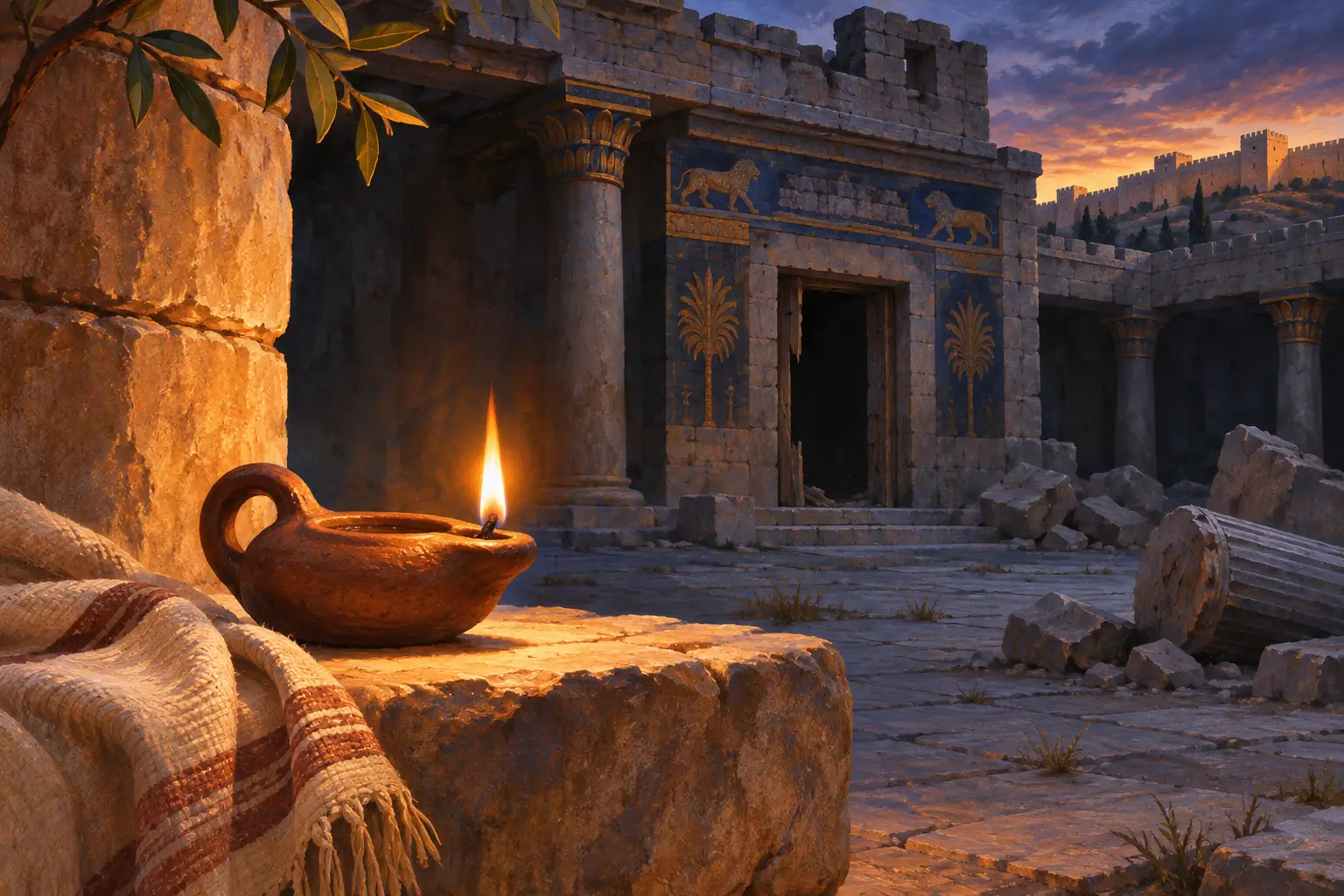
The father's songs fade from Jerusalem. The son's sword turns against his own brothers. The palace grows darker, the kingdom smaller. Yet behind the ruins, God keeps a lamp burning.
Passage: 2 Chronicles 21:1–20 Controlling metaphor: A covenant lamp burning behind a darkened palace Heart-question: When leaders destroy the inheritance entrusted to them, can God's faithfulness preserve hope without excusing their evil?
Introduction: When an Inheritance Becomes a Weapon
A family can inherit property without wisdom; a church can inherit a building without faithful worship. Leadership may inherit a respected chair without sharing its former occupant's convictions.
Jehoshaphat leaves Judah fortified cities, Scripture teachers, judicial reforms, and memories of answered prayer (2 Chr 17–20). Jehoram turns that inheritance into violence. Brothers die; false worship spreads; the kingdom fractures. What remains when authority destroys the community authority should protect?
This text is about an inherited kingdom becoming a house of violence, while God's covenant promise remains a lamp that human wickedness cannot extinguish. Mercy preserves the Davidic line, but mercy does not pronounce the king innocent. The contrast with Jehoshaphat is deliberately painful: the former generation filled Judah with teachers and songs; the new king fills the royal household with fear. The reader must ask which inheritance actually survives in the heart.
Historical and Literary Context: A Promise Surviving the Palace
Second Chronicles 21 begins the darker succession following Jehoshaphat. The Chronicler addresses a community familiar with lost kingship, temple, and homeland. Can God remain faithful to David after David's descendants prove unfaithful (2 Sam 7:12–16; 2 Chr 21:7)?
2 Kings 8:16–24 briefly covers Ahab's influence, Edom's rebellion, and Jehoram's death. Chronicles emphasizes fratricide, false worship, Elijah's warning, invasion, and dishonored burial (Japhet 1993; Klein 2012): the cost of forsaking the Lord.
The central surprise stands in verse 7. Jehoram's evil does not erase the covenant made with David. The Chronicler calls the enduring promise a lamp—a small but stubborn light for a people who have seen the palace burn (Sailhamer 1983).
Walking Through the Text
When a Father's Gifts Fall into a Brother's Sword (21:1–4)
Jehoshaphat dies in David's city, having granted silver, gold, and fortified cities to his sons but the throne to firstborn Jehoram (21:1–3).
Jehoram kills his brothers and several officials (21:4): inheritance, consolidation, murder. Family gifts cannot protect brothers whom the new king considers threats.
The murder violates the ideal of kingship without arrogance toward fellow Israelites (Deut 17:18–20). Jehoram seeks security without brotherhood; power without moral restraint.
When the Palace Darkens but the Lamp Remains (21:5–7)
Jehoram begins ruling at thirty-two and reigns eight years. Influenced by marriage into Ahab's house, Jehoram follows Israel's wicked kings (21:5–6).
Then comes the theological interruption: God refuses to destroy David's dynasty, because God has pledged to give David and David's descendants a continuing lamp (21:7; compare 1 Kgs 11:36). The language evokes the covenant in 2 Samuel 7:12–16.
The lamp belongs to God's promise, not Jehoram's virtue. Covenant grace neither excuses evil nor grants rulers immunity. A lamp is not a declaration that the whole palace is bright. A single flame testifies that another chapter remains possible. The hope is real precisely because the narrator refuses to hide the darkness.
When the Kingdom Breaks and Worship Goes Astray (21:8–11)
Edom rebels and appoints a king. Jehoram fights through a dangerous night encounter, but Edom remains independent. Libnah also revolts; the Chronicler links this revolt to Jehoram's abandonment of God (21:8–10).
Jehoram erects high places and leads Judah into covenant unfaithfulness (21:11). The language evokes a betrayed covenant relationship (Exod 20:3–6; Hos 2:2–13).
Jehoshaphat sent Scripture teachers through Judah (17:7–9); Jehoram teaches through destructive example. Leadership teaches even when Scripture remains closed.
When a Letter Arrives from a Prophet Beyond the Border (21:12–15)
A written message from Elijah confronts Jehoram. Elijah, remembered chiefly as a prophet against Ahab's northern kingdom, now challenges a Davidic king allied with Ahab's ways. The message names Jehoshaphat and Asa as contrasting examples, condemns the murder of Jehoram's brothers, and announces catastrophe for the royal household and a severe illness for the king (21:12–15).
Chronicles does not date the letter relative to Elijah's departure in 2 Kings 2. Its chronology and transmission remain debated (Dillard 1987; Klein 2012).
Elijah measures royal conduct against God's ways, not inherited prestige. Prophetic faithfulness names victims, not merely strategic failures. Jehoram might explain murder as necessary for a stable succession. Elijah refuses that convenient language. The brothers were people, not obstacles, and the covenant demands protection rather than the elimination of those who appear threatening.
When the Palace Is Stripped but One Son Remains (21:16–17)
The Philistines and Arabians associated with the region near Cush attack Judah. The invaders carry away possessions from the king's house, along with Jehoram's wives and sons. The account reports that only the youngest son, Jehoahaz, remains; the next chapter calls the surviving successor Ahaziah (22:1).
Judgment devastates the royal house, but the abduction of family members remains human suffering—not cause to celebrate violence.
The surviving son recalls verse 7: the lamp still burns, though Judah's future hangs by a thread.
When a King Dies Without the Honor of a King (21:18–20)
Jehoram develops a grave, incurable disease. After a prolonged period described as two years, the king dies in severe pain (21:18–19). The narrative portrays the illness as the fulfillment of Elijah's warning, but does not provide a diagnosis that modern readers can verify.
No customary commemorative burning honors Jehoram. The king is buried in David's city, not among royal tombs, and dies without public regret (21:19–20; compare Asa in 16:14). This final contrast separates a royal title from a worthy legacy. It asks leaders to consider what communities will remember after the official celebrations have ended.
Do not read every illness as punishment. This is a particular covenant judgment. Jesus rejects automatic blame of sufferers (John 9:1–3; Luke 13:1–5). Jehoram leaves wounded people behind.
Theological Reflection: What the Lamp Reveals
God's Faithfulness Is Not the Same as God's Approval
God keeps the promise to David despite Jehoram's betrayal (2 Sam 7:14–16; Ps 89:28–37). Royal evil receives judgment; the covenant future remains. Postexilic hope rests on God, not idealized ancestors.
Forsaking God Damages More Than Personal Devotion
Jehoram's idolatry accompanies violence and social fracture (21:4, 10–11). Worship cannot be divorced from justice (Isa 1:11–17). Seeking or forsaking the Lord affects an entire community.
God's Word May Arrive from an Unwelcome Direction
Elijah speaks from beyond Judah's royal circle (21:12–15). No court or institution owns divine truth. Faithful messengers confront abuse, even when truth threatens privilege.
The Remaining Lamp Looks Beyond Jehoram
A surviving heir cannot heal Judah. Chronicles creates longing for a faithful Son of David. Jesus embodies the enduring royal promise and the world's light (Isa 9:6–7; Luke 1:32–33; John 8:12); divine glory illumines the new creation (Rev 21:23). Future hope demands justice now.
Life Application: Keep the Lamp, Reject the Sword
- Audit inherited power. In families, churches, and institutions, identify privileges being used to intimidate rivals rather than protect people (21:1–4).
- Protect those harmed by leadership. Create safe reporting channels, independent accountability, and practical care for people injured by abuse (21:4, 13).
- Separate loyalty to God from loyalty to a leader. A respected office cannot turn cruelty into righteousness (21:6–7).
- Repair patterns of worship that teach compromise. Examine whether money, prestige, fear, or political access has quietly replaced Scripture and faithful service (21:10–11).
- Receive difficult correction. Invite truthful counsel from outside familiar circles and respond without retaliation (21:12–15).
- Attend to the suffering behind public collapse. Offer practical protection and restoration to affected families; do not celebrate the harm caused by invasion or conflict (21:16–17).
- Reject spiritual blame of the sick. Visit, pray, and arrange competent medical care. Do not call a patient's illness divine punishment without warrant (21:18–20; John 9:1–3).
Reflection Questions
- Which inheritance—position, reputation, property, or ministry—has become an excuse to control others?
- Whose suffering has been hidden behind a leader's success or a family's public image?
- What high places of ambition or divided loyalty are being normalized in communal worship?
- Which warning from Scripture or a truthful adviser has been resisted because the message threatens status?
- What concrete act of justice would show that trust in God's enduring promise is more than nostalgia?
Response Prayer
God of David's covenant, guard the lamp when human houses grow dark. Expose the swords hidden beneath respectable titles. Defend families wounded by the misuse of power, and restore the voices silenced by fear. Tear down the high places of ambition. Give churches courage to hear uncomfortable truth and wisdom to care for those who suffer. Save the community from confusing Your patience with Your approval. Through Jesus Christ, the faithful Son of David and light of the world, teach us to seek Your face, do justice, and keep faith when the palace trembles. Amen.
Window into What Comes Next
Jehoram's reign closes without honor, yet one son survives. Second Chronicles 22 follows Ahaziah into the dangerous influence of Ahab's family, and then into the violent grasp of Athaliah. The lamp will seem almost extinguished. Will God preserve the promise when even the royal nursery is threatened?
Annotated Bibliography
- Dillard, Raymond B. 2 Chronicles. Word Biblical Commentary 15. Waco, TX: Word Books, 1987. Explores the reign's theological structure and the historical questions surrounding Elijah's letter.
- Hill, Andrew E. 1 & 2 Chronicles. NIV Application Commentary. Grand Rapids: Zondervan, 2003. Relates covenant leadership, idolatry, and communal responsibility to contemporary life.
- Japhet, Sara. I & II Chronicles: A Commentary. Old Testament Library. Louisville: Westminster John Knox, 1993. Examines the Chronicler's distinctive portrayal of Jehoram and the Davidic promise.
- Klein, Ralph W. 2 Chronicles: A Commentary. Hermeneia. Minneapolis: Fortress, 2012. Offers close textual and historical analysis of the reign and its comparison with Kings.
- Sailhamer, John. First and Second Chronicles. Everyman's Bible Commentary. Chicago: Moody Press, 1983. Emphasizes forsaking the Lord, Elijah's prophetic intervention, and the unextinguished covenant lamp.
- Williamson, H. G. M. 1 and 2 Chronicles. New Century Bible Commentary. Grand Rapids: Eerdmans, 1982. Situates royal failure and covenant continuity within the Chronicler's postexilic message.
Be the first to leave a comment.